
ICT Silver Bullet Model – Complete Guide to Liquidity, MSS & Fair Value Gap (FVG)
1. What Is the ICT Silver Bullet Model?
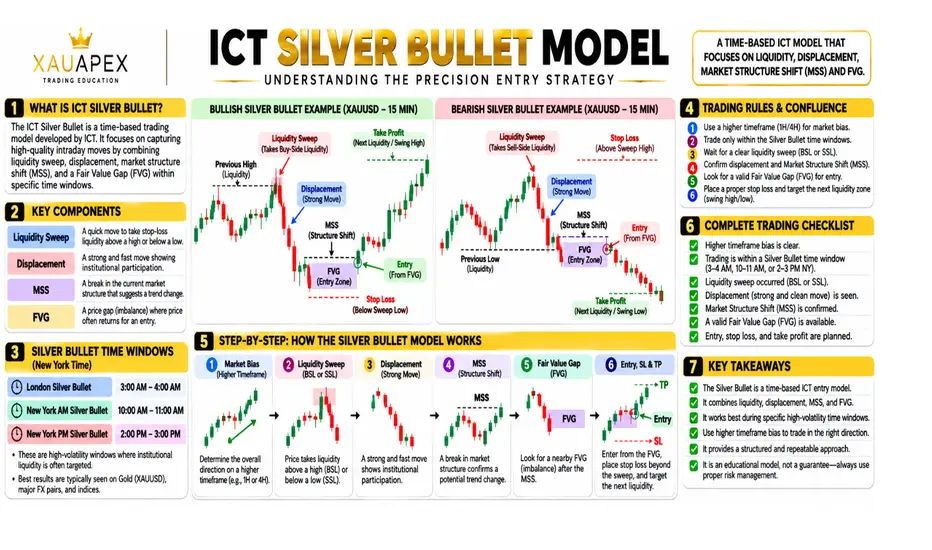
The ICT Silver Bullet Model is a time-based intraday trading approach developed by ICT (Inner Circle Trader). It focuses on identifying potential trading opportunities through the combination of liquidity, displacement, Market Structure Shift (MSS), and Fair Value Gaps (FVG).
The main objective is to wait for a specific trading window, identify a liquidity sweep, observe a strong displacement, confirm a market structure shift, and then look for a potential entry through a Fair Value Gap.
Unlike random entries, this model follows a structured sequence of market conditions.
2. ICT Silver Bullet Time Windows
The Silver Bullet model focuses on three commonly referenced New York trading windows:
London Session:
3:00 AM – 4:00 AM New York time.
New York AM Session:
10:00 AM – 11:00 AM New York time.
New York PM Session:
2:00 PM – 3:00 PM New York time.
These time windows help traders focus on specific intraday periods rather than searching for entries throughout the entire trading day.
Note: These are New York local times. Their corresponding Pakistan time changes with US daylight saving time.
3. Key Components of the Silver Bullet Model
A. Liquidity Sweep
Liquidity refers to areas where stop-loss orders and pending orders may be concentrated.
Two important types are:
Buy-Side Liquidity (BSL): Generally located above previous swing highs.
Sell-Side Liquidity (SSL): Generally located below previous swing lows.
A liquidity sweep occurs when price moves beyond an identifiable high or low to take liquidity and then potentially reverses or continues in the opposite direction.
B. Displacement
Displacement is a strong and decisive price movement that indicates an aggressive shift in buying or selling pressure.
Important characteristics:
Strong directional candles.
Large candle bodies.
Clear movement away from a liquidity area.
Potential creation of a Fair Value Gap.
Displacement helps traders identify whether price is showing meaningful directional strength.
C. Market Structure Shift (MSS)
Market Structure Shift refers to a break of a relevant short-term swing point that suggests a potential change in market direction.
For a bullish MSS:
Price takes sell-side liquidity.
Strong bullish displacement develops.
Price breaks a relevant previous short-term swing high.
For a bearish MSS:
Price takes buy-side liquidity.
Strong bearish displacement develops.
Price breaks a relevant previous short-term swing low.
D. Fair Value Gap (FVG)
A Fair Value Gap is a three-candle price imbalance.
It develops when the first and third candles do not overlap in a particular price area.
Traders monitor these gaps because price may return to the imbalance before continuing its directional move.
In the Silver Bullet model, an FVG formed during displacement after a liquidity sweep and MSS may provide a potential entry area.
4. How the ICT Silver Bullet Model Works – Step by Step
Step 1: Identify Higher Timeframe Bias
Start with the 1H or 4H chart to understand the broader market direction.
Identify:
Previous swing highs and lows.
Important liquidity levels.
Overall bullish or bearish market structure.
Potential draw on liquidity.
Step 2: Wait for the Silver Bullet Time Window
Focus on one of the three specified New York trading windows.
Avoid forcing trades outside the defined time periods.
Step 3: Identify a Liquidity Sweep
Observe whether price takes:
Buy-side liquidity above a previous high, or
Sell-side liquidity below a previous low.
Do not assume that every liquidity sweep automatically creates a reversal.
Step 4: Confirm Displacement
Wait for a strong directional movement following the liquidity event.
The displacement should demonstrate a meaningful shift in short-term price delivery.
Step 5: Confirm Market Structure Shift
Look for a break of a relevant short-term swing point in the direction of the potential trade.
This provides additional structural confirmation.
Step 6: Identify the Fair Value Gap
Look for a valid FVG created during the displacement move.
The FVG can serve as a potential retracement entry area.
Step 7: Plan Entry, Stop Loss and Take Profit
An entry may be considered when price returns to the identified FVG.
Risk management should include:
Stop loss beyond the relevant sweep extreme.
Take profit around a logical liquidity target.
A predefined risk-to-reward plan.
Appropriate position sizing.
5. Bullish ICT Silver Bullet Setup
A bullish Silver Bullet setup generally follows this sequence:
Price approaches an identifiable sell-side liquidity level.
Price sweeps below a previous swing low.
Strong bullish displacement develops.
Price breaks a relevant short-term swing high, confirming bullish MSS.
A bullish Fair Value Gap forms.
Price retraces into the FVG.
A potential buy entry is considered, with risk managed below the sweep low.
The next buy-side liquidity area may provide a potential target.
6. Bearish ICT Silver Bullet Setup
A bearish Silver Bullet setup generally follows the opposite sequence:
Price approaches an identifiable buy-side liquidity level.
Price sweeps above a previous swing high.
Strong bearish displacement develops.
Price breaks a relevant short-term swing low, confirming bearish MSS.
A bearish Fair Value Gap forms.
Price retraces into the FVG.
A potential sell entry is considered, with risk managed above the sweep high.
The next sell-side liquidity area may provide a potential target.
7. Trading Rules & Confluence
Before considering a Silver Bullet setup, pay attention to these conditions:
Establish a clear higher timeframe bias.
Trade within the defined Silver Bullet time windows.
Identify meaningful buy-side or sell-side liquidity.
Wait for a clear liquidity sweep.
Confirm displacement and MSS.
Look for an FVG created by the displacement.
Plan entry, stop loss and take profit before execution.
The more clearly these elements align, the more structured the trading opportunity becomes. However, confluence does not guarantee a successful outcome.
8. Complete ICT Silver Bullet Checklist
Before considering an entry, ask yourself:
Is the higher timeframe bias clear?
Am I inside a Silver Bullet time window?
Has price taken identifiable liquidity?
Is there clear displacement?
Has a valid MSS occurred?
Has a Fair Value Gap formed?
Is price returning to the FVG?
Is the stop-loss level clearly defined?
Is there a logical liquidity target?
Does the trade fit my risk management plan?
If important conditions are missing, waiting for another opportunity may be more appropriate.
9. Common Mistakes to Avoid
Entering immediately after a liquidity sweep.
Treating every FVG as a valid Silver Bullet entry.
Ignoring higher timeframe market direction.
Confusing a simple candle movement with displacement.
Entering without a confirmed MSS.
Trading outside the intended time windows.
Ignoring stop-loss placement and position sizing.
Forcing setups when market conditions are unclear.
10. Key Takeaways
The ICT Silver Bullet Model combines four important concepts:
Liquidity Sweep – Identifying where liquidity is taken.
Displacement – Recognizing strong directional price movement.
Market Structure Shift – Confirming a potential change in short-term structure.
Fair Value Gap – Identifying a potential retracement entry area.
The key is patience and following the sequence rather than entering based on a single candle or market movement.
Final Thought:
A good trading model is not about finding an entry on every chart. It is about understanding market structure, waiting for the right conditions, and managing risk with discipline.
Educational Disclaimer: This publication is intended for educational purposes only and does not constitute financial advice or a trading signal. The ICT Silver Bullet Model does not guarantee profitable results. Always conduct your own analysis and manage risk responsibly.

📲 Join Our Telegram Community
t.me/+TA9wLW8l7ywxNmVk
t.me/+TA9wLW8l7ywxNmVk
Bài đăng liên quan
Thông báo miễn trừ trách nhiệm
Thông tin và các ấn phẩm này không nhằm mục đích, và không cấu thành, lời khuyên hoặc khuyến nghị về tài chính, đầu tư, giao dịch hay các loại khác do TradingView cung cấp hoặc xác nhận. Đọc thêm tại Điều khoản Sử dụng.