
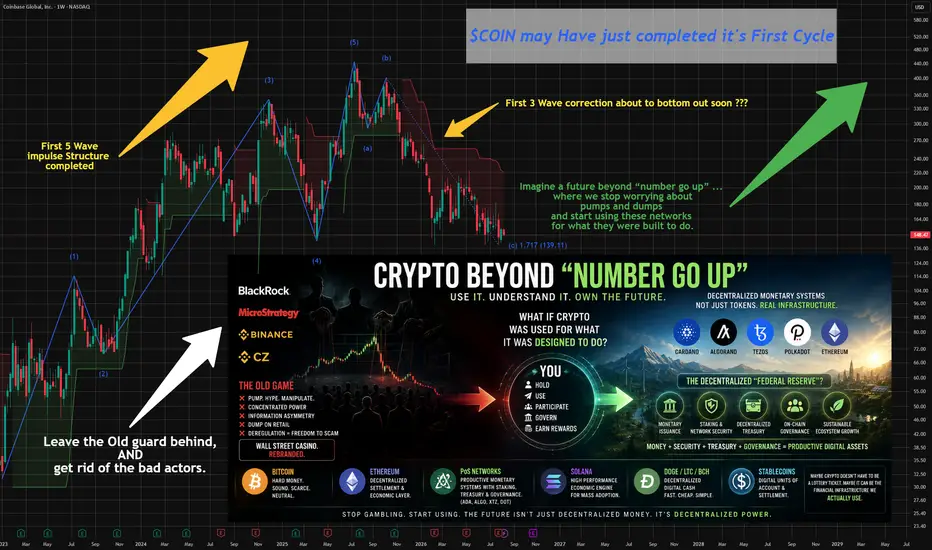
Crypto Beyond “Number Go Up”
Could Some Networks Become Decentralized Federal Reserves?
I've been thinking differently about crypto for quite a while.
And I don't think I'm some genius who has discovered something nobody else has. I'm sure plenty of people have reached similar conclusions, and many more may eventually do so.
But the longer I look at crypto, the more I wonder whether we've become obsessed with the wrong question:
“Which coin is going to pump next?”
Bitcoin goes up. A meme coin goes 10x. Everyone searches for the next one.
And that's where I've increasingly lost trust in the crypto market.
I believe we've seen a financial ecosystem develop where large institutional players, exchanges and other powerful market participants can influence supply, liquidity and narrative on a scale ordinary investors simply cannot match. To me, the push toward deregulation risks turning crypto into exactly what it originally promised to replace: another financial system where concentrated players have enormous power and retail investors ultimately carry much of the risk.
I don't want crypto to become another Wall Street casino.
What interests me is what these networks can actually do.
Maybe we're comparing the wrong things
Bitcoin isn't necessarily supposed to do what Cardano does.
Ethereum isn't necessarily supposed to do what Dogecoin does.
And a staking network isn't necessarily trying to be another Bitcoin.
Bitcoin's strength is its simplicity: hard, scarce, decentralized money with rules that are extremely difficult to change.
Ethereum is a decentralized economic and settlement network, with ETH also functioning as a productive asset through staking.
Then there are networks such as Cardano, Algorand, Tezos and Polkadot.
And here's where I think things get really interesting.
Some of these networks combine:
money + network security + staking rewards + governance + treasury
That starts looking like something quite different from simply holding a cryptocurrency.
Could some of them be a kind of decentralized Federal Reserve?
Not literally, of course.
A central bank has powers these protocols don't have: discretionary monetary policy, lender-of-last-resort functions, control over interest rates, and ultimately political authority.
But functionally, I think the comparison is worth exploring.
Imagine a monetary network where the participants collectively control the monetary system.
The network issues its currency according to predetermined rules.
Holders can participate in securing the network and receive protocol rewards.
A portion of economic activity or issuance can accumulate in a decentralized treasury.
That treasury can fund development, infrastructure and public goods.
And governance can allow the network's participants to collectively decide how the system evolves.
Instead of:
Central bank → currency → reserves → monetary policy → government treasury
you could have something closer to:
Protocol → native currency → staking/security → decentralized treasury → on-chain governance
That's not a Federal Reserve.
It's arguably something much more radical:
a monetary institution without a central institution.
And that's what fascinates me.
The investment question becomes completely different
Instead of asking:
“Will ADA go up?”
I'd rather ask:
“Could a decentralized monetary network like Cardano eventually become economically important enough that its native asset is genuinely valuable because people use and participate in the system?”
The same question applies differently to Algorand, Tezos, Polkadot and Ethereum.
Of course, staking yield isn't free money.
Inflation can dilute holders. Governance can make bad decisions. Treasuries can be wasted. A technically brilliant network can remain economically irrelevant if nobody uses it.
But those are questions about economics and adoption, rather than simply speculation.
And that's exactly why I find them more interesting than:
“Which shitcoin is going to 10x?”
Different networks can have different jobs
Maybe Bitcoin is the decentralized reserve asset.
Maybe Ethereum becomes the decentralized settlement and financial infrastructure layer.
Maybe Cardano, Algorand, Tezos or Polkadot demonstrate different models of productive, governable monetary networks.
Maybe Solana becomes a high-performance economic engine.
Maybe Dogecoin, Litecoin or Bitcoin Cash remain useful forms of decentralized digital cash.
Maybe stablecoins become the everyday digital units of account.
Maybe some of these projects fail completely.
I don't know.
And that's not the point.
I'm not claiming to have found the secret formula for picking winners.
I'm simply much more interested in owning and using networks because of what they can actually do, rather than buying whatever happens to be pumping.
If crypto eventually matures beyond the “number go up” mentality, I think the market may start valuing these networks for their underlying economic functions.
Maybe the real opportunity isn't finding the next coin that pumps.
Maybe it's recognizing which decentralized networks could eventually become financial institutions in their own right, without needing a central institution at all.
Use the technology. Understand the monetary system. Then worry about the price.
 BTCUSD
 ETHUSD
 ADAUSD
 ALGOUSD
 XTZUSD
 DOGEUSD
 BCHUSD
 ZECUSD
 SOLUSD
 DOTUSD
 USDC
 CRCL
 TLT
 DXY
 SP500
Could Some Networks Become Decentralized Federal Reserves?
I've been thinking differently about crypto for quite a while.
And I don't think I'm some genius who has discovered something nobody else has. I'm sure plenty of people have reached similar conclusions, and many more may eventually do so.
But the longer I look at crypto, the more I wonder whether we've become obsessed with the wrong question:
“Which coin is going to pump next?”
Bitcoin goes up. A meme coin goes 10x. Everyone searches for the next one.
And that's where I've increasingly lost trust in the crypto market.
I believe we've seen a financial ecosystem develop where large institutional players, exchanges and other powerful market participants can influence supply, liquidity and narrative on a scale ordinary investors simply cannot match. To me, the push toward deregulation risks turning crypto into exactly what it originally promised to replace: another financial system where concentrated players have enormous power and retail investors ultimately carry much of the risk.
I don't want crypto to become another Wall Street casino.
What interests me is what these networks can actually do.
Maybe we're comparing the wrong things
Bitcoin isn't necessarily supposed to do what Cardano does.
Ethereum isn't necessarily supposed to do what Dogecoin does.
And a staking network isn't necessarily trying to be another Bitcoin.
Bitcoin's strength is its simplicity: hard, scarce, decentralized money with rules that are extremely difficult to change.
Ethereum is a decentralized economic and settlement network, with ETH also functioning as a productive asset through staking.
Then there are networks such as Cardano, Algorand, Tezos and Polkadot.
And here's where I think things get really interesting.
Some of these networks combine:
money + network security + staking rewards + governance + treasury
That starts looking like something quite different from simply holding a cryptocurrency.
Could some of them be a kind of decentralized Federal Reserve?
Not literally, of course.
A central bank has powers these protocols don't have: discretionary monetary policy, lender-of-last-resort functions, control over interest rates, and ultimately political authority.
But functionally, I think the comparison is worth exploring.
Imagine a monetary network where the participants collectively control the monetary system.
The network issues its currency according to predetermined rules.
Holders can participate in securing the network and receive protocol rewards.
A portion of economic activity or issuance can accumulate in a decentralized treasury.
That treasury can fund development, infrastructure and public goods.
And governance can allow the network's participants to collectively decide how the system evolves.
Instead of:
Central bank → currency → reserves → monetary policy → government treasury
you could have something closer to:
Protocol → native currency → staking/security → decentralized treasury → on-chain governance
That's not a Federal Reserve.
It's arguably something much more radical:
a monetary institution without a central institution.
And that's what fascinates me.
The investment question becomes completely different
Instead of asking:
“Will ADA go up?”
I'd rather ask:
“Could a decentralized monetary network like Cardano eventually become economically important enough that its native asset is genuinely valuable because people use and participate in the system?”
The same question applies differently to Algorand, Tezos, Polkadot and Ethereum.
Of course, staking yield isn't free money.
Inflation can dilute holders. Governance can make bad decisions. Treasuries can be wasted. A technically brilliant network can remain economically irrelevant if nobody uses it.
But those are questions about economics and adoption, rather than simply speculation.
And that's exactly why I find them more interesting than:
“Which shitcoin is going to 10x?”
Different networks can have different jobs
Maybe Bitcoin is the decentralized reserve asset.
Maybe Ethereum becomes the decentralized settlement and financial infrastructure layer.
Maybe Cardano, Algorand, Tezos or Polkadot demonstrate different models of productive, governable monetary networks.
Maybe Solana becomes a high-performance economic engine.
Maybe Dogecoin, Litecoin or Bitcoin Cash remain useful forms of decentralized digital cash.
Maybe stablecoins become the everyday digital units of account.
Maybe some of these projects fail completely.
I don't know.
And that's not the point.
I'm not claiming to have found the secret formula for picking winners.
I'm simply much more interested in owning and using networks because of what they can actually do, rather than buying whatever happens to be pumping.
If crypto eventually matures beyond the “number go up” mentality, I think the market may start valuing these networks for their underlying economic functions.
Maybe the real opportunity isn't finding the next coin that pumps.
Maybe it's recognizing which decentralized networks could eventually become financial institutions in their own right, without needing a central institution at all.
Use the technology. Understand the monetary system. Then worry about the price.
BTCUSD ETHUSD ADAUSD ALGOUSD XTZUSD DOGEUSD BCHUSD ZECUSD SOLUSD DOTUSD USDC CRCL TLT DXY SP500 
Bài đăng liên quan
Thông báo miễn trừ trách nhiệm
Thông tin và các ấn phẩm này không nhằm mục đích, và không cấu thành, lời khuyên hoặc khuyến nghị về tài chính, đầu tư, giao dịch hay các loại khác do TradingView cung cấp hoặc xác nhận. Đọc thêm tại Điều khoản Sử dụng.
Bài đăng liên quan
Thông báo miễn trừ trách nhiệm
Thông tin và các ấn phẩm này không nhằm mục đích, và không cấu thành, lời khuyên hoặc khuyến nghị về tài chính, đầu tư, giao dịch hay các loại khác do TradingView cung cấp hoặc xác nhận. Đọc thêm tại Điều khoản Sử dụng.