
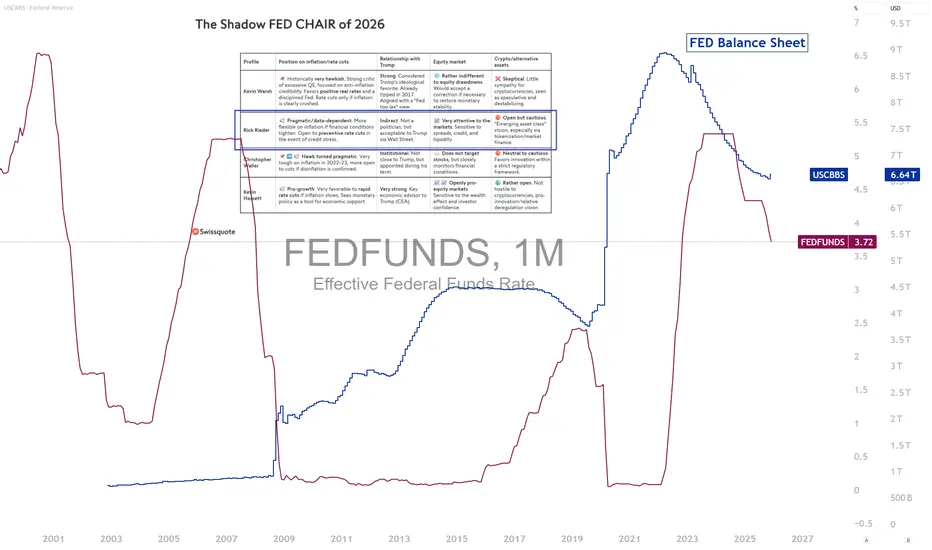
Who will be the next “shadow Fed Chair” while Jerome Powell prepares to leave his position next May? This question is central to the outlook for U.S. Federal Reserve monetary policy and to the trends in equities, bonds, and the U.S. dollar in the first half of 2026.
The name of the next Fed Chair is expected to be known by the end of January, with the leading candidates being Rick Rieder, Kevin Warsh, Christopher Waller, and Kevin Hassett. Among these four, Rick Rieder now appears to be the frontrunner to be chosen by Trump as the next shadow Fed Chair.
Indeed, during the period between February and May 2026, markets are likely to pay more attention to the future Fed Chair than to Jerome Powell, who will be in the final three months of his term.
Regarding the profile of the next Fed Chair, several key points are particularly important to monitor:
• Positioning on inflation and U.S. federal funds rate cuts
• Proximity to President Trump
• Stance toward equity markets
• Stance toward cryptocurrencies
Rick Rieder currently checks an increasing number of boxes across these criteria. As Chief Investment Officer for Global Fixed Income at BlackRock, he enjoys strong credibility with financial markets, particularly on interest rates, public debt, and global financial conditions. His ability to read macroeconomic cycles and anticipate shifts in monetary policy is widely recognized by institutional investors.

On inflation, Rick Rieder adopts a pragmatic and less dogmatic approach than the current Fed. He has repeatedly indicated that disinflation can continue despite a still-resilient labor market, supporting the case for gradual but meaningful rate cuts in 2026. This view is broadly aligned with market expectations and with Donald Trump’s desire to support growth and financial assets.
His indirect relationship with the Trump administration is also an asset. Without being a polarizing political figure, Rick Rieder is seen as compatible with a more pro-market vision—less restrictive and more attentive to the sustainability of U.S. public debt. By contrast, some other candidates are perceived as either too ideological or too academic.
Regarding equity markets, Rick Rieder has never hidden his favorable bias toward risk assets in an environment of abundant liquidity and contained real rates. Such a stance would reinforce the scenario of implicit Fed support for financial markets during the leadership transition.
Finally, on cryptocurrencies, Rick Rieder has shown relative openness, acknowledging their growing role in the global financial ecosystem while advocating pragmatic rather than restrictive regulation. This would likely be welcomed by crypto markets in the event of his appointment.

In this context, Rick Rieder’s rise as a potential “shadow Fed Chair” could become one of the main market catalysts of the first half of 2026.
DISCLAIMER:
This content is intended for individuals who are familiar with financial markets and instruments and is for information purposes only. The presented idea (including market commentary, market data and observations) is not a work product of any research department of Swissquote or its affiliates. This material is intended to highlight market action and does not constitute investment, legal or tax advice. If you are a retail investor or lack experience in trading complex financial products, it is advisable to seek professional advice from licensed advisor before making any financial decisions.
This content is not intended to manipulate the market or encourage any specific financial behavior.
Swissquote makes no representation or warranty as to the quality, completeness, accuracy, comprehensiveness or non-infringement of such content. The views expressed are those of the consultant and are provided for educational purposes only. Any information provided relating to a product or market should not be construed as recommending an investment strategy or transaction. Past performance is not a guarantee of future results.
Swissquote and its employees and representatives shall in no event be held liable for any damages or losses arising directly or indirectly from decisions made on the basis of this content.
The use of any third-party brands or trademarks is for information only and does not imply endorsement by Swissquote, or that the trademark owner has authorised Swissquote to promote its products or services.
Swissquote is the marketing brand for the activities of Swissquote Bank Ltd (Switzerland) regulated by FINMA, Swissquote Capital Markets Limited regulated by CySEC (Cyprus), Swissquote Bank Europe SA (Luxembourg) regulated by the CSSF, Swissquote Ltd (UK) regulated by the FCA, Swissquote Financial Services (Malta) Ltd regulated by the Malta Financial Services Authority, Swissquote MEA Ltd. (UAE) regulated by the Dubai Financial Services Authority, Swissquote Pte Ltd (Singapore) regulated by the Monetary Authority of Singapore, Swissquote Asia Limited (Hong Kong) licensed by the Hong Kong Securities and Futures Commission (SFC) and Swissquote South Africa (Pty) Ltd supervised by the FSCA.
Products and services of Swissquote are only intended for those permitted to receive them under local law.
All investments carry a degree of risk. The risk of loss in trading or holding financial instruments can be substantial. The value of financial instruments, including but not limited to stocks, bonds, cryptocurrencies, and other assets, can fluctuate both upwards and downwards. There is a significant risk of financial loss when buying, selling, holding, staking, or investing in these instruments. SQBE makes no recommendations regarding any specific investment, transaction, or the use of any particular investment strategy.
CFDs are complex instruments and come with a high risk of losing money rapidly due to leverage. The vast majority of retail client accounts suffer capital losses when trading in CFDs. You should consider whether you understand how CFDs work and whether you can afford to take the high risk of losing your money.
Digital Assets are unregulated in most countries and consumer protection rules may not apply. As highly volatile speculative investments, Digital Assets are not suitable for investors without a high-risk tolerance. Make sure you understand each Digital Asset before you trade.
Cryptocurrencies are not considered legal tender in some jurisdictions and are subject to regulatory uncertainties.
The use of Internet-based systems can involve high risks, including, but not limited to, fraud, cyber-attacks, network and communication failures, as well as identity theft and phishing attacks related to crypto-assets.
The name of the next Fed Chair is expected to be known by the end of January, with the leading candidates being Rick Rieder, Kevin Warsh, Christopher Waller, and Kevin Hassett. Among these four, Rick Rieder now appears to be the frontrunner to be chosen by Trump as the next shadow Fed Chair.
Indeed, during the period between February and May 2026, markets are likely to pay more attention to the future Fed Chair than to Jerome Powell, who will be in the final three months of his term.
Regarding the profile of the next Fed Chair, several key points are particularly important to monitor:
• Positioning on inflation and U.S. federal funds rate cuts
• Proximity to President Trump
• Stance toward equity markets
• Stance toward cryptocurrencies
Rick Rieder currently checks an increasing number of boxes across these criteria. As Chief Investment Officer for Global Fixed Income at BlackRock, he enjoys strong credibility with financial markets, particularly on interest rates, public debt, and global financial conditions. His ability to read macroeconomic cycles and anticipate shifts in monetary policy is widely recognized by institutional investors.
On inflation, Rick Rieder adopts a pragmatic and less dogmatic approach than the current Fed. He has repeatedly indicated that disinflation can continue despite a still-resilient labor market, supporting the case for gradual but meaningful rate cuts in 2026. This view is broadly aligned with market expectations and with Donald Trump’s desire to support growth and financial assets.
His indirect relationship with the Trump administration is also an asset. Without being a polarizing political figure, Rick Rieder is seen as compatible with a more pro-market vision—less restrictive and more attentive to the sustainability of U.S. public debt. By contrast, some other candidates are perceived as either too ideological or too academic.
Regarding equity markets, Rick Rieder has never hidden his favorable bias toward risk assets in an environment of abundant liquidity and contained real rates. Such a stance would reinforce the scenario of implicit Fed support for financial markets during the leadership transition.
Finally, on cryptocurrencies, Rick Rieder has shown relative openness, acknowledging their growing role in the global financial ecosystem while advocating pragmatic rather than restrictive regulation. This would likely be welcomed by crypto markets in the event of his appointment.
In this context, Rick Rieder’s rise as a potential “shadow Fed Chair” could become one of the main market catalysts of the first half of 2026.
DISCLAIMER:
This content is intended for individuals who are familiar with financial markets and instruments and is for information purposes only. The presented idea (including market commentary, market data and observations) is not a work product of any research department of Swissquote or its affiliates. This material is intended to highlight market action and does not constitute investment, legal or tax advice. If you are a retail investor or lack experience in trading complex financial products, it is advisable to seek professional advice from licensed advisor before making any financial decisions.
This content is not intended to manipulate the market or encourage any specific financial behavior.
Swissquote makes no representation or warranty as to the quality, completeness, accuracy, comprehensiveness or non-infringement of such content. The views expressed are those of the consultant and are provided for educational purposes only. Any information provided relating to a product or market should not be construed as recommending an investment strategy or transaction. Past performance is not a guarantee of future results.
Swissquote and its employees and representatives shall in no event be held liable for any damages or losses arising directly or indirectly from decisions made on the basis of this content.
The use of any third-party brands or trademarks is for information only and does not imply endorsement by Swissquote, or that the trademark owner has authorised Swissquote to promote its products or services.
Swissquote is the marketing brand for the activities of Swissquote Bank Ltd (Switzerland) regulated by FINMA, Swissquote Capital Markets Limited regulated by CySEC (Cyprus), Swissquote Bank Europe SA (Luxembourg) regulated by the CSSF, Swissquote Ltd (UK) regulated by the FCA, Swissquote Financial Services (Malta) Ltd regulated by the Malta Financial Services Authority, Swissquote MEA Ltd. (UAE) regulated by the Dubai Financial Services Authority, Swissquote Pte Ltd (Singapore) regulated by the Monetary Authority of Singapore, Swissquote Asia Limited (Hong Kong) licensed by the Hong Kong Securities and Futures Commission (SFC) and Swissquote South Africa (Pty) Ltd supervised by the FSCA.
Products and services of Swissquote are only intended for those permitted to receive them under local law.
All investments carry a degree of risk. The risk of loss in trading or holding financial instruments can be substantial. The value of financial instruments, including but not limited to stocks, bonds, cryptocurrencies, and other assets, can fluctuate both upwards and downwards. There is a significant risk of financial loss when buying, selling, holding, staking, or investing in these instruments. SQBE makes no recommendations regarding any specific investment, transaction, or the use of any particular investment strategy.
CFDs are complex instruments and come with a high risk of losing money rapidly due to leverage. The vast majority of retail client accounts suffer capital losses when trading in CFDs. You should consider whether you understand how CFDs work and whether you can afford to take the high risk of losing your money.
Digital Assets are unregulated in most countries and consumer protection rules may not apply. As highly volatile speculative investments, Digital Assets are not suitable for investors without a high-risk tolerance. Make sure you understand each Digital Asset before you trade.
Cryptocurrencies are not considered legal tender in some jurisdictions and are subject to regulatory uncertainties.
The use of Internet-based systems can involve high risks, including, but not limited to, fraud, cyber-attacks, network and communication failures, as well as identity theft and phishing attacks related to crypto-assets.

This content is written by Vincent Ganne for Swissquote.
This content is intended for individuals who are familiar with financial markets and instruments and is for information purposes only and does not constitute investment, legal or tax advice.
This content is intended for individuals who are familiar with financial markets and instruments and is for information purposes only and does not constitute investment, legal or tax advice.
Thông báo miễn trừ trách nhiệm
Thông tin và các ấn phẩm này không nhằm mục đích, và không cấu thành, lời khuyên hoặc khuyến nghị về tài chính, đầu tư, giao dịch hay các loại khác do TradingView cung cấp hoặc xác nhận. Đọc thêm tại Điều khoản Sử dụng.