

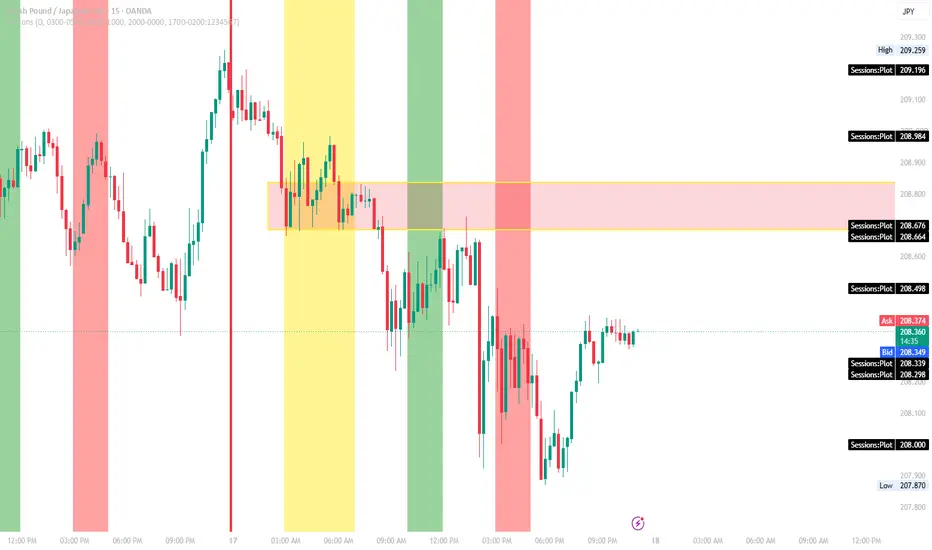
If ATR tells us that a market has already used, for example, 70% of its average movement during a specific period, we should not automatically expect the market to continue moving another large distance without a reason.
This applies to GBPJPY and to markets in general.
The important point is that **RR should be related to the amount of movement the market is realistically capable of producing during a specific period**, rather than using a fixed RR such as 1:2 or 1:3 for every trade.
For example, if the average movement of a market during a certain period is 100 pips and price has already moved 70 pips, then a significant portion of the expected range has already been consumed. The remaining realistic upside or downside may therefore be smaller.
However, this raises an important question:
**Why do some trades achieve RR of 1:3, 1:5, or even higher?**
Is it because the market had not yet consumed most of its ATR? Or can certain conditions—such as a strong breakout, increased volatility, a liquidity expansion, or major news—cause the market to move significantly beyond its normal ATR?
So perhaps the better question is not:
**"What fixed RR should I use?"**
but rather:
**"How much movement is realistically available in the market during this specific period, and what conditions could cause that range to expand?"**
In other words, RR should adapt to **ATR, volatility, the range already consumed, market structure, and the available price range**.
This could explain why a 1:2 target may sometimes be realistic, while under different market conditions a trade can run to 1:3, 1:5, or much further.
This applies to GBPJPY and to markets in general.
The important point is that **RR should be related to the amount of movement the market is realistically capable of producing during a specific period**, rather than using a fixed RR such as 1:2 or 1:3 for every trade.
For example, if the average movement of a market during a certain period is 100 pips and price has already moved 70 pips, then a significant portion of the expected range has already been consumed. The remaining realistic upside or downside may therefore be smaller.
However, this raises an important question:
**Why do some trades achieve RR of 1:3, 1:5, or even higher?**
Is it because the market had not yet consumed most of its ATR? Or can certain conditions—such as a strong breakout, increased volatility, a liquidity expansion, or major news—cause the market to move significantly beyond its normal ATR?
So perhaps the better question is not:
**"What fixed RR should I use?"**
but rather:
**"How much movement is realistically available in the market during this specific period, and what conditions could cause that range to expand?"**
In other words, RR should adapt to **ATR, volatility, the range already consumed, market structure, and the available price range**.
This could explain why a 1:2 target may sometimes be realistic, while under different market conditions a trade can run to 1:3, 1:5, or much further.

Thông báo miễn trừ trách nhiệm
Thông tin và các ấn phẩm này không nhằm mục đích, và không cấu thành, lời khuyên hoặc khuyến nghị về tài chính, đầu tư, giao dịch hay các loại khác do TradingView cung cấp hoặc xác nhận. Đọc thêm tại Điều khoản Sử dụng.
Thông báo miễn trừ trách nhiệm
Thông tin và các ấn phẩm này không nhằm mục đích, và không cấu thành, lời khuyên hoặc khuyến nghị về tài chính, đầu tư, giao dịch hay các loại khác do TradingView cung cấp hoặc xác nhận. Đọc thêm tại Điều khoản Sử dụng.