
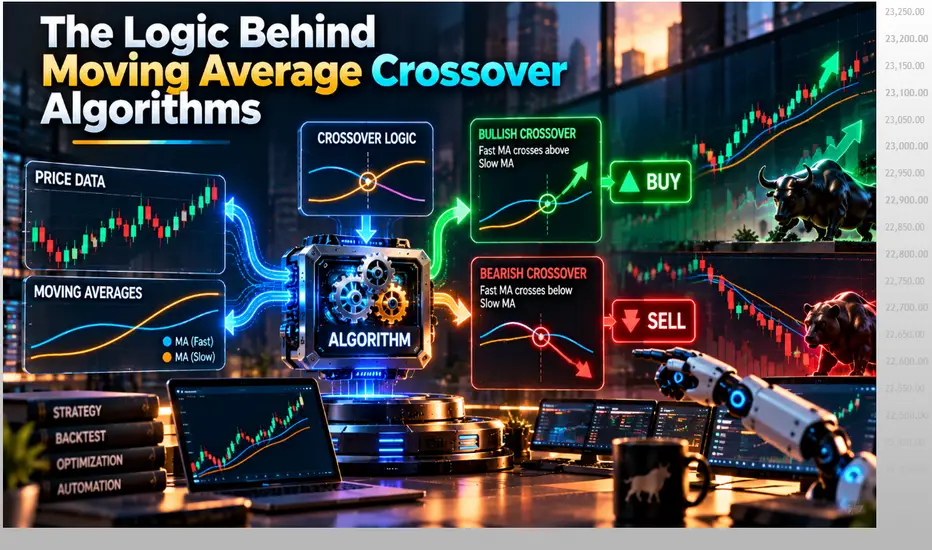
📊 The Logic Behind Moving Average Crossover Algorithms
Moving-average crossover systems are among the simplest forms of algorithmic trend trading.
The basic idea is:
**Fast MA crosses above Slow MA → Bullish Signal**
**Fast MA crosses below Slow MA → Bearish Signal**
But a professional algorithm should not trade every crossover blindly.
The real question is:
**Did the crossover happen inside a market that is genuinely trending?**
---------------------------------
📊 Fast MA vs Slow MA
A fast moving average reacts quickly to recent prices.
A slow moving average reacts more gradually.
For example:
20 EMA = Fast
50 EMA = Slow
When the 20 EMA moves above the 50 EMA, recent price behaviour is becoming stronger than the broader trend.
That may indicate bullish momentum.
---------------------------------
⚠️ The Biggest Problem: Sideways Markets
Crossovers often struggle when the market is ranging.
You may see:
Bullish Cross → Bearish Cross → Bullish Cross
without any real trend developing.
This creates repeated whipsaws.
That is why the crossover itself should not be the complete strategy.
---------------------------------
📈 Better Bullish Crossover Logic
A stronger system may require:
✅ Fast MA crosses above slow MA
✅ Price closes above both averages
✅ Both averages slope upward
✅ Volume expands
✅ Price remains above VWAP
✅ Higher-timeframe trend is bullish
Now the algorithm is checking the environment around the crossover.
---------------------------------
📊 MA Slope and Separation Matter
Two flat averages crossing repeatedly usually indicate noise.
A healthier bullish trend often shows:
• Fast MA above slow MA
• Both averages rising
• Distance between them increasing
This tells the algorithm that momentum is expanding rather than simply oscillating.
---------------------------------
🎯 Price Action Should Confirm
A moving-average crossover is a lagging signal.
Price may already have:
• Broken resistance
• Formed a higher low
• Expanded volume
before the averages cross.
So many stronger systems use:
**Price Action Trigger + MA Trend Confirmation**
instead of relying on the crossover alone.
---------------------------------
🤖 Use Closed-Candle Confirmation
A crossover can appear during a live candle and disappear before the candle closes.
For algorithmic systems, a safer rule is often:
**Generate signal only after the crossover is confirmed on a closed candle.**
This creates more stable, non-repainting execution logic.
---------------------------------
🛡️ Risk Still Comes First
After a valid crossover, the system should check:
• Structural stop
• Position size
• R:R
• Market regime
• Entry extension
A correct crossover can still be a poor trade if price has already moved too far.
---------------------------------
📊 For Option Traders
The underlying may generate the trend signal.
Then the option engine checks:
• CE / PE
• Strike liquidity
• Premium VWAP
• Premium swing breakout
• Risk
**Underlying crossover = Direction**
**Option premium = Execution confirmation**
---------------------------------
📊 Simple Formula
Fast MA Cross + Positive Slope + Price Confirmation + Volume + Trend Alignment + Defined Risk
= Higher-Quality Crossover Setup
But:
Frequent Crosses + Flat MAs + Sideways Price
= Whipsaw Risk
---------------------------------
📊 Finally, the important point to note is:
A moving-average crossover algorithm should not ask only:
“Did the two averages cross?”
It should ask:
**“Did this crossover happen inside a genuine trend transition?”**
That is the difference between a simple crossover alert and a professional crossover trading system.
---------------------------------
Educational Purpose Only.

⭐For Live Trading Courses And Trading Community 📈
Contact ⬇️
📱wa.me/919322295961
📱t.me/+UgF9lES_XxA0MTk9
⭐Advanced courses
⭐Fully Automated Algo Trading
⭐Daily F&O Trade tips
📱 t.me/+UgF9lES_XxA0MTk9
Contact ⬇️
📱wa.me/919322295961
📱t.me/+UgF9lES_XxA0MTk9
⭐Advanced courses
⭐Fully Automated Algo Trading
⭐Daily F&O Trade tips
📱 t.me/+UgF9lES_XxA0MTk9
Bài đăng liên quan
Thông báo miễn trừ trách nhiệm
Thông tin và các ấn phẩm này không nhằm mục đích, và không cấu thành, lời khuyên hoặc khuyến nghị về tài chính, đầu tư, giao dịch hay các loại khác do TradingView cung cấp hoặc xác nhận. Đọc thêm tại Điều khoản Sử dụng.