
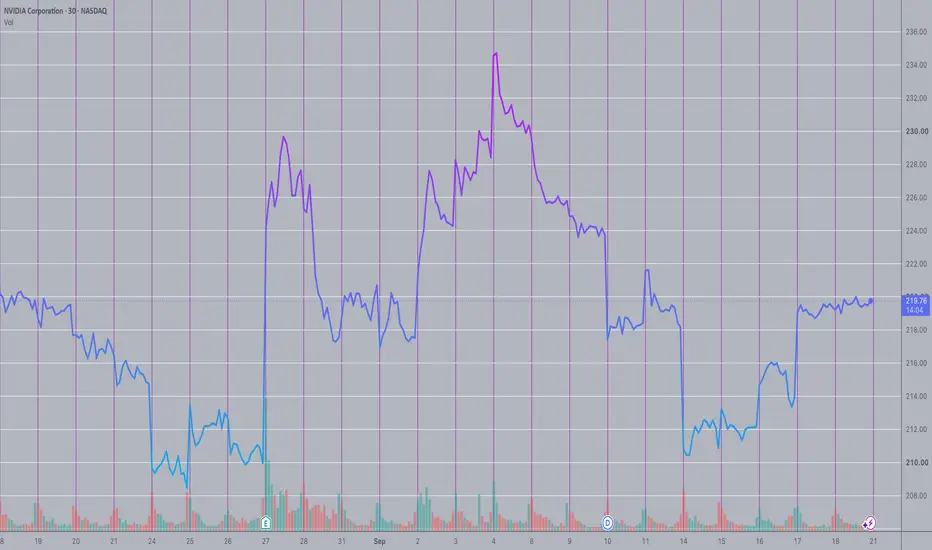
NVIDIA printed an intraday high of $234.55 on September 4. Ten days later, on September 14, it traded down near $210 -- a peak-to-trough decline of just over 10%. It has since recovered back above $219.
I don't use this space to call tops or bottoms. I use it to talk about the mechanical rules that keep a portfolio intact when the story around a stock gets loud in either direction.
The rule here is William O'Neil's: sell if a position falls 7-8% below where you bought it. No exceptions, no waiting for the fundamentals to "catch up." Applied here, an 8% stop off the September 4 high sits around $215.80 -- a level the stock cleared on the way down well before the eventual low near $210.
The rule doesn't claim to catch the exact bottom, and it won't feel good in a case like this one, where the stock bounced back within days. That's fine. The rule isn't graded trade by trade -- it's graded over hundreds of trades, where the handful of names that don't bounce are the ones that would otherwise do real damage to an account. Capping the downside mechanically is what lets you stay in the game long enough for the winners to matter.
I apply the same logic outside of equities too -- real estate, the private fund, even the vehicle fleet at Glencore: know the number that gets you out before you're in the position, not after.
Educational breakdown of a risk-management framework, not a recommendation to buy, sell, or hold NVDA. Not investment advice. Do your own research before trading any security.
I don't use this space to call tops or bottoms. I use it to talk about the mechanical rules that keep a portfolio intact when the story around a stock gets loud in either direction.
The rule here is William O'Neil's: sell if a position falls 7-8% below where you bought it. No exceptions, no waiting for the fundamentals to "catch up." Applied here, an 8% stop off the September 4 high sits around $215.80 -- a level the stock cleared on the way down well before the eventual low near $210.
The rule doesn't claim to catch the exact bottom, and it won't feel good in a case like this one, where the stock bounced back within days. That's fine. The rule isn't graded trade by trade -- it's graded over hundreds of trades, where the handful of names that don't bounce are the ones that would otherwise do real damage to an account. Capping the downside mechanically is what lets you stay in the game long enough for the winners to matter.
I apply the same logic outside of equities too -- real estate, the private fund, even the vehicle fleet at Glencore: know the number that gets you out before you're in the position, not after.
Educational breakdown of a risk-management framework, not a recommendation to buy, sell, or hold NVDA. Not investment advice. Do your own research before trading any security.

Thông báo miễn trừ trách nhiệm
Thông tin và các ấn phẩm này không nhằm mục đích, và không cấu thành, lời khuyên hoặc khuyến nghị về tài chính, đầu tư, giao dịch hay các loại khác do TradingView cung cấp hoặc xác nhận. Đọc thêm tại Điều khoản Sử dụng.
Thông báo miễn trừ trách nhiệm
Thông tin và các ấn phẩm này không nhằm mục đích, và không cấu thành, lời khuyên hoặc khuyến nghị về tài chính, đầu tư, giao dịch hay các loại khác do TradingView cung cấp hoặc xác nhận. Đọc thêm tại Điều khoản Sử dụng.