
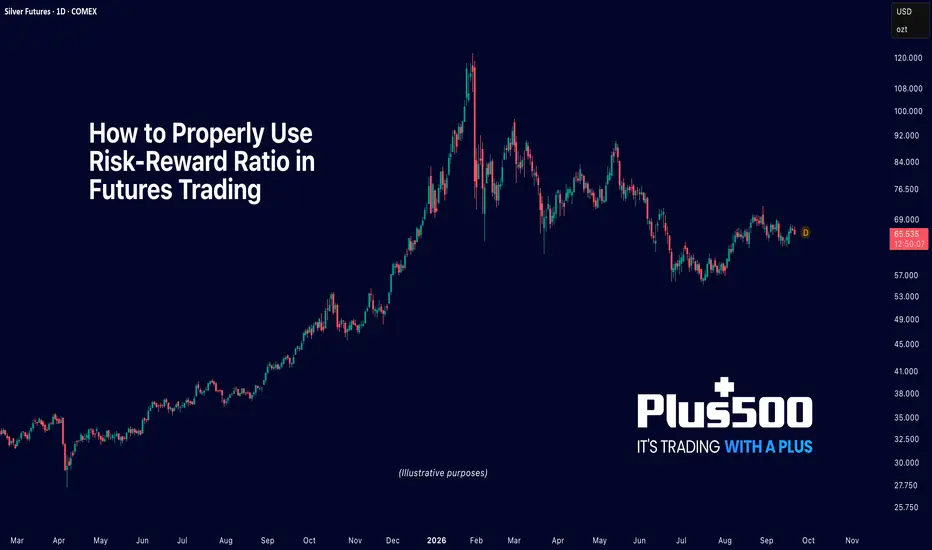
The risk-reward ratio measures how much potential reward you're targeting for every dollar you put at risk.
If you risk $100 to potentially make $300, that's a 1:3 ratio. Most professional traders treat this kind of thinking as non-negotiable, and for good reason. It gives you a clear, objective way to evaluate whether a trade is worth taking before you take it.
Why does this matter?
Without thinking about the ratio, even frequent wins can translate into long-term losses if your losers are big enough. Many first-time investors and traders learn this the hard way. So, it’s not just about being right more often than you’re wrong. It’s about what happens to your money when you are right, and when you aren’t.
📌 How to Calculate Risk-Reward Ratio
The process is simple. You only need 3 things:
The formula:
Risk-Reward Ratio = (Target Price - Entry Price) / (Entry Price - Stop-Loss Price)
Think of it like this:
You’re always asking:
“How much am I risking to make how much?”
Example (Long Trade)
You’re risking $3 to make $9
That’s a 1:3 risk-reward
Example (Short Trade)
You’re risking $5 to make $10
That’s a 1:2 risk-reward
Worth noting: The ratio only tells you the relationship between your risk and your target. It says nothing about how likely the trade is to work. That's your edge, and it's a separate question entirely.
📌 What “Good” Risk-Reward Ratios Look Like in Practice
There's no universally correct ratio. It depends on your strategy, your market, and your win rate. A scalper taking clean setups at high frequency might work comfortably with 1:1.5. A swing trader holding for days needs a wider target to justify the overnight risk, so 1:3 or better makes more sense.
The general floor most experienced traders use is 1:2. Below that, your win rate has to be high enough to compensate, and most traders overestimate their win rate.

📌 The Hidden Math: How Win Rate and Risk-Reward Ratio Work Together
Many traders don’t realize that win rate and risk-reward ratio trade off against each other. You can have a low win rate and still be profitable if your winners are big enough.

You can win fewer than half your trades and still be profitable, as long as your winners are large enough relative to your losers. Conversely, a high win rate means nothing if your losses consistently dwarf your gains.
A simple illustration: if you win 1 out of every 4 trades, but each win is three times the size of each loss, you break even. Add even a modest edge on top of that and you're profitable.
This is why many experienced traders focus as much on managing losses as on finding winners. The ratio is what keeps the math working even when your read on the market is wrong more often than right.
📌 Common Pitfalls: Where the Ratio Fails (and Why Beginners Get Tripped Up)
The risk-reward ratio is a starting point, not a guarantee. Several things can break the math in practice:
Market volatility. A stop placed at a logical level can still get hit before price moves to your target, simply because the market moved sharply in both directions. The ratio doesn't account for the path price takes to get there.
Execution. Slippage, wide spreads, and hesitation at the entry can quietly erode a ratio that looked clean on paper. A planned 1:3 can become 1:2 before the trade even starts.
Psychological pressure. Sitting in a trade that's showing profit but hasn't reached the target is harder than it sounds. The temptation to exit early, turning a 1:3 into a 1:1.5, is one of the most common ways traders undermine their own edge.
Actual win rate vs. expected. A setup that looks statistically strong doesn't guarantee the win rate holds over your next 30 trades. Small sample sizes produce noise, and traders often abandon sound approaches during short losing streaks.
Worth noting: If you consistently exit trades before your target, that's worth tracking. The gap between your planned ratio and your actual realized ratio is often larger than traders expect, and it's usually the biggest leak in an otherwise solid approach.
📌 Why Asymmetric Risk-Reward Trades Matter in Modern Markets
Occasionally you'll encounter setups where the potential reward is significantly larger than the risk, a 1:5, 1:8, or beyond. These are called asymmetric trades, and they have a specific logic.

Since the risk is small relative to the potential gain, you can be wrong most of the time and still come out ahead on the few trades that work. Options plays around earnings, breakouts from multi-month ranges, and volatility spikes can all produce this kind of setup.
The catch is consistency. Asymmetric trades don't occur frequently, and when they do, the win rate is usually low. The math only works if you keep losses small on the misses and let the winners run fully on the hits. Most traders cut winners too early and let that edge evaporate.
Worth noting: Asymmetric setups are worth cataloguing separately in your trade journal. Over time you'll see whether your hit rate on them actually justifies the approach, or whether you're overestimating how often they pay out.
📌 What the Data Actually Shows
A few patterns that show up consistently across backtests and fund data:
In trending equity markets, 1:2 setups produced steady results for traders who stuck to their plan. In choppy or high-volatility periods, stop-outs increased significantly, and traders who adjusted their ratio or widened stops mid-trade typically underperformed those who held their structure.
In forex, retail traders using 1:1 or tighter ratios without strict position sizing lost money at a disproportionate rate, consistent with data from multiple brokers over a multi-year period. The ratio alone wasn't the problem. The discipline to execute it consistently was.
Professional funds running 1:3 or better showed consistent outperformance, but almost universally combined that with strict position sizing and predefined exit rules. The ratio was one component of a system, not a standalone edge.
The consistent finding: the ratio is not where most traders fail. Sticking to it is.
Worth noting: If you have six months or more of trade data, calculate your average planned ratio versus your average realized ratio. The difference between those two numbers will tell you more about where your edge is leaking than almost any other metric.
📌 How to Apply It Without Undermining Yourself
A process most professionals follow:
📌 The Bottom Line
Over a large enough sample of trades, refusing to risk more than you stand to gain is one of the few structural edges a retail trader can actually control.
Markets change, setups evolve, and strategies need updating. The principle of protecting your downside while giving your upside room to run doesn't.
📌 Disclaimer
IMPORTANT: Trading in futures and options carries substantial risk of loss and is not suitable for every investor. The valuation of futures and options contracts may fluctuate rapidly and unpredictably, and, as a result, clients may lose more than their original investments. In no event should the content of this website be construed as an express or implied promise or guarantee by or from Plus500US Financial Services LLC that you will profit or that losses can or will be limited in any manner whatsoever. Market volatility, trade volume, and system availability may delay account access and trade executions. Past results are no indication of future performance. Information provided in this correspondence is intended solely for informational purposes and is obtained from sources believed to be reliable. Information is in no way guaranteed. The trading of futures is available through Plus500US Financial Services LLC d/b/a Plus500, a Futures Commission Merchant registered with the US Commodity Futures Trading Commission and a member of the National Futures Association (NFA ID number 0001398). Plus500US Financial Services LLC is a wholly-owned subsidiary of Plus500US Inc. Trading privileges subject to review and approval. Not all applicants will qualify. Information collected on account applications will be used to verify an applicant’s identity, as required under Federal law.
If you risk $100 to potentially make $300, that's a 1:3 ratio. Most professional traders treat this kind of thinking as non-negotiable, and for good reason. It gives you a clear, objective way to evaluate whether a trade is worth taking before you take it.
Why does this matter?
Without thinking about the ratio, even frequent wins can translate into long-term losses if your losers are big enough. Many first-time investors and traders learn this the hard way. So, it’s not just about being right more often than you’re wrong. It’s about what happens to your money when you are right, and when you aren’t.
📌 How to Calculate Risk-Reward Ratio
The process is simple. You only need 3 things:
- Entry price: where you take the trade
- Stop-loss: where you’re wrong (your risk)
- Target: where you exit in profit (your reward)
The formula:
Risk-Reward Ratio = (Target Price - Entry Price) / (Entry Price - Stop-Loss Price)
Think of it like this:
- Risk = what you lose (if wrong)
- Reward = what you make (if right)
You’re always asking:
“How much am I risking to make how much?”
Example (Long Trade)
- Entry: $50
- Stop-loss: $47 → Risk = $3
- Target: $59 → Reward = $9
You’re risking $3 to make $9
That’s a 1:3 risk-reward
Example (Short Trade)
- Entry: $80
- Stop-loss: $85 → Risk = $5
- Target: $68 → Reward = $10
You’re risking $5 to make $10
That’s a 1:2 risk-reward
Worth noting: The ratio only tells you the relationship between your risk and your target. It says nothing about how likely the trade is to work. That's your edge, and it's a separate question entirely.
📌 What “Good” Risk-Reward Ratios Look Like in Practice
There's no universally correct ratio. It depends on your strategy, your market, and your win rate. A scalper taking clean setups at high frequency might work comfortably with 1:1.5. A swing trader holding for days needs a wider target to justify the overnight risk, so 1:3 or better makes more sense.
The general floor most experienced traders use is 1:2. Below that, your win rate has to be high enough to compensate, and most traders overestimate their win rate.
📌 The Hidden Math: How Win Rate and Risk-Reward Ratio Work Together
Many traders don’t realize that win rate and risk-reward ratio trade off against each other. You can have a low win rate and still be profitable if your winners are big enough.
You can win fewer than half your trades and still be profitable, as long as your winners are large enough relative to your losers. Conversely, a high win rate means nothing if your losses consistently dwarf your gains.
A simple illustration: if you win 1 out of every 4 trades, but each win is three times the size of each loss, you break even. Add even a modest edge on top of that and you're profitable.
This is why many experienced traders focus as much on managing losses as on finding winners. The ratio is what keeps the math working even when your read on the market is wrong more often than right.
📌 Common Pitfalls: Where the Ratio Fails (and Why Beginners Get Tripped Up)
The risk-reward ratio is a starting point, not a guarantee. Several things can break the math in practice:
Market volatility. A stop placed at a logical level can still get hit before price moves to your target, simply because the market moved sharply in both directions. The ratio doesn't account for the path price takes to get there.
Execution. Slippage, wide spreads, and hesitation at the entry can quietly erode a ratio that looked clean on paper. A planned 1:3 can become 1:2 before the trade even starts.
Psychological pressure. Sitting in a trade that's showing profit but hasn't reached the target is harder than it sounds. The temptation to exit early, turning a 1:3 into a 1:1.5, is one of the most common ways traders undermine their own edge.
Actual win rate vs. expected. A setup that looks statistically strong doesn't guarantee the win rate holds over your next 30 trades. Small sample sizes produce noise, and traders often abandon sound approaches during short losing streaks.
Worth noting: If you consistently exit trades before your target, that's worth tracking. The gap between your planned ratio and your actual realized ratio is often larger than traders expect, and it's usually the biggest leak in an otherwise solid approach.
📌 Why Asymmetric Risk-Reward Trades Matter in Modern Markets
Occasionally you'll encounter setups where the potential reward is significantly larger than the risk, a 1:5, 1:8, or beyond. These are called asymmetric trades, and they have a specific logic.
Since the risk is small relative to the potential gain, you can be wrong most of the time and still come out ahead on the few trades that work. Options plays around earnings, breakouts from multi-month ranges, and volatility spikes can all produce this kind of setup.
The catch is consistency. Asymmetric trades don't occur frequently, and when they do, the win rate is usually low. The math only works if you keep losses small on the misses and let the winners run fully on the hits. Most traders cut winners too early and let that edge evaporate.
Worth noting: Asymmetric setups are worth cataloguing separately in your trade journal. Over time you'll see whether your hit rate on them actually justifies the approach, or whether you're overestimating how often they pay out.
📌 What the Data Actually Shows
A few patterns that show up consistently across backtests and fund data:
In trending equity markets, 1:2 setups produced steady results for traders who stuck to their plan. In choppy or high-volatility periods, stop-outs increased significantly, and traders who adjusted their ratio or widened stops mid-trade typically underperformed those who held their structure.
In forex, retail traders using 1:1 or tighter ratios without strict position sizing lost money at a disproportionate rate, consistent with data from multiple brokers over a multi-year period. The ratio alone wasn't the problem. The discipline to execute it consistently was.
Professional funds running 1:3 or better showed consistent outperformance, but almost universally combined that with strict position sizing and predefined exit rules. The ratio was one component of a system, not a standalone edge.
The consistent finding: the ratio is not where most traders fail. Sticking to it is.
Worth noting: If you have six months or more of trade data, calculate your average planned ratio versus your average realized ratio. The difference between those two numbers will tell you more about where your edge is leaking than almost any other metric.
📌 How to Apply It Without Undermining Yourself
A process most professionals follow:
- Define your risk before you enter. Know exactly where you're wrong before price tells you.
- Set a target based on what the market can realistically deliver, not on what you need to make.
- Only take trades with at least a 1:2 ratio. Many prefer 1:3 or better.
- Don't move your stop to give the trade more room unless something in the setup has genuinely changed.
- Keep risk per trade at 1 to 2% of account size. One loss shouldn't materially change your situation.
- Adjust for market conditions. Fast-moving markets require wider stops and lower expected win rates. Your ratio needs to reflect that.
📌 The Bottom Line
Over a large enough sample of trades, refusing to risk more than you stand to gain is one of the few structural edges a retail trader can actually control.
Markets change, setups evolve, and strategies need updating. The principle of protecting your downside while giving your upside room to run doesn't.
📌 Disclaimer
IMPORTANT: Trading in futures and options carries substantial risk of loss and is not suitable for every investor. The valuation of futures and options contracts may fluctuate rapidly and unpredictably, and, as a result, clients may lose more than their original investments. In no event should the content of this website be construed as an express or implied promise or guarantee by or from Plus500US Financial Services LLC that you will profit or that losses can or will be limited in any manner whatsoever. Market volatility, trade volume, and system availability may delay account access and trade executions. Past results are no indication of future performance. Information provided in this correspondence is intended solely for informational purposes and is obtained from sources believed to be reliable. Information is in no way guaranteed. The trading of futures is available through Plus500US Financial Services LLC d/b/a Plus500, a Futures Commission Merchant registered with the US Commodity Futures Trading Commission and a member of the National Futures Association (NFA ID number 0001398). Plus500US Financial Services LLC is a wholly-owned subsidiary of Plus500US Inc. Trading privileges subject to review and approval. Not all applicants will qualify. Information collected on account applications will be used to verify an applicant’s identity, as required under Federal law.

It's futures trading with a plus
Bài đăng liên quan
Thông báo miễn trừ trách nhiệm
Thông tin và các ấn phẩm này không nhằm mục đích, và không cấu thành, lời khuyên hoặc khuyến nghị về tài chính, đầu tư, giao dịch hay các loại khác do TradingView cung cấp hoặc xác nhận. Đọc thêm tại Điều khoản Sử dụng.