
Gold's Pullback Is Confirming What Smart Money Already Saw
One month ago, when gold was trading near $4,750, I published an article explaining why the rally looked exhausted and why a deeper correction was likely starting.
During this period, we executed multiple trades around our key levels, with most take-profit targets getting hit as momentum slowly shifted from panic buying into profit-taking.
The interesting part is not just that gold fell during geopolitical tensions.
It's why it started falling.
Gold Is No Longer Trading Purely On Fear
Earlier this year, gold rallied aggressively as traders rushed into safe-haven assets. Inflation fears, Middle East tensions, and uncertainty around central bank policy created the perfect environment for precious metals.
But markets eventually price in fear.
Now, traders are beginning to focus on a different question:
Will inflation actually stay high enough to force the Federal Reserve into more tightening?
That narrative started changing this week.
President Trump stated that the US was close to reaching an agreement to end the conflict with Iran, while reports showed supertankers successfully leaving the Persian Gulf toward Asia.
Oil supply fears eased. Treasury markets stabilized. Inflation expectations cooled slightly.
As a result, gold bounced back above $4,530 after briefly touching a two-month low near $4,490.
Why Treasury Markets Matter More Than Headlines
Many retail traders focus only on geopolitical news.
Professional traders watch bond yields.
Fresh Federal Reserve meeting minutes revealed that several policymakers still see the possibility of future rate hikes if inflation remains stubbornly above the 2% target.
That matters because:
Higher rates strengthen the dollar
Higher yields reduce the appeal of non-yielding assets like gold
Lower inflation fears weaken panic-driven buying
This is exactly why gold started losing momentum even while global tensions remained elevated.
The market was already repositioning before most traders noticed.
The Real Signal Was Momentum Exhaustion
Gold's rally became overcrowded.
Once buyers stopped aggressively chasing highs, every failed breakout created more selling pressure. That opened the door for a technical correction.
In my previous analysis, I highlighted how:
momentum was slowing,
resistance zones were strengthening,
and risk-reward heavily favored downside setups.
That scenario is now playing out almost perfectly.
The biggest lesson?
Markets often reverse before the news becomes obvious.
Is Gold's Bull Run Over?
Not necessarily.
Long-term fundamentals for gold still remain strong:
central bank accumulation continues,
debt levels globally remain extreme,
and investors still want protection against currency debasement.
But short-term, the market may need time to cool down after one of the strongest rallies in years.
If inflation continues stabilizing and Treasury yields remain elevated, gold could struggle to immediately reclaim previous highs.
For now, traders are closely watching whether the $4,500 zone can hold as support.
What Happens Next?
The next move likely depends on three factors:
Federal Reserve policy expectations
Oil prices and Middle East developments
Bond market behavior and inflation data
If inflation fears return aggressively, gold could quickly regain bullish momentum.
But if markets continue shifting toward higher yields and lower panic sentiment, gold may remain under pressure longer than many expect.
One thing is clear:
The market already started repricing this scenario weeks ago.
And the charts were warning about it before the headlines caught up.
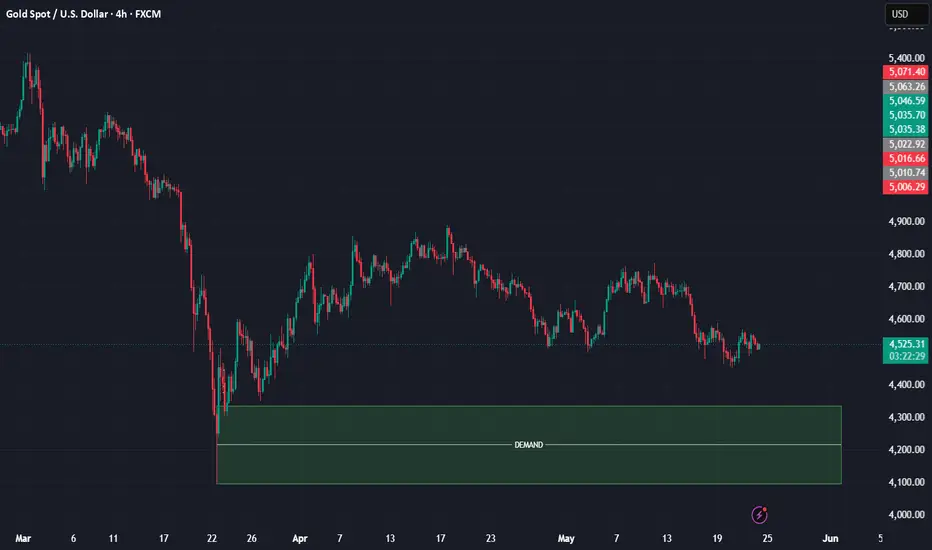
What The 4H Chart Is Showing Right Now
From a technical perspective, gold is still struggling to recover its bullish momentum on the 4H timeframe.
Price continues to trade around the $4,500 zone after rejecting multiple attempts to move higher, showing that sellers are still controlling short-term direction.
The chart also highlights a major demand zone between roughly $4,100 and $4,300.
This area acted as strong support after the aggressive selloff in March and remains the key zone bulls need to defend if volatility returns.
Current 4H Gold StructureAt the moment, gold is moving inside a weaker structure with lower highs forming across the chart.
Unless buyers reclaim the $4,650–$4,700 region with strong momentum, the market could remain vulnerable to another downside sweep toward lower liquidity areas.
This aligns with the broader macro narrative. Easing fears around inflation and potential stabilization in Middle East energy supply have reduced part of the panic bid that previously pushed gold toward record highs above $4,700.
Interestingly, this is very close to the scenario I outlined around one month ago in my previous analysis, when gold was trading near $4,750.
At the time, I explained why gold looked ready for a larger correction despite the ongoing geopolitical tensions.
You can mention the previous article right here naturally:
"In my previous analysis published about a month ago, I explained why gold looked increasingly vulnerable to a deeper correction despite the crisis narrative dominating headlines."
Since then, gold has dropped roughly 2,500 pips from those highs, while several of our key levels and trade setups played out almost exactly as anticipated.
Multiple take-profit targets were reached during the move as bearish momentum accelerated across the market.
Now the focus shifts toward whether gold can build a stronger base above current demand or if another wave of selling pressure emerges as markets continue repricing inflation and Federal Reserve expectations.
#Gold #Xauusd
One month ago, when gold was trading near $4,750, I published an article explaining why the rally looked exhausted and why a deeper correction was likely starting.
During this period, we executed multiple trades around our key levels, with most take-profit targets getting hit as momentum slowly shifted from panic buying into profit-taking.
The interesting part is not just that gold fell during geopolitical tensions.
It's why it started falling.
Gold Is No Longer Trading Purely On Fear
Earlier this year, gold rallied aggressively as traders rushed into safe-haven assets. Inflation fears, Middle East tensions, and uncertainty around central bank policy created the perfect environment for precious metals.
But markets eventually price in fear.
Now, traders are beginning to focus on a different question:
Will inflation actually stay high enough to force the Federal Reserve into more tightening?
That narrative started changing this week.
President Trump stated that the US was close to reaching an agreement to end the conflict with Iran, while reports showed supertankers successfully leaving the Persian Gulf toward Asia.
Oil supply fears eased. Treasury markets stabilized. Inflation expectations cooled slightly.
As a result, gold bounced back above $4,530 after briefly touching a two-month low near $4,490.
Why Treasury Markets Matter More Than Headlines
Many retail traders focus only on geopolitical news.
Professional traders watch bond yields.
Fresh Federal Reserve meeting minutes revealed that several policymakers still see the possibility of future rate hikes if inflation remains stubbornly above the 2% target.
That matters because:
Higher rates strengthen the dollar
Higher yields reduce the appeal of non-yielding assets like gold
Lower inflation fears weaken panic-driven buying
This is exactly why gold started losing momentum even while global tensions remained elevated.
The market was already repositioning before most traders noticed.
The Real Signal Was Momentum Exhaustion
Gold's rally became overcrowded.
Once buyers stopped aggressively chasing highs, every failed breakout created more selling pressure. That opened the door for a technical correction.
In my previous analysis, I highlighted how:
momentum was slowing,
resistance zones were strengthening,
and risk-reward heavily favored downside setups.
That scenario is now playing out almost perfectly.
The biggest lesson?
Markets often reverse before the news becomes obvious.
Is Gold's Bull Run Over?
Not necessarily.
Long-term fundamentals for gold still remain strong:
central bank accumulation continues,
debt levels globally remain extreme,
and investors still want protection against currency debasement.
But short-term, the market may need time to cool down after one of the strongest rallies in years.
If inflation continues stabilizing and Treasury yields remain elevated, gold could struggle to immediately reclaim previous highs.
For now, traders are closely watching whether the $4,500 zone can hold as support.
What Happens Next?
The next move likely depends on three factors:
Federal Reserve policy expectations
Oil prices and Middle East developments
Bond market behavior and inflation data
If inflation fears return aggressively, gold could quickly regain bullish momentum.
But if markets continue shifting toward higher yields and lower panic sentiment, gold may remain under pressure longer than many expect.
One thing is clear:
The market already started repricing this scenario weeks ago.
And the charts were warning about it before the headlines caught up.
What The 4H Chart Is Showing Right Now
From a technical perspective, gold is still struggling to recover its bullish momentum on the 4H timeframe.
Price continues to trade around the $4,500 zone after rejecting multiple attempts to move higher, showing that sellers are still controlling short-term direction.
The chart also highlights a major demand zone between roughly $4,100 and $4,300.
This area acted as strong support after the aggressive selloff in March and remains the key zone bulls need to defend if volatility returns.
Current 4H Gold StructureAt the moment, gold is moving inside a weaker structure with lower highs forming across the chart.
Unless buyers reclaim the $4,650–$4,700 region with strong momentum, the market could remain vulnerable to another downside sweep toward lower liquidity areas.
This aligns with the broader macro narrative. Easing fears around inflation and potential stabilization in Middle East energy supply have reduced part of the panic bid that previously pushed gold toward record highs above $4,700.
Interestingly, this is very close to the scenario I outlined around one month ago in my previous analysis, when gold was trading near $4,750.
At the time, I explained why gold looked ready for a larger correction despite the ongoing geopolitical tensions.
You can mention the previous article right here naturally:
"In my previous analysis published about a month ago, I explained why gold looked increasingly vulnerable to a deeper correction despite the crisis narrative dominating headlines."
Since then, gold has dropped roughly 2,500 pips from those highs, while several of our key levels and trade setups played out almost exactly as anticipated.
Multiple take-profit targets were reached during the move as bearish momentum accelerated across the market.
Now the focus shifts toward whether gold can build a stronger base above current demand or if another wave of selling pressure emerges as markets continue repricing inflation and Federal Reserve expectations.
#Gold #Xauusd

Thông báo miễn trừ trách nhiệm
Thông tin và các ấn phẩm này không nhằm mục đích, và không cấu thành, lời khuyên hoặc khuyến nghị về tài chính, đầu tư, giao dịch hay các loại khác do TradingView cung cấp hoặc xác nhận. Đọc thêm tại Điều khoản Sử dụng.
Thông báo miễn trừ trách nhiệm
Thông tin và các ấn phẩm này không nhằm mục đích, và không cấu thành, lời khuyên hoặc khuyến nghị về tài chính, đầu tư, giao dịch hay các loại khác do TradingView cung cấp hoặc xác nhận. Đọc thêm tại Điều khoản Sử dụng.