
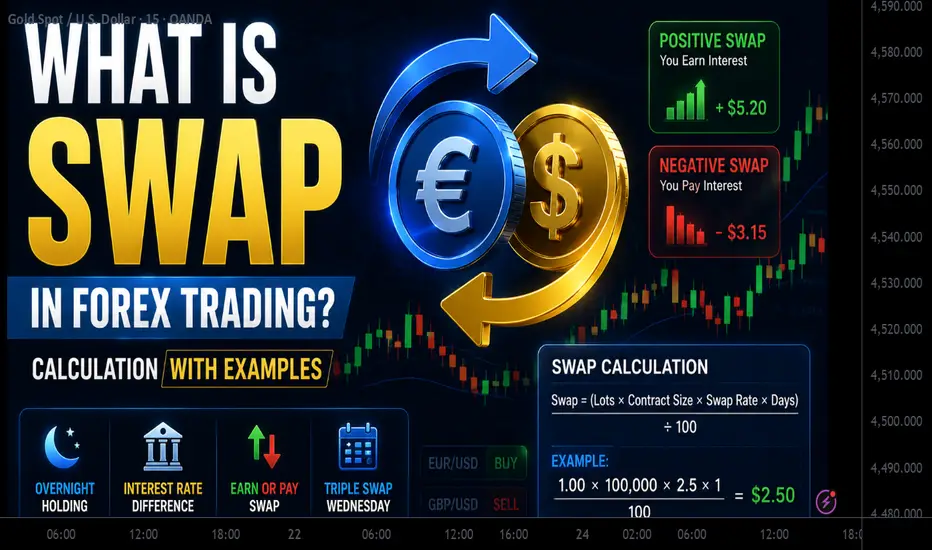
Have you ever logged into your forex account and noticed your balance had changed overnight even though you hadn't touched a single trade? That's swap rates at work. Most traders either don't know about them or just accept them as another line item eating into their profits. But here's the thing: swap rates don't have to be the enemy. Depending on how you trade, they can actually work in your favor. In this guide, we'll break down exactly what swap rates are, how brokers calculate them, and more importantly how you can use them as part of a smarter trading strategy instead of just watching them quietly drain your account.
Key Takeaways
Swaps are part of the deal when you hold positions overnight. They come from the interest rate difference between the two currencies you're trading. Whether you end up paying or getting paid comes down to which currency carries the higher rate and the direction of your trade. Once you understand this, you'll never look at your overnight positions the same way again.
Don't let the it's just a few dollar mindset fool you. Swap charges might look harmless at first glance, but they add up fast. Hold a position for weeks or months and those small nightly deductions (or additions) start to matter. And don't forget: brokers charge triple swaps on certain days to cover the weekend, which can catch a lot of traders off guard.
The best traders don't just tolerate swaps they plan around them. If the swap works in your favor, that's essentially money coming in while you sleep. If it's working against you, that's a signal to rethink how long you're holding. Either way, it should be part of your decision making, not an afterthought.
Risk management isn't just about stop losses and market moves. Swap rates can change, broker policies shift, and chasing favorable swap rates by over leveraging is a trap more traders fall into than you'd think. The bottom line: swaps are one piece of the puzzle, not the whole picture. Keep them in perspective.

What Is a Forex Swap?
A forex overnight swap is essentially an interest payment that comes into play when you hold a trading position overnight. It is when you either pay or receive for keeping your trade open beyond the market's daily closing, which by definition ends at 4:59:59PM EST.
When you trade currencies, you are actually borrowing one currency and lending another. Just like when you borrow money from a bank, there is interest involved. Since you are dealing with two different currencies, there are two different interest rates at play. The difference between these rates determines whether you will pay or receive an overnight swap fee.
For example, if you are buying a currency with a higher interest rate and selling one with a lower rate, you might actually earn a small payment each night. On the flip side, if you are holding the opposite position, you will be charged instead.
These overnight swap fees might seem small at first glance, often just a few dollars per night, but they can add up significantly over time, especially if you are holding positions for weeks or months. That is why understanding swaps is not just for forex nerds. It is practical knowledge that can directly impact your bottom line as a trader.
How to Calculate Overnight Swap in Forex?
At its core, an overnight swap calculation considers the interest rate differential between the two currencies in your pair, adjusted for your position size and how long you hold the trade.
First, you need to know the interest rates for both currencies in your pair. If you are trading EUR/USD, you would look at the European Central Bank's rate for euros and the Federal Reserve's rate for dollars.
The formula typically looks like this:
Swap = (Contract Size × Price × Interest Rate Differential / 100) / 365
The good news is you do not have to do these calculations yourself. Your broker handles them and displays the swap values directly in your trading platform as "swap long" and "swap short" for each currency pair. These values show exactly how much you will be charged or credited each night you hold the position.
One thing worth knowing is the triple swap, which usually happens on Wednesdays. Most currency pairs settle on a T+2 basis, meaning settlement occurs two days after the trade. Since the market is closed on weekends, brokers apply three days worth of swap on Wednesday to account for the weekend gap. Think of it as paying your weekend holding cost in advance.
Swaps can be positive or negative depending on which currency carries the higher interest rate and whether you are buying or selling it. This is why some traders use carry trades, holding positions in pairs with favorable interest rate differentials to earn swap payments over time.
Types of Swaps
Not all swaps work the same way. Here is a breakdown of the different types you might come across in forex trading.
Forward Swaps involve agreeing to exchange currencies at a predetermined rate on a specific future date. These are mostly used by businesses and institutional traders who need to hedge against currency fluctuations for upcoming transactions. Unlike spot next swaps that are automatically applied to overnight positions, forward swaps are arranged as separate contracts.
Currency Basis Swaps are more complex instruments where two parties exchange both principal amounts and interest payments in different currencies. These usually run for longer periods, sometimes years, and are commonly used by corporations and financial institutions managing long-term currency exposure. They are particularly useful for companies that borrow in one currency but earn revenue in another.
Mark-to-Market Swaps include regular revaluations of the swap's value based on current market rates. This adds complexity but gives a more accurate picture of how a swap's value shifts over time. These are mainly used in institutional trading rather than retail environments.
Cross-Currency Swaps involve the exchange of both interest payments and principal amounts in two different currencies. Multinational corporations operating across different currency zones use these to manage their exposure more efficiently.
Islamic or Swap-Free Accounts are not technically swaps at all. They are alternative arrangements built around Islamic finance principles, which prohibit interest-based transactions. Instead of standard swap charges, brokers typically replace them with administrative fees or adjusted spreads.
As a retail trader, spot next swaps will be your main concern day to day. But understanding the full picture helps you see how the forex market operates across different levels, from individual traders to institutions moving billions in currency exposure.

How a Currency Swap Works
A currency swap involves two parties agreeing to exchange currencies for a set period. Unlike a typical forex trade that lasts hours or days, these swaps often run for months or even years. During that time, both parties also exchange interest payments on the amounts they have borrowed.
Here is a simple example. An American company needs 10 million yen for its Japanese operations, while a Japanese firm needs 100,000 dollars for its American branch. Instead of each taking out foreign currency loans and dealing with the risks that come with them, they swap. The American company sends dollars to the Japanese firm and receives yen in return. Throughout the agreement, each side makes interest payments in the currency they borrowed. When the swap ends, they exchange the original amounts back.
What makes currency swaps genuinely useful is how they help businesses manage exchange rate risk. If you are an American company earning revenue in euros but making loan payments in dollars, you are constantly exposed to uncertainty about where the exchange rate will be when those payments are due. A currency swap lets you lock in a rate for the duration of the agreement, giving you predictability in a market that rarely offers it.

FX Swap Examples
Here are some straightforward examples that show how swap rates can actually affect your trading.
Say you buy EUR/USD at 1.1000, one standard lot of €100,000. You are long euros and short dollars. The European Central Bank's rate sits at 0.5% while the Federal Reserve's rate is at 3%. Since you are buying the lower interest currency and selling the higher one, you pay a swap fee each night. Your broker might charge around $8.20 per night. Hold that position for a month and you are looking at roughly $250 in swap costs, which can quietly wipe out smaller profits before you even notice.
Flip the trade around. If you are short EUR/USD, you are now holding the higher interest currency. Your broker might credit you around $3.50 per night instead. Over a month that adds up to about $105 earned just from holding the position, on top of whatever the price does.
This is where carry trades come in. Take AUD/JPY. Australia's rate sits at 4.35% while Japan's is near zero. Going long on this pair could earn you $15 to $20 per standard lot every night. A trader holding three lots for six months could collect over $2,700 in swap payments alone, even if the price barely moves.
The triple swap day adds another layer to this. If your GBP/USD position normally costs $5 in daily swap fees, on Wednesday you get charged $15 to cover the weekend. If you are holding positions through the weekend, that tripling effect needs to be part of your calculations.
As for swap-free accounts, there is always a trade-off. You might avoid a $10 daily swap charge, but wider spreads or different commission structures can end up costing you in other ways.
The bottom line is that smart traders do not just watch price movements. They factor swaps into their overall strategy, and some build entire approaches around capturing interest rate differentials alongside favorable price trends.
Risks Associated With Foreign Currency Swaps
Swaps can work in your favor, but they come with risks that do not always get enough attention. Here is what every trader should be aware of.
Counterparty risk is something retail traders often overlook. Your broker is essentially your counterparty for swaps. If they decide to change their swap rates with little or no notice, a carry trade that looked profitable on paper can quickly become far less attractive.
Market liquidity risk can catch even experienced traders off guard. If you need to close a large position in a less traded currency pair during volatile conditions, you may face significant slippage. This hurts even more when you built that position specifically for swap benefits but are now forced to exit at the worst possible time.
Operational risks are easy to underestimate. A miscalculation in your swap costs or an error in your platform's displayed rates might seem minor at first, but these small mistakes compound over time, especially when you are running multiple positions with different swap profiles.
The biggest danger is probably the "free money" trap. Positive swaps can tempt traders into sizing up their positions well beyond what their risk management allows. When the market moves against them, the margin calls that follow can wipe out every swap payment they collected and then some.
The point is simple. Swaps are one part of your trading equation, not the whole strategy. Take advantage of favorable interest rate differentials by all means, but always keep market direction, risk management, and your overall plan at the center of every decision you make.
Conclusion
Forex swaps are something most traders ignore until they see an unexpected charge on their account. By then, the damage is already done.
Once you understand how swaps work, you stop seeing them as a mystery and start seeing them as something you can actually plan around. Sometimes they work in your favor, sometimes they do not. Either way, knowing the difference puts you in a much better position than most retail traders.
Keep them in your calculations, manage your risk, and never let the appeal of daily swap income push you into positions you cannot afford to hold.
Disclaimer: This article is for educational purposes only and should not be considered financial advice. Always do your own analysis and use proper risk management.
Thank you for reading. I hope this article helped you better understand market behavior, trading psychology, and risk management during volatile conditions.
For more trading education, chart analysis, and market insights, follow:
Trade-Technique on TradingView
Key Takeaways
Swaps are part of the deal when you hold positions overnight. They come from the interest rate difference between the two currencies you're trading. Whether you end up paying or getting paid comes down to which currency carries the higher rate and the direction of your trade. Once you understand this, you'll never look at your overnight positions the same way again.
Don't let the it's just a few dollar mindset fool you. Swap charges might look harmless at first glance, but they add up fast. Hold a position for weeks or months and those small nightly deductions (or additions) start to matter. And don't forget: brokers charge triple swaps on certain days to cover the weekend, which can catch a lot of traders off guard.
The best traders don't just tolerate swaps they plan around them. If the swap works in your favor, that's essentially money coming in while you sleep. If it's working against you, that's a signal to rethink how long you're holding. Either way, it should be part of your decision making, not an afterthought.
Risk management isn't just about stop losses and market moves. Swap rates can change, broker policies shift, and chasing favorable swap rates by over leveraging is a trap more traders fall into than you'd think. The bottom line: swaps are one piece of the puzzle, not the whole picture. Keep them in perspective.
What Is a Forex Swap?
A forex overnight swap is essentially an interest payment that comes into play when you hold a trading position overnight. It is when you either pay or receive for keeping your trade open beyond the market's daily closing, which by definition ends at 4:59:59PM EST.
When you trade currencies, you are actually borrowing one currency and lending another. Just like when you borrow money from a bank, there is interest involved. Since you are dealing with two different currencies, there are two different interest rates at play. The difference between these rates determines whether you will pay or receive an overnight swap fee.
For example, if you are buying a currency with a higher interest rate and selling one with a lower rate, you might actually earn a small payment each night. On the flip side, if you are holding the opposite position, you will be charged instead.
These overnight swap fees might seem small at first glance, often just a few dollars per night, but they can add up significantly over time, especially if you are holding positions for weeks or months. That is why understanding swaps is not just for forex nerds. It is practical knowledge that can directly impact your bottom line as a trader.
How to Calculate Overnight Swap in Forex?
At its core, an overnight swap calculation considers the interest rate differential between the two currencies in your pair, adjusted for your position size and how long you hold the trade.
First, you need to know the interest rates for both currencies in your pair. If you are trading EUR/USD, you would look at the European Central Bank's rate for euros and the Federal Reserve's rate for dollars.
The formula typically looks like this:
Swap = (Contract Size × Price × Interest Rate Differential / 100) / 365
The good news is you do not have to do these calculations yourself. Your broker handles them and displays the swap values directly in your trading platform as "swap long" and "swap short" for each currency pair. These values show exactly how much you will be charged or credited each night you hold the position.
One thing worth knowing is the triple swap, which usually happens on Wednesdays. Most currency pairs settle on a T+2 basis, meaning settlement occurs two days after the trade. Since the market is closed on weekends, brokers apply three days worth of swap on Wednesday to account for the weekend gap. Think of it as paying your weekend holding cost in advance.
Swaps can be positive or negative depending on which currency carries the higher interest rate and whether you are buying or selling it. This is why some traders use carry trades, holding positions in pairs with favorable interest rate differentials to earn swap payments over time.
Types of Swaps
Not all swaps work the same way. Here is a breakdown of the different types you might come across in forex trading.
Forward Swaps involve agreeing to exchange currencies at a predetermined rate on a specific future date. These are mostly used by businesses and institutional traders who need to hedge against currency fluctuations for upcoming transactions. Unlike spot next swaps that are automatically applied to overnight positions, forward swaps are arranged as separate contracts.
Currency Basis Swaps are more complex instruments where two parties exchange both principal amounts and interest payments in different currencies. These usually run for longer periods, sometimes years, and are commonly used by corporations and financial institutions managing long-term currency exposure. They are particularly useful for companies that borrow in one currency but earn revenue in another.
Mark-to-Market Swaps include regular revaluations of the swap's value based on current market rates. This adds complexity but gives a more accurate picture of how a swap's value shifts over time. These are mainly used in institutional trading rather than retail environments.
Cross-Currency Swaps involve the exchange of both interest payments and principal amounts in two different currencies. Multinational corporations operating across different currency zones use these to manage their exposure more efficiently.
Islamic or Swap-Free Accounts are not technically swaps at all. They are alternative arrangements built around Islamic finance principles, which prohibit interest-based transactions. Instead of standard swap charges, brokers typically replace them with administrative fees or adjusted spreads.
As a retail trader, spot next swaps will be your main concern day to day. But understanding the full picture helps you see how the forex market operates across different levels, from individual traders to institutions moving billions in currency exposure.
How a Currency Swap Works
A currency swap involves two parties agreeing to exchange currencies for a set period. Unlike a typical forex trade that lasts hours or days, these swaps often run for months or even years. During that time, both parties also exchange interest payments on the amounts they have borrowed.
Here is a simple example. An American company needs 10 million yen for its Japanese operations, while a Japanese firm needs 100,000 dollars for its American branch. Instead of each taking out foreign currency loans and dealing with the risks that come with them, they swap. The American company sends dollars to the Japanese firm and receives yen in return. Throughout the agreement, each side makes interest payments in the currency they borrowed. When the swap ends, they exchange the original amounts back.
What makes currency swaps genuinely useful is how they help businesses manage exchange rate risk. If you are an American company earning revenue in euros but making loan payments in dollars, you are constantly exposed to uncertainty about where the exchange rate will be when those payments are due. A currency swap lets you lock in a rate for the duration of the agreement, giving you predictability in a market that rarely offers it.
FX Swap Examples
Here are some straightforward examples that show how swap rates can actually affect your trading.
Say you buy EUR/USD at 1.1000, one standard lot of €100,000. You are long euros and short dollars. The European Central Bank's rate sits at 0.5% while the Federal Reserve's rate is at 3%. Since you are buying the lower interest currency and selling the higher one, you pay a swap fee each night. Your broker might charge around $8.20 per night. Hold that position for a month and you are looking at roughly $250 in swap costs, which can quietly wipe out smaller profits before you even notice.
Flip the trade around. If you are short EUR/USD, you are now holding the higher interest currency. Your broker might credit you around $3.50 per night instead. Over a month that adds up to about $105 earned just from holding the position, on top of whatever the price does.
This is where carry trades come in. Take AUD/JPY. Australia's rate sits at 4.35% while Japan's is near zero. Going long on this pair could earn you $15 to $20 per standard lot every night. A trader holding three lots for six months could collect over $2,700 in swap payments alone, even if the price barely moves.
The triple swap day adds another layer to this. If your GBP/USD position normally costs $5 in daily swap fees, on Wednesday you get charged $15 to cover the weekend. If you are holding positions through the weekend, that tripling effect needs to be part of your calculations.
As for swap-free accounts, there is always a trade-off. You might avoid a $10 daily swap charge, but wider spreads or different commission structures can end up costing you in other ways.
The bottom line is that smart traders do not just watch price movements. They factor swaps into their overall strategy, and some build entire approaches around capturing interest rate differentials alongside favorable price trends.
Risks Associated With Foreign Currency Swaps
Swaps can work in your favor, but they come with risks that do not always get enough attention. Here is what every trader should be aware of.
Counterparty risk is something retail traders often overlook. Your broker is essentially your counterparty for swaps. If they decide to change their swap rates with little or no notice, a carry trade that looked profitable on paper can quickly become far less attractive.
Market liquidity risk can catch even experienced traders off guard. If you need to close a large position in a less traded currency pair during volatile conditions, you may face significant slippage. This hurts even more when you built that position specifically for swap benefits but are now forced to exit at the worst possible time.
Operational risks are easy to underestimate. A miscalculation in your swap costs or an error in your platform's displayed rates might seem minor at first, but these small mistakes compound over time, especially when you are running multiple positions with different swap profiles.
The biggest danger is probably the "free money" trap. Positive swaps can tempt traders into sizing up their positions well beyond what their risk management allows. When the market moves against them, the margin calls that follow can wipe out every swap payment they collected and then some.
The point is simple. Swaps are one part of your trading equation, not the whole strategy. Take advantage of favorable interest rate differentials by all means, but always keep market direction, risk management, and your overall plan at the center of every decision you make.
Conclusion
Forex swaps are something most traders ignore until they see an unexpected charge on their account. By then, the damage is already done.
Once you understand how swaps work, you stop seeing them as a mystery and start seeing them as something you can actually plan around. Sometimes they work in your favor, sometimes they do not. Either way, knowing the difference puts you in a much better position than most retail traders.
Keep them in your calculations, manage your risk, and never let the appeal of daily swap income push you into positions you cannot afford to hold.
Disclaimer: This article is for educational purposes only and should not be considered financial advice. Always do your own analysis and use proper risk management.
Thank you for reading. I hope this article helped you better understand market behavior, trading psychology, and risk management during volatile conditions.
For more trading education, chart analysis, and market insights, follow:
Trade-Technique on TradingView
Ghi chú
Follow me for upcoming updates. I’ll be posting a forensic research report shortly.
Bài đăng liên quan
Thông báo miễn trừ trách nhiệm
Thông tin và các ấn phẩm này không nhằm mục đích, và không cấu thành, lời khuyên hoặc khuyến nghị về tài chính, đầu tư, giao dịch hay các loại khác do TradingView cung cấp hoặc xác nhận. Đọc thêm tại Điều khoản Sử dụng.
Bài đăng liên quan
Thông báo miễn trừ trách nhiệm
Thông tin và các ấn phẩm này không nhằm mục đích, và không cấu thành, lời khuyên hoặc khuyến nghị về tài chính, đầu tư, giao dịch hay các loại khác do TradingView cung cấp hoặc xác nhận. Đọc thêm tại Điều khoản Sử dụng.