
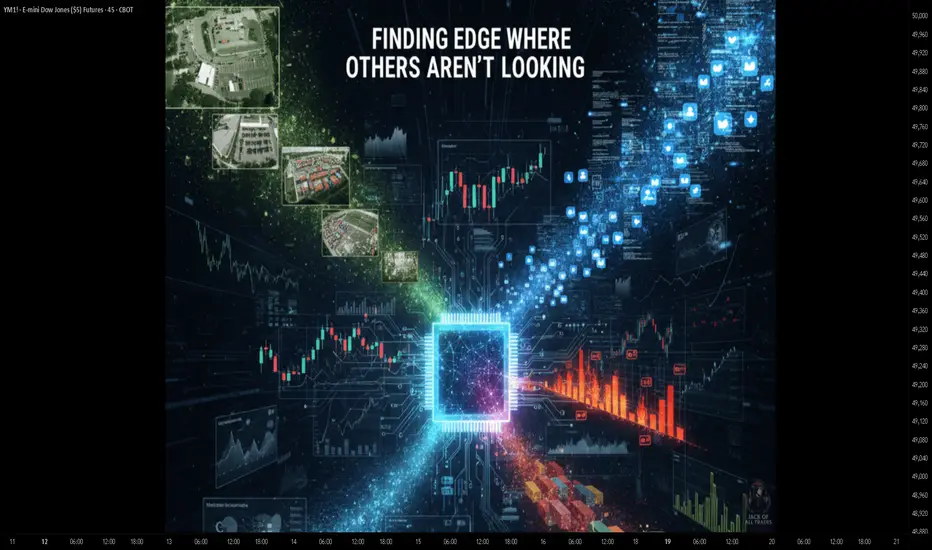
The Best Traders Aren't Just Looking at Charts Anymore
While most traders stare at the same charts, indicators, and news feeds...
A new breed of traders is counting cars in parking lots from space, tracking shipping containers across oceans, and analyzing millions of social media posts.
This is alternative data - and it's changing who has the edge.
What Is Alternative Data?
Definition:
Alternative data is any data used for investment decisions that isn't traditional financial data (price, volume, earnings, etc.).
Traditional Data:
- Price and volume
- Financial statements
- Earnings reports
- Economic indicators
- Analyst ratings
Alternative Data:
- Satellite imagery
- Social media sentiment
- Web traffic and app usage
- Credit card transactions
- Geolocation data
- Weather patterns
- Job postings
- Patent filings
- And much more...
Types of Alternative Data
1. Satellite and Geospatial Data
What It Tracks:
- Retail parking lot traffic
- Oil storage tank levels
- Crop health and yields
- Shipping and logistics
- Construction activity
Example:
Count cars in Walmart parking lots before earnings.
More cars = more sales = potential earnings beat.
Edge: Information before it appears in financial reports.
2. Social Media and Sentiment Data
What It Tracks:
- Brand mentions and sentiment
- Product buzz
- Consumer complaints
- Viral trends
- Influencer activity
Example:
Track sentiment around a new product launch.
Negative sentiment spike = potential sales disappointment.
Edge: Real-time consumer reaction before sales data.
3. Web Traffic and App Data
What It Tracks:
- Website visits
- App downloads and usage
- Search trends
- E-commerce activity
- User engagement
Example:
Track app downloads for a gaming company.
Declining downloads = potential revenue miss.
Edge: Usage data before quarterly reports.
4. Transaction Data
What It Tracks:
- Credit card spending
- Point-of-sale data
- E-commerce transactions
- Consumer behavior patterns
Example:
Aggregate credit card data shows spending at restaurants declining.
Restaurant stocks may underperform.
Edge: Spending patterns before earnings.
5. Employment and Job Data
What It Tracks:
- Job postings
- Hiring trends
- Layoff announcements
- Glassdoor reviews
- LinkedIn activity
Example:
Company suddenly posts many engineering jobs.
Could indicate new product development.
Edge: Corporate strategy signals before announcements.
6. Supply Chain Data
What It Tracks:
- Shipping container movements
- Port activity
- Supplier relationships
- Inventory levels
- Logistics patterns
Example:
Track shipping from key suppliers to Apple.
Increased shipments before product launch = strong demand.
Edge: Supply chain signals before sales data.
How AI Processes Alternative Data
Challenge:
Alternative data is:
- Massive in volume
- Unstructured (images, text, etc.)
- Noisy
- Requires specialized processing
AI Solutions:
1. Computer Vision
- Analyzes satellite imagery
- Counts objects (cars, ships, tanks)
- Detects changes over time
2. Natural Language Processing
- Processes social media text
- Extracts sentiment
- Identifies trends and topics
3. Machine Learning
- Finds patterns in transaction data
- Predicts outcomes from alternative signals
- Combines multiple data sources
4. Time Series Analysis
- Tracks changes over time
- Identifies anomalies
- Forecasts future values
Alternative Data in Practice
Case Study 1: Retail Earnings
- Satellite data shows parking lot traffic up 15% vs last year
- Social sentiment for brand is positive
- Web traffic to e-commerce site increasing
- Prediction: Earnings beat
- Result: Stock rises on earnings
Case Study 2: Oil Prices
- Satellite shows oil storage tanks filling up
- Shipping data shows tankers waiting to unload
- Prediction: Supply glut, prices may fall
- Result: Oil prices decline
Case Study 3: Tech Company
- App download data shows declining engagement
- Job postings show layoffs in key division
- Social sentiment turning negative
- Prediction: Guidance cut coming
- Result: Stock falls on earnings
Alternative Data Challenges
- Cost - Quality alternative data is expensive. Satellite data: $10,000-$100,000+/year. Transaction data: $50,000-$500,000+/year. Not accessible to most retail traders.
- Signal vs Noise - Most alternative data is noise. Requires sophisticated processing. Easy to find false patterns. Overfitting risk is high.
- Alpha Decay - As more traders use the same data, edge disappears. Popular datasets become crowded. Unique data sources are key.
- Legal and Ethical Issues - Some data collection is questionable. Privacy concerns. Data sourcing legality. Regulatory scrutiny increasing.
- Integration Complexity - Combining alternative data with trading is hard. Different formats and frequencies. Requires specialized infrastructure.
Alternative Data for Retail Traders
Accessible Options:
1. Social Sentiment Tools
- Free or low-cost sentiment indicators
- Twitter/X trending analysis
- Reddit sentiment trackers
2. Google Trends
- Free search trend data
- Track interest in products/companies
- Identify emerging trends
3. Web Traffic Estimators
- SimilarWeb, Alexa (limited free tiers)
- Estimate website traffic
- Compare competitors
4. App Store Data
- App Annie, Sensor Tower (limited free)
- Track app rankings and downloads
- Monitor mobile trends
5. Job Posting Aggregators
- Indeed, LinkedIn trends
- Track hiring patterns
- Identify company direction
Building an Alternative Data Framework
Step 1: Identify Your Edge
What information would give you an advantage?
- What do you trade?
- What drives those assets?
- What data could predict those drivers?
Step 2: Find Data Sources
- Free sources first (Google Trends, social media)
- Low-cost aggregators
- Premium sources if justified
Step 3: Process and Analyze
- Clean and structure the data
- Look for correlations with price
- Backtest any signals
Step 4: Integrate with Trading
- How will you use the signal?
- What's the trading rule?
- How do you size positions?
Step 5: Monitor and Adapt
- Track signal performance
- Watch for alpha decay
- Continuously improve
Key Takeaways
- Alternative data provides information before it appears in traditional sources
- Types include satellite imagery, social sentiment, web traffic, transactions, and more
- AI is essential for processing unstructured alternative data at scale
- Challenges include cost, noise, alpha decay, and integration complexity
- Retail traders can access some alternative data through free or low-cost tools
Your Turn
Have you used any alternative data sources in your trading?
What unconventional information do you think could provide edge?
Share your thoughts below 👇

The AI Trading Ecosystem, Built to win trades 📈
Get Full Access 👇
jackofalltrades.vip 🌐
t.me/jackofalltradesvip 🃏
Get Full Access 👇
jackofalltrades.vip 🌐
t.me/jackofalltradesvip 🃏
Thông báo miễn trừ trách nhiệm
Thông tin và các ấn phẩm này không nhằm mục đích, và không cấu thành, lời khuyên hoặc khuyến nghị về tài chính, đầu tư, giao dịch hay các loại khác do TradingView cung cấp hoặc xác nhận. Đọc thêm tại Điều khoản Sử dụng.
The AI Trading Ecosystem, Built to win trades 📈
Get Full Access 👇
jackofalltrades.vip 🌐
t.me/jackofalltradesvip 🃏
Get Full Access 👇
jackofalltrades.vip 🌐
t.me/jackofalltradesvip 🃏
Thông báo miễn trừ trách nhiệm
Thông tin và các ấn phẩm này không nhằm mục đích, và không cấu thành, lời khuyên hoặc khuyến nghị về tài chính, đầu tư, giao dịch hay các loại khác do TradingView cung cấp hoặc xác nhận. Đọc thêm tại Điều khoản Sử dụng.