OPEN-SOURCE SCRIPT
Haar Wavelet RSI [Jamallo]
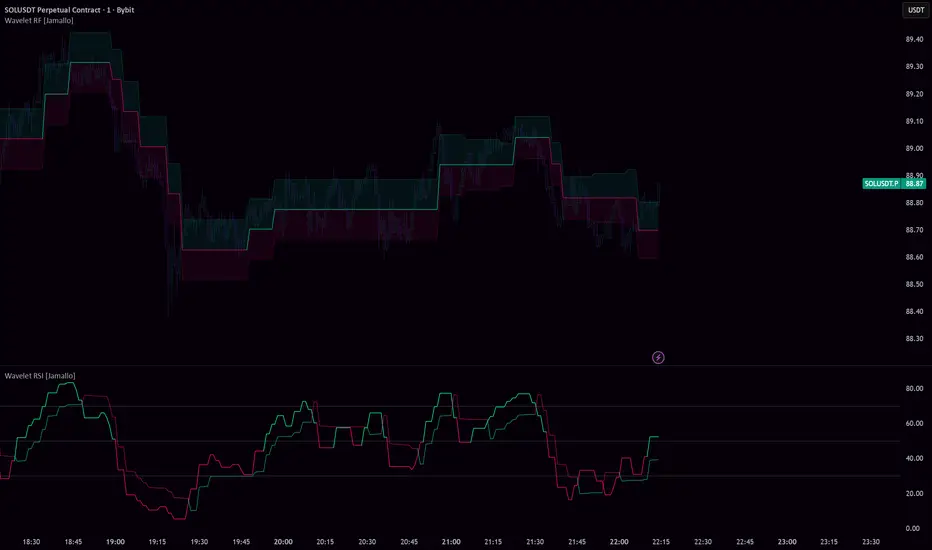
Author's Note
This is the oscillator companion to the Haar Wavelet Range Filter. Both indicators share the same MODWT Haar wavelet foundation, creating a synergistic effect when used together — trend and momentum derived from the same mathematical decomposition of price.
Introduction
The Haar Wavelet RSI is a momentum oscillator that replaces the standard price-difference input of a traditional RSI with wavelet detail coefficients derived from a Maximal Overlap Discrete Wavelet Transform (MODWT) with a Haar basis. Instead of measuring bar-to-bar price change, it measures momentum at a specific frequency scale — filtering out the noise above and below that scale before the RSI calculation even begins.
How It Works
MODWT Haar Wavelet Decomposition
The script decomposes hl2 through up to 5 wavelet levels using a shift-invariant Haar transform. At each level, the detail coefficients capture the local price delta at that specific scale — Level 1 is 2-bar momentum, Level 3 is 8-bar momentum, Level 5 is 32-bar momentum. These detail coefficients become the input to the RSI in place of raw price change, meaning the oscillator is measuring directional energy at a single isolated frequency rather than the full noisy price series.
Wavelet RSI Calculation
The selected detail coefficient is split into its upward and downward components, smoothed with Wilder's RMA, and fed into the standard RSI formula. The math is identical to a conventional RSI — the only difference is what it is measuring. Because the detail coefficients are already frequency-isolated, the resulting RSI is inherently cleaner than applying RSI to raw price.
Adaptive Deadband Step-Hold
The wavelet RSI output is then passed through an adaptive deadband filter. The threshold is self-derived from the RSI's own recent volatility — a short rolling average of absolute RSI changes — scaled by the deadband multiplier. The RSI only updates when it departs from its held value by more than this threshold. Below the threshold it holds flat. This eliminates the continuous micro-oscillation that makes standard RSI difficult to read on noisy bars, producing a stepped line that moves with conviction or not at all.
Closing
This is not a standard RSI with cosmetic changes. The wavelet decomposition fundamentally changes what the oscillator is measuring — momentum at a defined frequency scale rather than raw bar-to-bar noise. The decomposition level is the most important setting: lower levels suit faster timeframes and shorter momentum cycles, higher levels filter more aggressively and are better suited to swing-level momentum reads.
Mã nguồn mở
Theo đúng tinh thần TradingView, tác giả của tập lệnh này đã công bố nó dưới dạng mã nguồn mở, để các nhà giao dịch có thể xem xét và xác minh chức năng. Chúc mừng tác giả! Mặc dù bạn có thể sử dụng miễn phí, hãy nhớ rằng việc công bố lại mã phải tuân theo Nội quy.

No courses, don't sell signals — just my own edge, stats public: jalgo.ca/
Thông báo miễn trừ trách nhiệm
Thông tin và các ấn phẩm này không nhằm mục đích, và không cấu thành, lời khuyên hoặc khuyến nghị về tài chính, đầu tư, giao dịch hay các loại khác do TradingView cung cấp hoặc xác nhận. Đọc thêm tại Điều khoản Sử dụng.
Mã nguồn mở
Theo đúng tinh thần TradingView, tác giả của tập lệnh này đã công bố nó dưới dạng mã nguồn mở, để các nhà giao dịch có thể xem xét và xác minh chức năng. Chúc mừng tác giả! Mặc dù bạn có thể sử dụng miễn phí, hãy nhớ rằng việc công bố lại mã phải tuân theo Nội quy.
Thông báo miễn trừ trách nhiệm
Thông tin và các ấn phẩm này không nhằm mục đích, và không cấu thành, lời khuyên hoặc khuyến nghị về tài chính, đầu tư, giao dịch hay các loại khác do TradingView cung cấp hoặc xác nhận. Đọc thêm tại Điều khoản Sử dụng.