Regime Compass [Markov]
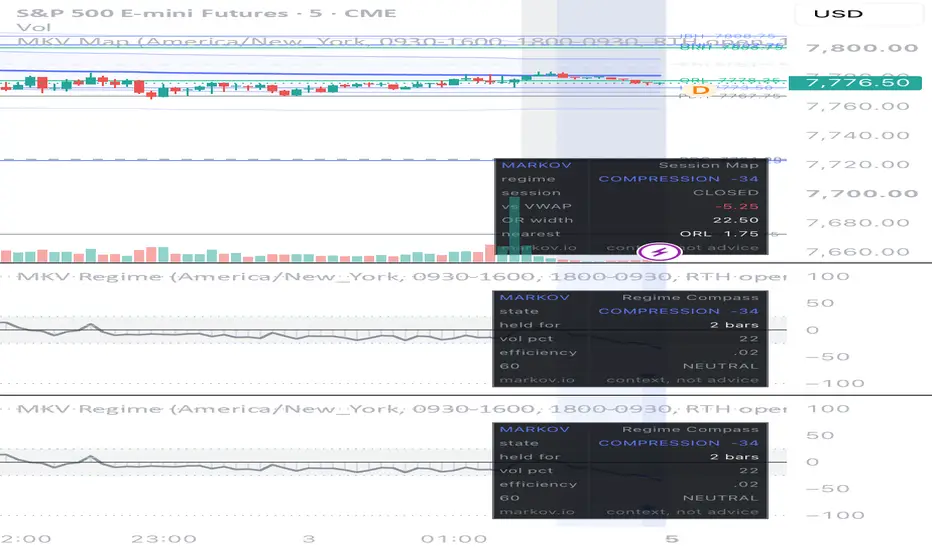
What it does
Answers one question with one number: is this session expanding or pinning?
How it works
Three orthogonal reads of price, each rescaled to the same −100…+100 axis and
blended 40/35/25:
• Volatility percentile — ATR as a share of price, ranked against its own
history, so "high volatility" means high *for this instrument*.
• Efficiency ratio — net travel divided by total path over the lookback
(Kaufman). High means the market is going somewhere; low means it is
working the same area repeatedly.
• Persistence — a variance ratio: the standard deviation of n-bar returns
against √n × the standard deviation of 1-bar returns. Above 1 leans
trending, below 1 leans mean-reverting.
Above the threshold reads EXPANSION, below −threshold reads COMPRESSION.
A higher-timeframe read of the same score is available for confluence.
How to use it
As context, not as a signal. It says what kind of day you are in, not what to
do about it. The Markov strategies gate on this exact value — what you see
here is what they act on.
Settings Session · Regime engine (ATR length, percentile lookback,
efficiency length, persistence length, threshold) · Display · Alerts
Alerts State change; agreement with the higher timeframe.
Notes This is derived from price only. It is an expansion/compression
proxy — it is not dealer gamma and does not measure options positioning.
Context and education, not advice.

Live multi-exchange order book depth, liquidation tracking & derivatives microstructure analytics -> usemarkov.com/
Thông báo miễn trừ trách nhiệm
Thông tin và các ấn phẩm này không nhằm mục đích, và không cấu thành, lời khuyên hoặc khuyến nghị về tài chính, đầu tư, giao dịch hay các loại khác do TradingView cung cấp hoặc xác nhận. Đọc thêm tại Điều khoản Sử dụng.