OPEN-SOURCE SCRIPT
Trend-Aligned Oscillator Reversal Engine
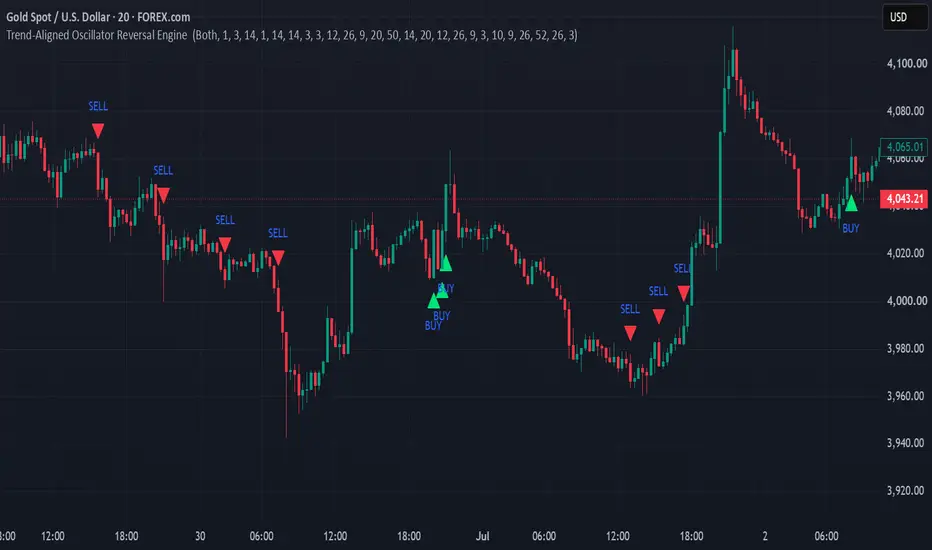
Comprehensive Guide: Trend-Aligned Oscillator Reversal Engine
Introduction: What is this script and its primary purpose?
The "Trend-Aligned Oscillator Reversal Engine" is a highly sophisticated, multi-layered custom indicator written in Pine Script for the TradingView platform. Unlike traditional single-metric indicators that often produce false signals in choppy markets, this script functions as a complete, self-contained trading system.
Its primary purpose is to identify high-probability market reversal points by combining momentum exhaustion with strict trend-following filters. The script aims to solve a common dilemma for traders: getting into a reversal early enough to maximize profit, while ensuring the broader market structure supports the trade. By demanding a "confluence of evidence" from multiple technical sources before issuing a buy or sell signal, it minimizes the risk of catching falling knives or shorting into parabolic uptrends. Furthermore, it includes automated alert conditions, making it seamlessly compatible with external platforms via webhooks, Telegram, or API integrations for automated trading.
Working Mechanism: How does it detect trading signals?
The script generates Buy and Sell signals through a complex, dual-engine architecture combined with a dynamic entry delay system. It operates using three distinct technical phases:
1. The Oscillator Reversal Engine (The Trigger)
This engine acts as the primary signal detector, scanning for moments when the market is overextended and ready to snap back. It aggregates data from four classic momentum oscillators:
RSI (Relative Strength Index): Set to a standard 14-period lookback, it detects extreme price levels. A long signal requires the RSI to cross back above the 30 (oversold) threshold, while a short signal triggers when crossing below 70 (overbought).
Stochastic Oscillator (14, 3, 3):This measures closing prices relative to the high-low range. It looks for bullish %K and %D crossovers below the 20 level and bearish crossunders above the 80 level.
Oscillator MACD (12, 26, 9): Identifies shifts in short-term momentum via the crossover or crossunder of the fast MACD line and the signal smoothing line.
CCI (Commodity Channel Index - 20): Detects when cyclical boundaries are breached, triggering upon crossing the -100 or +100 levels.
Confluence Scoring: Rather than relying on just one metric, the script assigns a score of 1 to 4 based on how many oscillators trigger simultaneously. The user can define the `osci_min_score` (default is 1) required to generate a baseline reversal signal.
2. The Trend Confirmation Engine (The Filter)
If the `use_trend_filter` setting is enabled, a reversal signal is completely blocked unless the broader market trend aligns with the trade direction. This engine evaluates five distinct trend indicators:
EMA (50-period): Assesses if the current price is above or below the baseline moving average.
ADX & DMI (14-period): Ensures there is actual trend strength (ADX > 20) and identifies whether buyers (+DI) or sellers (-DI) are in control.
Trend MACD: Validates medium-term momentum direction relative to the zero line.
Supertrend : Evaluates volatility-based trailing support and resistance bands.
Ichimoku Cloud: Checks if the price is trading above the Kumo Cloud (bullish) or below it (bearish).
Trend Scoring:Similar to the oscillators, it calculates a trend score out of 5. By default, at least 3 out of 5 indicators (`trend_min_score`) must agree to confirm the trend's legitimacy.
3. The Retest State Machine (Entry Optimization)
When a trend shift occurs, the script features an optional "Retest Mode". Instead of entering immediately on a breakout—which often leads to fake-outs—the system waits for the price to retest a specific support/resistance level. This level is calculated dynamically using a 14-period Average True Range (ATR) multiplier. The script will wait for a maximum number of candles (default is 3) for this retest to happen before validating or discarding the setup.
How to Use: Recommended Settings and Suitable Markets
Recommended Configurations:
For Conservative Traders: Increase the `osci_min_score` to 2 or 3. This means at least two or three oscillators (e.g., RSI and MACD) must agree simultaneously, drastically reducing false signals. Always keep `use_trend_filter` set to `true`.
Trade Direction Filter: If you are trading in a confirmed macro bull market (like Bitcoin leading up to a halving), set the `trade_direction` to "Buy Only". This ensures you only catch the dips in a larger uptrend and prevents you from fighting the primary market direction.
Retest Mode Adjustments: In highly volatile conditions, leave "Enable Retest Mode" checked with an ATR multiplier of 1.0 to secure better entry prices. In aggressive breakout markets where pullbacks are rare, you may want to disable this feature so you do not miss fast-moving trades.
Suitable Markets and Timeframes:
Because of its reliance on confluence, trend strength, and ATR volatility, this indicator is highly versatile.
Markets: It performs exceptionally well in the Forex market (e.g., EUR/USD, GBP/JPY) where trends and mean-reversions are clearly defined. It is equally effective in Crypto (BTC, ETH) and Indices (S&P 500, NASDAQ) because the rigorous trend-filtering engine automatically strips out the "noise" and fake-outs typical in high-volatility assets.
Timeframes:The script is optimized for medium to higher timeframes. The 15-minute (15m), 1-hour (1H), and 4-hour (4H) charts are ideal. Using it on lower timeframes (like the 1-minute chart) is not recommended, as micro-market noise can prematurely trigger the oscillators before the macro-trend indicators have time to align.
Introduction: What is this script and its primary purpose?
The "Trend-Aligned Oscillator Reversal Engine" is a highly sophisticated, multi-layered custom indicator written in Pine Script for the TradingView platform. Unlike traditional single-metric indicators that often produce false signals in choppy markets, this script functions as a complete, self-contained trading system.
Its primary purpose is to identify high-probability market reversal points by combining momentum exhaustion with strict trend-following filters. The script aims to solve a common dilemma for traders: getting into a reversal early enough to maximize profit, while ensuring the broader market structure supports the trade. By demanding a "confluence of evidence" from multiple technical sources before issuing a buy or sell signal, it minimizes the risk of catching falling knives or shorting into parabolic uptrends. Furthermore, it includes automated alert conditions, making it seamlessly compatible with external platforms via webhooks, Telegram, or API integrations for automated trading.
Working Mechanism: How does it detect trading signals?
The script generates Buy and Sell signals through a complex, dual-engine architecture combined with a dynamic entry delay system. It operates using three distinct technical phases:
1. The Oscillator Reversal Engine (The Trigger)
This engine acts as the primary signal detector, scanning for moments when the market is overextended and ready to snap back. It aggregates data from four classic momentum oscillators:
RSI (Relative Strength Index): Set to a standard 14-period lookback, it detects extreme price levels. A long signal requires the RSI to cross back above the 30 (oversold) threshold, while a short signal triggers when crossing below 70 (overbought).
Stochastic Oscillator (14, 3, 3):This measures closing prices relative to the high-low range. It looks for bullish %K and %D crossovers below the 20 level and bearish crossunders above the 80 level.
Oscillator MACD (12, 26, 9): Identifies shifts in short-term momentum via the crossover or crossunder of the fast MACD line and the signal smoothing line.
CCI (Commodity Channel Index - 20): Detects when cyclical boundaries are breached, triggering upon crossing the -100 or +100 levels.
Confluence Scoring: Rather than relying on just one metric, the script assigns a score of 1 to 4 based on how many oscillators trigger simultaneously. The user can define the `osci_min_score` (default is 1) required to generate a baseline reversal signal.
2. The Trend Confirmation Engine (The Filter)
If the `use_trend_filter` setting is enabled, a reversal signal is completely blocked unless the broader market trend aligns with the trade direction. This engine evaluates five distinct trend indicators:
EMA (50-period): Assesses if the current price is above or below the baseline moving average.
ADX & DMI (14-period): Ensures there is actual trend strength (ADX > 20) and identifies whether buyers (+DI) or sellers (-DI) are in control.
Trend MACD: Validates medium-term momentum direction relative to the zero line.
Supertrend : Evaluates volatility-based trailing support and resistance bands.
Ichimoku Cloud: Checks if the price is trading above the Kumo Cloud (bullish) or below it (bearish).
Trend Scoring:Similar to the oscillators, it calculates a trend score out of 5. By default, at least 3 out of 5 indicators (`trend_min_score`) must agree to confirm the trend's legitimacy.
3. The Retest State Machine (Entry Optimization)
When a trend shift occurs, the script features an optional "Retest Mode". Instead of entering immediately on a breakout—which often leads to fake-outs—the system waits for the price to retest a specific support/resistance level. This level is calculated dynamically using a 14-period Average True Range (ATR) multiplier. The script will wait for a maximum number of candles (default is 3) for this retest to happen before validating or discarding the setup.
How to Use: Recommended Settings and Suitable Markets
Recommended Configurations:
For Conservative Traders: Increase the `osci_min_score` to 2 or 3. This means at least two or three oscillators (e.g., RSI and MACD) must agree simultaneously, drastically reducing false signals. Always keep `use_trend_filter` set to `true`.
Trade Direction Filter: If you are trading in a confirmed macro bull market (like Bitcoin leading up to a halving), set the `trade_direction` to "Buy Only". This ensures you only catch the dips in a larger uptrend and prevents you from fighting the primary market direction.
Retest Mode Adjustments: In highly volatile conditions, leave "Enable Retest Mode" checked with an ATR multiplier of 1.0 to secure better entry prices. In aggressive breakout markets where pullbacks are rare, you may want to disable this feature so you do not miss fast-moving trades.
Suitable Markets and Timeframes:
Because of its reliance on confluence, trend strength, and ATR volatility, this indicator is highly versatile.
Markets: It performs exceptionally well in the Forex market (e.g., EUR/USD, GBP/JPY) where trends and mean-reversions are clearly defined. It is equally effective in Crypto (BTC, ETH) and Indices (S&P 500, NASDAQ) because the rigorous trend-filtering engine automatically strips out the "noise" and fake-outs typical in high-volatility assets.
Timeframes:The script is optimized for medium to higher timeframes. The 15-minute (15m), 1-hour (1H), and 4-hour (4H) charts are ideal. Using it on lower timeframes (like the 1-minute chart) is not recommended, as micro-market noise can prematurely trigger the oscillators before the macro-trend indicators have time to align.
Mã nguồn mở
Theo đúng tinh thần TradingView, tác giả của tập lệnh này đã công bố nó dưới dạng mã nguồn mở, để các nhà giao dịch có thể xem xét và xác minh chức năng. Chúc mừng tác giả! Mặc dù bạn có thể sử dụng miễn phí, hãy nhớ rằng việc công bố lại mã phải tuân theo Nội quy.

Thông báo miễn trừ trách nhiệm
Thông tin và các ấn phẩm này không nhằm mục đích, và không cấu thành, lời khuyên hoặc khuyến nghị về tài chính, đầu tư, giao dịch hay các loại khác do TradingView cung cấp hoặc xác nhận. Đọc thêm tại Điều khoản Sử dụng.
Mã nguồn mở
Theo đúng tinh thần TradingView, tác giả của tập lệnh này đã công bố nó dưới dạng mã nguồn mở, để các nhà giao dịch có thể xem xét và xác minh chức năng. Chúc mừng tác giả! Mặc dù bạn có thể sử dụng miễn phí, hãy nhớ rằng việc công bố lại mã phải tuân theo Nội quy.
Thông báo miễn trừ trách nhiệm
Thông tin và các ấn phẩm này không nhằm mục đích, và không cấu thành, lời khuyên hoặc khuyến nghị về tài chính, đầu tư, giao dịch hay các loại khác do TradingView cung cấp hoặc xác nhận. Đọc thêm tại Điều khoản Sử dụng.