OPEN-SOURCE SCRIPT
Cập nhật Planetary Retrograde Periods
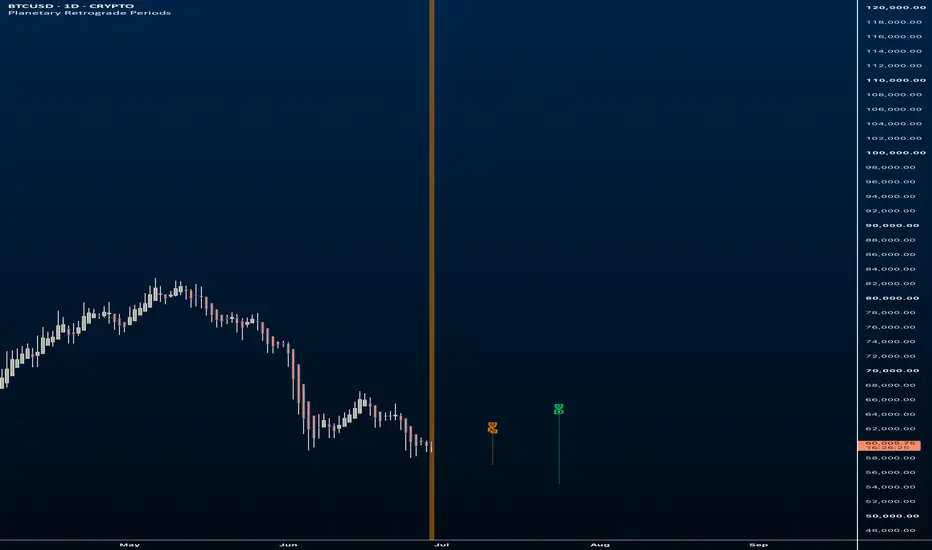
█ PLANETARY RETROGRADE PERIODS
Visualize when planets appear to move backward through the zodiac. This indicator detects and displays retrograde motion for all 8 planets that exhibit apparent retrograde motion from Earth's perspective: Mercury, Venus, Mars, Jupiter, Saturn, Uranus, Neptune, and Pluto.
Powered by the BlueprintResearch lib_ephemeris library.
█ FEATURES
• 8 Planets Supported — Mercury, Venus, Mars, Jupiter, Saturn, Uranus, Neptune, and Pluto
• Two-Phase Visualization — Distinguishes first half (speed increasing in retrograde direction) from second half (speed decreasing toward direct motion) with different transparency levels
• Future Projections — Projects upcoming retrograde periods up to 500 bars ahead on any timeframe
• Station Markers — Clear labels for Station Retrograde (℞), Midpoint (½), and Station Direct (D)
• Timezone-Aware Labels — Future date/time labels display in your selected timezone
• Alert Conditions — Set alerts for station retrograde, station direct, or any station point
• Per-Planet Colors — Customize colors for each planet individually
• Speed-Based Detection — More accurate than longitude-based methods
█ HOW TO USE
1. Select a Planet — Choose which planet to track from the dropdown (Mercury through Pluto)
2. Enable Two-Phase Display — Toggle "Show Retrograde Halves" to see first half vs. second half shading
3. Configure Future Projections — Set how many bars ahead to scan (1-500) and enable/disable date labels
4. Set Your Timezone — Choose your timezone for accurate future date/time display
5. Customize Colors — Adjust planet colors, transparency levels, and label text color to match your chart theme
6. Create Alerts — Use TradingView's alert system with the built-in conditions for station points
█ UNDERSTANDING THE DISPLAY
Background Colors:
• First Half of the Planet’s retrograde (lighter shade)
• Second Half of the Planet’s retrograde period (darker shade)
Future Projection Lines:
• ℞ (Station Retrograde) — Yellow dotted line marking when the planet will station retrograde
• ½ (Midpoint) — Shorter line in planet color marking the halfway point of the retrograde period
• D (Station Direct) — Green dotted line marking when the planet will station direct
Labels:
• Top label shows planet symbol and station type
• Bottom label shows projected date and time (optional)
█ ACCURACY
This indicator uses speed-based detection
Timing Accuracy:
• All planets (Mercury through Pluto): Within hours to ±1 day
• Future projections maintain accuracy up to 500 bars on any timeframe
• Spot tested on Daily and Weekly charts with excellent results
For Critical Applications:
Cross-reference with professional ephemeris tools such as JPL Horizons or Swiss Ephemeris for mission-critical timing.
█ TECHNICAL DETAILS
Theory: VSOP87 (Mercury through Neptune), Meeus algorithms (Pluto)
█ REFERENCES
• Meeus, Jean. "Astronomical Algorithms" (2nd Edition, 1998)
• Bretagnon & Francou. "VSOP87 Solutions" — Astronomy and Astrophysics 202 (1988)
Visualize when planets appear to move backward through the zodiac. This indicator detects and displays retrograde motion for all 8 planets that exhibit apparent retrograde motion from Earth's perspective: Mercury, Venus, Mars, Jupiter, Saturn, Uranus, Neptune, and Pluto.
Powered by the BlueprintResearch lib_ephemeris library.
█ FEATURES
• 8 Planets Supported — Mercury, Venus, Mars, Jupiter, Saturn, Uranus, Neptune, and Pluto
• Two-Phase Visualization — Distinguishes first half (speed increasing in retrograde direction) from second half (speed decreasing toward direct motion) with different transparency levels
• Future Projections — Projects upcoming retrograde periods up to 500 bars ahead on any timeframe
• Station Markers — Clear labels for Station Retrograde (℞), Midpoint (½), and Station Direct (D)
• Timezone-Aware Labels — Future date/time labels display in your selected timezone
• Alert Conditions — Set alerts for station retrograde, station direct, or any station point
• Per-Planet Colors — Customize colors for each planet individually
• Speed-Based Detection — More accurate than longitude-based methods
█ HOW TO USE
1. Select a Planet — Choose which planet to track from the dropdown (Mercury through Pluto)
2. Enable Two-Phase Display — Toggle "Show Retrograde Halves" to see first half vs. second half shading
3. Configure Future Projections — Set how many bars ahead to scan (1-500) and enable/disable date labels
4. Set Your Timezone — Choose your timezone for accurate future date/time display
5. Customize Colors — Adjust planet colors, transparency levels, and label text color to match your chart theme
6. Create Alerts — Use TradingView's alert system with the built-in conditions for station points
█ UNDERSTANDING THE DISPLAY
Background Colors:
• First Half of the Planet’s retrograde (lighter shade)
• Second Half of the Planet’s retrograde period (darker shade)
Future Projection Lines:
• ℞ (Station Retrograde) — Yellow dotted line marking when the planet will station retrograde
• ½ (Midpoint) — Shorter line in planet color marking the halfway point of the retrograde period
• D (Station Direct) — Green dotted line marking when the planet will station direct
Labels:
• Top label shows planet symbol and station type
• Bottom label shows projected date and time (optional)
█ ACCURACY
This indicator uses speed-based detection
Timing Accuracy:
• All planets (Mercury through Pluto): Within hours to ±1 day
• Future projections maintain accuracy up to 500 bars on any timeframe
• Spot tested on Daily and Weekly charts with excellent results
For Critical Applications:
Cross-reference with professional ephemeris tools such as JPL Horizons or Swiss Ephemeris for mission-critical timing.
█ TECHNICAL DETAILS
Theory: VSOP87 (Mercury through Neptune), Meeus algorithms (Pluto)
█ REFERENCES
• Meeus, Jean. "Astronomical Algorithms" (2nd Edition, 1998)
• Bretagnon & Francou. "VSOP87 Solutions" — Astronomy and Astrophysics 202 (1988)
Phát hành các Ghi chú
Bug Fix: Future Projections on Closed Markets Reported by: Hi-Phi
Fixed:
- Future retrograde/direct stations now appear on closed markets (DJI, etc.)
- Removed the barstate.isconfirmed blocking condition
- Implemented array-based marker cleanup for proper refresh
Phát hành các Ghi chú
New: Mercury Storm Detection
- Highlights the slow-speed zone (<40 arcmin/day) before Mercury stations retrograde and
after it stations direct
- Background shading on historical bars with configurable transparency (default 80, lightest
shade)
- Future projection markers: ⚡ (storm entry) and ✧ (storm exit) with shorter dotted lines
- Alert conditions for storm begin/end
- Only activates when Mercury is selected — zero overhead for other planets
Upgraded Library Import
- Migrated from lib_ephemeris/1 + lib_vsop_core/1 to consolidated blueprint_ephemeris_lib/4
- Replaced manual get_planet_enum() switch with eph.string_to_planet()
Bug Fixes
- Fixed future projection labels disappearing on the bar where the event occurs (daily
charts). Changed > time to >= time for all markers: ℞, D, ½, ⚡, ✧
- Fixed midpoint (½) future markers showing when "Show Retrograde Halves" is toggled off
Phát hành các Ghi chú
v2.3.0 — Zodiac Station Signs + Trading-Calendar AccuracyNEW — Zodiac sign at every station. Each ℞/D station shows the geocentric sign it is stationed in, across all history (scale-tested to DJI 1800s). Clean monochrome glyphs; color = direction (℞ vs D). Hover any station for exact degree in the Data Window (absolute + degrees-in-sign); future tooltips show the full "15°23' ♉ Taurus".
IMPROVED — Station timing. Stations now pin to the correct day, fixing a one-bar drift from open-time sampling. History detects at the session close; future projections bisect to the exact crossing. Band and glyphs share one boundary, so they line up.
NEW — Weekend & Holiday Snapping. Future stations on a non-trading day are drawn on the next session (weekends + full US/NYSE holiday calendar incl. Good Friday); the label keeps the true date.
Modes: Auto / Never (24/7 crypto) / Always (stocks). History skips holidays automatically via real bars.
IMPROVED. Date labels default to Exchange timezone (match the bar); marker positions
day-aligned (no rounding to the next bar); upgraded to Blueprint Ephemeris Library v7.
Open source. Cross-reference station timing with external sources across multiple dates to include the late 1800's on DJI.
Mã nguồn mở
Theo đúng tinh thần TradingView, tác giả của tập lệnh này đã công bố nó dưới dạng mã nguồn mở, để các nhà giao dịch có thể xem xét và xác minh chức năng. Chúc mừng tác giả! Mặc dù bạn có thể sử dụng miễn phí, hãy nhớ rằng việc công bố lại mã phải tuân theo Nội quy.

© 2026 Blueprint Research LLC · Hyperfork Matrix™
All indicators and Library MIT
All indicators and Library MIT
Thông báo miễn trừ trách nhiệm
Thông tin và các ấn phẩm này không nhằm mục đích, và không cấu thành, lời khuyên hoặc khuyến nghị về tài chính, đầu tư, giao dịch hay các loại khác do TradingView cung cấp hoặc xác nhận. Đọc thêm tại Điều khoản Sử dụng.
Mã nguồn mở
Theo đúng tinh thần TradingView, tác giả của tập lệnh này đã công bố nó dưới dạng mã nguồn mở, để các nhà giao dịch có thể xem xét và xác minh chức năng. Chúc mừng tác giả! Mặc dù bạn có thể sử dụng miễn phí, hãy nhớ rằng việc công bố lại mã phải tuân theo Nội quy.
© 2026 Blueprint Research LLC · Hyperfork Matrix™
All indicators and Library MIT
All indicators and Library MIT
Thông báo miễn trừ trách nhiệm
Thông tin và các ấn phẩm này không nhằm mục đích, và không cấu thành, lời khuyên hoặc khuyến nghị về tài chính, đầu tư, giao dịch hay các loại khác do TradingView cung cấp hoặc xác nhận. Đọc thêm tại Điều khoản Sử dụng.