H4 candle manipulation model v2.0
Goal
Alert on a setup, not an automatic bot. The indicator says "look at this" — Fabian decides. After every alert he gives feedback (was it right? did it hold? took it or not, and why), and that's how this rulebook gets refined.
The trigger
An H4 candle that sweeps the low (or high) of the previous candle AND closes above the previous CLOSE.
bullish: low < low[1] AND close > close[1]
bearish: high > high[1] AND close < close[1]
Wicks matter less than closes — that's why the close requirement exists instead of just "closed bullish." This is the strictest condition in the whole script.
Sweep depth is adjustable: default 1 candle. If it sweeps 2 or more (David's "strong low"), that earns a grading point.
The gate
H1 and H4 must both point the same direction according to the EMA Ribbon, and the setup has to go that direction too.
EMAs on close: 12, 25, 32, 35, 40, 45, 100, 200 — each can be toggled on/off individually.
above the EMAs → bullish
below → bearish
in between → consolidation
Not "above all of them": at most N EMAs are allowed to sit on the wrong side (default 2) and it still counts as trend. That covers two situations: the 100 and 200 still lagging early in a trend, and the 12 and 25 dipping briefly below during a pullback.
If either timeframe points to consolidation, or they point in opposite directions, nothing gets through.
On top of that, only the ADR check blocks: daily range above 100% of the 20-day average daily range = the day has already run its range.
Grading (score out of 4)
Not a filter, a tool — lets you see at a glance how strong the setup is.
+1 sweep of 2+ candles
+1 closure in the London KZ or NY KZ
+1 manipulation wick lands in an existing FVG (H4 or H1)
+1 there's already an H1 OB or FVG
−1 in NY while London hasn't taken the Asia range yet
A+ from 3, A from 2. Alert threshold is B — so anything that passes the gate triggers a notification.
Wick in FVG
The wick doesn't need to end inside the zone. Sweeping straight through it and closing above is actually the strongest variant. Condition: the wick touches the zone AND the close is back above it (below it, for shorts).
Zones are recorded as soon as they form. The check looks at the state as of the previous bar, so an FVG formed by the manipulation candle itself doesn't count — it didn't exist yet at the moment of the sweep.
Order Block
The candle(s) right before the impulsive move.
only bodies count (open→close), not wicks
there can be several: if the bodies are small, they get merged into one zone (up to 4 candles)
the grouping stops as soon as a large body in the direction of the impulse appears — at that point you're already in the previous move
only valid after the manipulation: OBs are only searched for while a setup is active
Entry, SL and TP
The alert fires at the H4 close. It doesn't wait for an OB or FVG — those are just for grading.
Entry the close of the manipulation candle
SL the low (long) or high (short) of that candle
TP H4 liquidity if it's ≥1R away, otherwise 1.5R
If an OB or FVG shows up during the running setup, it gets drawn as a dotted line on the chart — a sharper price if you want it.
Fabian decides discretionarily: enter immediately on the candle close, or wait for price to come back into the FVG.
Validity window — 2.5 hours
The reasoning behind the entry: the manipulation candle is strong, so the next H4 candle should be the distribution/expansion candle. You want to be in early on that candle, to catch the wick of the expansion.
Usually that's within the first hour, sometimes still in the second. After that the setup expires: the script stops drawing zones. Waiting hours for a retest doesn't make sense — the assumption was precisely that the next candle would expand.
Sessions (New York time)
Session Window Role
Asia 19:00–00:00 range only
London KZ 02:00–05:00 grading point
New York KZ 07:00–10:00 grading point
London Close KZ 10:00–12:00 no point
On the chart
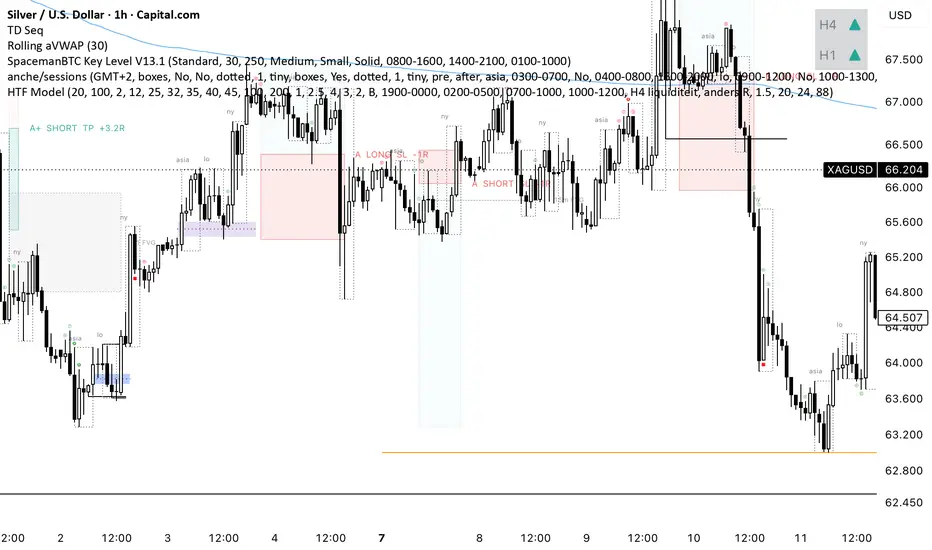
Three lines on a signal — entry, SL, TP — with the price level behind each, and the grade for the entry. Nothing else.
Panel top-right: H4 and H1 as an arrow. ▲ green bullish, ▼ red bearish, — gray consolidation. If they point the same way, the gate is open.
Alerts
Uses alert(), so when creating it choose "Any alert() function call." One alert per symbol.
Contains: direction, grade, entry price, stop, session, sweep depth, ADR%, and score.
Deliberately NOT in the indicator
This stays manual work:
Daily and weekly bias — gave too few signals, Fabian does this discretionarily
DXY — he tracks it himself
Daily/weekly/monthly high-low levels (A6) — he tracks these himself
News and economic calendar — his own pre-week analysis
Risk management, position sizing, trade management
Limitations
Everything works off closed candles. Nothing changes retroactively. Costs some signals, but the backtest doesn't lie.
The H1 EMA 200 needs history — on a short chart the beginning can be empty.
H4 candles don't align to the same clock across every instrument (crypto UTC, forex/futures per exchange). Not yet checked across the full asset list.
DXY has its own trading hours, so the Asia range falls differently there than on spot forex.
Open items
Script not yet compiled in TradingView
Asia range filled in as 19:00–00:00 NY; Fabian's notes mention 01:00–10:00 NL (Dutch time)
ADR threshold 100%, liquidity lookback 20 H4 candles, entry at zone midpoint: all starting values
Calibrate the A+/A boundary against the Rating column from the Notion log
Separate indices indicator (US500/NQ100 on 1m/3m/5m) still to do

Thông báo miễn trừ trách nhiệm
Thông tin và các ấn phẩm này không nhằm mục đích, và không cấu thành, lời khuyên hoặc khuyến nghị về tài chính, đầu tư, giao dịch hay các loại khác do TradingView cung cấp hoặc xác nhận. Đọc thêm tại Điều khoản Sử dụng.
Thông báo miễn trừ trách nhiệm
Thông tin và các ấn phẩm này không nhằm mục đích, và không cấu thành, lời khuyên hoặc khuyến nghị về tài chính, đầu tư, giao dịch hay các loại khác do TradingView cung cấp hoặc xác nhận. Đọc thêm tại Điều khoản Sử dụng.