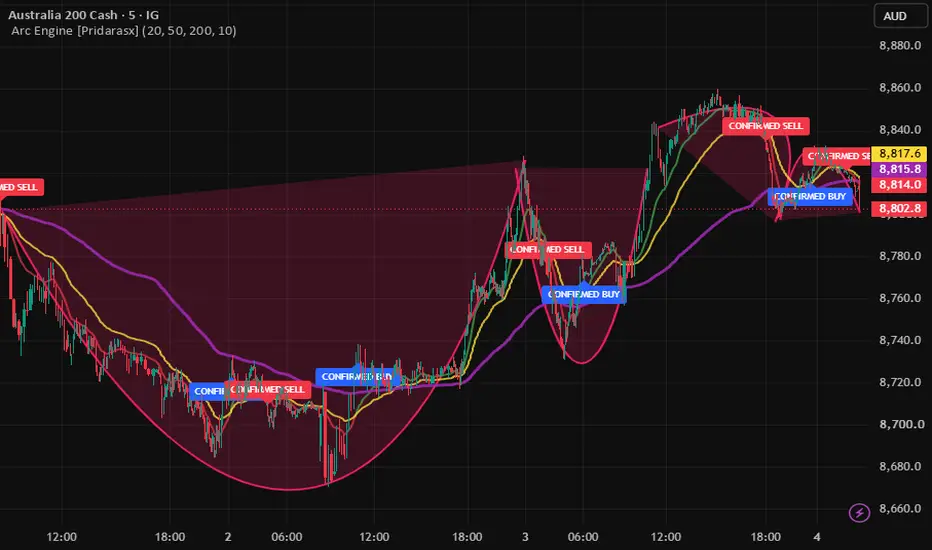
SBP Structured Trend Indicator# SBP Structured Trend Indicator
## Overview
SBP Structured Trend Indicator is a trend-following decision support tool designed to evaluate market structure through multiple layers of confirmation instead of relying on a single technical indicator.
Rather than generating signals from one moving average crossover or momentum oscillator, the indicator evaluates the agreement between several independent market characteristics before identifying a potential trading opportunity. The objective is to reduce low-quality signals while remaining responsive to changing market conditions.
The indicator automatically adapts its internal parameters for Scalping, Intraday and Swing trading modes so that the same methodology can be applied across different trading styles.
---
## Methodology
The indicator combines several analytical engines, each measuring a different aspect of market behaviour.
### 1. Structured Trend Engine
The primary trend is determined from a smoothed directional filter that measures both trend direction and trend slope. This establishes the dominant market bias before any trading signals are evaluated.
---
### 2. Adaptive Trend Smoothing
An adaptive moving average is used to smooth price movement while reducing lag during directional trends. The slope of this adaptive average is used as an additional confirmation of market direction instead of relying solely on price crossing a moving average.
---
### 3. Trend Consensus Engine
A fast and slow exponential average are evaluated together to estimate trend agreement. Rather than treating a crossover as a signal by itself, the distance between the averages is used to estimate trend strength.
This helps distinguish established trends from weak directional movement.
---
### 4. Volatility Assessment
Current market volatility is compared with its recent average using the Average True Range (ATR).
This allows the indicator to distinguish between expanding and contracting market conditions so that stronger trends receive greater confidence than periods of low activity.
---
### 5. Momentum Evaluation
Momentum is measured using the rate of price change together with recent candle direction.
Momentum confirmation is evaluated alongside the prevailing trend rather than acting as an independent entry trigger.
---
### 6. Trend Confidence Score
A confidence score is calculated from several independent observations, including:
• Momentum strength
• Trend persistence
• Trend strength
• Relative trading volume
The resulting confidence score allows traders to select Aggressive, Balanced or Conservative filtering depending on their preferred trading style.
---
### 7. Position State Logic
The indicator tracks the current directional state to avoid repeatedly issuing identical signals during the same market move.
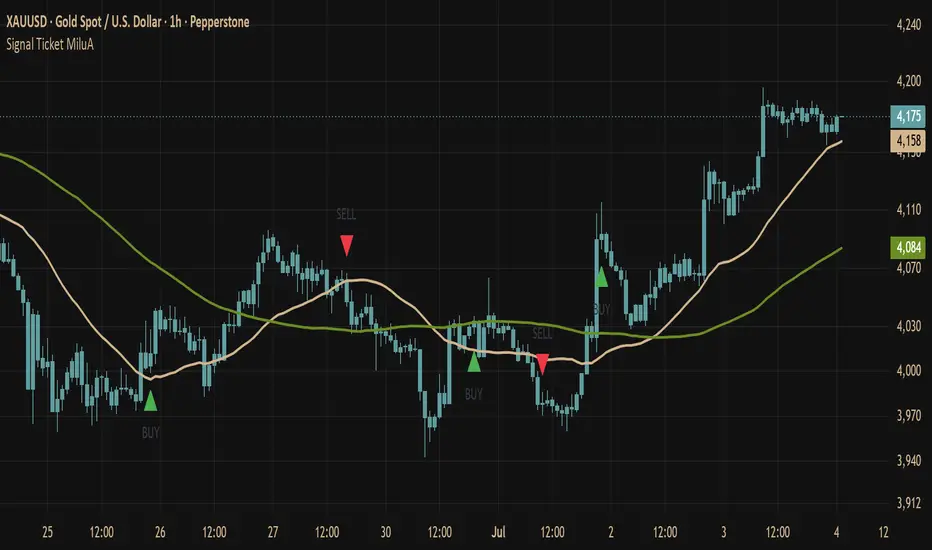
A new Buy signal is generated only after market conditions support a new bullish transition, while Sell signals follow the same principle for bearish conditions.
This design aims to reduce repetitive alerts during sustained trends.
---
## Trading Modes
### Scalping
Uses shorter internal lookback periods to respond more quickly to short-term price movement.
### Intraday
Balances responsiveness and stability for session-based trading.
### Swing
Uses longer adaptive calculations intended to identify broader market trends while filtering short-term fluctuations.
---
## Dashboard
The optional dashboard summarizes the current analytical state, including:
• Selected trading mode
• Current trend direction
• Market regime
• Trend confidence score
• Latest signal status
The dashboard is intended as a quick reference and should not replace chart analysis.
---
## Suggested Usage
The indicator is designed to be used alongside price action, support and resistance, market structure and prudent risk management.
It is not intended to predict future prices or guarantee profitable trades. Instead, it provides a structured framework for evaluating trend quality and identifying higher-confidence trading opportunities.
As with any analytical tool, users should evaluate signals within the broader market context and test the indicator on instruments and timeframes appropriate to their trading approach.
Chỉ báo