Search in ideas for "range trading"
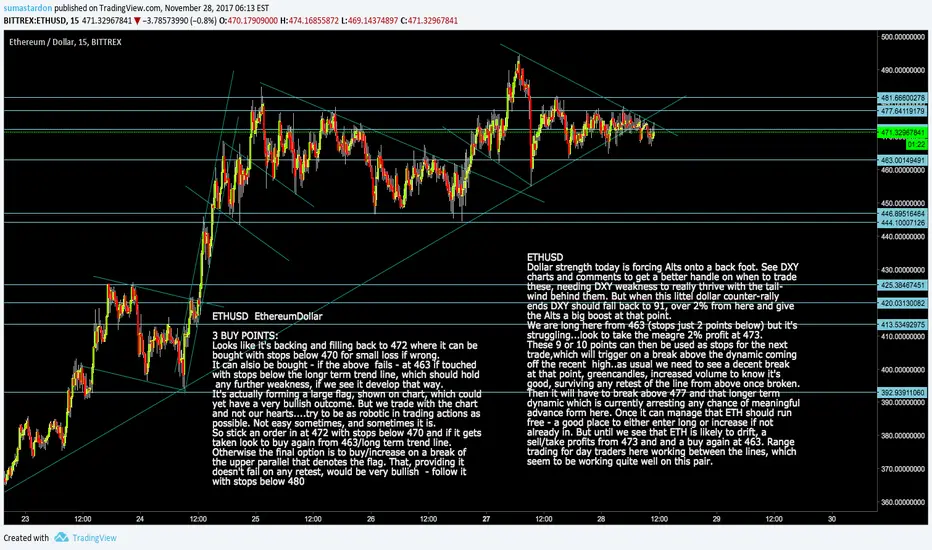
ETHUSD Range trading whilst DXY ralliesETHUSD Range trading whilst DXY rallies
Dollar strength today is forcing Alts onto a back foot. See DXY
charts and comments to get a better handle on when to trade
these, needing DXY weakness to really thrive with the tail-
wind behind them. But when this littel dollar counter-rally
ends DXY should fall back to 91, over 2% from here and give
the Alts a big boost at that point.
We are long here from 463 (stops just 2 points below) but it's
struggling...look to take the meagre 2% profit at 473.
These 9 or 10 points can then be used as stops for the next
trade,which will trigger on a break above the dynamic coming
off the recent high..as usual we need to see a decent break
at that point, greencandles, increased volume to know it's
good, surviving any retest of the line from above once broken.
Then it will have to break above 477 and that longer term
dynamic which is currently arresting any chance of meaningful
advance form here. Once it can manage that ETH should run
free - a good place to either enter long or increase if not
already in. But until we see that ETH is likely to drift, a
sell/take profits from 473 and and a buy again at 463. Range
trading for day traders here working between the lines, which
seem to be working quite well on this pair.
Range TradingMost popular forex Expert advisers are built on this concept of range trading. The basic idea is that with a small enough lot size and a large enough account you can withstand any bull or bear run for some currency pairs.
The forex market as we know doesn't move in straight lines. There are usually periods of retracements and corrections even within a strong trend.
Some traders even use EAs that use the martingale strategy. The principle is that with a martingale multiplier on new trade layers, any little retracement would cause the trade to be closed in good profit.
The major disadvantage of this trading style, however, is the high drawdown that is possible in a strong trend and possible blow-up of trading account in a really strong trend. A black swan event would most likely blow up any EA trading against the trend. One way to avoid this is to use equity stop. There are also indicators that can turn off EAs some hours before major news. They could also come in handy.
NB:
Most martingale EA would blow up your trading account eventually. Always ensure to take profit and do not invest more than you can afford to lose.
#NFA
#RiskManagement
Range tradingSome Pairs are a bit more suited for range trading. In my opinion, EURUSD could be one of such. I think the idea is to use a small enough lot size on a large enough account. Positions should be opened in Layers. Buy at the bottom, sell at the top, repeat again and again until the range is broken.
I think if you're on the wrong side of the trade during a breakout, a respectful thing to do would be to cut your loss and exit the trade.
#SpeculativeSetup
#NFA
#RiskManagement
Range TradingSome Pairs are a bit more suited for range trading. In my opinion, EURNZD could be one of such. I think the idea is to use a small enough lot size on a large enough account. Positions should be opened in Layers. Buy at the bottom, sell at the top, repeat again and again until the range is broken.
#SpeculativeSetup
#NFA
#RiskManagement
Range TradingSome Pairs are a bit more suited for range trading. In my opinion, CHFJPY could be one of such. I think the idea is to use a small enough lot size on a large enough account. Positions should be opened in Layers. Buy at the bottom, sell at the top, repeat again and again until the range is broken.
#SpeculativeSetup
#NFA
#RiskManagement
Range Trading Without GuessingRanges are one of the most common market conditions, yet many traders struggle to trade them correctly. The difficulty usually comes from trying to predict direction instead of understanding how price behaves inside a balanced environment.
A range forms when buyers and sellers reach temporary equilibrium. Neither side has enough strength to push price into sustained expansion. Instead, the market rotates between two boundaries where liquidity accumulates.
These boundaries are the range high and the range low.
Liquidity tends to build above the high and below the low because traders place breakout orders and stop losses in these areas. As price approaches these zones, participation increases and the market is forced to make a decision.
Inside the range, however, direction is uncertain.
This is where many traders begin guessing. They try to predict whether price will break up or break down from the middle of the range. In reality, the middle of the range rarely provides meaningful information.
Professional traders approach ranges differently.
Instead of predicting the breakout, they focus on behavior at the boundaries.
When price approaches the range high, two outcomes are possible. The market may reject the level and rotate back toward the opposite side of the range. Alternatively, price may show acceptance above the level, signaling the beginning of expansion.
The same logic applies at the range low. Rejection leads to rotation back toward the high. Acceptance below the level can trigger continuation downward.
The key is to wait for confirmation at the boundary rather than guessing direction in advance.
This approach provides several advantages.
First, entries occur near meaningful levels, which allows stops to be placed closer to invalidation. Risk becomes smaller relative to the potential movement across the range.
Second, decision-making becomes clearer. Instead of constantly searching for signals in the middle of the chart, the trader simply waits for price to reach locations where behavior matters.
Third, it aligns with how liquidity actually functions. The market seeks orders, and orders tend to accumulate at obvious levels.
Range trading is therefore not about predicting where price will go next. It is about recognizing when price has reached a location where reaction or acceptance must occur.
When traders stop guessing direction and start observing behavior at range boundaries, range environments become significantly easier to navigate.
In many cases, the most disciplined approach is simple:
wait for the edges, observe the reaction, and only then decide whether participation makes sense.
Range trading
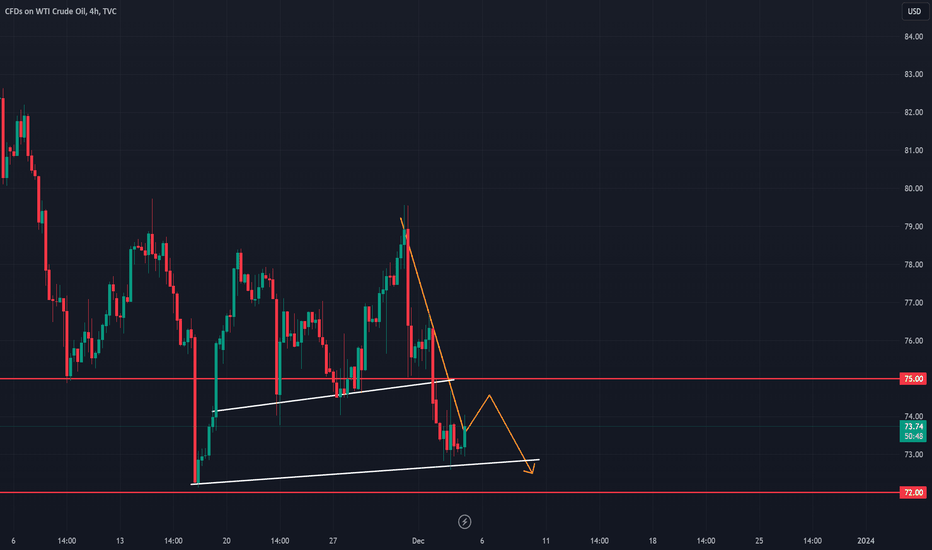
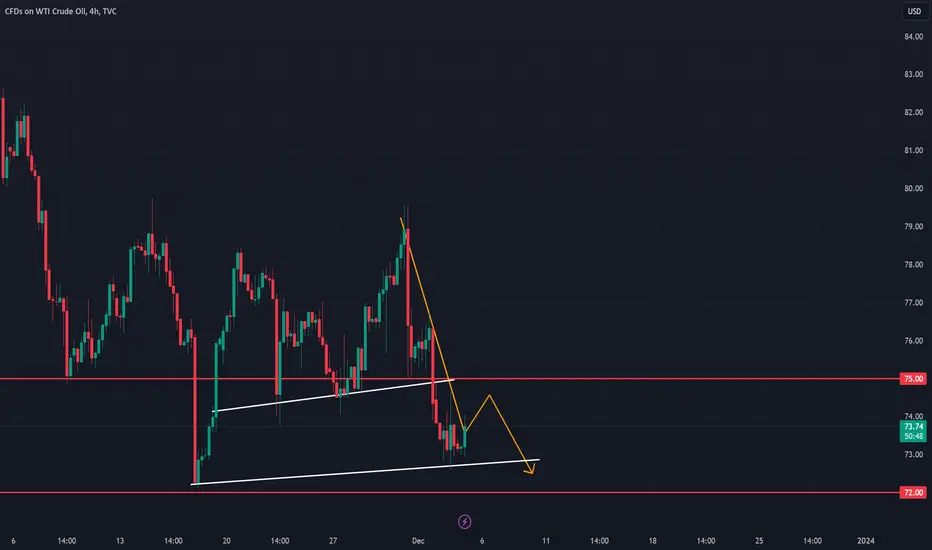
The market's reaction to OPEC+'s announcement of voluntary production cuts was a further decline in oil prices. According to reports, investors were pessimistic about crude oil ahead of the OPEC+ meeting and had already priced in their expectations that production cuts would not be enough to push oil prices higher.
The market's economic recession and investors' disappointed attitude towards crude oil have caused oil prices to continue to fall despite production cuts.
At present, crude oil pays attention to the resistance level of 75 and the support level of 72. The current market situation is still range trading and there will be no one-sided situation.
Range trading with Bearish BIAS : USDJPY In USDJPY we can see small range trading inside flat channel , as price action in daily chart is bullish with potential of retracement towards previous resistance turned support , for now we take bearish bias on pair unless it breaks above channel top ,
Sell on rise , with SL above previous highs , or sell if price closes below channel with stop above lower range of channel.
Follow us for more..
Range trading unless breakout : AUDUSD Acending channel pattern in 4hr ,
range trading suggested inside channel , with potential of bearish break below channel.
Further selling pressure to increase on price leaving ascending channel pattern... Our view remains bearish on this pair unless price is making new high on daily chart.
Follow us for more..