
How Much Risk Per Trade? Less Than You Think. With One Exception
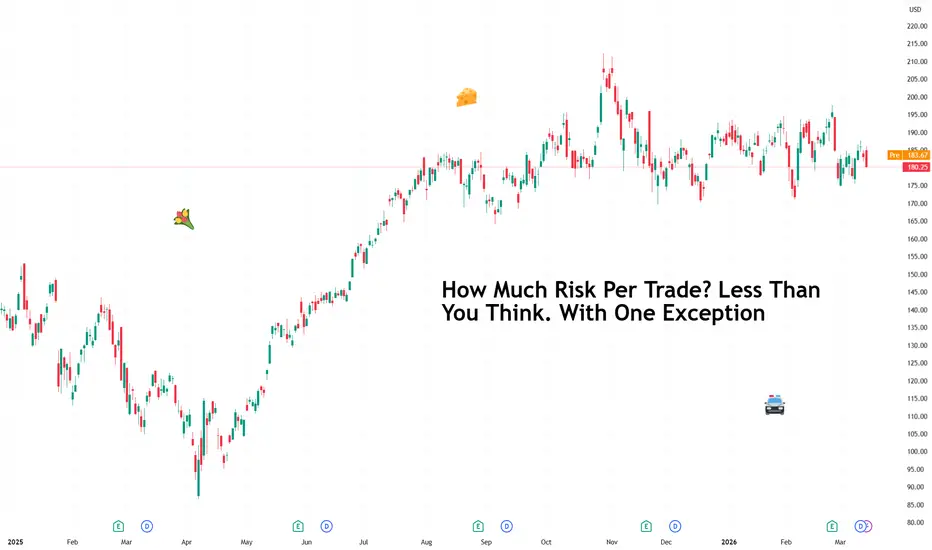
Picture this: third week of trading. You've done the reading, watched the tutorials, and found a setup that looks absolutely bulletproof.
Your gut tells you to buy. So you go in big. The trade reverses, takes 40% of your account with it, and leaves you staring at a red screen wondering where it all went wrong. Sounds familiar, silver traders from earlier this year?
🎯 The Number Most Beginners Ignore
Professional traders obsess over risk per trade. Beginners obsess over entries and dreamed-up profits. That gap in priorities explains a lot of blown accounts.
The standard rule, used by traders who keep things tight, is to risk no more than 1% to 2% of total capital on any single trade. On a $10,000 account, that's $100 to $200 per trade. It sounds modest. And that's the point.
The 1% rule keeps you alive long enough to get good (or lucky). A trader risking 1% per trade can lose twenty consecutive trades and still have most of their capital intact.
A trader risking 20% per trade on that same streak is essentially finished. The math is uncomfortable, but it is consistent.
📐 How to Calculate It
Risk per trade is the distance between your entry and your stop loss, multiplied by the number of units you hold. Work backwards from your maximum acceptable loss to determine how large a position to take.
Say you're buying a stock at $50 with a stop at $47. Your risk per share is $3. On a $10,000 account with a 1% risk limit, your maximum loss is $100.
Divide $100 by $3 and you get roughly 33 shares. That's your position size. The numbers give you the answer. Your gut does not get a vote.
Apart from thousand of stocks, you can apply that strategy to virtually any trading instrument out there, including currency crosses, and the volatile crypto assets.
🧘 Why Small Risk Feels Wrong at First
New traders resist this framework because small positions feel pointless. If you're only risking $200 into a trade, what's the upside worth getting excited about?
More than you expect, over time (especially if there’s leverage involved, which is most cases). Trading is a game of repetition and compounding.
A strategy with a solid edge, applied consistently at sensible position sizes, builds capital steadily. A strategy applied at reckless sizes might win big once, then erase everything on the following loss. One of those paths leads somewhere useful.
Small risk also does something underrated: it keeps your psychology intact. When you risk 20% of your account, every tick against you becomes a physical experience.
Judgement deteriorates. You close too early, hold too long, or freeze entirely. Risk 1% and the trade becomes almost academic and routine. You follow the plan because the plan is what you're managing, not the outcome.
⚡ The Exception: When Everything Lines Up
Here is where the rulebook earns a torn page, applied carefully and with full awareness.
Occasionally a trade arrives that is the convergence of everything. The technical setup is clean and unambiguous. The fundamentals support the direction. Market sentiment is moving in agreement.
Price action, story, and crowd psychology all pointing at the same target simultaneously. These moments are rare. When they arrive, sizing up is an appropriate response to a genuinely higher-probability opportunity. Call it a one-way bet, or an asymmetric bet, it happens sometimes.
Stretching to 3% or 5% of capital in these situations is a legitimate, considered decision. The most seasoned traders in the world reserve their largest positions for exactly these setups, keeping the rest of their book tight while concentrating firepower on the high-conviction, high-impact ideas.
The distinction worth burning into memory: conviction earned versus conviction felt. Conviction earned means the chart structure is there, the macro backdrop supports the trade, and the market is already moving in agreement.
Conviction felt means you really like the story and the stock or the currency cross went up last week. One of those justifies a larger bet. The other justifies the standard 1%.
📌 The Rule, Restated
Risk 1% to 2% per trade as your baseline. Treat it as the default, with room to stretch on the rare occasions when technicals, fundamentals, and market sentiment converge into a single coherent argument. When all three agree, listen and size accordingly.
The rest of the time, stay small, stay consistent, and let the edge do the work.
Off to you: What’s your risk per trade? Share your strategy in the comments!
Your gut tells you to buy. So you go in big. The trade reverses, takes 40% of your account with it, and leaves you staring at a red screen wondering where it all went wrong. Sounds familiar, silver traders from earlier this year?
🎯 The Number Most Beginners Ignore
Professional traders obsess over risk per trade. Beginners obsess over entries and dreamed-up profits. That gap in priorities explains a lot of blown accounts.
The standard rule, used by traders who keep things tight, is to risk no more than 1% to 2% of total capital on any single trade. On a $10,000 account, that's $100 to $200 per trade. It sounds modest. And that's the point.
The 1% rule keeps you alive long enough to get good (or lucky). A trader risking 1% per trade can lose twenty consecutive trades and still have most of their capital intact.
A trader risking 20% per trade on that same streak is essentially finished. The math is uncomfortable, but it is consistent.
📐 How to Calculate It
Risk per trade is the distance between your entry and your stop loss, multiplied by the number of units you hold. Work backwards from your maximum acceptable loss to determine how large a position to take.
Say you're buying a stock at $50 with a stop at $47. Your risk per share is $3. On a $10,000 account with a 1% risk limit, your maximum loss is $100.
Divide $100 by $3 and you get roughly 33 shares. That's your position size. The numbers give you the answer. Your gut does not get a vote.
Apart from thousand of stocks, you can apply that strategy to virtually any trading instrument out there, including currency crosses, and the volatile crypto assets.
🧘 Why Small Risk Feels Wrong at First
New traders resist this framework because small positions feel pointless. If you're only risking $200 into a trade, what's the upside worth getting excited about?
More than you expect, over time (especially if there’s leverage involved, which is most cases). Trading is a game of repetition and compounding.
A strategy with a solid edge, applied consistently at sensible position sizes, builds capital steadily. A strategy applied at reckless sizes might win big once, then erase everything on the following loss. One of those paths leads somewhere useful.
Small risk also does something underrated: it keeps your psychology intact. When you risk 20% of your account, every tick against you becomes a physical experience.
Judgement deteriorates. You close too early, hold too long, or freeze entirely. Risk 1% and the trade becomes almost academic and routine. You follow the plan because the plan is what you're managing, not the outcome.
⚡ The Exception: When Everything Lines Up
Here is where the rulebook earns a torn page, applied carefully and with full awareness.
Occasionally a trade arrives that is the convergence of everything. The technical setup is clean and unambiguous. The fundamentals support the direction. Market sentiment is moving in agreement.
Price action, story, and crowd psychology all pointing at the same target simultaneously. These moments are rare. When they arrive, sizing up is an appropriate response to a genuinely higher-probability opportunity. Call it a one-way bet, or an asymmetric bet, it happens sometimes.
Stretching to 3% or 5% of capital in these situations is a legitimate, considered decision. The most seasoned traders in the world reserve their largest positions for exactly these setups, keeping the rest of their book tight while concentrating firepower on the high-conviction, high-impact ideas.
The distinction worth burning into memory: conviction earned versus conviction felt. Conviction earned means the chart structure is there, the macro backdrop supports the trade, and the market is already moving in agreement.
Conviction felt means you really like the story and the stock or the currency cross went up last week. One of those justifies a larger bet. The other justifies the standard 1%.
📌 The Rule, Restated
Risk 1% to 2% per trade as your baseline. Treat it as the default, with room to stretch on the rare occasions when technicals, fundamentals, and market sentiment converge into a single coherent argument. When all three agree, listen and size accordingly.
The rest of the time, stay small, stay consistent, and let the edge do the work.
Off to you: What’s your risk per trade? Share your strategy in the comments!

Share TradingView with a friend:
tradingview.com/share-your-love/
Check out all #tradingviewtips
tradingview.com/ideas/tradingviewtips/?type=education
New Tools and Features:
tradingview.com/blog/en/
tradingview.com/share-your-love/
Check out all #tradingviewtips
tradingview.com/ideas/tradingviewtips/?type=education
New Tools and Features:
tradingview.com/blog/en/
منشورات ذات صلة
إخلاء المسؤولية
لا يُقصد بالمعلومات والمنشورات أن تكون، أو تشكل، أي نصيحة مالية أو استثمارية أو تجارية أو أنواع أخرى من النصائح أو التوصيات المقدمة أو المعتمدة من TradingView. اقرأ المزيد في شروط الاستخدام.
Share TradingView with a friend:
tradingview.com/share-your-love/
Check out all #tradingviewtips
tradingview.com/ideas/tradingviewtips/?type=education
New Tools and Features:
tradingview.com/blog/en/
tradingview.com/share-your-love/
Check out all #tradingviewtips
tradingview.com/ideas/tradingviewtips/?type=education
New Tools and Features:
tradingview.com/blog/en/
منشورات ذات صلة
إخلاء المسؤولية
لا يُقصد بالمعلومات والمنشورات أن تكون، أو تشكل، أي نصيحة مالية أو استثمارية أو تجارية أو أنواع أخرى من النصائح أو التوصيات المقدمة أو المعتمدة من TradingView. اقرأ المزيد في شروط الاستخدام.