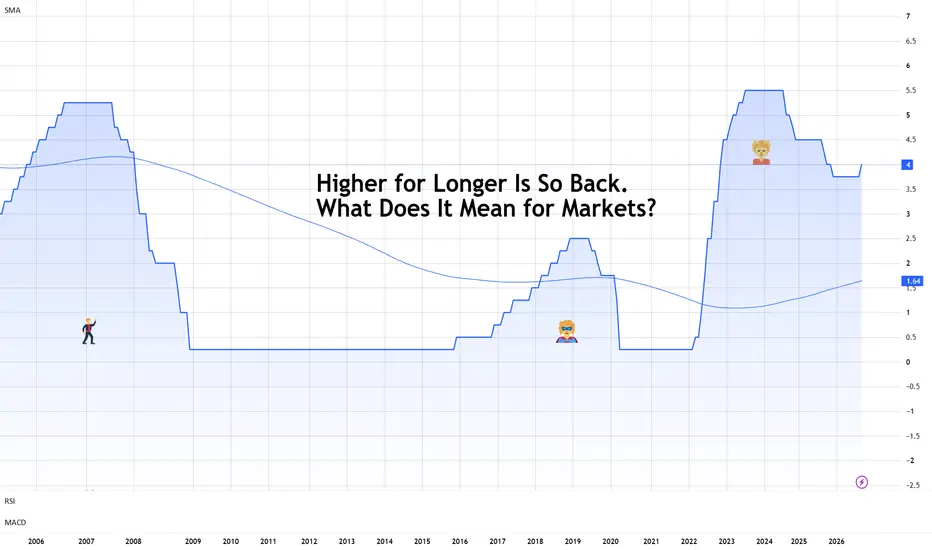
The Fed hiked. That wasn't the surprise.
For the first time in more than three years, the Federal Reserve has raised interest rates USINTR .
The Fed lifted its benchmark rate by 25 basis points Wednesday to 3.75%-4.00%, a move markets had overwhelmingly expected.
The bigger message arrived alongside it: policymakers aren't treating this as a quick adjustment before returning to lower rates. They think borrowing costs may need to stay higher for longer.
Sixteen of 18 policymakers expect at least one more hike before the end of 2026, while the median projection puts the federal funds rate at 4.1% at the end of both 2026 and 2027. In other words, the Fed's current base case contains no rate cuts next year.
Higher for longer is so back.
📈 Why Isn't the Fed Finished?
The problem is that the US economy isn't behaving like one that desperately needs cheaper money.
August payrollsUSNFP rose by 162,000, unemployment remains at 4.1% and retail sales jumped 1.2% in August, comfortably beating expectations. Core retail sales were even stronger at 1.4%.
Meanwhile, import prices increased 7% from a year earlier and elevated energy costs continue feeding inflation concerns. Keep an eye on the Economic Calendar so you won’t be caught off guard by a surprise data release.
Now the Fed faces an unusual combination: stubborn inflationUSCPI alongside surprisingly resilient economic growth.
Normally, higher rates eventually cool borrowing, spending and hiring. But if households keep shopping, companies keep investing and employment remains solid, policymakers have less reason to rush toward easier monetary policy.
Chair Kevin Warsh also argued that economic strength and enormous capital investment, particularly from technology companies, are helping push bond yields higher. The economy, so far, is refusing to take the hint.
💵 Higher Rates Make Cash Expensive Again
Why should equity traders care whether the Fed funds rate is 3%, 4% or 5%? Because interest rates effectively influence the price of money.
When rates rise, companies generally face higher borrowing costs. Mortgages and other consumer loans become more expensive. Investors can earn more from relatively safe government debt.
And future corporate profits are discounted at a higher rate when analysts calculate what they're worth today. That last part is especially true for expensive growth stocks.
Imagine a company expected to generate most of its profits many years from now.
Higher discount rates make those distant earnings worth less in today's money, which helps explain why richly valued technology stocks can become particularly sensitive to changes in Treasury yields.
A brilliant company doesn't automatically become a brilliant stock at every interest rate.
📊 It’s the Bonds We Make Along the Way
Higher for longer also changes the choice investors make between asset classes.
When Treasury yields are low, investors searching for returns have stronger incentives to venture into stocks, corporate bonds and other riskier assets. When government bonds offer attractive yields, that calculation changes.
Why accept significant equity risk if a Treasury can suddenly pay you considerably more?
That's sometimes called the TINA trade disappearing. When rates were near zero, investors joked that “There Is No Alternative” to stocks.
Higher yields mean there very much is. Check the Yield Curves tool to stay up to date.
That doesn't mean equities must fall whenever rates rise. Strong economic growth can simultaneously support corporate earnings.
It does mean stocks face a higher hurdle: profits need to grow sufficiently quickly to justify their valuations against increasingly attractive alternatives.
💻 Not Every Stock Feels It Equally
This is where the story becomes more useful than simply declaring higher rates “bad for stocks.”
Banks can sometimes benefit from higher interest rates because the spread between what they earn on loans and pay on deposits can improve, although the relationship depends heavily on the yield curve and credit conditions.
Highly leveraged companies face the opposite problem. Debt eventually needs refinancing, and replacing cheap borrowing with considerably more expensive borrowing can eat directly into profits.
💲 The Dollar Gets a Yield Advantage
Currencies have their own version of the story. Higher US rates can make dollar-denominated assets more attractive to global investors, increasing demand for dollars.
That helps explain why the greenback strengthened after Wednesday's decision. However, the important word is relative.
 EURUSD doesn't care only about what the Fed is doing. It cares about how US monetary policy compares with the ECB.
  USDJPY reflects the gap between US and Japanese rates.
  GBPUSD responds partly to the relationship between Fed and Bank of England policy.
Currency traders are constantly comparing one currency with another and their respective yields. A hawkish Fed matters most when everyone else is less hawkish.
🥇 Gold Has an Opportunity-Cost Problem
Gold XAUUSD demonstrated the mechanism almost immediately.
Spot gold dropped more than 1% after the Fed decision, falling toward $4,240 an ounce after trading above $4,365 earlier in the session. The dollar strengthened at the same time. Gold doesn't pay interest.
So when yields rise, holding bullion means giving up more potential income from interest-bearing assets. A stronger dollar can add another headwind because gold becomes more expensive for buyers using other currencies.
Yet the relationship isn't only mechanical. Persistent inflation, geopolitical uncertainty and concerns about currencies or government debt can still create demand for gold even when rates are high.
₿ Bitcoin Gets Its Own Stress Test
Crypto faces a similar, although considerably messier, calculation.
Easy monetary conditions historically encouraged investors to venture further along the risk curve. When cash paid almost nothing, speculative assets had plenty of room to attract capital.
Higher rates increase the return available elsewhere and can tighten financial conditions, potentially reducing some of that appetite.
But Bitcoin BTCUSD isn't simply a high-beta technology stock anymore. Its short-term correlation with equities and the dollar has weakened considerably at times this year, meaning crypto-specific flows, regulation (honorable mention: the Clarity Act setback) and institutional adoption can overwhelm the traditional macro relationship.
Higher for longer is therefore a headwind worth watching, not a guaranteed Bitcoin sell signal.
👀 What Does Higher for Longer Mean?
Perhaps the most important point is that the dot plot isn't a promise. Fed projections change when the economy changes. A sharp deterioration in employment, faster-than-expected disinflation or a serious slowdown in growth could completely rewrite today's rate path.
The opposite is also true. If inflation stays stubborn while employment and consumer spending remain strong, the market may eventually have to contemplate something even less comfortable than higher for longer: higher than currently expected.
For traders, that's why Wednesday's 25-basis-point move isn't really the end of the story.
Off to you: Now that the Fed changed the price of money, and plans to do it one more time by year end, what’s your outlook on the market?
For the first time in more than three years, the Federal Reserve has raised interest rates
USINTR .The Fed lifted its benchmark rate by 25 basis points Wednesday to 3.75%-4.00%, a move markets had overwhelmingly expected.
The bigger message arrived alongside it: policymakers aren't treating this as a quick adjustment before returning to lower rates. They think borrowing costs may need to stay higher for longer.
Sixteen of 18 policymakers expect at least one more hike before the end of 2026, while the median projection puts the federal funds rate at 4.1% at the end of both 2026 and 2027. In other words, the Fed's current base case contains no rate cuts next year.
Higher for longer is so back.
📈 Why Isn't the Fed Finished?
The problem is that the US economy isn't behaving like one that desperately needs cheaper money.
August payrolls
USNFP rose by 162,000, unemployment remains at 4.1% and retail sales jumped 1.2% in August, comfortably beating expectations. Core retail sales were even stronger at 1.4%. Meanwhile, import prices increased 7% from a year earlier and elevated energy costs continue feeding inflation concerns. Keep an eye on the Economic Calendar so you won’t be caught off guard by a surprise data release.
Now the Fed faces an unusual combination: stubborn inflation
USCPI alongside surprisingly resilient economic growth.Normally, higher rates eventually cool borrowing, spending and hiring. But if households keep shopping, companies keep investing and employment remains solid, policymakers have less reason to rush toward easier monetary policy.
Chair Kevin Warsh also argued that economic strength and enormous capital investment, particularly from technology companies, are helping push bond yields higher. The economy, so far, is refusing to take the hint.
💵 Higher Rates Make Cash Expensive Again
Why should equity traders care whether the Fed funds rate is 3%, 4% or 5%? Because interest rates effectively influence the price of money.
When rates rise, companies generally face higher borrowing costs. Mortgages and other consumer loans become more expensive. Investors can earn more from relatively safe government debt.
And future corporate profits are discounted at a higher rate when analysts calculate what they're worth today. That last part is especially true for expensive growth stocks.
Imagine a company expected to generate most of its profits many years from now.
Higher discount rates make those distant earnings worth less in today's money, which helps explain why richly valued technology stocks can become particularly sensitive to changes in Treasury yields.
A brilliant company doesn't automatically become a brilliant stock at every interest rate.
📊 It’s the Bonds We Make Along the Way
Higher for longer also changes the choice investors make between asset classes.
When Treasury yields are low, investors searching for returns have stronger incentives to venture into stocks, corporate bonds and other riskier assets. When government bonds offer attractive yields, that calculation changes.
Why accept significant equity risk if a Treasury can suddenly pay you considerably more?
That's sometimes called the TINA trade disappearing. When rates were near zero, investors joked that “There Is No Alternative” to stocks.
Higher yields mean there very much is. Check the Yield Curves tool to stay up to date.
That doesn't mean equities must fall whenever rates rise. Strong economic growth can simultaneously support corporate earnings.
It does mean stocks face a higher hurdle: profits need to grow sufficiently quickly to justify their valuations against increasingly attractive alternatives.
💻 Not Every Stock Feels It Equally
This is where the story becomes more useful than simply declaring higher rates “bad for stocks.”
Banks can sometimes benefit from higher interest rates because the spread between what they earn on loans and pay on deposits can improve, although the relationship depends heavily on the yield curve and credit conditions.
Highly leveraged companies face the opposite problem. Debt eventually needs refinancing, and replacing cheap borrowing with considerably more expensive borrowing can eat directly into profits.
💲 The Dollar Gets a Yield Advantage
Currencies have their own version of the story. Higher US rates can make dollar-denominated assets more attractive to global investors, increasing demand for dollars.
That helps explain why the greenback strengthened after Wednesday's decision. However, the important word is relative.
EURUSD doesn't care only about what the Fed is doing. It cares about how US monetary policy compares with the ECB. USDJPY reflects the gap between US and Japanese rates. GBPUSD responds partly to the relationship between Fed and Bank of England policy.Currency traders are constantly comparing one currency with another and their respective yields. A hawkish Fed matters most when everyone else is less hawkish.
🥇 Gold Has an Opportunity-Cost Problem
Gold
XAUUSD demonstrated the mechanism almost immediately.Spot gold dropped more than 1% after the Fed decision, falling toward $4,240 an ounce after trading above $4,365 earlier in the session. The dollar strengthened at the same time. Gold doesn't pay interest.
So when yields rise, holding bullion means giving up more potential income from interest-bearing assets. A stronger dollar can add another headwind because gold becomes more expensive for buyers using other currencies.
Yet the relationship isn't only mechanical. Persistent inflation, geopolitical uncertainty and concerns about currencies or government debt can still create demand for gold even when rates are high.
₿ Bitcoin Gets Its Own Stress Test
Crypto faces a similar, although considerably messier, calculation.
Easy monetary conditions historically encouraged investors to venture further along the risk curve. When cash paid almost nothing, speculative assets had plenty of room to attract capital.
Higher rates increase the return available elsewhere and can tighten financial conditions, potentially reducing some of that appetite.
But Bitcoin
BTCUSD isn't simply a high-beta technology stock anymore. Its short-term correlation with equities and the dollar has weakened considerably at times this year, meaning crypto-specific flows, regulation (honorable mention: the Clarity Act setback) and institutional adoption can overwhelm the traditional macro relationship.Higher for longer is therefore a headwind worth watching, not a guaranteed Bitcoin sell signal.
👀 What Does Higher for Longer Mean?
Perhaps the most important point is that the dot plot isn't a promise. Fed projections change when the economy changes. A sharp deterioration in employment, faster-than-expected disinflation or a serious slowdown in growth could completely rewrite today's rate path.
The opposite is also true. If inflation stays stubborn while employment and consumer spending remain strong, the market may eventually have to contemplate something even less comfortable than higher for longer: higher than currently expected.
For traders, that's why Wednesday's 25-basis-point move isn't really the end of the story.
Off to you: Now that the Fed changed the price of money, and plans to do it one more time by year end, what’s your outlook on the market?

Share TradingView with a friend:
tradingview.com/share-your-love/
Check out all #tradingviewtips
tradingview.com/ideas/tradingviewtips/?type=education
New Tools and Features:
tradingview.com/blog/en/
tradingview.com/share-your-love/
Check out all #tradingviewtips
tradingview.com/ideas/tradingviewtips/?type=education
New Tools and Features:
tradingview.com/blog/en/
相关出版物
免责声明
这些信息和出版物并非旨在提供,也不构成TradingView提供或认可的任何形式的财务、投资、交易或其他类型的建议或推荐。请阅读使用条款了解更多信息。
Share TradingView with a friend:
tradingview.com/share-your-love/
Check out all #tradingviewtips
tradingview.com/ideas/tradingviewtips/?type=education
New Tools and Features:
tradingview.com/blog/en/
tradingview.com/share-your-love/
Check out all #tradingviewtips
tradingview.com/ideas/tradingviewtips/?type=education
New Tools and Features:
tradingview.com/blog/en/
相关出版物
免责声明
这些信息和出版物并非旨在提供,也不构成TradingView提供或认可的任何形式的财务、投资、交易或其他类型的建议或推荐。请阅读使用条款了解更多信息。