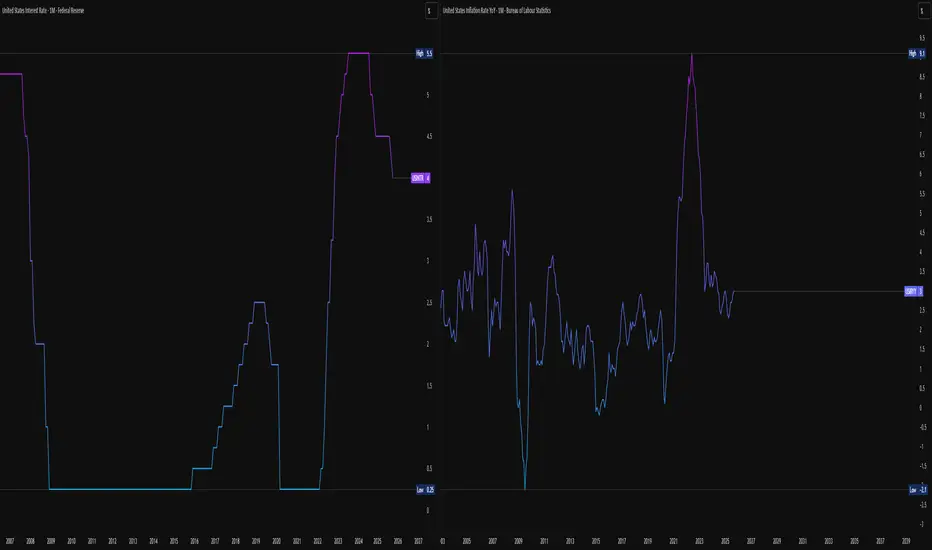
Fed’s New Boss Vows to Stir Things Up. What’s Changing Ahead.What do you mean “Good day?” It’s “Good afternoon.” Or not anymore.
The Federal Reserve got a new leader. Kevin Warsh wasted little time showing that things may look very different from here on out.
His first meeting as Fed Chair delivered a clue right from the opening words. You, and all traders
Key data points
Last release
—
Observation period
Jun 17, 2026
Next release
—
Forecast
—
Highest
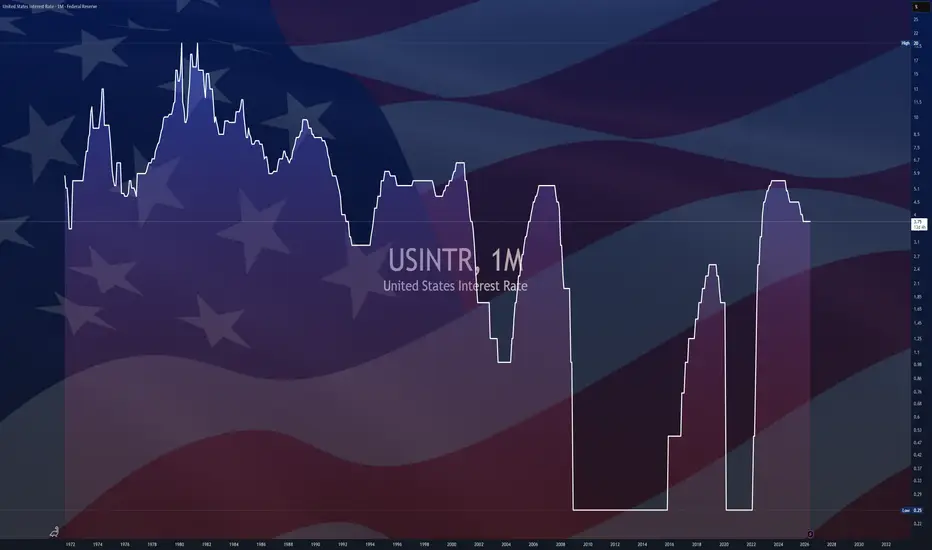
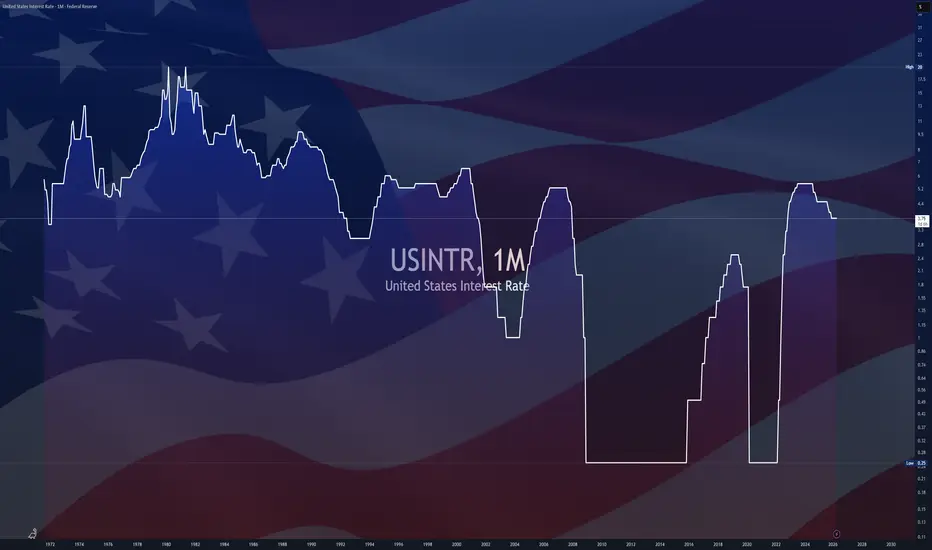
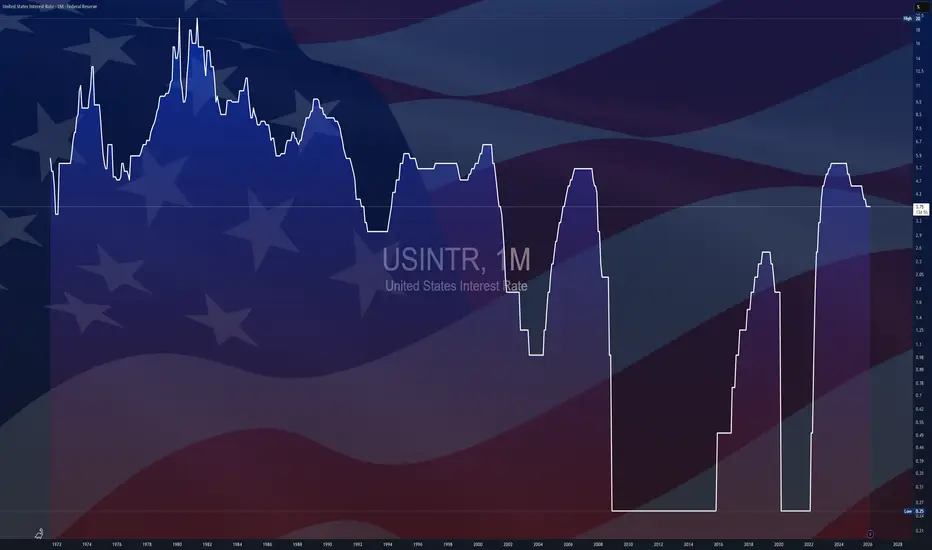
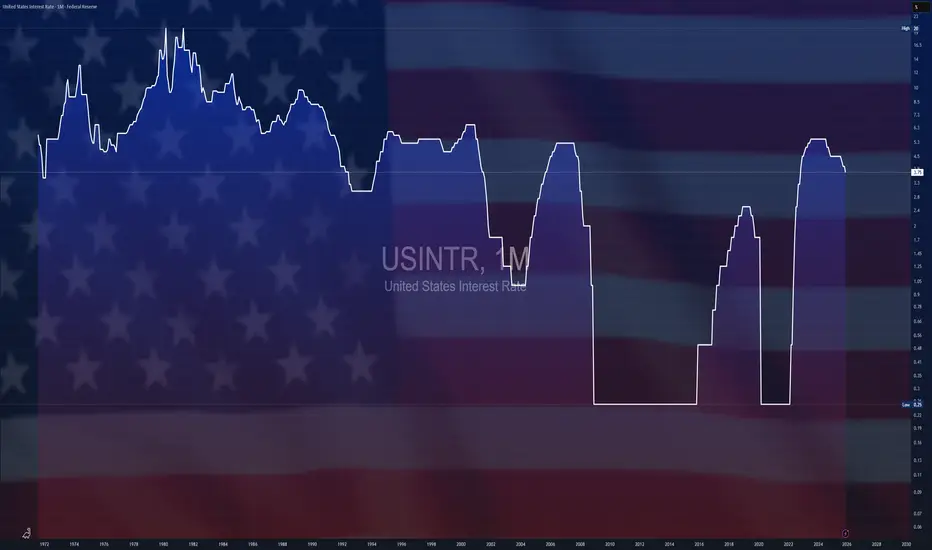
20.00 %on May 8, 1981
Lowest
0.25 %on Feb 28, 2022
Profile
In the United States, the authority to set interest rates is divided between the Board of Governors of the Federal Reserve (Board) and the Federal Open Market Committee (FOMC). The Board decides on changes in discount rates after recommendations submitted by one or more of the regional Federal Reserve Banks. The FOMC decides on open market operations, including the desired levels of central bank money or the desired federal funds market rate.
Related indicators
$USINTR - U.S Interest Rates (June/2026)ECONOMICS:USIRYY
June/2026
source: Federal Reserve
- The Fed kept the federal funds rate unchanged at 3.50%–3.75% for a fourth consecutive meeting in June, the first under Chairman Kevin Warsh, in line with expectations.
Updated projections showed that nine officials expect at least one rate
$USINTR - U.S Interest Rates (April/2026)ECONOMICS:USINTR
April/2026
source: Federal Reserve
- The Fed held the funds rate steady at 3.5%–3.75% for a third meeting, as the outlook for the rest of the year remains uncertain due to Middle East conflict.
Four officials voted against the decision, including three who opposed wording su
$USINTR - U.S Interest Rates (March/2026)ECONOMICS:USINTR
March/2026
source: Federal Reserve
- The Federal Reserve held the funds rate steady within the 3.5%–3.75% target range.
The committee made few changes to statement, noting uncertainty surrounding the war with Iran and slightly stronger growth and higher inflation in 2026, wh
A downturn is imminent - 10 Year Treasury Note based analysisIn recent years, many of us acknowledge that the term "recession" has been appearing in news and social media outlets at an increasing rate. While it acts as great clickbait, most sources tend to avoid to avoid a more fundamentals data driven approach, but rather are preferential an opinionated view
$USINTR - U.S Interest Rates (January/2026)ECONOMICS:USINTR
January/2026
source: Federal Reserve
- The Federal Reserve left the federal funds rate unchanged at the 3.5%–3.75% target range in its January 2026 meeting, in line with expectations.
The central bank paused its easing cycle after three consecutive rate cuts last year that push
$USINTR - Fed Signals Single Cut in 2026 (December/2025)ECONOMICS:USINTR 3.75%
December/2025 (-0.25%/bps)
source: Federal Reserve
-The Federal Reserve lowered the funds rate by 25bps to 3.5%–3.75%, marking the lowest level since 2022, but signaled a tougher road ahead for further reductions.
The policymakers left their projections unchanged from Sept
Real Rates, Policy Transition & Cross-Asset Bias (Update)Macro Overview
Global monetary policy remains in a transitional phase, not yet a true easing cycle.
The Federal Reserve executed a hawkish 25 bps cut (4.25% → 4.00%), maintaining its QT program and signaling that further reductions are not guaranteed.
The ECB held rates steady amid slightly higher
$USINTR -Fed Delivers Rate Cut (October/2025)ECONOMICS:USINTR
October/2025
source: Federal Reserve
- The Federal Reserve lowered the federal funds rate by 25 bps to a target range of 3.75%–4.00% at its October 2025 meeting, in line with market expectations.
The move followed a similar cut in September,
bringing borrowing costs to their lo
Fed Update: The Dissenting VoteSo I've covered last week's interest rate cut , but a word came out that there was a dissenting vote.
11 FOMC Members voted for a standard 25 bps cut.
1 FOMC Member (Steven Mirren - a Trump appointee recently from the White House) voted for a more aggressive 50 bps cut.
This matters because Mirre
See all ideas
Frequently asked questions
US interest rate is 3.75% at the moment.
Last month US interest rate was 3.75%, and the month before it reached 3.75%.
Interest rate is the proportion of a loan that is charged as interest to the borrower, typically an annual percentage of the loan outstanding. When it comes to the national level, interest rate is a rate at which banks borrow money from a country's central bank.
Yes, negative interest rate can be used by the government as a monetary policy tool to stimulate economy growth.
Growing or falling interest rate can influence the country's economy, stimulate it or lower the inflation level. Even people can feel the effect of interest rate's movements — for example, if interest rate increases, loans get more expensive.