Gann
Trading Road Mapoptions trading and institutional trading are important parts of modern financial markets. Options trading offers flexibility and opportunities for profit, while institutional trading provides liquidity and stability to the market. However, beginners should learn market concepts carefully before entering options trading because losses can occur quickly without proper knowledge and risk management. Education, practice, and disciplined investing are essential for long-term success in trading.
Eternal/Zomato can be exceptional stock for next 5 years Based on my Elliott Wave analysis, Eternal (formerly Zomato) appears to have completed a larger Wave 2 correction and may now be forming multiple nested 1–2 wave structures. If this interpretation is correct, the stock could be preparing for a strong Wave 3 advance, which is typically the most powerful phase in an Elliott Wave cycle.
From a business perspective, the investment thesis also looks compelling. Eternal provides exposure to multiple long-term growth segments through its food delivery business and Blinkit, giving investors participation in both online food delivery and the rapidly expanding quick-commerce market.
If execution remains strong, profitability continues to improve, and the Wave 3 scenario plays out as expected, the stock has the potential to become a multibagger over the long term. That said, Elliott Wave analysis is a probabilistic framework rather than a certainty, so risk management and monitoring business fundamentals remain important.
Option Trading Intraday trading involves buying and selling financial instruments within the same trading session, with all positions closed before the market ends. Traders aim to take advantage of short-term price fluctuations using fast decision-making and technical analysis. Intraday trading is highly active and often relies on chart patterns, volume analysis, momentum indicators, and market news to identify quick trading opportunities.
Institutional Trading MasterclassCore Structure of Institutional Option Trading
Institutions focus on 4 pillars:
A. Direction
Will market go up, down, sideways?
B. Volatility
Will movement increase or decrease?
C. Time Decay
How much premium melts daily?
D. Risk Exposure
How much capital at risk?
Rules to Become Consistent
Never trade without plan
Never increase size emotionally
Trading Road Mapoptions trading and institutional trading are important parts of modern financial markets. Options trading offers flexibility and opportunities for profit, while institutional trading provides liquidity and stability to the market. However, beginners should learn market concepts carefully before entering options trading because losses can occur quickly without proper knowledge and risk management. Education, practice, and disciplined investing are essential for long-term success in trading.
Waiting For Bitcoin At $30K Will End Up Buying It Above $100KMost Investors Waiting For Bitcoin At $30K Will End Up Buying It Above $100K
A large part of the market is still waiting for Bitcoin to revisit the $40K-$35K range before becoming bullish.
But here's the question...
"What if Bitcoin never gives the market that opportunity?
What's the plan then?
Will you continue waiting...
Or will you finally buy after Bitcoin is trading above $100K, once the headlines turn bullish again?
This happens in every cycle.
Investors spend months waiting for an extra 20-30% downside, only to miss A 70-150% upside.
That's not investing.
That's letting emotions make your decisions.
If your investment horizon is 3-5 years, accumulating Bitcoin around current levels is far more important than trying to catch the exact bottom.
Could Bitcoin still correct another 15-25%?
Absolutely.
Markets are never linear.
But a deeper pullback should be viewed as an opportunity to increase exposure, not as a reason to avoid building a position today.
Professional investors don't wait for perfect prices.
They accumulate high-conviction assets over time while sentiment is weak and liquidity is available.
The biggest mistake isn't buying a little too early.
It's having no Bitcoin when the next institutional wave arrives.
One Final question...
If Bitcoin eventually reaches $500,000...
Will you have the patience to hold your Bitcoin until then?
NFA & DYOR
Option AnalysisOptions Data
PCR at 0.90, slightly bearish reading
Max call pain sitting near 55,000, acting as a ceiling
What to Do
Short traders hold with stop-loss above 54,609 on daily close
Long trades only if index closes above 54,609
Avoid aggressive buying unless 56,400 is reclaimed with a proper closing
Key Risk
Crude oil above 100 dollars is a pressure point for India
Any global news on geopolitics can cause sudden sharp moves either way
Trading AnalysisWhere is Nifty right now?
Nifty closed at 23,689 on Thursday May 14. After a brutal fall earlier this week (it touched ~23,300), it bounced back for 2 days in a row. So right now it's in a recovery mood — but it hasn't really "fixed" itself yet. Think of it like someone who had a fever, now feeling slightly better, but not fully healthy.
2 What's the wall above? (Resistance)
If Nifty tries to go up next week, it will hit a wall around 23,500–23,600 first. That's the first test. If it somehow crosses that, the BIGGER wall is at 23,900–24,000 — where all the major moving averages (50-day & 200-day) are sitting. Lots of sellers will be waiting there to book profits. So going above 24,000 next week? Unlikely unless something very positive happens.
3 What's the floor below? (Support)
If Nifty starts falling, the first safety net is around 23,300–23,150. This zone has held multiple times recently. If it breaks this level decisively (and stays below it), then the next stop could be 23,000 or even 22,900. That's the danger zone — but that's not the most likely scenario for next week.
Trading Masterclass #1Institutional trading means trading like hedge funds, banks, prop firms, and professional desks. They do not trade based on emotions, random tips, or gambling. They use systems, probabilities, risk control, position sizing, discipline, and psychology.
Retail traders often lose because they focus only on “entry.” Institutions focus on:
Risk Management
Capital Protection
Position Sizing
Probability
Psychology
Consistency
Repeatable Edge
In options trading, if you think like institutions, your results can improve significantly
Institutional Trading MasterclassCore Structure of Institutional Option Trading
Institutions focus on 4 pillars:
A. Direction
Will market go up, down, sideways?
B. Volatility
Will movement increase or decrease?
C. Time Decay
How much premium melts daily?
D. Risk Exposure
How much capital at risk?
Rules to Become Consistent
Never trade without plan
Never increase size emotionally
Never revenge trade
Protect capital first
Focus on process daily
Trading Masterclass #1Institutional trading means trading like hedge funds, banks, prop firms, and professional desks. They do not trade based on emotions, random tips, or gambling. They use systems, probabilities, risk control, position sizing, discipline, and psychology.
Retail traders often lose because they focus only on “entry.” Institutions focus on:
Risk Management
Capital Protection
Position Sizing
Probability
Psychology
Consistency
Repeatable Edge
Advanced Intraday TradingOptions Trading is a type of financial trading where investors buy or sell contracts that give them the right, but not the obligation, to purchase or sell an asset at a fixed price before a specific date. Traders use options to earn profits, hedge risks, or speculate on market movements. Common strategies include call options, put options, straddles, and spreads. Options trading can provide high returns, but it also carries significant risk because prices can change rapidly due to market volatility.
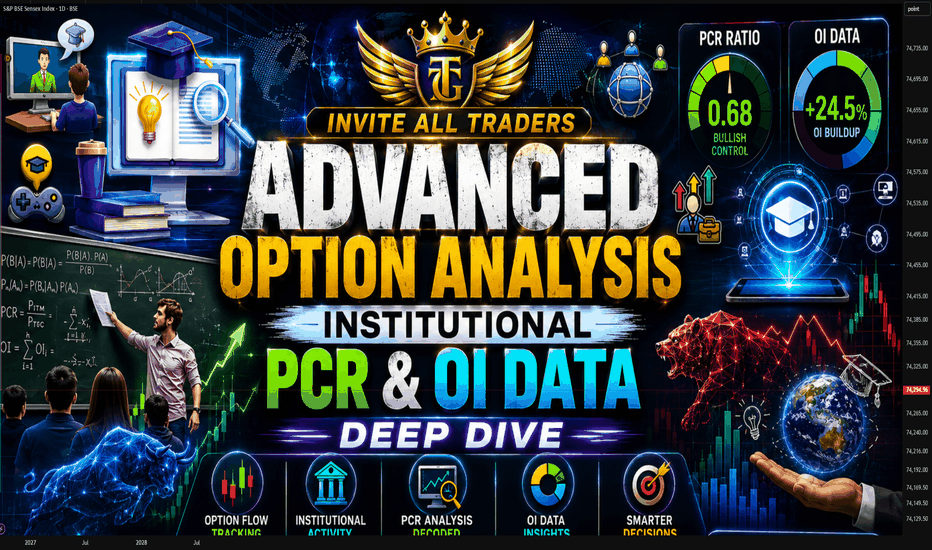
Options TradingPCR means Put Call Ratio
It tells us how many Put options and Call options people are buying or trading.
Why it matters for institution trading
Big players mostly use options. So PCR helps us understand what big money may be thinking.
If PCR is high
More puts than calls.
Means traders are scared or taking protection.
Sometimes big players expect weakness.
If PCR is low
More calls than puts.
Means confidence in upside.
Sometimes market is bullish.
Why learn this
Price only shows movement.
PCR shows mindset behind movement.
Institutions think different
Retail people chase candles.
Institutions manage risk first.