Part 1 Intraday Institutional Trading How Option Premium Is Calculated
Premium = Intrinsic Value + Time Value + Volatility Value
1. Intrinsic Value (IV)
Actual value based on difference between spot and strike.
2. Time Value
More days to expiry → higher premium
Closer to expiry → premium decays (Theta)
3. Volatility (Implied Volatility – IV)
Higher volatility = higher premium
Low volatility = low premium
Trend Line Break
Part 3 Institutional Trading VS. Technical AnalysisWhat Are Options? — The Foundation
Options are derivative contracts whose price is derived from an underlying asset like:
Stocks
Indices (Nifty, Bank Nifty)
Commodities
Currencies
An option is a contract between a buyer and a seller that gives special rights to the buyer.
✔ In simple words:
An option gives you the right, but not the obligation, to buy or sell the underlying at a fixed price before a fixed date.
This fixed price = Strike Price
This fixed date = Expiry Date
Options are o
Gold Squeezing Into Resistance – Breakout Loading?Gold is currently compressing between a rising short-term channel and a broader resistance trendline. Price is holding structure well, and buyers are gradually pushing higher lows into resistance.
What makes this setup interesting is the tightening range. When price compresses like this, it usually leads to expansion. If buyers manage to break and hold above the upper trendline, the upside continuation zone marked on the chart becomes active.
RSI previously showed bearish pressure, but momentu
Part 3 Institutional Option Trading VS. Technical Analysis⭐Why Trade Options? Benefits
Lower capital requirement than futures or stocks.
Unlimited profit potential for buyers (CE/PE).
Limited risk — premium paid is the maximum loss.
Multiply returns because of leverage.
Profit in any market direction — up, down, or sideways.
Hedge portfolio risk (insurance for your positions).
Create income strategies, like selling options.
Combine multiple options for advanced setups.
Manage risk precisely using Greeks.
Control emotions better with predefine
Part 2 Institutional Option Trading VS. Technical Analysis⭐ Types of Options
Two main types:
Call Options (CE)
A call gives you the right to buy.
You buy a call when you expect the market to go up.
If the price rises, your call premium increases.
You can sell the call later and book profit.
You are not required to buy the stock — you only trade the premium.
Put Options (PE)
A put gives you the right to sell.
You buy a put when you expect the market to fall.
If the price falls, your put premium increases.
You sell the put later to book profi
Part 1 Institutional Option Trading VS. Technical Analysis ⭐ 1. What Are Options?
Options are contracts, not shares.
They give you a right, not an obligation, to buy or sell something.
That “something” is usually a stock, index, commodity, or currency.
Options have an expiry date — they lose value as time passes.
Options are part of a bigger market called derivatives.
They derive their value from the underlying asset (like Nifty, Bank Nifty, stocks).
An option is like a reservation — you pay a small price to control a large position.
This small
Shifting to Next Trend Kaynes 1DKaynes Technology India Ltd is a leading integrated electronics manufacturing and IoT solutions company in India, providing end-to-end services that cover conceptual design, process engineering, manufacturing, and life-cycle support of electronic systems and products. It serves diverse sectors including automotive, industrial, aerospace & defence, space, nuclear, medical, railways, IT and IoT applications
Above 4012
Expecting 4432
For analysis of any stock, feel free to comment the stock name
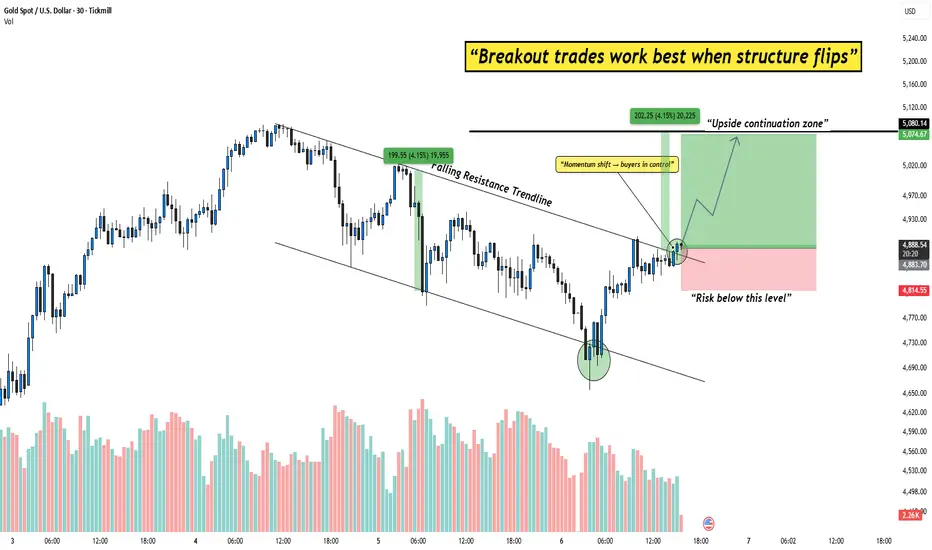
Gold Price Update: Trendline Breakout with Clear Risk DefindGold has broken above the falling trendline, and this move is important not because of one candle, but because of the change in structure. After a prolonged corrective phase, price is now holding above the breakout level, which signals that buyers are starting to step in.
What I like about this setup is the clarity. The breakout is clean, risk is clearly defined below the structure, and price is now trading in an area where continuation becomes more likely if buyers maintain control.
There is
Part 1 Institutional Trading VS. Technical Analysis What Is Premium?
The premium is the price of the option contract. It is influenced by several factors:
Current price of the underlying
Strike price
Time remaining till expiry
Volatility
Interest rates
Dividends
Premiums are higher when:
Market is volatile
Expiry is far away
Stock price is near the strike price
Breakout with volume | upside moveIFCI is currently exhibiting a highly constructive technical setup that signals a significant shift in long-term momentum. After a period of healthy consolidation, the stock successfully reclaimed its 200-day Daily Moving Average (DMA), a critical barometer for the long-term trend. What makes this setup particularly compelling is the subsequent price action: rather than a "fakeout," the stock returned to the 200 DMA to retest it as support. This successful retest and the stock's ability to susta
Gold Breaks Falling Resistance– Structure Shift Signals PossibleGold has finally broken above the falling resistance trendline, and more importantly, the market structure has flipped. This is the key reason why breakout trades start working better after long corrections.
Earlier, price was respecting the falling trendline, but once sellers failed to push it lower, buyers stepped in with strength. The breakout candle shows a clear momentum shift, and price is now holding above the previous resistance area.
This zone is important. As long as price stays abov
Event-Driven Earnings Trading: A Complete ExplanationWhy Earnings Are Market-Moving Events
Every publicly listed company reports earnings quarterly. These reports include:
Revenue
Profit (net income, EPS)
Operating margins
Forward guidance
Management commentary
Markets are forward-looking. Prices already discount expectations well before earnings are released. When actual results differ from expectations, the stock must quickly reprice—sometimes violently.
That repricing creates opportunity.
Expectations vs Reality: The Real Driver
A com
Best Sectors For DIP Buying: Long-Term Investor + Smart TraderUnderstanding DIP Buying at a Sector Level
Sector-based DIP buying works better than stock-only dip buying because:
Sector corrections are often cyclical, not permanent
Money rotates between sectors, not out of markets forever
Institutions buy sectors in phases, not randomly
The goal is to buy quality sectors during pessimism, not hype.
1. Banking & Financial Services
Why banks are prime DIP-buying candidates
Banking is one of the most cyclical sectors in any economy. Corrections often oc
Option Chain – Terms and ConditionsIntroduction to the Option Chain
An option chain is a structured table that displays all available call (CE) and put (PE) options for a particular underlying asset (stock or index) across different strike prices and expiry dates. It is the most important tool for option traders because it reveals market expectations, positioning, liquidity, and risk at a glance.
The option chain is not just data—it reflects the collective psychology of traders, hedgers, institutions, and market makers.
1. Und
Mastering Technical Analysis: From Charts to Consistent Decision1. The Core Philosophy of Technical Analysis
Technical analysis is built on three foundational principles:
Price discounts everything
News, fundamentals, expectations, fear, and greed are all embedded in price. A chart is a real-time emotional record of market participants.
Prices move in trends
Markets rarely move randomly. Once a trend starts, it tends to persist until a clear reversal occurs.
History repeats itself
Human behavior does not change. Fear and greed create recurring patterns t
Part 4 Technical Analysis Vs. Institutional Option TradingPut Options (PE) Explained
Put = Right to sell
You buy a put when you expect the price to go down.
Loss is limited to premium paid.
Profit can rise significantly in sharp downtrends.
Example:
If Nifty is at 22,000 and you buy 21,900 PE, you are expecting Nifty to fall below 21,900.
Part 3 Technical Analysis Vs. Institutional Option TradingCall Options (CE) Explained
Call = Right to buy
You buy a call when you expect the price to go up.
Your loss is limited to premium paid.
Your profit can be unlimited (theoretically).
Example:
If Nifty is at 22,000 and you buy a 22,100 CE, you are expecting Nifty to rise above 22,100 before expiry.
Profit if market rises → premium increases.
Loss if market falls → premium decreases.
Private vs. Public Banks: Who Will Win in a Trade War?Trade wars are no longer just geopolitical events—they are financial stress tests for entire economies. Tariffs, supply-chain disruptions, currency volatility, and slowing global growth directly affect capital flows, corporate profitability, and credit demand. In this environment, the banking sector becomes both a shock absorber and a transmission channel of economic stress.
The big question investors and traders ask is simple but powerful:
In a trade war scenario, will private sector banks out
PSU Banks Rising: Understanding the Structural Turnaround1. Resolution of the NPA Crisis
The most important reason behind the rise of PSU banks is the significant improvement in asset quality. Between 2015 and 2019, PSU banks were hit hard by a surge in Non-Performing Assets (NPAs), mainly from stressed corporate loans in sectors such as infrastructure, power, steel, and telecom. This period forced banks to recognize bad loans transparently under stricter RBI norms.
With the introduction of the Insolvency and Bankruptcy Code (IBC), banks finally rec
Part 1 Technical Analysis VS. Institutional Option Trading What Are Options?
Options are contracts that give you the right but not the obligation to buy or sell an asset at a fixed price before a certain date.
They are derivative instruments — their value comes from the underlying asset (index, stock, commodity, currency).
Options are mostly used for hedging, speculation, and income generation.
Two Types of Options
Call Option (CE): Right to buy at a chosen price.
Put Option (PE): Right to sell at a chosen price.
Volatility Index (VIX) Trading: Measuring Risk and Timing TradesWhat Is the Volatility Index (VIX)?
The VIX measures the market’s expectation of 30-day forward volatility derived from S&P 500 index option prices. Instead of tracking past price movements, it reflects implied volatility, meaning how much traders expect the market to fluctuate in the near future.
A low VIX suggests calm markets and investor confidence
A high VIX indicates fear, uncertainty, and elevated risk
Unlike price indices, the VIX is mean-reverting, meaning it tends to return to long