Australian Dollar / U.S. Dollar
No trades
No trades
Peers for comparison
Pair info
The Australian Dollar and the US Dollar pair belong the Majors, a group of the most popular traded pairs in the world. This pair's popularity soared because traders were attracted to the interest rate differential of the pair. This has waned in recent years due to economic volatility worldwide.
AUDUSD Sell position idea Price is on a downtrend
Below 20MA
Break out and retest on the new area of value
Broke support and it has been retesting the new resistance
Daily confirmation candle - price is below resistance
Take profit is the next large area of value, New support
Price has came to an area to enter, making it
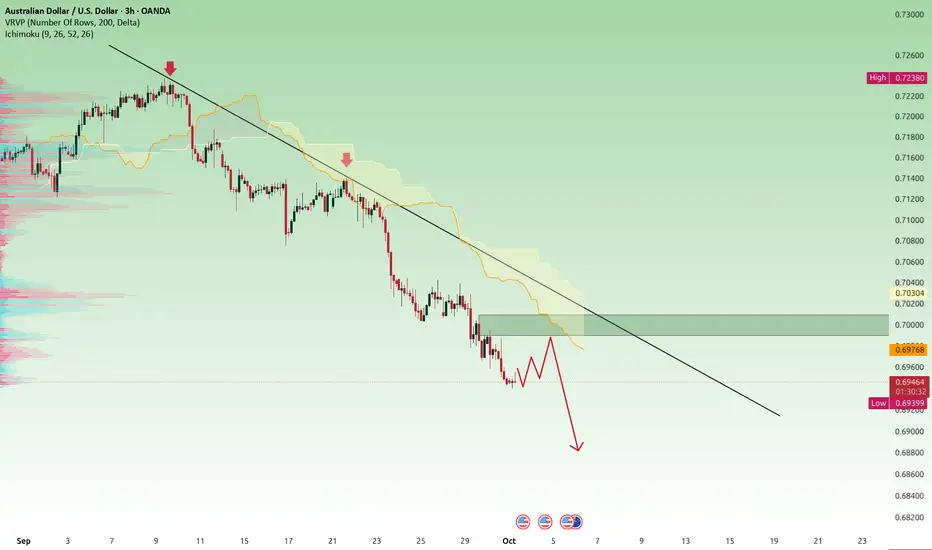
AUDUSD Could Drop Toward 0.6880AUDUSD is still trading within a clear bearish structure, with price continuing to respect the descending trendline and staying below the Ichimoku cloud.
The latest move lower has pushed price beneath the recent support area, while the zone around 0.6990–0.7010 now looks more like a supply area tha
AUDUSD nearing bullish reversal?Overall trend on the higher timeframes is very bullish, the decline which we saw is just the brief correction and it has already started to show signs of reversal.
first sign is facing bounce back form an existing support & the bounce back came exactly from Fibonacci retracement 0.5 level (Bullish)
ANOTHER BUY ATTEMPT IN AUDUSDIn our previous trade, we were failed. The trade was executed but stopped out when the price hovered the Yellow trendline drawn on 4H Timeframe.
Why I am going Bullish again? its just because of:
Bullish Divergence at 4H Timeframe.
Bullish Divergence at Hourly timeframe.
Both of the abov
AUDUSD Bullish Move expectedDaily TF is strongly bullish.
4H is also bullish enough to be traded.
Bullish Triggers
4H Trendline respected multiple times
Nice HH and LH on both Daily and 4H Time frames.
Price above 50 EMA and 89 EMA
Bearish Triggers
RSI on 4H time frame.
Trade
Time frame: 1H
Buy Stop: 0.72177
SL: 0.71551
TP
AUDUSD BULLS TRAPAUD/USD Short Setup: Reversal Off Major Resistance Zone 📉After an aggressive multi-week rally pushing AUD/USD up to the 0.7200–0.7214 supply zone, the pair is showing signs of exhaustion. Despite positive Australian GDP numbers, a sharp risk-off environment driven by escalating Middle East geopoliti
See all ideas
Summarizing what the indicators are suggesting.
Oscillators
Neutral
Oscillators
Neutral
Summary
Neutral
Summary
Neutral
Summary
Neutral
Moving Averages
Neutral
Moving Averages
Neutral
Displays a symbol's price movements over previous years to identify recurring trends.
Frequently asked questions
Today, AUD/USD rate is 0.66440 USD.
For broader market analysis, dive into the technicals on the AUDUSD live chart and read the latest AUDUSD news:
– Dollar set for weekly gain as risk appetite returns
– Risk-sensitive currencies rise on tech rebound, dollar set for weekly gain
– Dollar set for flat week as haven bids counter yields
For broader market analysis, dive into the technicals on the AUDUSD live chart and read the latest AUDUSD news:
– Dollar set for weekly gain as risk appetite returns
– Risk-sensitive currencies rise on tech rebound, dollar set for weekly gain
– Dollar set for flat week as haven bids counter yields
Markets don't sleep, here's what's going on with AUDUSD at the moment:
– Dollar set for weekly gain as risk appetite returns
– Risk-sensitive currencies rise on tech rebound, dollar set for weekly gain
– Dollar set for flat week as haven bids counter yields
See more updates in real-time with our News Flow.
– Dollar set for weekly gain as risk appetite returns
– Risk-sensitive currencies rise on tech rebound, dollar set for weekly gain
– Dollar set for flat week as haven bids counter yields
See more updates in real-time with our News Flow.
The safest way to trade AUDUSD is through a reliable broker. Create an account, fund it, and place a buy order.
You can trade AUDUSD directly from TradingView:
– Choose a broker: Explore our supported trading partners and pick one that fits your needs
– Compare options: View available brokers side by side to evaluate fees and features
– Connect your account: Open Supercharts, click "Trade", select your broker, and log in
– Start trading: Place orders without leaving the chart
Tip: If you're new to trading, try paper trading first — it lets you practice strategies in real market conditions without risking funds.
It's worth checking AUDUSD rate change for various periods to get the full picture:
– 1 day — +0.18%
– 1 week — −0.17%
– 1 month — −5.76%
AUDUSD's all-time low was 0.47760 USD (Apr 2, 2001), and its highest price is 1.48850 USD (Dec 10, 1973). Track the dynamics with the latest forex news right on TradingView.
– 1 day — +0.18%
– 1 week — −0.17%
– 1 month — −5.76%
AUDUSD's all-time low was 0.47760 USD (Apr 2, 2001), and its highest price is 1.48850 USD (Dec 10, 1973). Track the dynamics with the latest forex news right on TradingView.
When trading AUDUSD, one should keep in mind many factors.
First, analyze the fundamentals:
– Macroeconomic data: Inflation, GDP, employment, and other key indicators in the economies behind both currencies
– Central bank policy: Interest rate decisions and monetary policy from the respective central banks
– Market sentiment: Check what other traders anticipate
– News flow: Geopolitical events and economic releases
Then check technical ratings:
– Today — sell
– 1-week — sell
– 1-month — strong sell
Identify the trend, watch key levels (support and resistance), consider volatility and upcoming economic events. Then, you'll be closer to an informed decision.
AUDUSD is a major currency pair, meaning it combines one of the world's most traded currencies with the US dollar.
What it means for traders:
– High liquidity: Actively traded with large market participation
– Tight spreads: Typically lower trading costs
– Global relevance: Often reflects major economic trends
What you should remember about major pairs:
– Macro-driven: Influenced by key economic data and central bank decisions
– Stable execution: High volume usually means smoother price movement
– Popular among traders: Widely used for both short-term and long-term strategies
Track rate movements on the AUDUSD chart and follow the latest forex news to stay updated.
AUDUSD volatility measures how much the exchange rate fluctuates over time, i.e. how quickly and how strongly it moves up or down.
The current volatility rating is 0.79%.
What it means for traders:
– Higher volatility: Larger and faster price swings → higher risk and opportunity
– Lower volatility: More stable price movement → smaller trading ranges
– Market behavior: Volatility often increases during major economic news or central bank decisions
Volatility helps traders estimate risk and position sizing. It's also useful for adapting strategies to market conditions.
How to use volatility:
– Compare volatility across other currency pairs
– Combine with technical analysis (trends, support/resistance)
– Monitor economic events that may increase market movement
AUDUSD is quoted as how many USD (quote currency) it takes to buy one AUD (base currency).
For example, if the pair trades at 1.50, it means 1 AUD = 1.50 USD.
What can influence the rate:
– Supply and demand: Driven by trade, investment flows, and speculation
– Economic data: Inflation, GDP, employment reports
– Central bank policy: Interest rates and monetary decisions
Follow these and more events in the Economic Calendar.