

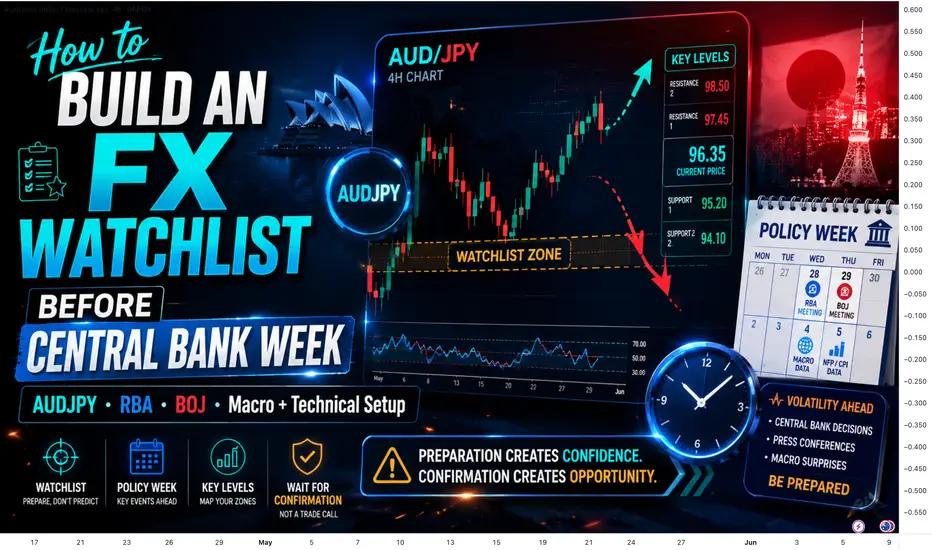
Many traders look at currency pairs only after the big move has already happened.
But in forex, some of the best preparation happens before the event.
This is why I like building a watchlist around three things:
1. Central bank expectations
2. Yield difference
3. Key technical levels
For June, one of the most interesting pairs to study is AUD/JPY.
This pair is not only a normal currency pair. It shows a battle between two very different economies.
Australia is linked to commodities, inflation pressure, and RBA policy expectations.
Japan is linked to low-yield conditions, yen weakness, BOJ policy risk, and possible intervention concerns.
That makes AUD/JPY useful for learning how macro forces can show up on a chart.
Why AUD/JPY matters
When traders expect Australia to keep rates restrictive while Japan stays cautious, AUD/JPY can stay supported because of carry demand.
But this does not mean traders should blindly buy.
The same pair can reverse sharply if the BOJ becomes more hawkish, if yen short positions unwind, if risk sentiment weakens, or if commodity prices lose strength.
This is why a watchlist is not a prediction.
A watchlist is a preparation tool.
How I would read this pair
First, I check the macro story.
Is the AUD side supported by RBA expectations and commodity sentiment?
Is the JPY side still weak because of yield divergence?
Is there intervention risk near important yen levels?
Then I check the chart.
Is price trending cleanly?
Is price near resistance?
Is there a breakout, retest, or rejection?
Are buyers still defending higher lows?
Where would the idea become invalid?
Simple checklist for AUD/JPY
1. Check the RBA and BOJ calendar.
2. Watch whether the yen is weakening or recovering.
3. Mark the main support and resistance zones.
4. Avoid entering directly before major central bank news.
5. Wait for price confirmation after the event.
6. Respect invalidation because FX can move sharply during policy surprises.
The main lesson is simple:
Do not trade only because an event is coming.
Use the event to prepare.
Use the chart to confirm.
Use risk management to survive being wrong.
AUD/JPY can be a strong learning example because it combines macro, policy divergence, risk sentiment, and technical structure in one chart.
Do you build an FX watchlist before central bank decisions, or do you only react after the move starts?
Share your view below.
But in forex, some of the best preparation happens before the event.
This is why I like building a watchlist around three things:
1. Central bank expectations
2. Yield difference
3. Key technical levels
For June, one of the most interesting pairs to study is AUD/JPY.
This pair is not only a normal currency pair. It shows a battle between two very different economies.
Australia is linked to commodities, inflation pressure, and RBA policy expectations.
Japan is linked to low-yield conditions, yen weakness, BOJ policy risk, and possible intervention concerns.
That makes AUD/JPY useful for learning how macro forces can show up on a chart.
Why AUD/JPY matters
When traders expect Australia to keep rates restrictive while Japan stays cautious, AUD/JPY can stay supported because of carry demand.
But this does not mean traders should blindly buy.
The same pair can reverse sharply if the BOJ becomes more hawkish, if yen short positions unwind, if risk sentiment weakens, or if commodity prices lose strength.
This is why a watchlist is not a prediction.
A watchlist is a preparation tool.
How I would read this pair
First, I check the macro story.
Is the AUD side supported by RBA expectations and commodity sentiment?
Is the JPY side still weak because of yield divergence?
Is there intervention risk near important yen levels?
Then I check the chart.
Is price trending cleanly?
Is price near resistance?
Is there a breakout, retest, or rejection?
Are buyers still defending higher lows?
Where would the idea become invalid?
Simple checklist for AUD/JPY
1. Check the RBA and BOJ calendar.
2. Watch whether the yen is weakening or recovering.
3. Mark the main support and resistance zones.
4. Avoid entering directly before major central bank news.
5. Wait for price confirmation after the event.
6. Respect invalidation because FX can move sharply during policy surprises.
The main lesson is simple:
Do not trade only because an event is coming.
Use the event to prepare.
Use the chart to confirm.
Use risk management to survive being wrong.
AUD/JPY can be a strong learning example because it combines macro, policy divergence, risk sentiment, and technical structure in one chart.
Do you build an FX watchlist before central bank decisions, or do you only react after the move starts?
Share your view below.

Powiązane publikacje
Wyłączenie odpowiedzialności
Informacje i publikacje nie stanowią i nie powinny być traktowane jako porady finansowe, inwestycyjne, tradingowe ani jakiekolwiek inne rekomendacje dostarczane lub zatwierdzone przez TradingView. Więcej informacji znajduje się w Warunkach użytkowania.
Powiązane publikacje
Wyłączenie odpowiedzialności
Informacje i publikacje nie stanowią i nie powinny być traktowane jako porady finansowe, inwestycyjne, tradingowe ani jakiekolwiek inne rekomendacje dostarczane lub zatwierdzone przez TradingView. Więcej informacji znajduje się w Warunkach użytkowania.