$LUV - 50 SMA Breakout on Growing Volume💡 Swing setup idea
The 50SMA strategy
🔎 Analysis summary:
The stock recently broke above key resistance and successfully pushed above the 50 SMA.
Growing buyers volume is stepping in, showing strong momentum behind the move.
🔔 Sector note: There is a recent upward move across the airlines sector as gas prices go down, giving this setup a nice tailwind.
👀 Levels to watch:
Entry trigger: Break above $43.90
Target: $52.07
Stop: Under the breakout level
💬 What do you think of this setup? Let me know in the comments! 👇
Good luck!
⚠️ Note: This is for educational purposes only and is not financial advice.
Southwest Airlines Co.
No trades
No trades
In-depth trading ideas
Southwest Airlines (LUV): Geopolitics, Oil Prices, and Market ReThe recent conflict involving Iran created a challenging environment for airline stocks. As geopolitical tensions increased, energy markets experienced heightened volatility, leading investors to focus on the potential impact of higher fuel costs on airline profitability.
Southwest Airlines (LUV) experienced a significant decline during this period as market participants reacted to uncertainty surrounding oil prices and the broader economic implications of the conflict.
From a chart perspective, LUV provides an interesting example of how market participants process changing information.
Current observations from the chart:
Price has traded within an upward-sloping channel since April.
Multiple tests of the lower trendline have been followed by rebounds toward the upper boundary of the range.
Price is currently approaching an area that has previously acted as resistance.
The stock is trading above both the 50-day and 200-day moving averages.
Momentum indicators have improved relative to the lows established earlier in the year.
This chart highlights the relationship between geopolitical events, commodity markets, and equity prices. Airline stocks are often sensitive to changes in fuel costs, making them useful case studies when analyzing how external events can influence investor behavior.
Whether the current trend continues, reverses, or transitions into a different trading range remains unknown. The purpose of this analysis is to examine how fundamental developments and technical price action can interact during periods of elevated uncertainty.
This post is intended solely for educational and informational purposes and should not be construed as investment advice, a recommendation, or a solicitation to buy or sell any security.
Southwest Airlines Near Key Support — Long Setup Toward $41+:Current Price: 39.41 (Analysis was generated on Monday Morning)
Direction: LONG
Confidence level: 58%(Price is sitting near major support with slightly oversold momentum indicators and generally bullish trader discussions, but limited direct snippet data lowers confidence.)
Targets
Target 1: 40.90
Target 2: 42.50
Stop Levels
Stop 1: 38.60
Stop 2: 37.80
Key Insights:
Here's what's driving this setup. Southwest Airlines is trading very close to a well‑defined support zone around $38.5–$38.9 that traders have been watching since previous lows. When a stock approaches a strong historical support area like this, many short‑term traders start looking for bounce trades rather than breakdowns.
At the same time, momentum indicators are beginning to stabilize. RSI is hovering around 38, which places the stock in a slightly oversold area. Several traders pointed out that when RSI dips into the high‑30s while price sits on support, a short‑term rebound often follows. The MACD histogram is also shrinking on the downside, suggesting selling pressure is slowing.
Another interesting point: sentiment across recent trading discussions leans bullish despite concerns about fuel costs. Many market participants are talking about the liquidity improvement from the recently announced $500M loan facility and how route adjustments could help margins later this year.
Recent Performance:
Southwest Airlines recently pulled back to $39.41 after dropping about 3.6% over the last session. Volume ticked higher than average during the decline, which tells me traders were actively repositioning. The stock is still far from its 52‑week high of $55.11, so short‑term bounces from oversold levels aren't unusual. The key now is whether buyers defend the $38.5 support area.
Expert Analysis:
Several professional traders are focusing on two key levels: support around $38.5 and resistance around $40.9–$41.3. That resistance zone lines up with the 20‑day EMA and recent intraday highs, which explains why so many traders are watching it.
The trading community also noted a potential momentum shift if price moves back above $41. Once that level breaks, short covering could push the stock toward the mid‑$42 range quickly. On the downside, traders agree that a decisive break below $38.5 would invalidate the bounce setup.
News Impact:
Recent developments are adding some fuel to the bullish case. Southwest announced a $500 million senior secured term loan that strengthens liquidity and helps manage fuel‑cost risk. Meanwhile, the company plans to exit routes at Chicago O’Hare and Washington Dulles, a move some traders believe could improve margins by focusing on more profitable routes. While there are concerns about fuel volatility, the balance‑sheet improvement is currently dominating trader discussions.
Trading Recommendation:
Putting it all together, I’m leaning LONG on Southwest Airlines for a short‑term bounce trade. The risk‑reward looks favorable because price is sitting right above a strong support level.
My approach would be entering near the current zone around $39–$39.50, targeting $40.90 first and $42.50 if momentum builds this week. Risk management matters here — if price breaks below $38.60, the trade thesis weakens, and a deeper move toward $37.80 becomes possible.
In short: this looks like a classic support bounce setup with defined risk and reasonable upside for the week.
LUV - Abandons Legacy Policies While Embrace StarlinkSouthwest Airlines, long celebrated as one of the most beloved and distinctive carriers in the American aviation landscape, is undertaking a profound transformation that has left loyalists nostalgic and industry observers intensely curious. Over the past 11 months, the airline has systematically dismantled two of its most iconic differentiators—open seating and the "bags fly free" policy—while simultaneously preparing to introduce a game-changing technological upgrade: Starlink-powered in-flight WiFi . The question looming over Dallas-based carrier is whether these moves will alienate its core customer base or position it for sustainable growth in an increasingly competitive market.
The End of an Era: Open Seating and Free Bags Disappear
For decades, Southwest's unique boarding process—which allowed passengers to choose any available seat after boarding in an assigned group—was both a source of customer loyalty and occasional frustration. The "cattle call" boarding system, as critics dubbed it, created anxiety for travelers who feared being separated from companions or ending up in a middle seat. Yet it also fostered a sense of egalitarianism and spontaneity that endeared the airline to millions of frequent flyers .
The decision to abandon open seating in favor of assigned seats represents a fundamental shift in Southwest's customer value proposition. The airline has argued that market research shows more passengers would choose Southwest if it offered the predictability of assigned seats . This reasoning reflects a strategic calculation: the preferences of infrequent travelers who might be deterred by the unfamiliar boarding process outweigh the attachment of loyalists who cherished the system's quirks .
Similarly, the "bags fly free" policy—which allowed passengers to check two bags at no cost—had been a cornerstone of Southwest's brand identity for years. Its elimination represents a significant departure from the airline's historical positioning as the consumer-friendly alternative to legacy carriers with their à la carte fee structures .
Kyle Potter, executive editor of the travel site Thrifty Traveler, captured the sense of loss felt by many observers: "We're talking about one of the most beloved brands of all time, and they just completely nuked it over the course of the last 11 months" . This sentiment reflects the magnitude of the transformation and the risks inherent in alienating a passionate customer base.
A Real-World Test: Booking Despite the Changes
To understand how these policy changes are landing with actual passengers, consider the experience of a recent traveler who booked a Southwest flight from Fort Lauderdale to Las Vegas in late January 2026, returning on February 2 . Despite personally preferring the old system, this traveler chose Southwest because it offered the right itineraries at competitive prices—exactly the calculus the airline is betting on .
The passenger paid for extra legroom but opted not to check a bag, demonstrating how the new à la carte pricing model can generate ancillary revenue even from price-sensitive travelers . The experience was generally positive until a critical failure emerged: the in-flight WiFi, provided free through a T-Mobile partnership, barely functioned for portions of the outbound flight and was largely unusable on the return journey .
This connectivity failure—while potentially attributable to weather or equipment issues—represents exactly the kind of friction point that can permanently alienate customers in an era when seamless digital experiences are table stakes .
The Starlink Solution: Transforming In-Flight Connectivity
Southwest appears to have recognized that reliable, high-speed internet is no longer a luxury but a fundamental expectation for modern air travelers. The airline announced a comprehensive partnership with SpaceX's Starlink to revolutionize its in-flight connectivity infrastructure .
Key implementation details:
The first Starlink-equipped aircraft will enter service in summer 2026
By the end of 2026, more than 300 aircraft will be equipped with Starlink
The service promises a "ground-like experience" enabling streaming, live sports viewing, music downloads, gaming, and seamless connectivity from takeoff to landing
Tony Roach, Southwest's Chief Customer Officer, emphasized the transformative nature of the upgrade: "Starlink delivers that at-home experience in the air, giving Customers the ability to stream their favorite shows from any platform, watch live sports, download music, play games, work, and connect with loved ones from takeoff to landing" .
Industry Context: The Competitive Imperative
Southwest's Starlink partnership is not occurring in isolation. The broader aviation industry is recognizing that connectivity has become a competitive differentiator. As Aviation Week reported, "Airlines opting for Starlink-enabled Wi-Fi say the high-speed service increases passenger expectations for in-flight connectivity while boosting both onboard experience and airline ancillary revenue and improving operations" .
The ancillary revenue angle is particularly relevant as Southwest seeks to offset the potential revenue loss from its policy changes. Reliable, high-speed WiFi creates opportunities for premium pricing, partnerships, and enhanced customer engagement that can generate incremental revenue while improving satisfaction.
Strategic Calculus: Balancing Change and Loyalty
Southwest's transformation reflects a high-stakes strategic bet. The airline is simultaneously:
Abandoning legacy differentiators: Eliminating open seating and free bags removes two of the most distinctive elements of the Southwest brand
Investing in future capabilities: The Starlink partnership positions Southwest at the forefront of in-flight connectivity
Betting on itinerary-driven loyalty: The airline's assumption is that route networks and flight times ultimately matter more than boarding processes
Managing customer expectations: The traveler experience described above—satisfied with routing but frustrated by WiFi—illustrates both the promise and the peril of this approach
Conclusion: A Defining Moment for a Beloved Brand
Southwest Airlines stands at a defining moment in its half-century history. The simultaneous abandonment of open seating and free bags, combined with the ambitious Starlink rollout, represents the most significant strategic shift in the airline's modern era. For loyal customers who treasured Southwest's distinctive approach, the changes feel like a betrayal of the brand's DNA. For the airline's leadership, they represent necessary adaptations to evolving market realities and passenger preferences.
The ultimate verdict will be delivered by travelers themselves. If Southwest can execute the Starlink integration flawlessly—delivering reliable, high-speed connectivity that transforms the in-flight experience—passengers may forgive the loss of open seating and free bags. If the WiFi fails to meet expectations, as it did for the Fort Lauderdale-to-Las Vegas traveler, the airline risks alienating customers without delivering compensating value.
As Southwest navigates this transition, the words of CEO Bob Jordan will be tested: "We are committed to taking care of our people and our customers as we transform our company for the future" . The Starlink partnership offers a tangible path to improved customer experience; the policy changes represent a gamble that customers will follow itineraries rather than traditions. The coming months will reveal whether Southwest can successfully modernize without losing the essence of what made it beloved in the first place.
Southwest Airlines | Descending Within a Falling ChannelSouthwest shares are currently sliding inside a defined down channel as we head into the next earnings print. Price is testing lower levels and the next structural support sits around the $41 area, which has held previously. The RSI remains soft, suggesting limited upside momentum for now.
Macro/context: Southwest is in a transition phase on its revenue mix. After decades of its “bags fly free” model, the airline has shifted to assigned seating with premium and extra-legroom options, alongside newly introduced checked baggage fees as part of a broader effort to lift revenue per passenger. Management has outlined that these ancillary streams (paid seat choice, bag fees, new fare bundles) are expected to contribute materially to earnings and help boost margins as the business evolves. 
With earnings near, watch how guidance around these new revenue initiatives influences the reaction off support at ~$41 and whether the falling channel continues to cap strength.
LuvbugI quick look at SW Airlines Ticker $LUV.
Very Interesting position here using fundamental and technical analysis. This is my first video recording so I hope you can hear me in it.
I do see Luv going to $60 dollars here but only talk about the squeeze that can come in during the . ;)
#symmetrictriangle
LUV Southwest Airlines | Re-rating + Momentum Breakoutouthwest is starting to confirm its fundamental re-rating through price. The stock has now broken above two long-term anchored VWAPs (white lines), which signals that the market is re-anchoring fair value higher after a long basing phase. This type of VWAP reclaim usually happens when conviction improves and new buyers are willing to pay up.
What’s driving the move
The re-rating is being driven by a structural change in how Southwest monetises its customers. Bag fees are already contributing to higher-quality revenue, and the shift toward assigned seating and premium / extra-legroom options introduces pricing segmentation that the airline historically lacked. This improves unit revenue potential and brings Southwest closer to peer economics. At the same time, management has shown improving cost discipline, which matters because airlines only re-rate when investors believe margins can expand, not just revenues.
Why momentum is building now
As these catalysts have become clearer, price has reclaimed key anchored VWAP levels that previously acted as long-term resistance. This suggests that sellers tied to older price anchors are being absorbed and that the market is beginning to price in the forward earnings power of the new model rather than the old one.
What could drive the next leg
The next upside catalyst is earnings and guidance follow-through. Any confirmation that unit revenue continues to improve while costs remain controlled would reinforce the re-rating and keep momentum intact. The market does not need perfection, just consistency in the direction of travel.
Risk / invalidation
The setup weakens if unit revenue momentum stalls, costs re-accelerate, or price fails to hold above the reclaimed anchored VWAPs. A sustained move back below those levels would suggest the re-rating narrative is being questioned.
Technical view
As long as price holds above the broken anchored VWAPs, pullbacks look constructive rather than distributive. If momentum persists, the chart opens up a potential move toward the $48–$50 region, which represents the next major overhead supply zone.
LUV Next Move 📉 LUV Bearish Thesis
Despite Southwest Airlines appointing a new CEO, the chart suggests bearish price action rather than immediate optimism. Here’s why:
🔻 Key Bearish Levels:
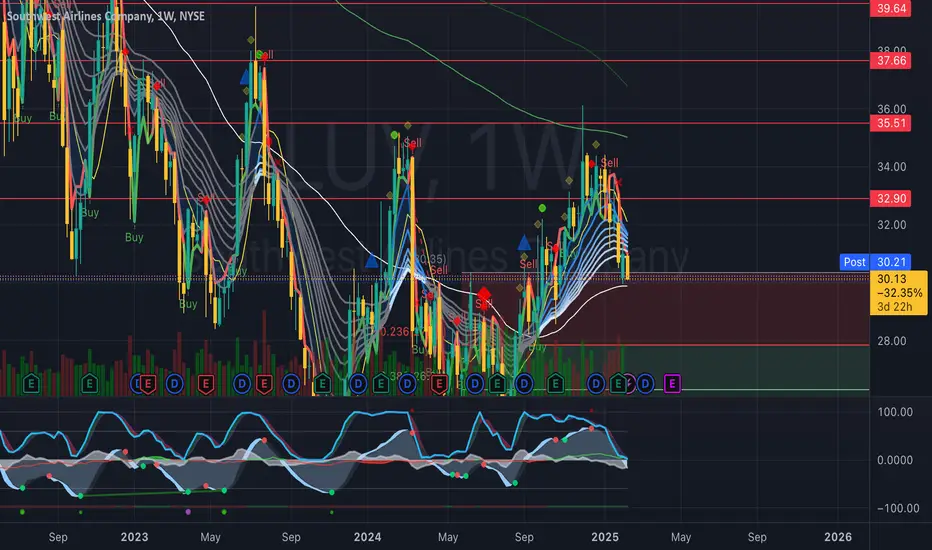
Break below $30 → Downside target: $28
Break below $28 → Next target: $24-$22 (potential capitulation zone)
🛑 Bearish Trade Plan:
Confirmation: If LUV trades under $28 with strong volume, expect accelerated selling.
Put Option Targets: 2/21 $30 puts or $28 puts
Trigger: A rejection at resistance (like $30.50) or continued unusual put flow signals a solid entry.
📈 LUV Bullish Case (Reversal Play)
If buyers step in, a bullish move could develop. Watch these levels:
✅ Key Bullish Levels:
Support hold at $30.50 → Next upside target: $32.79
Breakout above $32.79 → Target $33-$35
🛑 Bullish Trade Plan:
Confirmation: If $30.50 holds with rising volume, we could see a reversal.
Call Option Targets: Watch 2/21 $33 Calls (currently down 50%) to see if volume returns.
Trigger: If call buying picks up and stock reclaims $30.50, momentum could shift upward.
🚀 Unusual Whales Insights & Smart Money Flow
A large play was made on 2/21 $33 calls, but it's down 50%, meaning trapped buyers.
If smart money doubles down on calls, a bullish reversal could happen.
If put volume increases, expect continued downside pressure.
🎯 Final Trading Strategy
1️⃣ Bearish Plan: Enter puts if LUV stays below $30 and unusual put flow increases.
2️⃣ Bullish Plan: Look for bullish volume at $30.50+ and enter calls if call flow strengthens.
3️⃣ Confirmation Tools: Watch VWAP, volume spikes, and unusual options activity to confirm entries.
Southwest Airlines (LUV) - A Bullish Opportunity Ahead!📈 Key Targets:
First Target: $44.07
Based on historical price behavior and current market dynamics.
Stretch Target: $45.58
A potential upside extension if momentum persists beyond the initial target.
Market Observations:
Strong Recovery: The price has shown consistent recovery from previous lows, building a solid case for a continued upward trajectory.
Critical Support: $31.27 serves as a safety net. Any breach below this level could signal a reversal or correction.
Bullish Momentum: Indicators and wave patterns suggest the stock is preparing for a final push to the upside.
Scenarios:
Positive Breakout:
A move beyond recent resistance levels could pave the way for the target zones. Momentum indicators suggest this is a likely path.
Risk to Downside:
A breakdown below $31.27 could invalidate the bullish thesis and lead to a reevaluation.
Risk/Reward Profile:
The current setup provides a favorable risk/reward ratio for a medium-term trade to $44.07, offering significant upside with manageable downside risks.
⚠️ Disclaimer:
This analysis is not financial advice. Please conduct your own research or consult with a financial advisor before making investment decisions. Always manage your risk!
LUV eyes on $28.xx: Double Golden fibs that might start next legAirlines have been on the rise for a while.
LUV earnings beat but stock has dipped.
Major support, long above, short below.
$ 28.53 - 28.92 is the key zone of interest.
$ 27.64 solo fib for SL if long or TP if short.
======================================
.
Southwest Airlines Co.Key arguments in support of the idea.
• Changing the structure of the offer.
• The shares are poised to align with their industry peers.
Investment Thesis
Southwest Airlines Co. (LUV) stands as a prominent leader among passenger airlines in the United States. LUV manages an extensive fleet, comprising 811 Boeing 737 aircraft.
Changing the structure of the offer. Beginning in 2025, the company will start selling assigned seats priced at a minimum of 15% above the base fare. This strategic move is expected to be the primary catalyst for its share growth. By the end of 2025 or early 2026, at least 30% of cabins will be equipped with these new premium seats. Even with a marginal increase in the base fare, the airline's margin is projected to improve significantly. Despite these promising prospects, the market seems determined to overlook the future benefits that Southwest Airlines can achieve with relatively minimal effort.
The shares are poised to align with their industry peers. In the past, following selloffs triggered by the carry trade effect, competitors' stocks experienced significant growth, whereas LUV demonstrated weaker performance due to ongoing proceedings with the activist fund. However, the current technical indicators appear quite favorable, and the sell-off that transpired on the day of the report release has already been recovered. We anticipate that the upward trend will persist through the end of the year. Furthermore, historical data suggests that November and December typically yield positive outcomes for this stock.
For the next two months, the price target for LUV is set at $36.50, with a recommended stop-loss at $27.90.
The #1 Catalyst For South West Airlines Company StockAm dealing with the gap between the rich and poor
its so painful because the moment your friend
starts to make more money than you
its like they make new friends who are more fun
and exciting
and if you are poor or just starting out the only friends
you will have are those that follow your wisdom
and want to better their lives.
Trading is more than just making money for me
its my occupation as most of my friends from
my high school have no clue what I do for
my occupation and if I try to explain
there is a blank stare of doubt
This stock NYSE:LUV
has followed the rocket booster strategy
to the full stop.
What is the rocket booster strategy?
the price has to be above the 50 EMA
the price has to be above the 200 EMA
the price has to gap up
one more step is called the catalyst
in this case, the catalyst is the earning report
which will happen in the pre-market hours
in the morning
one of my mentor called tim sykes calls
this a morning break out.
this is what I predict tomorrow
also, remember on the 2nd of November
am giving you a price update of the
Top13 Iron watchlist
save that date.
Remember to rocket boost this content
to learn more.
Disclaimer: Trading is risky please learn risk management
and profit-taking strategies
because you will lose money wether you like it or not.
Southwest Airlines Welcomes Seat Change and a Massive BoardingAs Southwest Airlines ( NYSE:LUV ) charts a course through turbulent times in the aviation industry, the iconic carrier is contemplating a radical overhaul of its boarding and seating policies. In a bid to address operational challenges and enhance revenue streams, CEO Bob Jordan has hinted at sweeping changes that could revolutionize the passenger experience.
Rethinking Tradition:
Since its inception in the 1960s, Southwest Airlines ( NYSE:LUV ) has prided itself on its unique boarding process, eschewing assigned seats in favor of a free-for-all seating arrangement. However, amidst mounting frustrations and evolving consumer preferences, the airline is reevaluating this hallmark strategy, considering alternatives to streamline the boarding process and optimize cabin utilization.
Navigating Turbulent Skies:
The airline industry has been rocked by unprecedented challenges, with Southwest Airlines ( NYSE:LUV ) facing a particularly turbulent journey in recent times. A dismal earnings report, coupled with significant workforce reductions and route cancellations, has underscored the urgent need for strategic recalibration. Against this backdrop, the exploration of new boarding and seating initiatives emerges as a pivotal strategy for charting a path towards sustained profitability.
Embracing Change:
In a candid acknowledgment of the need for transformation, CEO Bob Jordan has signaled a departure from convention, asserting that Southwest Airlines ( NYSE:LUV ) is actively exploring innovative solutions to enhance the passenger experience and bolster financial performance. By reassessing seating configurations and cabin layouts, the airline aims to unlock new revenue streams while optimizing operational efficiency.
Balancing Tradition with Innovation:
While Southwest Airlines ( NYSE:LUV ) remains committed to its core principles of affordability and accessibility, the company recognizes the imperative of adapting to shifting market dynamics. The proposed changes in boarding and seating represent a delicate balance between preserving the airline's distinctive identity and embracing innovation to meet the evolving needs of modern travelers.
A Vision for the Future:
As Southwest Airlines ( NYSE:LUV ) embarks on this journey of reinvention, the airline industry watches with bated breath, anticipating the potential impact of these bold initiatives. Beyond mere logistical adjustments, the contemplated changes symbolize a broader commitment to reimagining the flying experience, reaffirming Southwest's position as a trailblazer in the skies.
Technical Outlook
Southwest Airlines ( NYSE:LUV ) stock closed Friday trading down 0.84% with a Relative Strength Index (RSI) of 36 trading below the 200-day Moving Average (MA).
Stocks pairs trading: UAL vs LUVWhen evaluating the investment potential between United Airlines Holdings Inc. (UAL) and Southwest Airlines Co. (LUV), several critical factors come into play, guiding a strategic approach to buying UAL shares while considering the sale of LUV.
Reasons to Consider Buying UAL:
Attractive Valuation with Growth Potential: UAL's forward P/E of 3.74 presents a significantly lower valuation compared to LUV's 12.42. This disparity in valuation becomes even more compelling when considering UAL's robust expected EPS growth over the next 5 years at 42.79%. This suggests that UAL is not only undervalued relative to its growth prospects but also stands as a promising investment for those looking at long-term growth.
Market Recovery and Performance: UAL has shown a promising recovery trajectory, highlighted by a 5.85% increase year-to-date and a 4.59% increase over the past quarter. These metrics indicate a solid path to recovery, positioning UAL as an attractive option for investors betting on the airline industry's rebound.
Strong Financial Health Indicators: With a market cap of $14.33B and income of $2.62B, alongside a notable EPS next 5Y growth rate of 42.79%, UAL showcases a sturdy financial foundation. This points to its ability to not just weather industry turbulence but to emerge stronger and more profitable in the coming years.
Reasons to Consider Selling LUV:
Concerns Over High Valuation and Sustainability: Despite LUV's impressive expected EPS growth next year of 48.61%, its high forward P/E of 12.42 raises questions about valuation and growth sustainability. Investors might view LUV as overvalued, especially when juxtaposed against its recent market performance, including a -17.50% drop over the past month.
Short-Term vs. Long-Term Growth Perspectives: LUV's near-term growth prospects are undoubtedly strong. However, when considering long-term investment strategies, UAL's more attractive valuation and substantial five-year growth outlook offer a more compelling case. This suggests that while LUV may provide short-term gains, UAL presents a more favorable long-term growth trajectory at a better value.
Market Performance and Recovery Concerns: LUV's recent performance, including significant monthly declines, contrasts with UAL's recovery momentum. This discrepancy may signal underlying challenges for LUV, potentially making it a less attractive hold for investors focused on stability and sustained growth.
Decision:
Buy 1 UAL: Given its lower valuation, significant long-term growth prospects, and evidence of a strong recovery path, UAL emerges as a strategic buy. Its current market position and financial metrics suggest it is undervalued, offering a favorable opportunity for investors aiming for long-term capital growth within the airline sector.
Sell 2 LUV: Considering LUV's higher valuation and recent market challenges, coupled with sustainability concerns for its short-term growth, it may be prudent for investors to realize potential gains from LUV and reallocate investments towards more undervalued opportunities like UAL, which offers a better growth outlook and valuation proposition.
LUV and Attendants love the Settlement LONGLUV on a 120 minute chart fell heavily on news of a looming strike by flight attendants 18 %
into a bear flag and support followed by a narrow range consolidation and a volatility
squeeze which broke on news of the settlement. I LUV Sowthwest and its travel mileage perks
and open seating. The NR7 indicator on watch was firing continuously. I am taking a long trade
here and now with adds at any dips found moving foward. It is hard to pass by an 18% sale.
This will be profitable and will subsidize travel on LUV.
Southwest Airlines Faces Turbulence Shares Drops by 14.5%Southwest Airlines ( NYSE:LUV ) finds itself navigating through stormy skies as it grapples with the cascading effects of Boeing's ongoing challenges. The airline, renowned for its efficiency and customer-centric approach, has been forced to implement drastic measures, including a hiring freeze and capacity cuts, in response to disrupted aircraft deliveries from the troubled planemaker. As Southwest ( NYSE:LUV ) shares plummet and industry-wide repercussions unfold, the turbulence facing the aviation sector becomes increasingly evident.
Boeing Woes Cast Shadow:
Southwest's decision to slash capacity and halt hiring stems from the ripple effects of Boeing's turbulent saga. Regulatory scrutiny and criminal investigations following a near-catastrophic accident have compelled Boeing to cap output of its 737 Max model, leaving airlines like Southwest in a lurch. With diminished aircraft deliveries and heightened uncertainty, Southwest faces an uphill battle in maintaining operational stability amidst turbulent skies.
Financial Fallout and Industry Impact:
The repercussions of Boeing's woes extend far beyond Southwest, casting a shadow over the broader aviation industry. Alaska Airlines, another casualty of the January accident involving a Boeing 737 Max 9, grapples with capacity uncertainties and financial setbacks. As airlines recalibrate their forecasts and adjust to the evolving landscape, the challenges posed by Boeing's crisis underscore the interconnectedness of the aviation ecosystem.
Navigating Uncertain Skies:
Southwest's revised outlook for the year reflects the harsh realities of navigating uncertain skies. With reduced aircraft deliveries and lower-than-expected leisure passenger volumes, the airline braces for a challenging quarter ahead. However, early indications of strong second-quarter bookings offer a glimmer of hope amidst the turbulence, highlighting the resilience of Southwest's customer base in the face of adversity.
Industry Insights and Outlook:
As the aviation industry converges at a pivotal industry conference, airlines confront a landscape fraught with challenges and opportunities. While American Airlines anticipates a first-quarter loss at the low end of expectations, Delta Air Lines maintains optimism with robust revenue growth projections. JetBlue Airways, meanwhile, grapples with declining revenue but remains cautiously optimistic about cost management and capacity adjustments.
$LUV - Southwest going South?NYSE:LUV Daily:
- Climbed above the 200 DMA, with 20 and 50 DMAs aligning for further upward momentum.
- Bullish if we solidify support at the 30.16 level.
- Earnings on Jan 25 (Thurs) will be crucial to see if this uptrend is genuine or just a false breakout.
- If not sustained, we might soon retest the 27.31 low.
Note: Airlines remain a mixed bag with cost control being a key factor.
Highlighting $LUV's Key Pivot Level
Fundamentals Analysis
1. NYSE:LUV announced a quarterly dividend of $0.18 per share, payable on January 6, 2024, to shareholders of record on December 20, 2023.
2. NYSE:LUV faced a regulatory action from the Federal Aviation Administration (FAA), which proposed requiring Boeing 737 operators to replace certain fan blades after a fatal incident involving a Southwest flight in 2018.
Technical Analysis
NYSE:LUV 50-day Moving Average is trading below the 200-day Moving Average of the stock indicating a Bearish Trend.
Despite the current trend, NYSE:LUV 's showing signs of a Retest at the 2nd Pivot Level.