Boeing Wave Analysis – 18 September 2026– Boeing broke support level 205.00
– Likely to fall to support level 188.00
Boeing shares recently broke through the support zone between the key support level 205.00 (which has been reversing the price from July) and the support trendline of the wide weekly down channel from May.
The breakout of this support zone accelerated the active short-term impulse wave 3, which belongs to intermediate impulse wave (3) from May.
Given the strong daily downtrend, Boeing can be expected to fall further to the next support level 187.40 – former multi-month low from March.
In-depth trading ideas
BA | Continued stock growth- Timeframe: Weekly
- Trade type: Buy stop order
- Price: 212.26
- Take Profit: Open
- Stop Loss: 205.50 (-3.20 %)
Idea: Long on a breakout above last week's high - bullish momentum continuation.
Entry: Buy stop above last week’s high.
Stop-loss: Below the low of the same candle.
If the weekly candle closes below this level, the trade is invalidated.
Take Profit: Trailing stop following the lows of new weekly candles.
Boeing May Face Breakdown RiskBoeing has limped for months, and some traders may see risk of a breakdown.
The first pattern on today’s chart is the series of lower highs since January. This contrasts with breakouts in both the S&P 500 and the broader industrial sector, potentially reflecting a lack of relative strength.
Second, the 50-day simple moving average (SMA) recently had a “death cross” below the 200-day SMA.
Third, the 8-day exponential moving average (EMA) is under the 21-day EMA. MACD is also falling. Those signals may be consistent with short-term bearishness.
Next, the aerospace company bounced around $205 in July. It’s been trying to hold in the same area in recent weeks. Traders could monitor that line for evidence of a breakdown.
Finally, they might eye November’s 52-week low of $176.77 as a potential level to test.
TradeStation has, for decades, advanced the trading industry, providing access to stocks, options and futures. If you're born to trade, we could be for you. Learn more here about TradingView’s Broker of the Year!
Past performance, whether actual or indicated by historical tests of strategies, is no guarantee of future performance or success. There is a possibility that you may sustain a loss equal to or greater than your entire investment regardless of which asset class you trade (equities, options or futures); therefore, you should not invest or risk money that you cannot afford to lose. Online trading is not suitable for all investors. View the document titled Characteristics and Risks of Standardized Options at www.TradeStation.com . Before trading any asset class, customers must read the relevant risk disclosure statements on www.TradeStation.com . System access and trade placement and execution may be delayed or fail due to market volatility and volume, quote delays, system and software errors, Internet traffic, outages and other factors.
Securities and futures trading is offered to self-directed customers by TradeStation Securities, Inc., a broker-dealer registered with the Securities and Exchange Commission and a futures commission merchant licensed with the Commodity Futures Trading Commission). TradeStation Securities is a member of the Financial Industry Regulatory Authority, the National Futures Association, and a number of exchanges.
TradeStation Securities, Inc. and TradeStation Technologies, Inc. are each wholly owned subsidiaries of TradeStation Group, Inc., both operating, and providing products and services, under the TradeStation brand and trademark. When applying for, or purchasing, accounts, subscriptions, products and services, it is important that you know which company you will be dealing with. Visit www.TradeStation.com for further important information explaining what this means.
BA LONG — 4H ALMA Setup (WR 73% · avg RR 1.3)█ SETUP
NYSE:BA · 4H · long only.
(Context: Boeing — commercial airplanes + defense/space beta — trades with deliveries, FAA certification path, and labor/quality headlines, not a discretionary “buy the aerospace dip” call.)
ALMA Averaging Strategy: ALMA 3 / σ2, SD band 2, min diff 6/1, 25% per bar, up to 4 adds, hard stop −10% from average entry.
Strategy Tester (BA 4H):
Win rate 73% · profit factor 1.8 · max drawdown 25%
Avg winning trade +6.9% · avg losing trade −5.3%
Typical hold ~27×4H bars on winners — aerospace mean-reversion grid on the 4H Averaging template · 267-trade sample
═
█ WHY NOW
Fresh 4H ALMA arm into the post-certification fade — now three lots on this clock:
· lot 1 — 24 Aug 13:30 UTC ~ 212.25
· lot 2 — 24 Aug 17:30 UTC ~ 210.07
· lot 3 — 25 Aug 13:30 UTC ~ 212.45 (3 of 4)
Working average ~ 211.6 . Bar-close ladder into the ~$210–212 pocket after the Aug slide from the early-Aug ~$233 zone, not a size-up on a PT headline. Hard stop −10% from the working average ~ 190.4 . Exits follow Pine ALMA flip + min diff or the hard stop. Scale-in stays 25% per bar, up to 4 adds, if lower bars qualify.
═
█ MACRO
Sector: BA = commercial airplanes (737/787/777X) + defense/space + Global Services — beta to deliveries, FAA oversight, FCF path, and labor/quality risk more than Mag7 leadership.
Tape (03–25 Aug): 03 Aug FAA type certificate for the 737-7 popped the tape (~+ 8% session) after Q2 ( 28 Jul : rev ~$24.6B, FCF ~$631M, backlog record ~$715B, still GAAP loss); then fade ~$232 → ~$210 into late Aug — 07 Aug 737 MAX fuselage-inspection headlines, 10 Aug eVTOL subsidiaries sold / Archer stake, 20 Aug Air Force One schedule pressure, 21 Aug SPEEA engineers/technical rejected the contract (strike setup). Research Hub feed also flagged late-Aug Street pressure ( RBC PT ~ $265 from ~$275) and relative underperformance vs GE Aerospace in 2026 sector compares ( 24 Aug ). Execution is 4H ALMA Averaging on the fill closes — not a certification, SPEEA, PT, or AF1 forecast.
═
█ OUTLOOK
Factor board from 25 Aug ~ 211.5 (long-score ~49.2 · short-score ~−38.6) — same ~$210–212 pocket as the three-lot blend.
Positive factors
- Tester: 73% WR · PF 1.8 · avg win +6.9% vs avg loss −5.3% (avg RR 1.3) · 267-trade sample — hit-rate edge with a bounded −10% stop (below the usual 75% Idea gate — transparency)
- Pyramid already 3 of 4 — Averaging cushion building into the post-cert wash, not a one-tick scalp
- EMA — 1H Below time-stretched: 1H Cur S:43 vs Avg S:10.1 · Dev +1.1% — LTF sell-time stretch into the fill pocket
- EMA — 4H / 1D Below with Dev stretch: 4H Cur S:12 · Dev +5.0% · 1D Cur S:6 · Dev +4.8% — execution ladder discounted vs the mean after the Aug fade
- ALMA — 1D / 3D OVERHEAT-S: 1D SHORT · S:7 vs SAvg:4.2 · OVERHEAT-S · 3D S:4 vs SAvg:3.2 · OVERHEAT-S — daily/structure clocks pressed below the band
- SMC — 4H OB Enter Breaker Bull ~ 210.45 ( 24 Aug ) · bounce B 46.1% · break Br53.9% (n=102) — demand print under the ladder (break skew still loud)
- SMC — 1D OB Enter Normal Bull ~ 210.46 ( 24 Aug ) · bounce B 48.4% · break Br51.6% (n=153) — daily demand at the same pocket
- VWAP — Support touched ~ 211.95 — price sitting on the active support rail into the board
- ALMA — 4H LONG still young: L:1 vs LAvg:3.2 — execution clock just flipped; lower adds or the stop can print first
Negative factors
- ALMA — 1W SHORT still young: S:2 vs SAvg:3.1 — weekly band not fully stretched
- EMA — 3D / 1W Below still young: Cur S:2 on both — slow below-sessions not mature; wash can extend
- SMC — 4H / 1D OB bounce under 50% — demand events with break-side skew, not clean holds
- TL — Ranging Channel ( 24 Aug ) · bounce B 33% · break Br67% (n=30) — range/break-down skew at the arm zone
- Price-action tag: Bearish FVG Formed — overhead inefficiency still on the board
- VWAP — Resistance active ~ 225.86 / ~ 223.08 — supply shelves overhead after the early-Aug spike
- SPEEA strike setup + quality/AF1 headlines can gap aerospace beta before the ~27-bar sample hold completes
- Hub tape: RBC PT trim + GE Aerospace leadership vs BA in 2026 sector compare — Street/relative drag into the ~$210 pocket
- Thin lot-4 room left — next add is the last 25% rung on this template
Takeaway: the 4H ALMA strategy and 1.3 avg RR support a disciplined three-lot arm ~$212 after the post-737-7 fade, with 1D/3D ALMA OVERHEAT-S, 1H/4H/1D EMA below-stretch, and 4H/1D bull OB prints framing repair fuel — but sub-75% WR, young 4H ALMA LONG / slow below-sessions, ranging-channel break skew, bearish FVG / VWAP resistance overhead, and labor headline risk frame a grind under supply, not a clean reclaim chase; nominal risk stays on the −10% hard stop / Pine exit path.
Base case: follow 4H ALMA Averaging · hold/add on the last qualifying close while the ~$210–212 pocket digests · mean-revert toward the prior mid-$220s / VWAP resistance band if aerospace beta stabilizes without a gap through the stop.
Bear case: lose the ~$208–210 pocket · SPEEA/quality headline gaps lower · template posts −10% toward ~190 from the working average · wait for the next bar-close arm.
Chart: NYSE:BA 4H — ALMA Averaging Strategy.
Educational idea. Live position — past backtest ≠ future results. NFA.
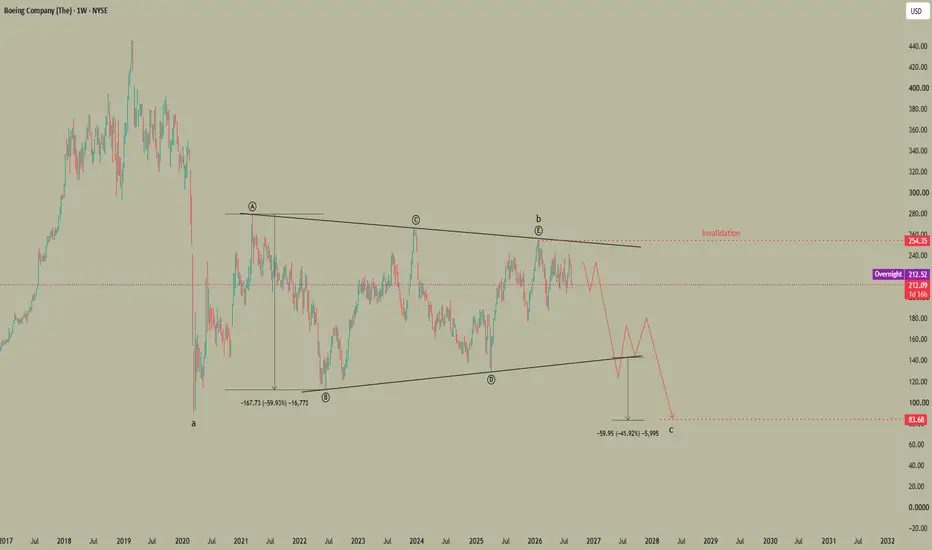
BOEING - Multi Year TriangleBoeing has been painting a pretty clear symmetrical triangle pattern between 2020 and 2026 which could be ABCDE waves for wave B.
Triangles formed after a bear trend tend to lead to a continuation of the bear trend so could expect the triangle lower trendline to be tested and broken in the future to complete wave C.
Invalidation would be a break above wave E at $254.
You can use Bulkowskis method for calculating targets for triangle breakouts:
thepatternsite.com
Compute the height from the highest peak to the lowest valley in the triangle pattern then multiply it by 36%. Add it (upward breakouts) or subtract it (downward breakouts) from the breakout price; that puts a target around $84 (depending exactly where the triangle breaks on the downside).
Boeing Wave Analysis – 17 August 2026 – Boeing falling inside impulse wave 3
– Likely to fall to support level 220.00
Boeing continues to fall inside the minor impulse wave 3 which started earlier from the pivotal resistance level 240.00 (which reversed wave (2) sharply in May).
This active impulse wave 3 belongs to the intermediate impulse wave (3) which started from the aforementioned resistance level 240.00.
Boeing can be expected to fall further to the next support level 220.00, former resistance which reversed Boeing twice in July.
Trump’s Air Force One:contract weighing on Boeing as it recoversBy Ion Jauregui – Analyst at ActivTrades
Boeing (NYSE: BA) closed the first half of 2026 with signs of operational stabilisation, although cost overruns related to the new Air Force One programme continued to weigh on its results.
The company reported a larger-than-expected quarterly loss in the second quarter after taking additional charges related to the VC-25B programme. However, revenue exceeded market expectations and free cash flow returned to positive territory, supported by higher commercial aircraft deliveries.
During the first quarter, Boeing generated approximately $22.2 billion in revenue, with 143 commercial aircraft delivered. In the second quarter, revenue increased to around $24.6 billion, while deliveries reached 171 units, the highest quarterly volume since 2018.
Production progress remains the main focus for investors after several years marked by regulatory restrictions, supply chain issues and industrial delays that limited Boeing’s ability to meet demand from its large order backlog.
Air Force One continues to pressure margins
The VC-25B programme, designed to replace the current US presidential aircraft, remains one of Boeing’s main financial challenges. The company signed a fixed-price contract in 2018 worth approximately $3.9 billion to transform two Boeing 747-8 aircraft into presidential aircraft. Under this type of agreement, Boeing must absorb additional costs arising from delays or deviations from the initial budget.
The complexity of the project has increased costs due to the integration of secure communication systems, defensive capabilities and specialised equipment required to ensure the operational continuity of the US government.
The cost of official aircraft is also a subject of debate in Europe. Countries such as France, Germany, Italy and Spain operate state aircraft for the transportation of their main authorities. In Spain, the use of government Falcon aircraft by the Prime Minister has generated political criticism regarding the frequency of some trips and transparency surrounding operating costs.
Technical analysis: Boeing consolidates a recovery trend
Boeing shares closed the latest session at $214.18, while the pre-market price stood at $213.61. The market reaction following the results suggests investors are placing greater emphasis on the company’s operational improvement than on the one-off impact of Air Force One costs.
From a technical perspective, Boeing maintains a long-term bullish structure that began in April 2025, defined by a sequence of higher lows. The recovery started from the floor established at $128.88, which remains the key long-term structural reference.
Since then, the stock has developed ascending support levels at $176.26, $187.65 and $203.90, with the latter becoming the key reference after the most recent low before the latest rebound. As long as the price holds this area, the recovery structure remains intact.
On the upside, Boeing faces a significant resistance zone at the highs of $242.69 reached in July 2025 and January 2026. Subsequently, the stock reached a high of $244.07 in May, forming what could be interpreted as a potential head-and-shoulders pattern, although confirmation would require a clear break of current support levels.
The moving averages are currently compressed, reflecting a phase of balance between supply and demand. This type of configuration often precedes a more defined directional move, although no clear technical signal has emerged yet.
Momentum indicators show a neutral setup. The RSI stands at 47.39%, close to the middle range, indicating the absence of overbought or oversold conditions. The MACD has recently moved below the bearish zone, although the histogram remains negative, suggesting that selling pressure has not completely disappeared.
In the short term, the $203.90 area will be the most relevant technical level to monitor. Holding this support would favour the continuation of the recovery, while a break below it could trigger a corrective phase. On the upside, overcoming intermediate resistance levels would be necessary for Boeing to move back towards its annual highs.
The stock’s recovery will depend on the company’s ability to increase production, improve margins and establish sustainable positive cash generation. Air Force One will remain a negative factor for earnings, but the market appears focused on Boeing’s ability to normalise its commercial operations.
*******************************************************************************************
The information provided does not constitute investment research. The material has not been prepared in accordance with the legal requirements designed to promote the independence of investment research and such should be considered a marketing communication.
All information has been prepared by ActivTrades ("AT"). The information does not contain a record of AT's prices, or an offer of or solicitation for a transaction in any financial instrument. No representation or warranty is given as to the accuracy or completeness of this information.
Any material provided does not have regard to the specific investment objective and financial situation of any person who may receive it. Past performance and forecasting are not a synonym of a reliable indicator of future performance. AT provides an execution-only service. Consequently, any person acting on the information provided does so at their own risk. Political risk is unpredictable. Central bank actions can vary. Platform tools do not guarantee success.
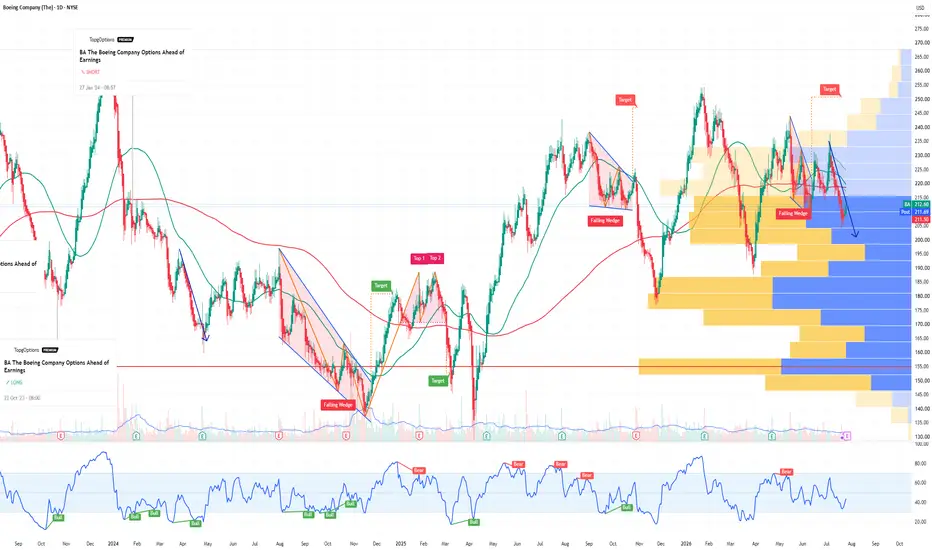
BA The Boeing Company Options Ahead of EarningsIf you haven`t sold BA before the previous earnings:
Now analyzing the options chain and the chart patterns of BA The Boeing Company prior to the earnings report this week,
I would consider purchasing the 215usd strike price Puts with
an expiration date of 2026-12-18,
for a premium of approximately $18.80.
If these options prove to be profitable prior to the earnings release, I would sell at least half of them.
Boeing ($BA): One of the Most Asymmetric Aerospace Setups Right Entry: $222
Stop: $175
Target: $300+
While most investors are focused on AI, semiconductors, and software, Boeing may be quietly building one of the more interesting long-term setups in the market.
The reason is surprisingly simple.
Commercial aviation is effectively a duopoly.
If an airline wants to purchase large commercial aircraft at scale, there are realistically only two major options: Boeing and Airbus. Despite years of operational challenges, delays, and negative headlines, the long-term demand for aircraft has not disappeared. In fact, global aircraft order backlogs recently reached record levels, representing roughly a decade or more of production for the industry.
What makes Boeing interesting today is not where the company has been.
It's where it appears to be heading.
Recent production data shows Boeing continuing to increase commercial aircraft output, including the launch of a new 737 MAX assembly line designed to support higher production rates over the next several years.
At the same time, Boeing's commercial backlog has grown to more than 6,100 aircraft with a total company backlog approaching $700 billion.
That's not the profile of a business facing demand problems.
That's the profile of a company trying to execute on demand it already has.
Another factor investors may be underestimating is geopolitical support.
Aerospace remains a strategic industry for the United States. Boeing is not just a commercial aircraft manufacturer; it is also deeply integrated into U.S. defense, exports, and industrial policy. Large international aircraft agreements often become part of broader diplomatic and trade discussions.
From a technical perspective, Boeing has spent years consolidating below previous highs while sentiment remains far from euphoric.
If execution continues improving, production ramps successfully, and upcoming earnings reinforce the recovery narrative, I believe the market could start pricing Boeing as a recovery story rather than a turnaround story.
The risk is obvious: execution issues, safety concerns, supply-chain disruptions, or a broader market shock.
But if those risks remain contained, the risk/reward here looks attractive.
My thesis is simple:
Global air travel demand continues to grow.
The Boeing-Airbus duopoly remains intact.
Production is gradually improving.
Backlog remains enormous.
Sentiment is still far below historical peaks.
Sometimes the biggest opportunities appear when a great business is still being judged by its past instead of its future.
Trade Setup
Entry: $222
Stop: $175
Target: $300+
Not financial advice. Just sharing my research and market observations.
#Boeing #BA #Stocks #Investing #SwingTrading #StockMarket #Aerospace #Airlines #ValueInvesting #MarketAnalysis #TechnicalAnalysis #TradingIdeas #WallStreet #LongTermInvesting
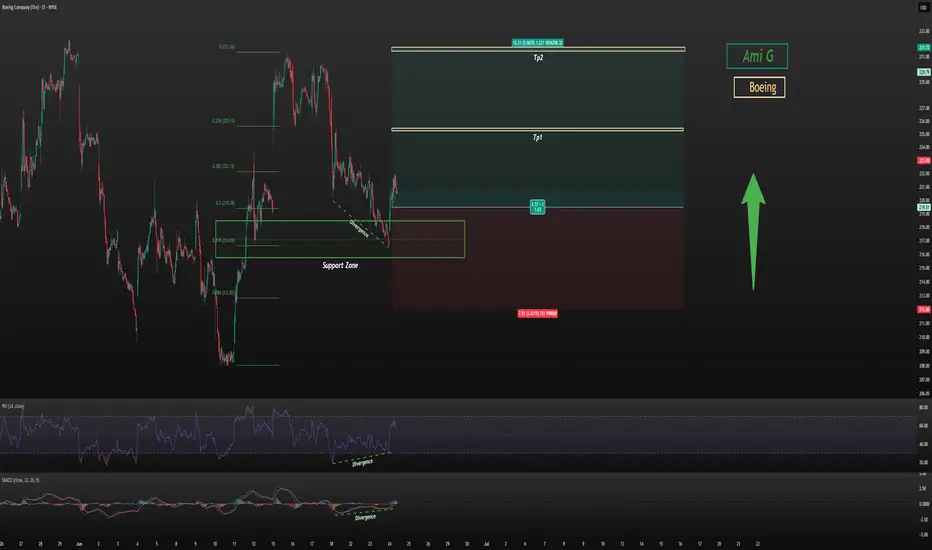
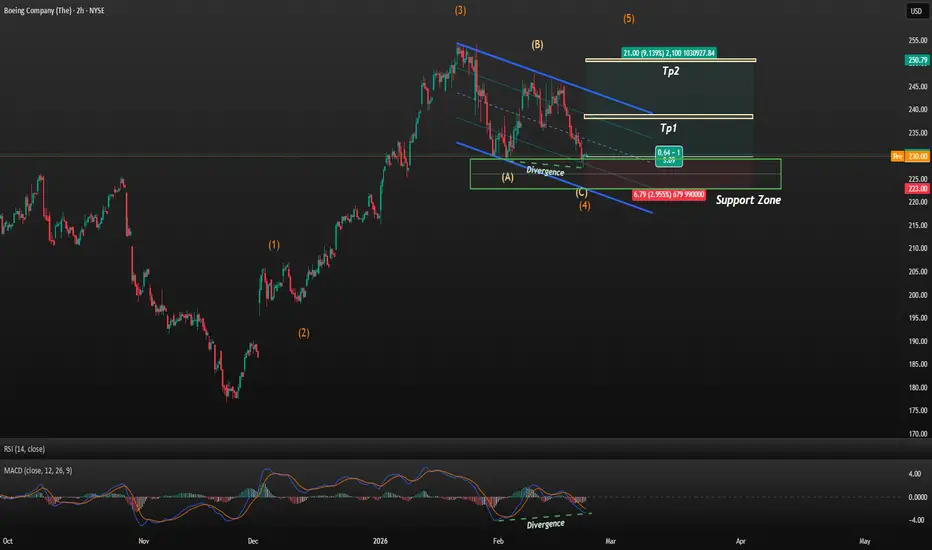
Live Trade Setup — Boeing (BA) Boeing (BA) — Live Trade NYSE:BA
Technical Context
As we can see, after a strong bullish advance and a breakout above several key price levels, the stock has entered a corrective phase and is now trading within a well-defined support zone.
Confluence Factors
* The current support area aligns with the 0.618 Fibonacci retracement level.
* Both RSI and MACD are showing acceptable bullish divergences, suggesting that bearish momentum may be weakening.
Trading Signal
In addition, one of our proprietary trading systems has generated a buy signal in this area, providing further confirmation for the setup.
Potential Targets
Based on the current market structure, price may have the potential to:
Move first toward TP1
Then continue higher toward TP2
As always, manage risk properly and trade according to your own strategy.
Follow proper risk and money management.
This is just my personal view, so please trade based on your own strategy and trading system.
Feel free to share your thoughts in the comments.
Boeing Bearish Setup: Two Major Reversal Patterns EmergeTechnically Boeing does not loot good. Dual bearish pattern align; big ABCDE pattern and a Head & Shoulders. Technically it looks very bearish. Also it looks like impulse, correction, impulse. Looks like traders and investor will ground Boeing.
Boeing: Boeing breaks 100-EMA: Bearish MACD signals downside!We dissect the breakdown of Boeing's market structure and outline how to tactically trade this coordinated momentum shift using key indicators.
Key highlights covered:
The structural breakdown : Analysis of the price action dropping below the 20-day, 50-day, and 100-day EMAs, converting a prior support cushion into an aggressive overhead supply wall.
The MACD bearish confirmation : Why the clean downside crossover below the signal line and an expanding negative histogram validate that heavy institutional selling is driving this move.
RSI downside runway : Evaluating the Relative Strength Index at 45.39, proving that the stock has strong bearish velocity without being trapped in oversold territory.
Actionable short parameters : Mapping out a precision tactical short entry horizon between 217.50 and 219.50, a primary structural target at 206.00, and a risk management stop loss at 223.80.
I ignore market sentiment and execute strictly on structural alignment. Watch the full technical update to protect your trading capital and establish your risk parameters for the sessions ahead.
Trading Boeing: Why the $217–$219 cluster caps near-term upsideThe global aerospace and defense sector is showing some serious performance differences. Supply chain troubles and strict quality control are really impacting orders coming in. After a small boost in the middle of the quarter, things dipped again. This downturn is mainly due to ongoing regulatory issues, delivery hold-ups, and investors moving away from capital-intensive industries with higher operating costs.
From a technical standpoint, things look grim. The price action dropped below its short-term and medium-term EMAs the 20-day, 50-day, and 100-day EMAs all act as strong resistance levels around 218.58 to 230.48. Momentum is clearly with the sellers here. The RSI is sitting at 45.39, still pretty weak and showing significant downward pressure. It hasn’t hit lows that would suggest an imminent rebound, though. The MACD adds to this picture; the line crossed below the signal line, and the negative histogram is getting bigger. This all shows that the big players are continuing to sell off.
Trade Recommendation :
Direction : Short
Entry horizo n: 217.50 – 219.50
Primary target : 206.00 .
Secondary target : 198.50.
Stop loss : 223.80
Technical scenarios
Bearish breakdown : A daily close below 213.50 with an expanding MACD histogram will trigger immediate downward acceleration toward the 206.00 major support zone.
The dead-cat churn : If the price remains bound between 215.00 and 220.00 while the RSI flattens near 45, volatility will temporarily compress as the market digests distribution ahead of the next corporate delivery update.
Bullish : A clean daily close above 221.50 with a bullish convergence curl on the MACD will pause near-term bearish momentum, potentially triggering a short-covering squeeze back toward the 225.84 line.
BA accelerates from the 200-day moving averageBA stock is bouncing off the 200-day moving average
The rotation from AI stocks to industrial sector can lift BA higher and make it break to the new peak
📌 Core Thesis
BA is currently trading near multi-year structural lows, priced for worst-case scenarios after prolonged production halts, regulatory scrutiny, and supply chain bottlenecks. However, the fundamental thesis is shifting from "crisis management" to a coiled-spring turnaround play for late 2026 and 2027 as production normalized and defense margins stabilize.
The consensus forecast is $275, according to the edition.cnn.com
The technical realization is momentum trade with a scope of 3-10 days, whithin which the stock can achieve the project target.
Don't forget - ths is just the idea, always do your own research and never forget to manage your risk!
the current pull back is healthyBA is in a Re-Accumulation / Phase C–D transition. The stock carved a clear Spring off $176.77 (52-week low) in late 2025, rallied through a Sign of Strength to ~$254, then retraced back into the trading range. The current price action near $210–$225 is consistent with Last Point of Support (LPS) testing — institutions absorbing supply before a potential markup leg.
Boeing Setup: Social Sentiment Points to Short-Term UpsideCurrent Price: 227.38 (Analysis was generated on Monday Morning)
Direction: LONG
Confidence level: 45%(Limited YouTube trader commentary but X sentiment shows more bullish than bearish discussion and price is holding above support near $220, suggesting modest upside bias.)
Targets
Target 1: 232.00
Target 2: 236.00
Stop Levels
Stop 1: 222.00
Stop 2: 218.00
Key Insights:
Here’s what stands out right now. The professional trader data didn’t produce strong directional commentary about Boeing this week, which is unusual for a large industrial stock. That lack of bearish discussion actually matters—when traders see clear downside risk, they tend to talk about it loudly. Instead, the silence on the bearish side suggests the market isn’t expecting a sharp correction right now.
At the same time, social sentiment from trading discussions is tilting positive. Several trading conversations point to accumulation behavior rather than distribution. Even though many comments are cautious, the bullish messages clearly outnumber bearish ones, and that usually reflects traders positioning for a short‑term bounce rather than preparing for a selloff.
Recent Performance:
Boeing has been trading around the $220–$230 zone recently, holding above the mid‑$220s despite broader market volatility. That stability is important. When a stock refuses to break lower while sentiment improves slightly, it often leads to a gradual move higher as traders step in on dips. The $227 area is sitting roughly in the middle of that range, which makes a push toward the upper band plausible this week.
Expert Analysis:
Several professional traders following industrials are paying attention to Boeing’s ability to hold above the $220 area. That level has acted as a short-term support zone in recent sessions. When traders see repeated defenses of a level like this, they often interpret it as institutional buying.
Another interesting point is positioning. Because there’s limited bearish discussion among the traders tracked this week, short pressure looks relatively light. When a stock climbs without heavy short interest pushing back, upside moves tend to be smoother and faster, especially if momentum traders jump in.
News Impact:
From a news perspective, Boeing continues to sit at the intersection of defense demand, aerospace recovery, and manufacturing progress. While there isn’t a single headline driving this week’s move, the broader narrative around aircraft demand and production normalization in 2026 continues to support investor sentiment. That background theme gives traders a reason to buy dips rather than aggressively short the stock.
Trading Recommendation:
Putting it all together, I’m leaning toward a short‑term LONG setup on Boeing. The combination of mild bullish social sentiment, absence of bearish trader commentary, and price stability near support suggests a bounce toward the low‑$230s is realistic this week. I’d look for entries near the current $227 area with targets at $232 and $236. Risk should be controlled with stops below $222 and stronger protection at $218 in case the support zone fails. Confidence isn’t extremely high due to limited direct trader commentary, so position sizing should stay moderate.
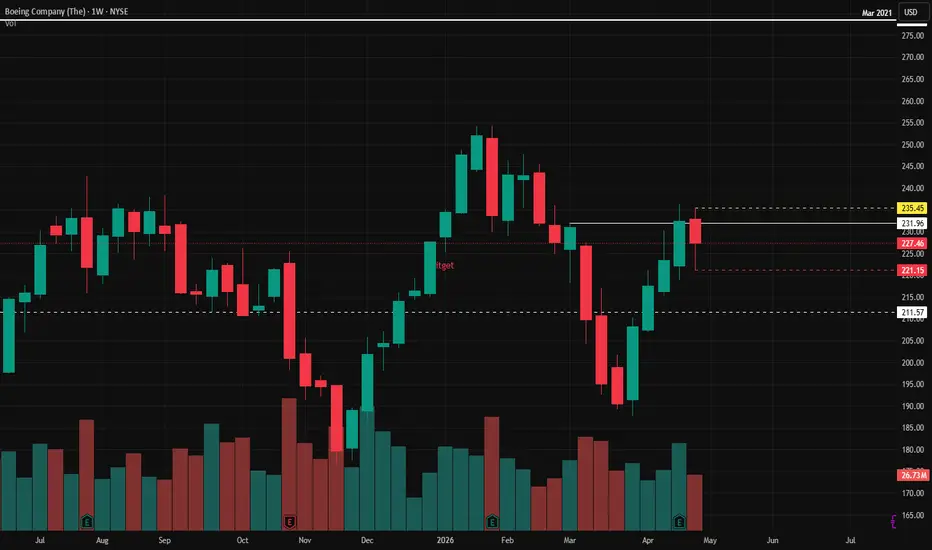
May 3, 2026 BA. Continued stock growth.- Exchange: Bitget TradFi
- Instrument: BAon
- Timeframe: Weekly
- Trade type: Buy stop order
- Price: 235.45
- Take Profit: Open
- Stop Loss: 221.15 (-6.10 %)
Idea: Long on a breakout above last week's high — bullish momentum continuation.
Entry: Buy stop above last week’s high.
Stop-loss: Below the low of the same candle. A pullback below this level invalidates the trade.
Take Profit: Trailing stop following the lows of new weekly candles.
This is not an individual investment recommendation.
A list of over 250 Bitget TradFi (stock tokens)
Boeing holding $230 support – traders eye short‑term upsideCurrent Price: 232.44 (Analysis was generated on Monday Morning)
Direction: LONG
Confidence level: 45%(Limited Boeing-specific trader commentary, but both trader sentiment and X signals lean bullish with no bearish signals present. Low data volume reduces certainty.)
Targets
Target 1: 238.00
Target 2: 244.00
Stop Levels
Stop 1: 227.00
Stop 2: 222.00
Key Insights:
Here’s what stands out first: trader sentiment across available channels leans bullish, even though direct Boeing‑specific commentary from professional traders is limited in the provided data. The few signals we do have point toward buyers stepping in rather than aggressive selling. Importantly, none of the trader insights suggested a breakdown scenario.
What I’m seeing is a market environment that’s broadly supportive for large U.S. industrial names. Professional traders highlighted strong equity momentum overall, with major indices pushing higher and capital flowing into large‑cap sectors. When that kind of macro tailwind shows up, companies like Boeing often benefit from passive inflows and institutional rotation.
Another thing worth watching is the $230 area. With the stock currently around $232, that level acts like a short‑term psychological support. If buyers keep defending it this week, a move toward the mid‑$240s becomes a realistic short‑term target.
Recent Performance:
Boeing has been moving inside a broad consolidation range recently, and the current price sits roughly in the middle of its short‑term trading zone. The stock hasn’t shown aggressive downside momentum lately, which tells me sellers aren’t fully in control. Instead, price action has been stabilizing around the low‑$230s, a sign that accumulation may be happening under the surface.
Expert Analysis:
Several professional traders tracking large‑cap equities pointed out the strength in the broader U.S. market. With trillions added to total market value during the recent rally, capital rotation into industrial and defense names is a real possibility.
At the same time, the X sentiment analysis shows bullish positioning dominating the conversation. Out of the trading‑relevant posts detected, bullish signals clearly outnumbered other views, and there were no strong bearish arguments circulating. That kind of imbalance usually suggests traders are positioning for a bounce rather than a breakdown.
So when I combine the macro bullish environment with the supportive social sentiment, the short‑term bias tilts upward.
News Impact:
There hasn’t been a major negative catalyst affecting Boeing recently, which matters more than people realize. In a market already pushing higher, the absence of bad news can allow momentum to slowly lift the stock. Meanwhile, ongoing demand for aerospace manufacturing and defense spending continues to support the longer‑term narrative.
Trading Recommendation:
Here’s my take: I’m leaning LONG on Boeing for a short‑term swing this week. The stock is holding above $230 support while broader market momentum remains positive. I’d look for a move toward $238 first, with a possible extension to $244 if buyers step in aggressively.
Risk management is key with the relatively low data confidence. I’d keep stops tight at $227, with a hard invalidation level near $222. If the stock holds above $230 and momentum picks up, the upside trade toward the mid‑$240s becomes a solid short‑term opportunity.
Live Trading on Boeing (BA)As you can see, the price is completing its Wave 4 within an Elliott Wave structure. Given the confluence of the support zone, the 25% parallel channel area, and a valid divergence on the MACD, it appears that the price may move from this zone at least toward the TP1 level and then potentially to TP2.
Follow proper risk and money management.
This is just my personal view, so please trade based on your own strategy and trading system.
Follow me on TradingView for more analyses and live stock trades.
Boeing (BA): A Duopoly Franchise Still Searching for Its EconomiBoeing (BA): A Duopoly Franchise Still Searching for Its Economics
Executive Summary:
Boeing remains one of only two companies capable of producing large commercial jetliners at global scale. That position alone almost guarantees the company a place in global aviation for decades. The challenge for investors is that the current thesis depends on an operational recovery that still has not produced consistently durable free cash flow. Accounting profitability has improved, but cash generation remains uneven, leverage is elevated, and capital intensity is climbing as Boeing works to repair manufacturing systems and rebuild trust with regulators.
Margin of safety verdict: At roughly $217 per share, Boeing appears to be priced for a successful turnaround rather than trading at a clear discount to conservative intrinsic value. For investors focused on durable free cash flow and returns on capital, the stock likely belongs on a watchlist rather than in a portfolio.
One Stock, Dozens of Voices:
This is not built on a single analyst's view. CrowdWisdom aggregated 32 independent sources for BA (6 professional trader videos (YouTube); 20 financial research articles (web); 1 live market intelligence feeds; 4 prior CrowdWisdom analysis snapshots (internal archive); 1 verified financial data checks (Yahoo Finance)) and synthesized the shared thesis: where traders, investors, and researchers broadly agree, where opinions diverge, and what the market might be overlooking.
Those viewpoints were then tested against each other through opposing scenarios: a bull case, a bear case challenging consensus assumptions, and an assessment of what expectations are already embedded in the current share price. All financial metrics were cross checked against live market data.
What follows highlights where opinion aligns, where it fractures, and whether today's price leaves any real margin of safety.
Business Quality and Moat Durability:
At first glance Boeing resembles the textbook wide moat industrial business. The global large aircraft industry effectively operates as a duopoly with Airbus. Between them, the two companies produce the vast majority of commercial jetliners delivered worldwide. The barriers to entry are formidable: regulatory certification, decades of aerospace engineering capability, massive capital requirements, intricate supplier networks, and high switching costs for airlines.
Airlines rarely change aircraft suppliers on a whim. Pilot training, spare parts logistics, maintenance infrastructure, and fleet commonality all lock in long decision cycles that can stretch across decades. Once an airline commits to an aircraft family such as the 737 or the A320, that choice tends to persist across multiple fleet generations.
That installed base also creates a second economic layer. Once planes are delivered, manufacturers participate in decades of aftermarket revenue through maintenance services, spare parts, and software upgrades. These revenue streams typically carry higher margins than the initial aircraft sale.
In theory, this structure should produce durable economics.
In practice, Boeing’s moat has been weakened by internal missteps rather than competitive pressure. The 737 MAX crisis, manufacturing defects, and extended regulatory scrutiny damaged trust with airlines and aviation authorities. During Boeing’s recovery period, Airbus captured incremental share in the critical narrow body market.
Moat verdict: structurally stable but reputationally weakened. The duopoly still stands, but Boeing’s execution issues have temporarily reduced its practical advantage.
Return on Invested Capital (ROIC):
Historically Boeing produced attractive returns on invested capital during strong production cycles. Aircraft programs demand enormous upfront development spending, but once fleets are deployed they can generate decades of high margin aftermarket revenue.
The current picture looks very different.
Recent financial data shows:
Revenue approximately $89.5 billion in FY2025, growing modestly year over year.
Gross margin roughly 4.8 percent.
Operating margin roughly 4.8 percent.
Net margin roughly 2.5 percent.
Those margins are thin for a business with such heavy capital requirements.
Capital expenditures have also risen meaningfully. Capex increased to roughly $2.94 billion in 2025 and management guided toward approximately $3.9 billion in 2026. A large share of this spending is not growth investment but remediation capital aimed at strengthening manufacturing quality controls, stabilizing the supply chain, and satisfying regulatory oversight.
In other words, much of the incremental capital is being deployed to repair operational issues rather than expand high return programs.
Because explicit ROIC data is unavailable in the dataset, the closest proxy is free cash flow relative to invested capital. On that measure the business currently generates negative incremental returns.
Until consistent free cash flow returns, it is difficult to argue Boeing is earning attractive returns on incremental capital.
Quality of Earnings:
Accounting earnings and economic earnings currently tell very different stories.
Reported profitability improved sharply in 2025:
Operating margin improved by more than twenty percentage points year over year.
Net margin turned positive.
However, free cash flow remained negative at approximately negative $1.79 billion in 2025.
The volatility is equally notable:
Free cash flow was positive $2.29 billion in 2024.
One year later it swung back to negative territory.
Some variability is normal during aerospace production ramps, but this level of instability complicates valuation. Debt obligations are paid with cash, not accounting earnings.
Until Boeing produces several consecutive years of positive and expanding free cash flow, the quality of earnings remains uncertain.
Capital Allocation Scorecard:
Management’s capital allocation decisions largely reflect the limits of the balance sheet.
Dividends were suspended earlier in the decade and only modestly reinstated in 2025 at $0.23 per quarter.
Share buybacks remain minimal.
Most internally generated cash is directed toward reducing debt and funding operational improvements.
Long term debt stands around $45.6 billion while tangible equity is negative, meaning creditors effectively hold a significant claim on enterprise value.
Capital allocation grade: cautious but constrained. Management has limited flexibility given the leverage and ongoing operational recovery.
Customer and Revenue Concentration:
The commercial aerospace industry naturally operates with a concentrated customer base. Global airline fleets are dominated by a relatively small group of large carriers including American Airlines, United Airlines, Southwest, Ryanair, Emirates, and Qatar Airways.
Aircraft purchases are typically negotiated as multi billion dollar orders that can materially affect annual delivery schedules. For instance, a single widebody order from Qatar Airways was valued around $96 billion and helped push Boeing’s total backlog above $600 billion.
While backlog provides strong visibility, it is not perfectly secure. During recessions airlines often defer deliveries rather than cancel them outright, which can shift revenue recognition years into the future.
On the defense side, the U.S. government represents another major customer whose procurement cycles depend heavily on political budgeting.
Revenue concentration risk therefore exists even if exact percentages are unavailable.
Management Alignment:
Institutional investors dominate Boeing’s shareholder base. Large asset managers hold substantial stakes, while insider ownership remains extremely small relative to total shares outstanding.
Recent insider activity has leaned somewhat toward selling rather than buying, though a significant portion of the transactions relate to option exercises rather than outright share liquidation.
Low insider ownership does not automatically imply weak governance, but it does limit the direct financial alignment between management and long term shareholders.
10-Year Durability Test:
The key strategic question is whether Boeing will occupy a similar competitive position in 2036.
Several structural forces support long term durability.
First, the Airbus Boeing duopoly is unlikely to disappear. Building a rival large aircraft manufacturer would require decades of engineering capability, certification infrastructure, and supplier relationships.
Second, global air travel demand has historically grown faster than GDP. Expanding middle classes in emerging markets continue to drive long term increases in airline traffic.
Third, defense spending appears structurally elevated due to geopolitical competition, creating an additional revenue stream.
However, the primary risks to Boeing are internal rather than structural.
Another major safety incident could permanently damage airline confidence.
Sustained regulatory oversight could slow production ramps for years.
Airbus could continue gaining narrow body market share if Boeing struggles with execution.
New technologies such as hydrogen propulsion or electric aviation could force expensive development cycles.
Durability verdict: the industry structure is stable, but Boeing’s execution risk makes long term economics difficult to forecast with confidence.
Multi-Year Thesis (3 to 7 years):
Because the company remains in a recovery phase, valuation depends heavily on normalized margins and production volumes.
Bull Case Scenario:
Assumptions:
737 MAX production reaches targeted levels and remains stable.
787 production ramps without additional regulatory delays.
Operating margins eventually recover to approximately 12 percent.
Free cash flow reaches $8 billion annually later in the decade.
Intrinsic value estimate: approximately $320 per share.
Probability estimate: 25 percent.
Base Case Scenario:
Assumptions:
Production stabilizes but remains below historical peak rates.
Operating margins normalize around 7 percent.
Free cash flow stabilizes near $5 billion annually.
Intrinsic value estimate: approximately $210 per share.
Probability estimate: 50 percent.
Bear Case Scenario:
Assumptions:
Production disruptions persist intermittently.
Operating margins stabilize near 5 percent.
Free cash flow averages roughly $3 billion annually.
Intrinsic value estimate: approximately $150 per share.
Probability estimate: 25 percent.
Probability weighted intrinsic value lands near roughly $222 per share.
Margin of Safety Verdict:
With shares trading around $217, the market price sits very close to the probability weighted intrinsic value estimate.
That leaves very little room for error.
At current levels the valuation assumes the base case recovery unfolds without major setbacks. Investors are effectively underwriting management’s ability to stabilize manufacturing, maintain regulatory approval, and convert backlog into consistent free cash flow.
For a disciplined value investor, that does not represent a meaningful margin of safety.
Peak Margin Stress Test:
The central valuation sensitivity is normalized operating margins.
Before the 737 MAX crisis, Boeing periodically generated double digit operating margins in its commercial aircraft segment.
Today margins remain below 5 percent.
If the business ultimately stabilizes around 5 to 7 percent operating margins rather than returning to historical levels, normalized earnings power could be significantly lower than optimistic recovery models assume.
Under a 6 percent margin scenario, normalized earnings could be roughly one third lower than in a full recovery case.
That outcome would likely justify an equity valuation closer to the $150 to $180 range, implying meaningful downside if margin recovery falls short.
Valuation Framing:
The market appears to be incorporating several optimistic assumptions:
Production ramp of the 737 MAX toward roughly 500 deliveries annually.
Steady growth in 787 production.
Conversion of the $600 billion backlog into predictable revenue streams.
A gradual return to strong free cash flow later in the decade.
What does not appear fully priced in is a complete return to pre crisis margins. If Boeing ultimately restores double digit operating margins while expanding its services segment, additional upside could still exist.
However, the baseline recovery scenario already seems reflected in the current share price.
Perception vs Reality:
Perception: Boeing is an inevitable aerospace giant with a massive backlog guaranteeing future growth.
Reality: Backlog provides visibility but not guaranteed cash flow. Aircraft deliveries can be deferred, and production delays frequently push revenue years into the future.
Perception: Accounting profitability proves the turnaround is working.
Reality: Free cash flow remains inconsistent, which is ultimately the metric that determines debt repayment capacity and shareholder returns.
Why This May Be Misunderstood:
Many investors focus primarily on industry structure. The Airbus Boeing duopoly is real and extremely durable.
But industry structure alone does not ensure attractive shareholder returns. Execution quality matters enormously in aerospace manufacturing.
Boeing’s current challenge is not competition.
It is operational discipline.
Three Measurable Things to Watch Next Quarter:
First, aircraft delivery numbers, particularly for the 737 MAX and 787 programs.
Second, free cash flow generation. Investors should focus on cash rather than earnings.
Third, regulatory updates from aviation authorities regarding manufacturing oversight.
Historical Conviction Drift:
In previous aerospace cycles, the best returns often came from buying during periods of crisis. Cyclical industrial companies frequently deliver strong long term gains when fundamentals appear weakest.
However, context matters. Earlier downturns were driven primarily by demand cycles rather than crises of safety credibility.
The current recovery involves rebuilding regulatory trust and manufacturing discipline, a process that may take longer than many investors expect.
Disconfirming Evidence:
The most serious argument against owning Boeing is straightforward.
The company may never fully return to its previous economic model.
Persistent regulatory oversight, higher quality control costs, and fragile supply chains could permanently compress margins.
If normalized profitability settles around 5 to 7 percent rather than historical double digits, long term returns on capital may remain mediocre.
In that scenario the duopoly survives, but shareholders receive modest returns.
Risks:
Major safety incident or aircraft grounding.
Regulatory production limits imposed by aviation authorities.
Airbus capturing additional narrow body market share.
Airline demand downturn due to recession or high fuel prices.
Persistent negative free cash flow combined with high leverage.
Large legal liabilities related to past safety issues.
Summary:
Boeing remains strategically important and structurally advantaged. The global aviation system depends on the Airbus Boeing duopoly, and that reality is unlikely to change within a decade.
But successful investing depends on more than business quality. Purchase price and execution certainty matter just as much.
At the moment Boeing is still demonstrating whether it can restore stable free cash flow and acceptable returns on invested capital. The current valuation already assumes a successful recovery, leaving little margin of safety if the turnaround proves slower or more difficult than expected.
For now the stock looks less like a classic value investment and more like a fairly priced bet on operational recovery.
Data Snapshot:
Revenue (FY2025): about $89.5 billion
| Metric | Value |
|---|---|
| Current Price (BA) | $217.63 |
| Market Capitalization | $171.02 billion |
| Shares Outstanding | 785,844,140 |
| Trailing P/E | 87.75x |
| Forward P/E | 47.41x |
| Enterprise Value (EV) | $198.63 billion |
| EV/EBITDA | -61.34x |
| Revenue (TTM) | $89.46 billion |
| Gross Margin | 4.83% |
| Operating Margin | -3.18% |
| Free Cash Flow (FCF) | $1.76 billion |
| FCF Yield | 1.03% |
| 52-Week Range | $153.54 to $254.35 |
| Sector | Industrials |
| Industry | Aerospace & Defense |
References:
1. Finance Yahoo. The Boeing Company (BA): A Bull Case Theory. finance.yahoo.com
2. Forbes. When Everything Feels Out Of Control, Value Investing Doesn't. www.forbes.com
3. Forbes. Wally Weitz On Value Investing And Keeping Pace With A Raging Bull Market. www.forbes.com
4. Finance Yahoo. Bill Nygren: Fundamentals Are the Key to Value Investing. finance.yahoo.com
5. Forbes. Beyond Cheap: How Vulcan Value Partners Redefined Value Investing. www.forbes.com
6. YouTube Channel: WSJ. Video discussing sixth generation fighter jet contract and aerospace competition. www.youtube.com
7. YouTube Channel: HDFC Securities Official. Enterprise adoption and AI modernization discussion referencing Boeing. www.youtube.com
8. YouTube Channel: ChartGuys. Market commentary referencing policy signaling toward Boeing and aerospace manufacturing. www.youtube.com
9. Source identity unavailable in payload for certain financial datasets referenced in the evidence pack.
Disclaimer:
This analysis is for informational purposes only and does not constitute investment advice. Investors should conduct their own research and consider their financial situation before making investment decisions.