BARK Inc. (BARK)BARK Inc. (BARK): A Strategic Pivot from Growth-at-All-Costs to Profitable Durability
BARK Inc. (NYSE:BARK), the dog-centric company best known for its direct-to-consumer monthly subscription boxes, is navigating a deliberate and transformative shift in its corporate strategy. The company's fiscal third-quarter 2026 earnings report, released on February 5, painted a clear picture of a business in transition: one that is willing to sacrifice top-line growth in the short term to build a foundation of sustainable profitability and operational efficiency. While headline revenue figures disappointed, the underlying metrics of cash flow, gross margin, and customer quality tell a more nuanced and encouraging story of a company maturing into its next phase.
The Quarter by the Numbers: A Mixed Bag with a Purpose
BARK's FQ3 2026 results were a study in contrasts, reflecting the conscious trade-offs management is making.
Revenue and the Subscriber Base: The company reported total revenue of $98.4 million, a figure that fell below its own guidance and represented a significant year-over-year decline. This top-line softness was a direct and deliberate consequence of a dramatic pullback in marketing spend. BARK slashed its marketing expenses by a staggering 40% year-over-year, a reduction of approximately $11 million. The rationale was simple: stop chasing low-quality, high-churn subscribers with expensive advertising. The inevitable result of this austerity was a shrinking subscriber base, as the company prioritized the quality of new customers over the sheer quantity.
Profitability and Cash Flow: Despite the revenue contraction, the quarter was marked by significant financial discipline. BARK reported an adjusted EBITDA loss of $(1.6) million, which was squarely in line with both prior guidance and the previous year's performance. This stability, achieved amidst a 40% marketing cut, demonstrates a leaner cost structure. More importantly, the company achieved a major milestone: it generated $1.6 million in positive free cash flow. This was a critical validation of its new strategic direction, proving that the business model is capable of sustaining itself without constant cash infusions.
Margins and Order Value: On a positive note, the company reported a consolidated gross margin of 62.5% , a testament to the inherent profitability of its product mix and its ability to manage input costs. Furthermore, BARK recorded its strongest average order value (AOV) in nearly two years, reaching $31.41 . This increase in AOV suggests that the customers who are being acquired are more engaged, are buying more items per transaction, and are likely to be more loyal, validating the "quality over quantity" approach.
The Amazon Partnership: A Game-Changer for Efficiency
A central pillar of BARK's operational efficiency pivot is its strategic transition of last-mile delivery to Amazon. This move is expected to be transformative for the company's logistics profile. By leveraging Amazon's world-class fulfillment and delivery network, BARK aims to achieve two critical objectives simultaneously: a meaningful reduction in per-unit shipping costs and a significant acceleration in delivery times for its customers. Faster, cheaper delivery is a powerful combination that should enhance customer satisfaction, reduce churn, and directly improve the bottom line over time. This partnership effectively outsources a complex, capital-intensive part of the business to a best-in-class operator, allowing BARK to focus on its core competencies: product innovation, brand building, and customer experience.
Balance Sheet Strength and Capital Allocation
The company's focus on financial durability is also evident in its balance sheet management. BARK ended the quarter with $22 million in cash, a healthy position that was achieved after successfully repaying a $45 million convertible note . This deleveraging reduces financial risk and interest expense, freeing up capital for reinvestment in the business.
Management also highlighted a concerted effort to improve working capital. Inventory levels were reduced by $10 million sequentially, a trend the company plans to continue. This disciplined approach to inventory management not only improves cash conversion but also reduces the risk of obsolescence and the need for discounting, which can harm brand equity and margins.
Segment Overview: DTC and Commerce
BARK operates through two primary segments, each playing a distinct role in its ecosystem:
Direct-to-Consumer (DTC): This remains the company's core, anchored by the flagship BarkBox and Super Chewer subscription services. This segment is the primary focus of the marketing efficiency pivot, where the goal is to build a loyal, high lifetime value subscriber base through more targeted and cost-effective acquisition channels.
Commerce: This segment encompasses BARK's wholesale and retail partnerships, as well as its presence on platforms like Amazon. This channel provides brand diversification, reaches customers who may not subscribe to a box, and offers a lower-cost avenue for customer acquisition. The Commerce segment is a key component of the long-term strategy to diversify revenue streams beyond the core subscription model.
Looking Ahead: A Focus on Durability
Management's forward-looking statements reinforced the commitment to the new strategic path. The priorities for BARK are now squarely centered on:
Diversifying Revenue Streams: Reducing reliance on any single channel or product line by expanding the Commerce business and exploring new product categories.
Maintaining Strict Operational Discipline: Continuing the focus on cost control, efficient marketing spend, and working capital management.
Ensuring Long-Term Profitability: The ultimate goal is to build a business that is not just popular, but consistently profitable and capable of generating sustainable free cash flow, regardless of the macroeconomic environment.
The Verdict: A Necessary Transition for Long-Term Survival
For years, BARK was judged primarily on subscriber growth. The new management team is effectively resetting those expectations, asking investors to judge the company on its ability to generate cash, maintain healthy margins, and build a durable business model. The FQ3 results show that this transition is underway, albeit with the growing pains of declining revenue and a shrinking subscriber base.
The success of this pivot hinges on whether the "quality over quantity" strategy can eventually lead to renewed, profitable growth. If the higher AOV and the logistics benefits from the Amazon partnership translate into a more stable and valuable customer base, BARK could emerge as a leaner, stronger company. For now, the message is clear: BARK is no longer playing the startup game of growth-at-all-costs. It is playing the long game of building a durable, profitable enterprise, and the early signs from its cash flow and margins suggest the strategy is beginning to work.
BARK, Inc.
No trades
No trades
In-depth trading ideas
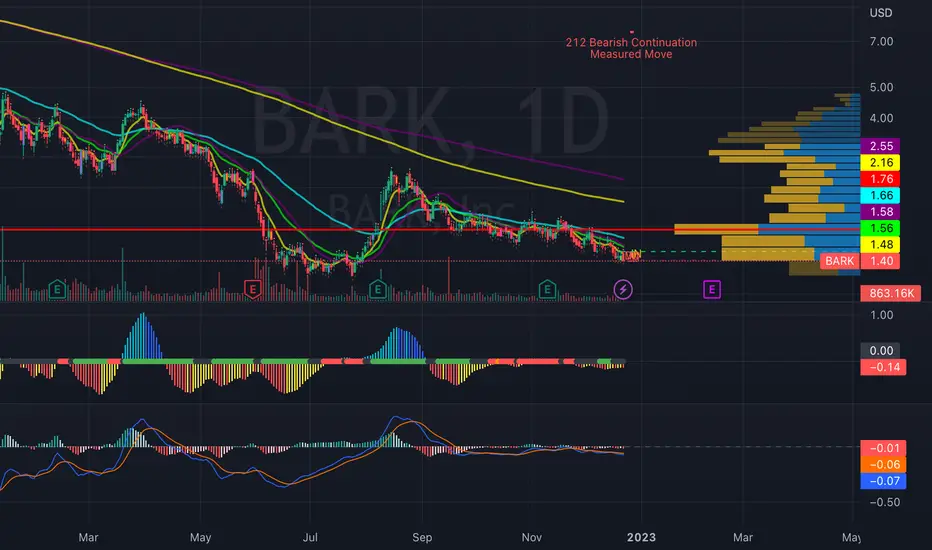
Bark | BARK | Long at $0.84BARK, Inc. NYSE:BARK is a dog-focused company offering subscription-based products like BarkBox and Super Chewer, delivering monthly toys, treats, and pet supplies. It operates in Direct-to-Consumer and Commerce segments, selling through its website, retail partners, and e-commerce platforms. While not overly bullish here, especially given the economic / recession-fear headwinds, I think this is one of those stocks that may have a future "pop" as interest rates are lowered, or news emerges of the company expanding to new retail partners. A few insiders have recently purchased shares (~$75k under $1.00) and others have been awarded options. The book value currently rests near $0.64. It may dip between that price at $0.50 in the near-term. However, that's just been the trajectory of SO many of these SPAC stocks... dip then pop or bust.
Fundamentally, nothing to uproar over and this is a risky investment (Nasdaq delisting may occur). The positive is the debt-to-equity in 0.9x, which is pretty good for a small company. But 2026 is expected to be its worst earnings year. The future may look bright in 2027 and beyond, but can the company last? Time will tell.
Thus, for a swing trade, NYSE:BARK is in a personal buy zone at $0.84 with a risk of further near-term decline between $0.50 and $0.64.
Targets into 2027
$0.95 (+13.1%)
$1.25 (+48.8%)
Bark INCTo justify a move toward $7, you’d typically need a combination of:
Consistent revenue growth (especially in commerce and consumables)
Sustained profitability and positive cash flow
Market re-rating toward higher valuation multiples
Significant retail expansion and strong brand loyalty
Possibly a strategic acquisition or partnership
Without a clear path here, $7 remains speculative and long-term.
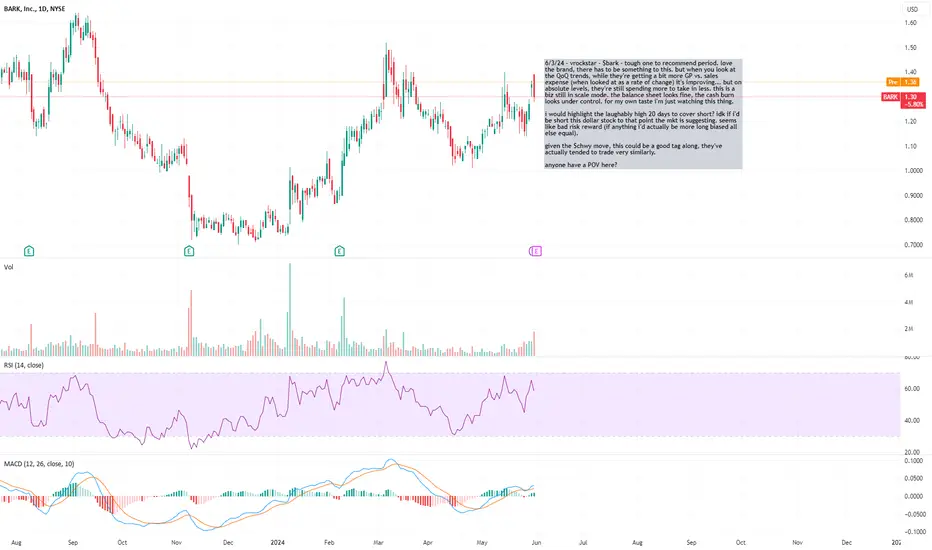
6/3/24 - $bark - interesting long setup, but risky AF. thoughts?6/3/24 - vrockstar - NYSE:BARK - tough one to recommend period. love the brand, there has to be something to this. but when you look at the QoQ trends, while they're getting a bit more GP vs. sales expense (when looked at as a rate of change) it's improving... but on absolute levels, they're still spending more to take in less. this is a biz still in scale mode. the balance sheet looks fine, the cash burn looks under control. for my own taste i'm just watching this thing.
i would highlight the laughably high 20 days to cover short? idk if i'd be short this dollar stock to that point the mkt is suggesting. seems like bad risk reward (if anything i'd actually be more long biased all else equal).
given the NYSE:CHWY move, this could be a good tag along, they've actually tended to trade very similarly.
anyone have a POV here?
Pay attention to management and board changes... Do your due diligence and research the background of the new C suite execs and board members. I see a dream team that could potentially result in the sale of BARK to Petsmart. I'm loading up every time the stock dips to 1.08. At worse this is a healthy company with low debt and earnings forecasted to grow by an average of 50% per year for the next 3 years. As best, it's a potential acquisition target. Happy hunting!
BARK a dog supply speciality stock Reverses LONGBARK is the stock of a relatively young company.It is now growing
and has had positive earnings The chart shows a reversal from the
prior downtrend which started with a double top in January.
The order block indicator shows a base of buy order blocks forming the support.
Upside is 45% to the resistance of the double top and the sell order
blocks. The anchored VWAP shows that price was supported by
the line of two standard deviations below VWAP in the deep
undervalued zone. However, with the reversal, price is now targeting
the VWAP itself which also could be an initial target for trade.
Fundamentally, no matter whether a recession is impending, people will care
for their dogs and sales should not suffer. If anything, people will seek
value deals compared with brick-and-mortar sources. Not a coincidence
but another dog-related stock WOOF is on an uptrend as well.
As a penny stock, this is a risky long trade however I also see the
reward potential. The call options for expiration on 5/19 are
priced at about $10 per contract making them very affordable
way to leverage the trade.
see also the stock analyst report linked here stockanalysis.com
BarkBox is UndervaluedThis is a company that has high insider ownership at 30% and more cash than debt with market cap at 255.22 M and enterprise value at 222.40 M. Balance Sheet
The company has $166.31 million in cash and $133.49 million in debt, giving a net cash position of $32.82 million or $0.19 per share.
The company has a current ratio of 3.20, with a Debt / Equity ratio of 0.67.
bark.co
This companies stock is looking to possibly be a great long term investment in my portfolio. Since they are growing year after year.
Buyers like Bark Box at 4.00Fundamental view: I use this company personally. My girlfriend introduced me to the company when she signed up for their services. It's a great idea, they basically send your pet a customized goodie box every month. Pet industry sales surpassed 100 billion for the first time this year.
This company IPO'd a year ago roughly, I know a lot about early stage investing. My mentor makes his living on pre presale rounds. Basically my theory is that early stage investors dumped their shares on the public when the company was offered giving us this consistent downtrend since its inception.
Quarterly: We made it almost to $20.00 before selling off to 4.00, a 5x discount from its first quarter highs.
Monthly: I drew a trend line off the first highs available simply to highlight that the supply line has been tested multiple times already, how much more before it breaks and holds?
Weekly: The market is consolidating well below the range, in newly formed trends these "free bars" are indicative of trend strength, but in mature trends they're more indicative of a parabolic/ oversold condition.
Daily: The market was oversold relative to its most recent demand line on this timeframe. Also, the market tested $4.00 on 3 different days recently and found demand in the short term with no closes below that level. Nice even number, third times a charm.
On investments of this nature I typically aim for the IPO price, so $13.00, not a bad return.
Thanks for reading, hit the like button!
Opening (Margin): BARK May 20th 2 x 5/7.5 Back Ratio Spread... for a 3.15 debit.
Comments: My dog got into my brokerage account and took this trade (and then ordered a bunch of Bark Box stuff).
Buying two 75 deltas out in May, selling the 50 delta to yield a synthetic position with a delta metric of around +100. I'll start looking at taking profit at 120% of what I put it on for.
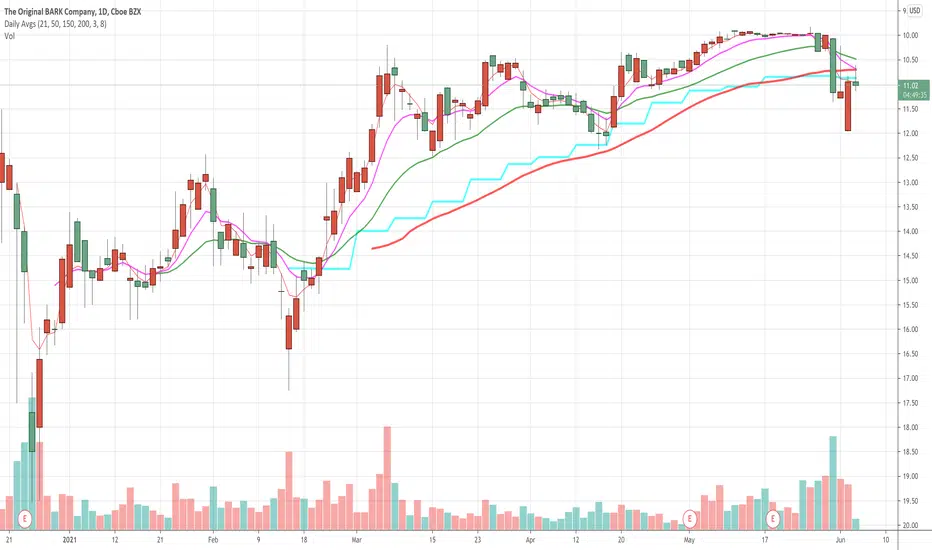
20-9-21 Shake OutBARK is one of the few SPACs that actually delivered with earnings this quarter.
High volume shake out shows sellers are gone and might create FOMO. Especially since they started accelerating retail sales and food program. They also got more social media followers than Peleton. These fundamentals can easily translate in FOMO as sellers are gone.