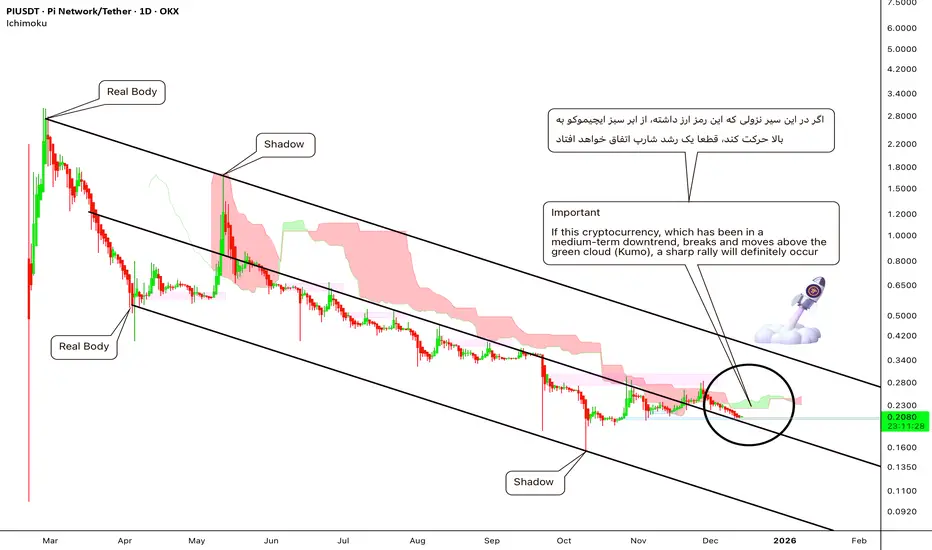
Pi: Will it achieve a breakthrough alongside the ecosystem?Pi Network (PI) is facing selling pressure on higher timeframes, trading within the $0.08 to $0.09 range. Given its history of high volatility and a circulating supply affected by periodic token releases, PI’s short-term outlook is bearish, while its long-term prospects depend on ecosystem development.
Price Trend and Support/Resistance Analysis:
- Long-term trend: PI is currently trading within a downtrend channel, showing a significant decline from previous all-time highs.
- Key support zone: The $0.075 level serves as a critical support zone. Maintaining this level is essential to prevent further downside.
- Resistance zone: To reverse the trend, PI needs to break above the immediate resistance level around $0.085 (corresponding to the 38.2% Fibonacci retracement level) and sustain a trading volume exceeding $30 million USD to confirm buying momentum.
Supply-Demand Dynamics and Token Supply:
- Regarding supply and demand, the price of PI is often influenced by the project's periodic token unlock events. These unlocks increase the circulating supply, thereby triggering short-term price corrections.
- The current market for PI reflects not only chart-based factors but is also deeply influenced by the progress toward the official Open Mainnet launch.
On the Bitget platform, you can purchase Pi tokens to support the vision of the Pi ecosystem—home to the world's largest community.
In-depth trading ideas
Expert Warns Pi Could Lose Top-100 Status Below $0.01Crypto expert Dr Altcoin has alleged that Pi Network is facing a supply crisis tied to a wave of token unlocks scheduled for the second half of 2026.
According to the post, pioneers who locked their Pi for three years are now seeing large amounts of that supply released. Roughly 775.8 million Pi tokens are set to unlock between now and December 2026. That works out to an average of 129.3 million Pi tokens unlocked each month now. Dr Altcoin argued that a significant portion of this unlocked supply is likely to reach exchanges, adding further selling pressure to the market.
Calls for the Pi Core Team to respond
The post argued that no single announcement, ecosystem update, or exchange listing would be enough to stabilize price without the Pi Core Team directly addressing supply, demand, and liquidity concerns. It called for the team to publicly acknowledge the situation and discuss potential solutions with the community, framing continued silence as a failure of leadership.
Proposed steps, according to the post
Dr Altcoin outlined several measures that could be considered if the Core Team continues its current communication approach:
Burning a substantial portion of remaining supply, potentially as much as 50%, drawing a comparison to Stellar’s historical token burn.
Allowing major exchanges, including Binance and Coinbase, to list Pi.
Introducing a transparent and verifiable buyback-and-burn mechanism.
Price risk raised in the post
The post also warned that if Pi falls below $0.01, it could lose its position among the top 100 cryptocurrencies by market cap, and that a sustained price decline could pressure the project financially, potentially forcing spending cuts or restructuring.
Community reaction
Replies to the post were mixed. Some users voiced support for the criticism, while others questioned Dr Altcoin’s own past promotional activity around Pi. Several replies echoed concerns about token distribution, with some users arguing that a small number of wallets, including the Core Team’s own holdings, control a disproportionate share of total supply.
The Pi Core Team has not publicly responded to these specific allegations as of now. These claims reflect one crypto expert’s analysis and have not been independently verified.
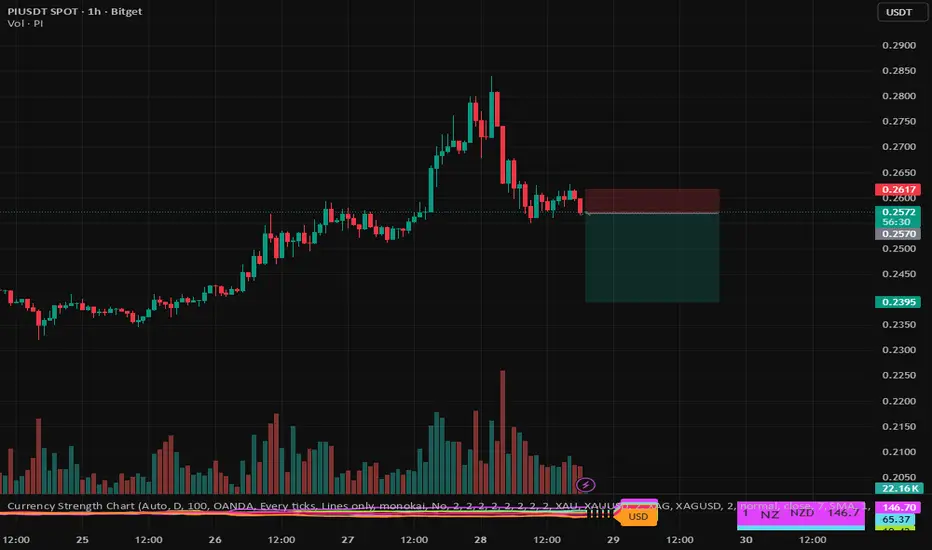
PIUSDT: The Breaker Block Before the C MagnetOKX:PIUSDT is showing a clean bullish continuation structure on the 1H.
The main ABC sequence is still active:
C target remains unreached, and B / invalidation is still protected.
Price already reacted from the BC region, which also aligned with the rising structural trendline. That matters because the move was not random — price returned to a meaningful zone, defended it, then created displacement to the upside.
Now the key area for me is the breaker block below current price.
I am not chasing the move from the middle. I want price to return into the breaker block and prove that buyers are still defending the structure. If price pulls back cleanly into the block and holds, the next draw becomes the open ABC target above.
The trade idea is simple:
Wait for price to return into the breaker block.
Look for bullish reaction / lower-timeframe confirmation.
Invalidation is below the protected B zone.
Target is the open ABC C magnet.
The cleanest trades usually do not come from excitement.
They come from waiting for price to return to the zone that caused displacement.
SmellyTaz — decoding chaos.
Pi Network News Today: CiDi Games Earns Mainnet Verified BadgeCiDi Games has reached a major milestone within the Pi Network ecosystem after officially receiving the Mainnet Verified Badge in the Pi Browser.
The gaming platform announced that it has been approved by the Pi Core Team, confirming that it is a verified Mainnet application that uses real Pi. The achievement places CiDi Games among a growing number of apps that have completed Pi Network’s verification process and are actively operating within the ecosystem.
In its announcement, the team thanked its community, known as “CiDizens,” for supporting the project from the early days.
“CiDi Games is now Mainnet Verified. Approved by Pi Core Team. A Mainnet app using real Pi,” the project wrote on X.
One of Pi’s Most Popular Gaming Apps
The verification comes as CiDi Games continues to build a strong presence inside the Pi ecosystem. According to the team, the app currently holds a 4.8-star rating with more than 14,000 reviews, making it one of the highest-rated gaming applications available through the Pi Browser.
The Mainnet Verified Badge shows that the platform supports real Pi transactions and has passed the Pi Core Team’s review.
For many users, the badge adds credibility as the Pi ecosystem continues to expand its list of verified applications.
Community Sees Growing Utility
The news also generated positive reactions across the Pi community.
Pi community member Dao World said the role CiDi Games plays in driving engagement inside the Pi Browser. According to him, the game encourages repeat visits, with many users returning to the browser multiple times each day.
The argument is simple. When users repeatedly visit Pi applications, spend time interacting with them, and use Pi within those platforms, it helps create practical utility for the network.
That type of engagement is exactly what many Pi supporters have been hoping to see as the ecosystem develops.
CiDi Games’ verification reflects Pi Network’s increasing focus on practical use cases. For users, it is another sign that the ecosystem is gradually evolving beyond mining and toward applications that drive regular participation.
Pi Network Reclaims Support, Higher Prices ?Pi Network is currently trading at a significant weekly support level and is showing early signs of attempting a reclaim following a recent deviation below the zone. This area is particularly important because weekly support levels often determine the broader directional bias of the market. The recent move below support may prove to be a failed breakdown if buyers can successfully push price back above the level and establish acceptance.
From a technical perspective, confirmation of a deviation—or failed auction below support—would be a bullish development. Failed auctions often occur when sellers are unable to sustain price below a key level, resulting in a reversal that forces market participants to reposition. This type of setup can create the conditions for a strong impulsive move higher as trapped sellers exit positions and buyers regain control.
The key level to monitor is the weekly support around $0.13. Price action needs to continue accumulating above this region and demonstrate sustained acceptance in order to strengthen the bullish case. Holding this support would significantly increase the probability of a rotational move toward the Point of Control, with the broader upside target sitting near $0.21.
For now, the technical structure suggests that Pi Network is positioned for a potential recovery. As long as weekly support remains intact and the reclaim continues to develop, the immediate short-term outlook remains constructive, with the market favouring a bounce and continuation toward higher value areas.
Pi Network News Why the PIRC 23.8% Floor Creates a ContradictionA post from pioneer Daniel F is generating discussion in the Pi community, and the argument at the centre of it is more technically interesting than most of the price speculation that usually dominates the conversation.
The claim is interesting but the implications are uncomfortable for anyone trying to reconcile Pi’s DEX pricing with its centralised exchange activity.
The Core Argument
Pi’s ecosystem includes PIRC tokens, which reportedly carry a design feature protecting holders from losing more than 23.8% of their initial listing value, measured in Pi. That floor is the starting point of Daniel’s argument.
If PIRC tokens cannot fall more than 23.8% relative to Pi, then Pi itself must behave with a certain degree of price stability to make that guarantee meaningful. A token whose floor is measured against a wildly volatile asset is not really floored at all. For the 23.8% protection to function as described, Pi’s liquidity would need to behave more like a stablecoin than a speculative asset.
“If they explain that PIRC tokens will never lose more than 23.8% of the initial value, they will have to admit that Pi liquidity acts like a stablecoin,” Daniel wrote. “This would contradict CEX prices. To avoid this paradox, they prefer to remain silent.”
The Contradiction
The tension he is identifying is real. Pi trades on centralised exchanges at prices determined by speculative market activity, prices that have already seen significant volatility. Pi itself has dropped more than 90% from its peak by some measures.
If the DEX operates with a protected floor measured in Pi, and Pi is simultaneously trading as a volatile speculative asset on CEXs, then either the floor protection is weaker than it appears or the DEX pricing operates on fundamentally different logic than the exchange price.
One community member extended the arithmetic simply. “If PIRC tokens will never lose more than 23.8% of listing price measured in Pi, then at that time it is expected that Pi, the most liquid token, will react to the same ratio around 23.8%. Simple arithmetic.”
Why the Silence
Daniel’s broader point is about transparency rather than price prediction. The technical architecture of Pi’s DEX and its relationship to exchange-listed Pi creates a logical tension that has not been publicly addressed. Speculators on centralised exchanges are operating on one price discovery mechanism. Pioneers participating in the DEX and Launchpad are operating on another.
“If someone tries to mislead you, ask them why the liquidity of tokens, which is in Pi, cannot fall if Pi is volatile,” he wrote.
The question is pointed and has not received a clean answer from the project. Whether that silence is strategic, technical or simply a matter of timing is something the community continues to debate.
Pi Network: could this be the bounce we’ve been waiting for?Pi Network. Tired of watching this bleed or hunting for that first real bounce? While the whole alt market is chopping on regulation headlines and ETF flows, Pi is quietly grinding at the lows, and according to industry sources the project is again popping up in community chatter around future listings. Volatility is crushed, which is usually when most traders look away right before something moves.
On the 4H chart, price is sitting right on that big orange demand shelf with a green “last line” support just below, while RSI is hovering near the oversold zone but trying to curl up. Volume by price shows a fat node above, meaning if bulls manage to reclaim that lower red zone, there’s a vacuum that can fuel a squeeze higher toward the upper resistance band. I’m leaning slightly long here, expecting a mean‑reversion pop rather than a full trend reversal.
My plan: ✅ watch for a 4H close back inside the orange band with RSI pushing above its recent swing high, then look for a move toward the mid red zone as the first target. If we lose the green support with strong volume, that bounce idea is dead and I treat any rally as a short‑the‑pop setup back into broken support. I might be wrong, but this is exactly the type of boring range where the next sharp move is born.
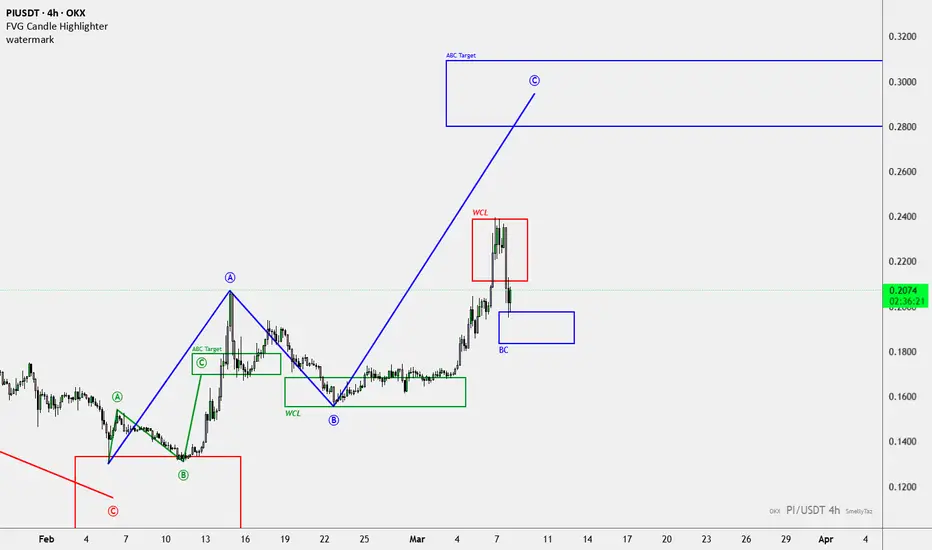
PIUSDT 4H | Blue BC Targets HigherPIUSDT is not just pulling back here. It’s reloading .
This whole move started after price completed the bearish red sequence C target . From that completion, buyers stepped in aggressively and launched a bullish green sequence that successfully reached its own C target .
That alone was already a shift in tone.
Then price formed a green WCL , respected it, and pushed higher again. The key moment came when price broke above the green C , because that is what activated the larger blue matryoshka bullish sequence .
That changes the reading of the chart.
This is no longer a simple bounce off lows.
This is a smaller bullish structure expanding into a larger continuation framework .
Now yes, price reacted lower from the red WCL overhead. That zone clearly caused selling pressure. But here’s the important part: the rejection did not destroy the bullish structure. Instead, price formed a bullish blue BC .
And that BC matters.
Because in valid sequence logic, BC is the fuel leg . It is the loading zone that can carry price toward the active blue C target .
So right now the chart is showing a battle between:
Red WCL overhead resistance
Blue BC continuation support below
Blue C still active above
That is why this zone is so important.
If buyers defend the blue BC , then this current pullback may simply be the market building energy before continuation. In that case, the bigger blue sequence remains valid and the chart still points toward the blue C objective .
So my current read is bullish unless the market proves otherwise.
I am not treating this as a random rejection.
I am treating it as a structured reset inside an active bullish matryoshka sequence .
Bullish case
Hold the blue BC , regain momentum, continue toward blue C .
Invalidation idea
Lose the blue BC decisively , and this continuation thesis weakens hard.
Until that happens, the structure still says the market has unfinished business higher .
Not financial advice. This is just my personal read based on sequence logic, WCL behavior, and market structure.
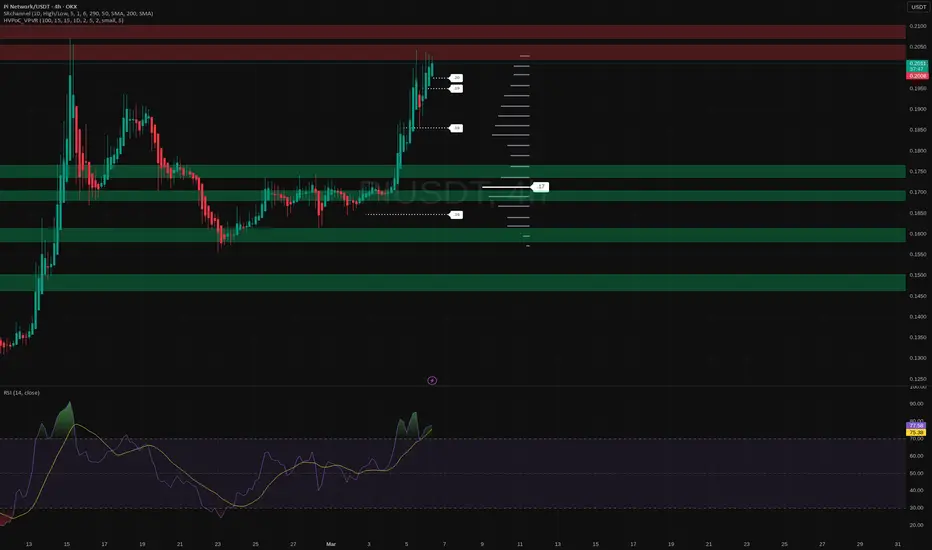
Pi Network: potential pullback or breakout? key levels to watchPi Network – who’s chasing this spike and who’s about to be exit liquidity? According to industry sources, fresh rumors around mainnet progress and new exchange interest hit the feed this week, and Pi ripped straight into a big supply pocket. Price has gone vertical, which is fun for screenshots, but usually not for late buyers.
On the 4H chart we’re trading right inside a heavy red resistance zone around 0.20, with RSI stretched in the high 70s. That combo screams “heat check” to me, so I’m leaning short term corrective rather than immediate moonshot. I might be wrong, but after moves like this the market usually needs to catch its breath before the next leg.
My base plan: I’m watching for rejection wicks and fading volume here, aiming for a pullback into the nearest green demand around 0.185 then 0.175 ✅. If price rips clean above the red box and holds above 0.21, that kills the pullback idea and opens space toward the upper liquidity ladder on the chart. For now I’m patient and waiting for confirmation instead of FOMOing into candles that already did the running ⚠️.
Pi Network DEX Launch ConfirmedPi Network open mainnet launch approaches. Explore the crypto utility, adoption potential, and expert Pi analysis on what this means. Pi Network is preparing for a broader open mainnet phase. Reports highlight upcoming improvements in utility and ecosystem access. The update focuses on real-world usage. Developers are pushing toward payments, DeFi integration, and Web3 connectivity. This marks a shift from a closed ecosystem. The network now aims to interact with the wider crypto market.
Utility Push — From Mining to Real Use
Pi started as a mobile mining project. It attracted millions of users with easy accessibility. Now the focus is changing. The ecosystem wants to turn Pi into a usable digital asset. Planned features include decentralized exchanges, merchant payments, and app integrations. If executed well, this could move Pi beyond speculation. Utility will define its long-term value.
Despite the excitement, challenges still exist. KYC verification remains a major bottleneck. Users must complete verification to access the open mainnet. Without it, funds stay locked. Migration delays have already slowed adoption. This remains a key risk factor. The success of the rollout depends heavily on smooth onboarding.
Market Impact and Volatility Ahead
An open mainnet changes everything. It introduces real price discovery. Once trading expands, volatility will increase significantly. Supply and demand will finally balance in open markets. Early participants may see sharp price swings. Both upside and downside risks will rise. This transition phase often creates hype cycles followed by corrections.
Pi aims to become part of the global Web3 ecosystem. That includes payments, apps, and digital identity. If adoption grows, Pi could build a strong network effect. Its large user base gives it an advantage. However, execution matters more than vision. Many projects fail at this stage. The next phase will test whether Pi can compete with established blockchains.
Pi Network stands at a critical turning point. The open mainnet could unlock real value—or expose weaknesses. Utility, adoption, and execution will decide the outcome. Hype alone will not sustain growth. The coming months will reveal whether Pi delivers or disappoints.
Pi Network Completes Upgrade Before March 12 DEX LaunchPi Network news today reveals it has completed its mandatory v19.6 node upgrade on February 15. This marks a key step toward the upcoming decentralized exchange launch. The upgrade was required for all mainnet nodes to stay connected. With support, the next phase of the network’s development will begin. Community leaders say this is only the first step in a sequence of protocol updates. The next major milestone is the planned activation of the Pi DEX on March 12. The network now has more than 16 million migrated users preparing for on-chain trading features.
Mandatory Upgrade Strengthens Network Core
The v19.6 upgrade focused on stability, security and scalability. Node operators had to complete the update by the February 15 deadline to avoid disconnection. This step helps the network prepare for heavier activity as new features roll out.
The upgrade is part of a broader roadmap. More protocol versions are expected in the coming weeks. Each step aims to improve performance and decentralization before the DEX goes live. Developers want the network to handle higher transaction volumes without major disruptions. At the same time, community members described the upgrade as a turning point. Many see it as proof that the project is moving closer to a functional, real-world ecosystem.
DEX Launch Set for March 12
The next major milestone is the planned launch of the Pi DEX on March 12. This platform is expected to allow users to trade tokens directly within the Pi ecosystem. It could also open the door to broader DeFi tools over time.
The DEX is part of a larger push to build a self-contained digital economy. Developers want users to move beyond simple mining and start using Pi for actual transactions and services. The exchange will likely serve as the first major utility layer for that vision. However, the success of the DEX will depend on performance and adoption. The transition from testnet experiments to a stable mainnet environment remains a key challenge.
Price Rally and Community Momentum
The upgrade also came during a period of rising market activity. Pi coin price reportedly climbed more than 40% between February 11 and February 16. The move followed growing excitement around the upgrade and the upcoming DEX launch. Still, analysts note that the token faces resistance near the $0.20 level. Broader market volatility could also affect short-term momentum. Even so, the community remains optimistic as the network approaches its one-year mainnet anniversary on February 20.
What Comes Next for Pi Network
Pi Network news today shares that the completed upgrade signals the start of a busy month for the project. More protocol updates are scheduled ahead of the March 12 DEX launch. Each step aims to prepare the network for higher usage and real economic activity. If the DEX launches smoothly, it could mark a major shift for Pi Network. The project would also move from a mining-focused model toward an actual on-chain marketplace. For now, the Pi network’s large user base is watching closely as the next phase approaches.
Pi Network: is it time to short? key levels and targets aheadPi Network. Thinking about catching this dip, or letting it bleed first? Altcoins are getting hammered again after the latest risk-off wave in crypto, and Pi is no exception - every bounce is being sold. According to the current market mood, speculative coins are being used as an ATM to cover risk elsewhere.
On the 4H chart price is in a clean staircase downtrend, trading below the main volume cluster near 0.155 and having flipped 0.14 from support to resistance. RSI is buried in oversold, so I expect a technical bounce, but for now I treat it as a dead cat, not a new uptrend. My base scenario is a pullback into the 0.138-0.145 supply zone then another leg down toward 0.128 and maybe 0.118.
My plan: wait for a weak retest of 0.14 with rejection candles and fading volume, then look for short setups with tight invalidation above 0.15. If price suddenly reclaims 0.15 and holds with RSI back above 50, that would cancel the short idea and open the road toward 0.165. I might be wrong, but buying this straight downtrend without confirmation looks like volunteering as exit liquidity ⚠️
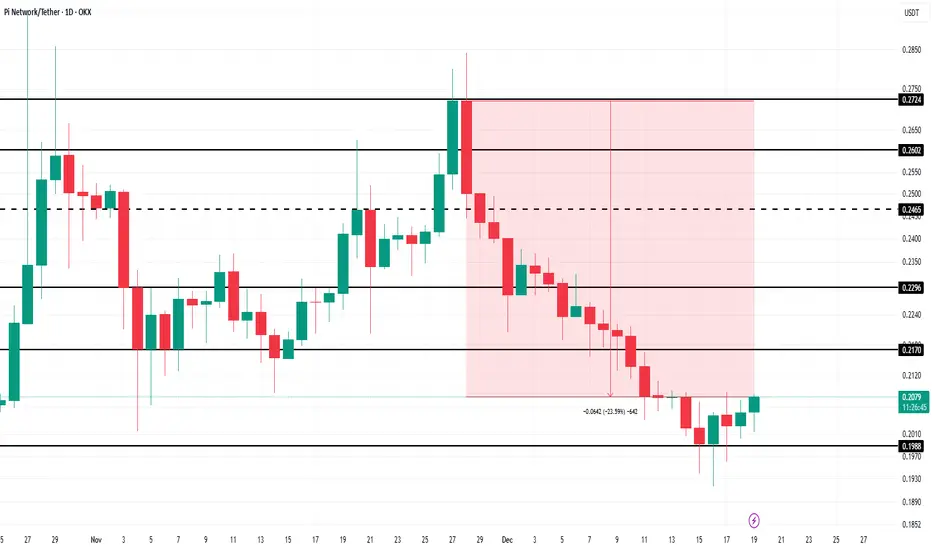
3 Weeks Since Local Top, Pi Coin Price Is Down By 28%Pi Coin trades near $0.203 at the time of writing, holding above the $0.198 support and below the $0.208 resistance. The token remains down about 28% from its $0.284 local top. Price action suggests consolidation rather than a decisive move.
If the downtrend strengthens, Pi Coin may remain range-bound between $0.198 and $0.208. This structure would limit upside potential and delay recovery. Prolonged consolidation could further test investor patience during ongoing market uncertainty.
A bullish scenario depends on sustained capital inflows. Continued accumulation could help Pi Coin reclaim $0.208 as support. A successful breakout may drive price toward $0.217, with further upside to $0.224. Such a move would invalidate the bearish thesis.
Pi Network (PI) Update - Lower Coming? Pi Network is showing weakening momentum as bullish volume fades around the $0.22 point of control, opening the probability of a deeper sweep of liquidity below current levels.
Sellers are gaining traction, and a test of the $0.20 value area low is becoming increasingly likely unless buyers step in with stronger volume.
Key Points:
- Weak bullish volume at the $0.22 POC
- Liquidity building below support
- Downside target sits at $0.20
What to Expect:
Price likely wicks below $0.22 toward $0.20 before any attempt at reclaiming the range.
PI is pulling back into a short-term support areaThe recent rejection from the upper zone created a corrective structure, and price is now retesting the previous demand region. If this area fails to hold, a deeper correction toward the next liquidity zone is likely. The stop-loss is placed above the recent consolidation, targeting a continuation move in line with the current short-term bearish momentum.
PI Update🚨📊 PI Update
We have a strong resistance zone in red 🔴 on PI.
Previously, price tried to break this level and failed,
showing how important this zone is.
Now the price is approaching this resistance again,
and there is a possible breakout this time
if buyers show enough strength to push above it.
This level will decide the next move —
breakout = continuation,
failure = another rejection at the ceiling.
PI Breakout Needs $0.24 While $0.22 Still Threatens a DropOKX:PIUSDT trades inside a very tight band, with price stuck between $0.24 and $0.22 since mid-November. The range is narrow enough that even a small move can decide the next trend. A close above $0.24 turns the recovery into a proper rally toward $0.26 and $0.29, but a slip below $0.22 exposes $0.21 and confirms downside pressure.
Large holders still keep the OKX:PIUSDT bounce alive. CMF remains above its trendline and above zero, which shows steady accumulation from big wallets. But retail strength is fading. MFI continues to fall even as price forms higher lows, which signals weak dip-buying. OBV is also stuck under its trendline and has not built the volume support needed for a breakout. If OBV rolls over, OKX:PIUSDT can face another fast pullback.
The structure is simple. Strength only confirms above $0.24. Weakness only confirms below $0.22. Until one side breaks, OKX:PIUSDT stays in a compressed zone where big wallets support the upside but weak retail flow still leaves a clear 5% risk on the lower end.
Pi Network (PI) Update — Adam & Eve Pattern FormingPi Network is developing a rare Adam and Eve bullish reversal pattern, with price holding firmly above the Point of Control. This behaviour signals early accumulation and improving sentiment at current levels.
As PI pushes toward the neckline between $0.21 and $0.28, the rounded bottom structure continues to strengthen. Buyers are becoming more active, suggesting the market may be preparing for a breakout attempt.
Key Points
- Rare Adam and Eve reversal structure forming
- Price holding above the Point of Control showing demand
- Neckline at $0.21–$0.28 is the major breakout zone
What to Expect
If PI breaks above the neckline with strong volume, a move toward $0.35 becomes likely. Losing the POC would weaken the setup and delay the reversal.