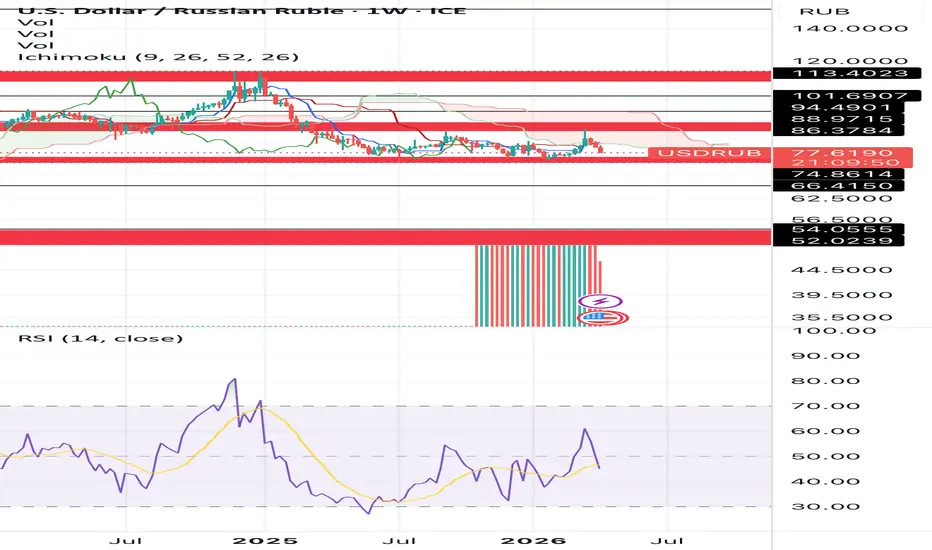
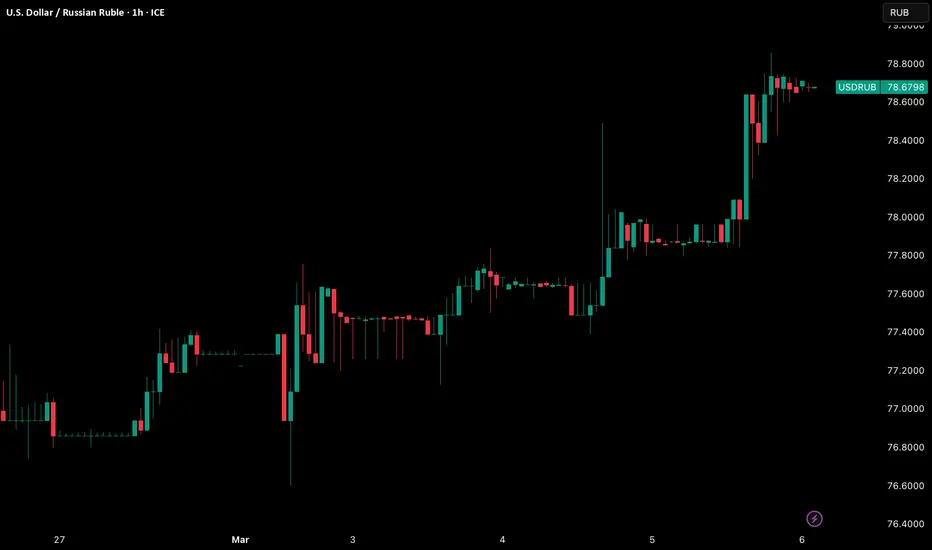
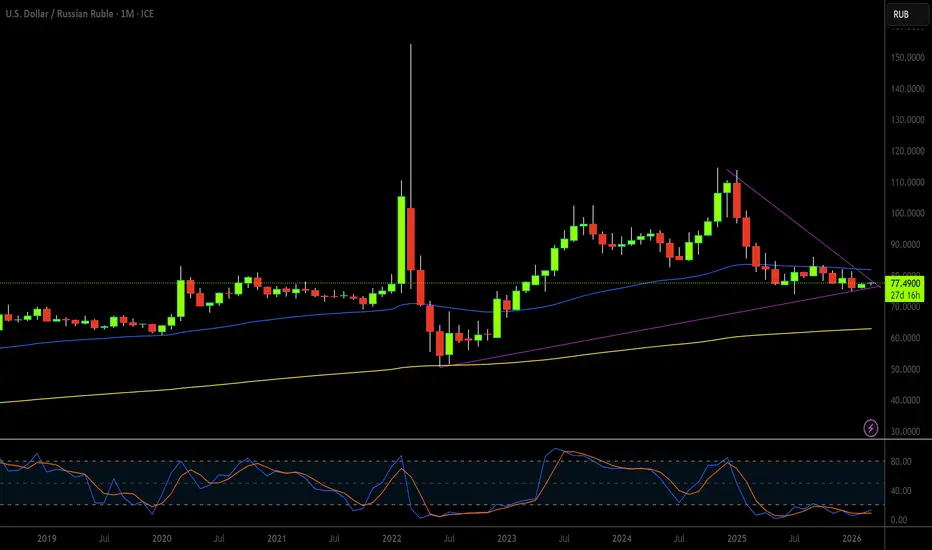
USD-RUB distribution/reaccumulation channelThe chart shows the main trend , with a distribution/reaccumulation channel at its top.
The key reversal zones are horizontal levels and liquidity blocks.
The percentages show the potential for medium-term movements in local trends when local structures are broken (downward channel/breakthrough of the horizontal channel of the main trend/continuation of the main trend after a retest).
Also two different low-possibility scenarios if strong break upwards/downwards happens. — "turkish lira"/"georgian lari" scenarios.
USDRUB_SPT - USD/RUB
No trades
No trades
In-depth trading ideas
Global clock is ticking down, but minute arrow is still moving66 rubles level is too scarily accurate, and still, this huge nuclear bomb on global scale is tormenting me.
When will it detonate? Will it let us go to 66 levels one last time?! I don't want to be late for this party.
Global probabilities are already starting to move, but this little agent on minutes timeframe is almost reversed, could this little guy confront this huge historical hyperion?
30 minutes, 2 days. This is where you can see those beautiful harbingers of change.
USDRUB targets 51 after consolidationRUB was called the best performing currency in the world
so let's take a look at its chart
EW count shows it can do even better as we have large ABC zigzag
with the last wave C down in progress
The latter consists of 5 waves and 4 of them have been completed
as broke down the recent consolidation that was sitting on the roof
of the long term range 51-80
The conservative target is located both at the bottom of the wave A and range at 51 RUB/$1
This double support could contain this falling knife
The drop would result in 28% loss of dollar value versus ruble
This EW count alings very well with Brent Crude upside EW count posted earlier
as this currency could benefit from high oil prices
USDRUB - Roadmap Update - 26.03.2026Update of the related idea from 25.01.2026
First part worked out perfectly.
It needs a little redrawing.
Latest notes from the previous idea:
Oil and gas companies focused on exports have significant foreign currency revenue.
At the same time, they pay corporate income tax (rate 25% from 2025, previously 20%).
The base is taxable profit under RAS (revenue minus expenses, including MET as costs).
Declaration — new form from 2026 (Federal Tax Service Order).
For the year — until March 25 of the following year (for 2025 — until 25.03.2026).
Reporting periods: quarterly (by the 25th after the quarter) or monthly (if they pay advances based on actual profit — by the 25th of the following month).
Also, the weakening of the ruble (growth of the dollar/euro exchange rate) increases ruble revenue from exports → taxable profit grows.
In the 2025 reporting, the strengthening of the ruble (the ruble rose against the dollar by ~20–25%) led to positive exchange rate differences, which helped to show profit under RAS (a decrease in the ruble amount of foreign currency debt reduced expenses).
In short, when Sechin and Miller submitted their reports, after the 20th there is no point in keeping the currency rate strong.
A weak ruble is beneficial for hydrocarbon exports.
A strong ruble is beneficial for reporting.
Will you say “coincidence”? Possibly. But our goal as traders is to look for recurring “coincidences” in order to make money.
Technically, I redrew it a bit. I am not expecting a fall.
The goal of our oligarchs is to maximize earnings on exports.
High oil prices will push towards ruble weakening.
The conflict with Iran contributes to this.
The correction worked out at 61.8% as per the ascending trend.
Extension target — 91.1187
Possible correction to 86.22 (as in a strong trend)
Possible weakening to 95 rubles.
After the first of April, FNB statistics will be released.
We are also monitoring the development of the conflict in Iran.
USDRUB — Current Thoughts — 01/25/2026 — What's Next?Good day, friends.
Today we'll analyze the USDRUB pair and try to predict where the ruble is heading.
Obviously, the exchange rate is currently under manual control, but still.
Let's start with the big picture
We can observe that the price is at a key historical level — roughly the same level as before the conflict began.
The second level of interest lies in key accumulation zones. In this zone, we can expect potential consolidation if the regulator continues pumping the market with foreign currency.
Now, let's zoom in — the price is being pushed toward a key level.
Why is that?
Let's look at the news. The main points:
CMASF (Center for Macroeconomic Analysis and Short-term Forecasting) — an analytical center close to the Russian government — warns of a high probability of a banking crisis in the second half of 2026 and a possible recession by October 2026 (due to loan servicing problems among households and businesses, as well as rising delinquencies).
NWF (National Wealth Fund)
The Fund is injecting one trillion rubles into state banks following warnings about an impending banking crisis.
Information about NWF injections into state banks fully corresponds to official data from Russia's Ministry of Finance, published on January 20, 2026.
NWF Injections into State Banks:
• VEB.RF — 1,319.0 billion RUB (deposits and subordinated deposits)
• VTB — 293.2 billion RUB (subordinated deposits)
• Gazprombank — 204.1 billion RUB (subordinated deposits)
• Sberbank — 94.2 billion RUB (subordinated deposit)
• Sovcombank — 29.6 billion RUB (subordinated deposit)
Earlier, Bloomberg reported that executives of Russia's largest banks discussed the possibility of seeking government support due to rising bad loans.
But the devil is in the details, and the name of that detail is — the Central Bank's Fiscal Rule.
What It Is and How It Works
The CBR Fiscal Rule is a mechanism that directly links government spending (including from the NWF) to the exchange rate through automatic liquidity sterilization.
Simplified scheme:
When the Ministry of Finance spends NWF money to support banks, it pumps rubles into the economy.
This creates excess liquidity, which can cause inflation and weaken the ruble.
The Central Bank sells foreign currency from its reserves on the domestic market to absorb excess rubles and ease pressure on the exchange rate.
Simultaneously, the CBR could raise interest rates (making credit more expensive) to sterilize excess liquidity.
💥 Why the Fiscal Rule Is Currently Working Against the Ruble
Problem #1: Depletion of Foreign Currency Reserves
In January 2026, the CBR sharply increased currency sales — by 17.42 billion rubles daily. This is twice as much as at the end of 2025.
The paradox: The more the NWF spends on bank support, the faster the CBR is forced to dump currency to prevent inflation. But currency reserves are finite — according to the data above, the liquid portion of the NWF has shrunk to 4.08 trillion rubles (~1.9% of GDP).
Problem #2: The Cost of Money Trap
• CBR sells currency → USD supply increases → Weakens ruble ↓ • CBR raises rates → Attracts investment → Strengthens ruble ↑ • MinFin spends NWF → Pumps rubles into economy → Weakens ruble ↓
Problem #3: Loss of Rate Maneuverability
Currently, the CBR is in a contradictory position: • Upward pressure on rates: NWF spending generates excess rubles and inflationary pressure, requiring higher rates. • Downward pressure on rates: Banks are in crisis and need lower rates for debt servicing.
Expected trajectory: The CBR plans to reduce the average key rate from the current ~19% to 13% in 2026.
When rates start to decline, this will directly undermine the attractiveness of ruble-denominated assets for foreign investors, creating additional pressure on the currency.
Current Situation (January 2026)
The Ministry of Finance is actively increasing currency sales under the fiscal rule:
• In January–early February, the volume of gold and currency sales will increase.
• This has led to temporary ruble strengthening below 78 RUB/USD.
• However, this is a short-term effect.
🎯 Conclusions on the Fiscal Rule's Impact on USD/RUB
Final assessment: The fiscal rule in this context is not a panacea but a delaying mechanism. It buys time but simultaneously accumulates risks through NWF depletion. If the banking crisis hits (H2 2026) and even larger injections are needed, the system could quickly collapse, causing sharp ruble depreciation.
📊 Current NWF Liquidity Level (as of January 1, 2026)
NWF liquid assets totaled:
• 4.085 trillion rubles or 52.2 billion USD
• This is ~1.9% of GDP (for comparison: at the beginning of 2024, it was ~7% of GDP)
NWF Structure (end of December 2025):
• Total volume: 13.42 trillion rubles (6.2% of GDP)
• Liquid portion: 4.08 trillion rubles (30% of total)
• Illiquid portion: 9.34 trillion rubles (stocks, gold, real estate)
Depletion Rate: Critically High
Over one year (2025), the liquid portion decreased by approximately 1.5–2 trillion rubles due to:
Injections into state banks: 1.02 trillion rubles
Budget deficit financing: unofficially another ~0.5–0.7 trillion rubles
Currency revaluation losses: foreign currency depreciates when the ruble weakens
The currency position is particularly vulnerable: • Chinese yuan reserves fell to 209.15 billion yuan — the lowest since the fund's creation. • This indicates maximum currency sales to support the ruble exchange rate.
🚨 Budget Pressure in 2026
Planned budget deficit: 3.8 trillion rubles
Officially approved by the State Duma:
• Revenue: 40.3 trillion rubles
• Expenditure: 44 trillion rubles
• Deficit: 3.8 trillion rubles (1.8% of GDP)
• From NWF: only 38.5 billion rubles (officially)
The NWF was created as a buffer for rainy days, but it is currently being spent to maintain the current economy. This means there is no safety cushion, and the first serious shock (banking crisis, oil price collapse, new sanctions) will lead to an uncontrolled crisis in late 2026 – early 2027.
Some may beat their chest and claim that sanctions don't work, but...
The treasury is running dry, milord.
⏰ Depletion Forecast: 3 Scenarios (assuming current sanctions persist)
Scenario 1: BASELINE (1.5–2 trillion RUB/year spending from NWF)
At the 2025 pace:
• Jan 1, 2026 — 4.08 trillion RUB — Current state
• Jan 1, 2027 — 2.0–2.5 trillion RUB — Critical level
• Jan 1, 2028 — 0.5–1.0 trillion RUB — Rock bottom
Scenario 2: ACCELERATED (2.5–3 trillion RUB/year spending)
This scenario develops if:
• The banking crisis starts earlier (Q2 2026 instead of H2 2026)
• Bank injections increase from 1.02 trillion to 2+ trillion rubles per year
• The budget deficit expands (due to military operations, sanctions, revenue decline)
Timeline:
• Jan 1, 2026 — 4.08 trillion RUB
• Jul 1, 2026 — 2.5–2.8 trillion RUB — Crisis begins
• Jan 1, 2027 — 1.5–1.8 trillion RUB — Panic begins
• Jul 1, 2027 — ~0 trillion RUB
Scenario 3: OPTIMISTIC (replenishment from oil & gas revenues)
Conditions:
• Brent oil price stable at 70–72 USD/barrel
• IMF forecasts 62.13 USD/barrel average for 2026
• Current prices: 66–70 USD/barrel
Calculation:
If oil holds at 70 USD/barrel, annual oil & gas revenues will be ~10–10.5 trillion rubles. With planned NWF spending of 38.5 billion rubles (per the official 2026 budget), the fund:
• Will be replenished by approximately 1–2 trillion RUB per year
• Depletion will be postponed by 5–7 years
(However, news about the seizure of the shadow fleet doesn't add much optimism here.)
📈 Key Monitoring Checkpoints
• Jan 1, 2026 — 4.08 trillion — Current state
• Apr 1, 2026 — 3.2–3.5 trillion — Q1: budget & bank support
• Jul 1, 2026 — 2.5–2.8 trillion — Possible crisis onset
• Oct 1, 2026 — 1.8–2.2 trillion — Panic begins (new injections)
💥 What Happens When the NWF Is Depleted
Short-term effect (1–3 months before depletion):
Markets will panic:
• Speculation on ruble weakening → massive capital outflow
• Accelerating inflation → CBR forced to raise rates despite the crisis
• Chaos in the currency market — CBR may introduce exchange controls
Scenarios (from most to least likely):
Introduction of currency controls
Sharp ruble depreciation (110–130 RUB/USD)
Depositor panic, bank runs
Bank defaults (payment failures)
Devaluation, restructuring
Related Conclusion
To negotiate sanctions relief in the context of a Russia-Ukraine ceasefire, there are approximately 3 years left.
Otherwise, things will get very tough.
To cover the budget deficit, our government officials, out of love for the people and economic necessity, will invent even more taxes and fees. The one-party system will easily pass any law.
Raising the retirement age, pension points, VAT increases — these are just flowers.
📉 Forecast Thoughts
If the CBR continues currency sales — ruble strengthening to 73 RUB.
A spike down to 72 is possible.
Keep in mind that they need to push the rate to a level where there's enough buffer when rates are cut.
Consolidation is possible amid Q1 injections, followed by expected growth.
First growth target: 80.70
Second target: 87–90
Possible scenario breaker: Progress in negotiations.
On positive news with official confirmation, the ruble could strengthen sharply (which isn't great for business, but that's another story).
What do you think?
With Respect to Everyone, Your #SinnSeed
[USD\RUB] Enter email subjectHi Ivan, good day again.
I’ve had a look at your idea regarding the ruble. I'm afraid you still didn’t quite catch my sense of humor.
And unfortunately, you haven’t fully absorbed the program either.
But hey—you’re doing well! Your efforts show. And your ideas aren't the worst ones I’ve seen on LLC "Trading View". I can say that for sure. I've seen some crazy forecasts there.
You’ve already used a kind of Elliott approach and added RSI. I’m glad you picked that up quickly.
Now, back to the critique - there’s a lack of innovation, some fresh perspective, and generally, a bit more realism is needed.
I get that on TW everyone copies each other. But you need to develop new methods and theory, which means you need to form a clearer vision.
Ivan, drop by my office. I’ll help you, maybe we can brainstorm together.
I sketched a rough draft of an idea. I want to tell you about it-don’t get scared, just take a look at the attachment.
Subject: "Forming Long-Term Forecasts on Global Timeframes Using Transparent Overlay Method."
Check out the screenshots - you’ll see that by overlaying semi-transparent bars at the 1M level, we can estimate the chart’s behavior on 3M, 6M, and 12M timeframes.
It helps assess the realism of the forecast and the fluctuation levels within a given range.
Like, surely you understand that we’re unlikely to see seven consecutive red 3M candles at this stage. When building long-term forecasts, that sort of thing matters—even if no one seems to care.
Anyway, we’ll talk about it in person. Call me if anything.
Also—do you by any chance know how Oleg’s doing? I haven’t heard from him in a while. Has he at least figured out how to switch to 3M, 6M, and yearly candles yet?
Come together, both of you. I’ll go over everything again.
By the way, could you help me reinstall Outlook? For some reason all my settings vanished, the shortcut’s gone, and I can’t find any contacts. Or maybe bring over a tech person - maybe that’s why I’m not getting any emails.
Best regards,
Riva Trick
Decoding USD/RUB: Geopolitics, Energy, and Tech ShiftsThe USD/RUB exchange rate remains a premier barometer for global risk. This currency pair sits at the intersection of Western finance and Eastern energy. Investors must look beyond simple charts to understand its trajectory. Current volatility stems from a complex mix of war, technology, and shifting trade routes.
The Macroeconomic Tug-of-War
The Russian Central Bank maintains an aggressive stance to combat inflation. High interest rates support the Ruble by making domestic savings attractive. Conversely, the U.S. Federal Reserve balances cooling inflation with labor market stability. This interest rate spread dictates the immediate flow of capital. Strong U.S. economic data often bolsters the Dollar against all emerging currencies.
Geopolitical Chokepoints and Energy Shocks
Recent analysis highlights the Strait of Hormuz as a critical trigger for USD/RUB movement. A potential blockade would skyrocket global energy prices instantly. Moscow initially gains from higher oil revenues during such crises. However, long-term instability in the Middle East threatens Russia's strategic alliances. A regime collapse in Tehran could leave Moscow isolated in the region.
Geostrategy and the Pivot to the East
Russia is aggressively decoupling from Western financial systems. The Kremlin prioritizes trade in Yuan and other "friendly" currencies. This shift reduces the direct impact of U.S. sanctions on the Ruble. However, it increases dependency on the Chinese economic health. Geostrategy now dictates currency reserves more than traditional economic theory.
Industry Trends: The Sanction-Proof Business Model
Russian industries are adopting a "fortress" business model. Companies focus on internal supply chains to mitigate external shocks. This self-reliance stabilizes the domestic economy during periods of Ruble weakness. Energy firms are also investing in independent tanker fleets. These "shadow fleets" ensure consistent export volumes despite Western price caps.
Leadership and Company Culture in Crisis
Corporate Russia has embraced a culture of rapid adaptation. Management teams now prioritize agility over long-term stability. Leadership styles have become increasingly centralized and assertive. This top-down approach allows firms to pivot quickly when new sanctions emerge. Such resilience provides an unexpected floor for the Ruble's value.
High-Tech Innovation and Patent Analysis
Russia is accelerating its "technological sovereignty" program. Patent filings in domestic software and industrial hardware have surged. Russian engineers are replacing Western tech with homegrown alternatives. This innovation reduces the demand for foreign currency to fund imports. Patent analysis shows a heavy focus on energy extraction and aerospace technology.
Cyber Security and Financial Infrastructure
The stability of the Ruble depends on robust cybersecurity. Russia has developed the SPFS as an alternative to the SWIFT system. This infrastructure protects financial transactions from external interference. Constant cyber-attacks require state-of-the-art defense mechanisms. Success in this domain prevents catastrophic bank runs and currency collapses.
The Future Outlook for USD/RUB
The USD/RUB pair will remain highly sensitive to geopolitical headlines. Energy prices provide the primary support for the Ruble today. Yet, technological isolation presents a significant long-term challenge for Russia. Investors must monitor both the Strait of Hormuz and Silicon Valley. The future of this pair lies in the balance between oil and innovation.
Long - term goals for long. Daily chartThe price has entered the optimal trade entry zone. Break of the structure on the daily and return to the optimal trade entry zone of this break with the removal of inducement. Targets 114 and so on for the extension of Fibonacci above ATH. This is not a financial recommendation!!! Just a look at the opportunity. Follow the risks!!! Good trading!
Why Western Capital Avoids RussiaRESEARCH NOTES ⚖️ Geopolitical Profile
I've heard Senator John Kennedy on radio talking about sanctioning Russia, which made me think of deeper reasons of why the West and Russia have been confronting since forever. In short, the West sees Russia as not a normal investment destination because it doesn't function as rule-based market economy.
Law as a Tool, Not a Framework – In Russia, laws apply only to commoners. Elites live “above the law,” operating through privileges and unwritten instructions. This makes legal protections for investors meaningless.
Clan-Based Power – Industries and regions are controlled by clans. Investors are not protected by institutions but are instead vulnerable to arbitrary clan rivalries and “re-appropriation” of assets.
Criminalized Economy – What counts as a “crime” is class-based. For elites, asset seizure is a privilege, not theft. Contracts and ownership rights can be revoked overnight.
Weaponized Ambiguity – Vague laws exist so they can be selectively enforced against rivals or outsiders. This creates permanent uncertainty for foreign capital.
Expansionist Instability – The system constantly produces “hungry hunters.” With limited internal resources, external conquest (Ukraine, other neighbors) becomes a survival strategy, raising geopolitical risk.
What the West sees as sins:
Lack of Rule of Law → No enforceable contracts, no independent courts.
High Expropriation Risk → Assets can be seized by clans or the state at any time.
Cultural Romanticization of Criminality → Western mindset can't digest a "business climate" where “power > rules”.
Foreign direct investment has collapsed, major Western firms exited, and capital flight continues. Russia is now increasingly dependent on China, the Middle East, and shadow finance channels to sustain liquidity. This will only make FX_IDC:USDRUB appreciate in the long-term.
Western capital avoids Russia because it is structurally unsafe. Until the system shifts from a feudal-mafia hierarchy to a rule-based economy, I believe sanctions won't be canceled anytime soon and foreign investors will treat Russia as uninvestable.
USDRUB upside potential 20%Almost 2 years later, the government completely abolishes the mandatory sale of foreign currency earnings for exporters.
The Central Bank of the Russian Federation has begun a cycle of rate cuts.
The budget deficit continues to worsen. The budget needs a higher exchange rate
Today, the Central Bank of the Russian Federation is very tightly clamping down on the money Supply and historically this has led to a sharp jump in the exchange rate
We expect the usdrub to be around 95 rubles per dollar
USD/RUB: Russian Banking Sector Faces Default CrisisIon Jauregui – Analyst at ActivTrades
The ruble is under the spotlight as Russian banks prepare to request a bailout amid a growing wave of loan defaults.
1. Russian banks falter behind the scenes
Although the Central Bank of Russia maintains a narrative of stability, the actual state of the financial system could be far more fragile. According to Bloomberg, several senior executives at major banks privately acknowledge that default levels are much higher than what is reflected in official data. This discrepancy has led at least three systemically important banks to consider requesting a bailout in 2026.
The concern is significant: these institutions are so large that their collapse could trigger contagion across the entire Russian financial system—just as it did in 2017 with the collapse of Otkritie, Promsvyazbank, and B&N Bank, which required a rescue exceeding one trillion rubles.
2. Secret meetings and emergency plans
Since late June, leading banks in Russia have held discreet meetings to explore how they might jointly approach the Central Bank with a formal request for assistance, should defaults continue to rise. The progressive deterioration of their balance sheets and mounting macroeconomic pressure are accelerating the preparation of this potential rescue plan. Although no official request has been made, the very fact that such discussions are taking place underscores the growing urgency within the sector.
3. The impact of war: inflation, high rates, and delinquency
The roots of this new crisis lie in the ongoing military conflict. The war effort has triggered uncontrolled inflation, forcing the Central Bank to raise interest rates above 20% in an attempt to stabilize the economy. However, this restrictive monetary policy has sharply increased borrowing costs for businesses and consumers alike, leading to a surge in loan defaults.
This domino effect has undermined the credit quality of banking assets. While official figures do not yet reflect the full extent of the problem, insiders describe the situation as both “concerning and structural.”
4. Nabiullina caught between the official narrative and containment measures
Elvira Nabiullina, Governor of the Central Bank of Russia, has sought to calm markets by stating that “the banking system is well capitalized.” However, recent actions by the central bank partially contradict this stance: it has temporarily allowed banks to operate with lower capital ratios—a relief measure that implicitly acknowledges serious vulnerabilities in the sector.
5. Sberbank acknowledges a challenging environment
Even at Sberbank, the country’s largest and state-controlled bank, CEO Herman Gref admitted that “it’s clearly not going to be easy.” While he expressed confidence in the sector’s ability to weather the storm, his remarks reflect the mounting tension among Russia’s top financial players.
USD/RUB Analysis: Between Apparent Stability and Systemic Risk
Fundamental Outlook
The deterioration of Russian bank balance sheets—combined with an economy under stress from the war effort, elevated inflation, and interest rates above 20%—creates a fragile backdrop for the ruble. Although the financial system appears stable on the surface, the potential for a bailout in 2026 points to deeper structural issues that may eventually surface in the currency market.
So far, the ruble has shown relative strength, trading around 77–78 RUB per dollar—well below the weakest levels seen in the aftermath of the war’s onset. However, this apparent stability could be short-lived if the market begins to price in the fiscal and monetary impact of large-scale bank bailouts. Moreover, the ruble remains isolated from international markets, with low liquidity and volatility artificially suppressed by capital controls, preventing a true market-based valuation.
Technical Outlook
The ruble has regained ground against the US dollar over the past year, currently trading within a range between 76.80 and 79 RUB/USD. The point of control lies near the current price at 77.73, with a heavily concentrated volume area.
Resistance: 80.4184 RUB
Support: 76.7918 RUB (May 2023 low)
A trend reversal would require a clear break above the first resistance and a move toward the 85 RUB zone. The RSI is currently neutral, slightly oversold at 48.19%. Meanwhile, the MACD and its signal line remain below the histogram but are nearing a crossover, suggesting a possible bullish movement for the dollar against the ruble—especially if the aforementioned fundamentals materialize.
Conclusion
Russia’s banking sector is facing a silent crisis, marked by rising defaults and deteriorating balance sheets, while behind-the-scenes meetings multiply in preparation for a potential bailout in 2026. Although the Central Bank maintains a stable narrative, its actions reflect growing stress in the financial system.
Against this backdrop, the ruble—currently trading around 77–78 per dollar—may come under pressure if the situation worsens. The currency’s apparent stability masks systemic risks that have yet to be fully priced in by the market.
*******************************************************************************************
The information provided does not constitute investment research. The material has not been prepared in accordance with the legal requirements designed to promote the independence of investment research and such should be considered a marketing communication.
All information has been prepared by ActivTrades ("AT"). The information does not contain a record of AT's prices, or an offer of or solicitation for a transaction in any financial instrument. No representation or warranty is given as to the accuracy or completeness of this information.
Any material provided does not have regard to the specific investment objective and financial situation of any person who may receive it. Past performance and forecasting are not a synonym of a reliable indicator of future performance. AT provides an execution-only service. Consequently, any person acting on the information provided does so at their own risk. Political risk is unpredictable. Central bank actions can vary. Platform tools do not guarantee success.
USDRUB - Hourly chartTrading Idea:
Short from 79,50-79,80!
Support & resistance:
🔴 Resistance Levels:
79.8360 — the nearest key resistance level, previously acted as a pullback and profit-taking zone.
80.1531 — strong resistance from which the last downward impulse originated.
80.4933 — the upper boundary of the range; serves as a potential target if the price breaks higher.
🟡 Support Levels:
79.5086 — local support level, where price may consolidate after breaking the descending trendline.
77.1250 — a confirmed level where downward momentum previously halted.
76.7750 — important support zone from which the current bullish impulse started.
🔍 Additional Notes:
Price has confidently broken above the descending trendline and is testing the 79.50 level — a potential setup for consolidation and continuation upward.
RSI has exited the oversold zone, confirming bullish momentum.
Volume increased on the upward impulse, supporting the probability of further upward movement.
The Ruble's Unlikely Triumph: What's Driving It?The early months of 2025 have seen the Russian Ruble emerge as the world's top-performing currency, achieving a significant appreciation against the US dollar. This unexpected rally is largely attributed to robust domestic economic measures. Faced with persistent inflation exceeding 10%, the Central Bank of Russia implemented a stringent monetary policy, raising the key interest rate to a high of 21%. This aggressive stance not only aims to curb price growth but also makes the Ruble highly attractive to foreign investors seeking elevated yields through carry trade strategies, thereby increasing demand for the currency. Furthermore, a healthy trade surplus, marked by increased exporter conversion of foreign earnings, has bolstered the Ruble's supply-demand dynamics.
Beyond internal economics, shifting geopolitical perceptions have played a vital role. Growing market anticipation of a potential ceasefire in the Ukraine conflict has notably reduced the perceived political risk associated with Russian assets. This improved sentiment encourages some international investors to return cautiously to Russian markets. Concurrently, a weakening trend in the US dollar, influenced by evolving US trade policies, has amplified the Ruble's relative strength on the global stage.
Strategically, Russia's ongoing efforts to decrease its reliance on the US dollar are also providing underlying support for the Ruble. Initiatives promoting trade settlements in national currencies, such as recent agreements enabling Ruble payments with Cuba, reflect a long-term pivot towards establishing alternative financial channels. However, this Ruble strength presents challenges, particularly for the state budget heavily dependent on converting dollar-denominated oil revenues. A stronger Ruble yields fewer domestic funds, potentially straining finances, especially amidst volatile global oil prices. The balancing act between maintaining high rates to control inflation and mitigating their impact on domestic credit and investment remains a critical consideration for policymakers.
USDRUB: Ruble Recovery and the Lagarde AppearanceThe outlook for the currency market has been radically transformed. After a period in which the ruble hit record lows, today marks the start of a bullish rebound. The dollar's loss of value has allowed the ruble to strengthen significantly, while attention is focused on the appearance of Christine Lagarde, president of the European Central Bank (ECB).
Lagarde's Appearance and ECB Policy
At the same time, the focus in Europe is on the appearance of Christine Lagarde, who could shed new light on the ECB's monetary policy strategy. Investors are hoping that her statements will provide clarity in a complex global context, as any hints about adjustments to the bank's policy could influence capital flows and thus USDRUB performance. This situation adds another layer of uncertainty and opportunity in a market already marked by sharp movements.
Other Relevant Market Factors
In addition to the dynamics between the dollar and the ruble and the expectations around the ECB, other elements that are influencing the day should be considered:
- Cryptocurrencies and Commodities: volatility in the cryptocurrency sector and fluctuations in assets such as Brent, coffee or gold act as thermometers of risk appetite, complementing the USDRUB analysis.
- Global Markets: Asian indices and Wall Street continue to offer mixed signals. While some Asian markets show slight rises, optimism in the United States translates into green closes, contributing to an environment of uncertainty and, at the same time, opportunities.
Technical Analysis
With the Ruble in Recovery the dollar has lost ground and has fallen to a price similar to the one recorded on June 20, 2024, when the momentum zone led the ruble to reach its lows at 112.37 rubles per dollar. Today, the market has reacted with a remarkable bullish rebound, and the Russian currency currently stands at 80.26 rubles to the dollar. This recovery is evidence of a significant turnaround in market sentiment, reflecting renewed investor confidence amid a backdrop of geopolitical and economic changes. Since the January 3 highs, the ruble has been recovering in price to $80.26, reinforcing the idea that Russia is gaining strength over the US from an economic strength standpoint. Several banks have reported their new offer on access to Forex trading on USDRUB due to this growing interest in the ruble and its apparent strength in the markets. A triple contact is occurring (June 14, 2023, June 20, 2024, and yesterday March 18) which is marking the possibility of seeing if this value is a passing thing and will return in the direction of the checkpoint (POC) located at $91.40 given that this is the area of the price bell with the highest average trading volume. Everything suggests that the price will not continue to fall as RSI is highly oversold from yesterday's 23.80% to today's 35.26%, which could signal a return to the range between $97.31 and $86.01. Increased interest in this currency could generate more volume and volatility in the market than usual.
Conclusion
In summary, the USDRUB's performance is determined by the conjunction of critical elements reshaping the market outlook. On the one hand, the surprising recovery of the ruble - driven by the remarkable depreciation of the dollar from levels as extreme as 112.37 rubles - signals a turnaround in investor sentiment and reinforces Russia's economic strength. On the other, Christine Lagarde's imminent appearance before the ECB adds a component of uncertainty and opportunity, as any hint of adjustments in European monetary policy could trigger further moves in this pair. In an environment marked by high volatility, investors will need to rigorously assess each variable and combine technical and fundamental analysis to identify opportunities and manage the risks inherent in such a dynamic and constantly evolving market.
*******************************************************************************************
The information provided does not constitute investment research. The material has not been prepared in accordance with the legal requirements designed to promote the independence of investment research and such should be considered a marketing communication.
All information has been prepared by ActivTrades ("AT"). The information does not contain a record of AT's prices, or an offer of or solicitation for a transaction in any financial instrument. No representation or warranty is given as to the accuracy or completeness of this information.
Any material provided does not have regard to the specific investment objective and financial situation of any person who may receive it. Past performance is not reliable indicator of future performance. AT provides an execution-only service. Consequently, any person acing on the information provided does so at their own risk.
Russia after peace 2: an idea for a moral tradeOn December 22 we were long on the inevitable peace deal, while the rest of the world was salivating at the idea of a ruble collapse.
3 out of 4 take profits hit. this was a free trade and 30% is a lot in forex. speculators bit concrete, peace wins along with my followers. trade remains open but we closed already the big sizes.
Russia after peace: an idea for a moral tradeIf you do forex, there is huge speculation going on against Russia since the Pluto transit occurred. The barbaric world of speculation is currently betting on the total collapse of the Ruble, which has lost yet another key level since the November 22 attacks. The attacks that followed the Ukraine bombing of Russia in Nov 18.
A Russian collapse means a single thing: Nuclear holocaust, which is why it won't happen. And if it does, then money will be the last of your problems.
A long here with a tp at 0.9060 and 0.9534 was a free trade I gave on other platforms. A long for the Ruble if the current 0.95 level holds can lead to higher targets in the mentioned dates. It would be both a smart and morally correct thing to do, in order to fight in GME style those reckless speculators.