Is the High-Yield Lira Trade Running Out of Time?Macroeconomics and Central Bank Policy
USD/TRY currently trades near 47.20 as tight monetary policy persists. The Central Bank of Tรผrkiye delays rate cuts to suppress sticky inflation. High interest rates attract foreign capital into lucrative carry trade strategies. However, elevated inflation expectations threaten long-term currency stability across markets. Financial institutions expect policymakers to tolerate a gradual, controlled lira slide.
Foreign investors harvest short-term yield while domestic consumers face elevated living costs. The central bank must balance currency defense against slowing domestic economic growth. This monetary tightrope defines the present macroeconomic environment for Turkish markets.
Geopolitics and Geostrategy
Tรผrkiye sits at a vital geostrategic crossroads linking Europe and Asia. Ongoing Middle East conflicts increase regional energy import expenses significantly. Higher energy bills widen the current account deficit and pressure the lira. Ankara actively leverages diplomatic relations to attract sovereign foreign capital inflows. Strategic supply corridors enable Turkish exporters to maintain global trade volumes.
Geopolitical friction forces Ankara to diversify trade partnerships across developing economies. Cross-border commerce depends on stable diplomatic channels and secure energy routes. These geostrategic initiatives cushion the broader economy against sudden capital flight.
Industry Trends, Business Models, and Leadership
Sky-high borrowing costs compel corporate leaders to restructure traditional business models. Executive management emphasizes cash flow discipline over debt-fueled commercial expansion. Local manufacturers pivot aggressively toward dollar-denominated foreign export revenue. Firms implement advanced hedging strategies to manage severe foreign exchange volatility. Corporate culture shifts toward lean operations and rapid supply chain adaptation.
Leadership teams prioritize export competitiveness to offset domestic currency devaluation pressures. Innovative business models help local enterprises survive challenging credit conditions.
High-Tech Innovation, Cybersecurity, and Pharma
High-tech exporters invest heavily in automation to preserve global cost advantages. Turkish tech firms actively register international patents to protect core intellectual property. Meanwhile, domestic pharmaceutical companies expand local manufacturing to replace expensive imported drugs. Local drugmakers secure patents for novel chemical synthesis and formulation methods. These scientific advances insulate the healthcare sector from severe currency swings.
Cybersecurity forms the structural foundation of modern digital financial infrastructure. Banks deploy advanced hardware encryption to safeguard cross-border capital transactions. Protecting financial technology networks prevents catastrophic cyber disruptions in foreign exchange.
U.S. Dollar / Turkish Lira
No trades
No trades
In-depth trading ideas
๏ปฟCan Turkeyโs 37% Rate Still Save the Lira?The Turkish lira has slid to a record low beyond 46 per dollar, leaving the Central Bank of the Republic of Turkey to defend it with an unusually blunt tool. The bank has held its policy rate at 37% for three straight meetings, with effective funding costs sitting near 40% as overnight lending stays elevated. That stance is built to break a persistent inflation cycle and reward holders of lira assets. The open question is whether rates this high can deliver genuine stability or merely slow a managed depreciation.
The macro backdrop offers a cautious positive. Turkey's current account deficit narrowed to $5.7 billion in April, helped by lower gold imports and a tighter goods trade gap, and the annualized shortfall fell for the first time since September 2025. Even so, the structural imbalances remain firmly in place. Inflation is still elevated, real rates are thin, and Deutsche Bank projects USD/TRY near 52 by year-end. The improvement is real, but it rests on a fragile base.
The lira's appeal sits almost entirely in the carry trade. Its wide rate gap makes it one of the most attractive high-yield positions in emerging markets, yet that crowded positioning is exactly what makes it dangerous. A regional shock this spring triggered the unwinding of roughly $15 billion in carry positions before an April truce restored calm and tempted investors back. Each round of inflows lifts the currency, and each shock forces a violent exit. This reflexivity, not the headline rate, is the lira's defining risk.
Politics and geopolitics ultimately set the ceiling. Renewed tension in the Middle East has lifted energy prices and fed back into Turkish inflation, while domestic political friction has tested the central bank's credibility just as it tries to anchor expectations. For now, a 37% rate buys time and a yield cushion, not a cure. Durable stability will require sustained disinflation and fiscal discipline, and until those arrive, the lira stays a high-reward position with a fat tail.
Will Autocracy and Conflict Collapse the Lira?Macroeconomics and Economics
The USD/TRY currency pair faces unprecedented volatility today. Turkish inflation forecasts recently skyrocketed to 26 percent amid severe global shocks. Consequently, the Turkish Lira plummeted to record lows near 45.77 against the US Dollar. Markets anticipate a massive 300 basis point rate hike from Turkey's central bank. Top economic policymakers constantly scramble to stem this extreme market turbulence. A hawkish US Federal Reserve significantly exacerbates this severe economic pressure. Rising US energy prices threaten to keep American interest rates elevated longer. This macroeconomic divergence severely punishes emerging market currencies like the Lira. Traders rapidly dump Turkish assets to secure safe-haven US Dollars.
Geopolitics and Geostrategy
Fierce geopolitical tensions fundamentally dictate the trajectory of USD/TRY. A regional conflict involving Iran heavily strains Turkey's strategic borders. In response, Ankara ruthlessly sacrificed its American treasury holdings to defend the Lira. Geostrategists view this massive reserve depletion as a desperate defensive tactic. Simultaneously, severe domestic political turmoil terrifies international investors. An Ankara court recently annulled the main opposition party's leadership congress. This aggressive move to crush political opposition signals enduring autocracy. Authoritarian governance inherently destroys long-term foreign direct investment prospects. Consequently, geostrategic instability guarantees sustained downward pressure on the Turkish Lira.
Industry Trends, Culture, and Innovation
Turkish corporate culture must rapidly adapt to survive this hostile economic environment. Top export firms aggressively discard outdated, slow corporate hierarchies. They foster agile, innovation-driven environments to maintain international competitiveness. Industry trends highlight a desperate pivot toward hard-currency revenue streams. Modern Turkish managers prioritize extreme operational efficiency above all else. Companies actively empower their engineering teams to develop sustainable, cost-saving technologies. This cultural shift helps mitigate the devastating impact of rampant inflation. Resilient corporate cultures recognize that stagnant bureaucracies cannot survive currency collapses. Innovation remains the only viable lifeline for Turkish industrial leaders today.
Business Models, Management, and Leadership
Business leaders deploy highly sophisticated models to navigate absolute currency chaos. They utilize complex financial derivatives to hedge against USD/TRY fluctuations. Effective management requires extreme financial agility and ruthless cost-cutting. The Turkish Wealth Fund moved aggressively in equity and bond markets recently. State-backed managers attempt to artificially stabilize domestic asset prices through sheer force. However, private sector executives cannot rely on such massive state interventions. They must rapidly adjust their capital expenditures during sudden market crashes. Exceptional leaders build incredibly resilient supply chains to withstand these macroeconomic shocks. Strong leadership ensures corporate survival despite devastating political and economic instability.
Science, Technology, and High-Tech
Technological breakthroughs offer a crucial defense against rampant currency devaluation. Turkish manufacturing conglomerates deploy advanced artificial intelligence to optimize supply chains. Autonomous robotics increasingly dominate modern, high-tech industrial production lines. These scientific advancements drastically reduce domestic operating costs and boost margins. Machine learning algorithms precisely predict supply shortages before they occur. Tech firms actively partner with exporters to integrate seamless robotic automation. This high-tech revolution strengthens the underlying economic foundation of Turkish exports. Consequently, scientific innovation directly combats the devastating effects of a collapsing Lira.
Cybersecurity and Patent Analysis
Rapid digital transformation introduces severe cybersecurity threats to Turkish financial infrastructure. Hackers aggressively target the fragile systems executing high-frequency currency trades. Turkish banks therefore invest heavily into zero-trust security architectures. They must ruthlessly protect proprietary financial data from state-sponsored cyber espionage. A deep dive into regional patent analysis reveals intense cybersecurity innovation. Financial institutions constantly file patents for novel cryptographic transaction ledgers. Software engineers patent advanced data-sorting protocols and automated threat detection daily. Protecting these high-tech patents ensures survival in a heavily digitized, volatile economy. Intellectual property now functions as a vital corporate shield in Turkey.
The Liraโs Last Stand: USD/TRY and the $100 Oil ShockThe USD/TRY pair enters April 2026 facing a perfect storm of macroeconomic and geopolitical pressures. Turkeyโs central bank is fighting to stabilize the Lira against a backdrop of surging energy costs. Investors must now analyze the complex intersection of monetary policy and regional defense strategy.
Geostrategy: Turkey as the Regional Pivot
The ongoing Iran conflict places Turkey in a precarious geostrategic position. As a net energy importer, Turkey feels the immediate sting of $100 crude oil. High energy prices drain foreign currency reserves and widen the current account deficit.
The Central Bank of Turkey (CBT) recently revived FX swaps with local lenders to bolster these reserves. This maneuver provides a temporary liquidity cushion against regional war pressures. However, Turkey's role as a NATO mediator remains its strongest geopolitical asset. Any shift in this diplomatic balance will trigger immediate USD/TRY volatility.
Macroeconomics: The CBTโs High-Stakes Defense
The CBT is employing aggressive liquidity management to protect the Lira. Analysts at ING suggest the bank must maintain high real interest rates to curb inflation. Current data indicate a "sticky" inflation environment near 40% for 2026.
The bankโs decision to revive swap lines signals a return to active currency intervention. This strategy aims to prevent a disorderly devaluation of the Lira. Traders are closely monitoring the CBTโs net reserve levels for signs of exhaustion. A failure to defend the Lira could lead to a rapid spike toward new historic highs.
High-Tech Exports: The Defense Patent Engine
Turkey is successfully shifting its business model toward high-value defense exports. The nationโs drone technology, led by Bayraktar, has become a global gold standard. Patent analysis reveals a massive surge in Turkish aerospace and autonomous systems filings.
These high-tech exports generate critical hard currency inflows for the economy. This industrial trend provides a structural hedge against traditional manufacturing weaknesses. Turkey is no longer just a textile hub; it is a leading global defense innovator. These technology-driven revenues act as a long-term stabilizer for the national currency.
Technology and Cybersecurity Moats
The Turkish banking sector is prioritizing "secure-by-design" cybersecurity architectures. Protecting the financial system from state-sponsored cyberattacks is now a national security priority. Leading lenders are integrating AI to detect fraudulent FX transactions in real-time.
Digital Lira pilot programs are also accelerating to modernize the payment infrastructure. These technological advancements aim to reduce the economy's reliance on physical dollarization. A secure, digital-first financial ecosystem improves investor confidence in Turkish assets. Technology is effectively becoming the new frontline in the battle for currency stability.
Management and Corporate Leadership
Turkish corporate leaders are adapting to extreme currency volatility with sophisticated hedging. Assertive CEOs are diversifying revenue streams into Euro and Dollar-denominated markets. This management shift reduces the internal impact of Lira depreciation.
Company culture is evolving to prioritize extreme operational efficiency and cost-cutting. Management teams are utilizing digital twin technology to optimize manufacturing supply chains. This "in-the-trenches" leadership style is essential for surviving a high-inflation environment. Excellence in corporate execution remains a key differentiator for Turkish equities in 2026.
The #1 Forex + The 3 Step Rocket Booster StrategyLook at this long chart...
Its so obvious that this is the #1
forex pair in the market
Also it follows the rocket booster
strategy.
Now everyone is talking about silver
and gold and the fall of bitcoin
Imagine having a x2 leverage when you bought
bitcoin at the top
you would be down today at about 70%!!
This is why for some reason i didnt
believe the bitcoin hype.
I exited bitcoin last year around $89,000
But i did it at a loss
this lost hurt me so much that i kind
of gave up on bitcoin and forex trading
But something again told me to
not give up...
This Friday we are having the jobs report
this is the best time to trade
this Forex pair.
Do you remember the rocket booster strategy?
It has 3 steps.
-The price has to be above the 50 ema
-The price has to be above the 200 ema
-The price should gap up
That last step is very important on number 3.
please rocket boost this content to learn more.
Disclaimer: Trading i risky please learn
risk management
and profit taking strategies also feel
free to use a simulation trading account
before you trade with real money.
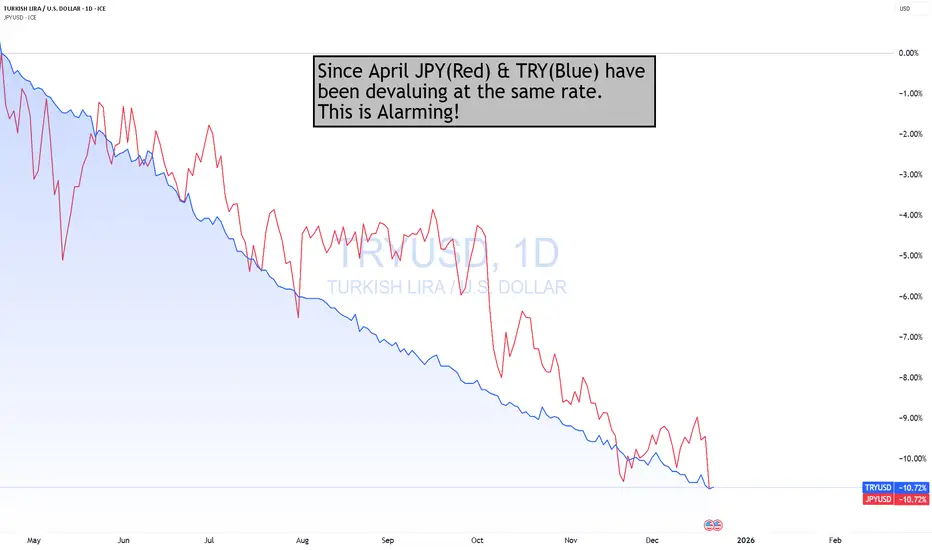
JPY Devaluing At The Same Rate As TRY Against $Since April, the JPY has been falling at the same rate as the TRY against the $. This is Alarming, should the trend continue.
This makes this even more interesting, is that the DXY since Trump took office, has dropped almost by the same amount!
What is important to also understand is that the JPY is 145 of the DXY. As such, if the JPY were to strengthen (all else being equal) the DXY would be down even more!
How would that help the "AFFORDABILITY HOAX" if the $ keeps devaluing, requiring more $s to buy the same amount of goods & services?
Now, does it make a bit more sense why Gold & Silver have soared this year?
I hate to keep harping on JPY, but it is important to all traders/investors in all asset classes, not just FX.
THANK YOU for getting me to 5,000 followers! ๐๐ฅ
Letโs keep climbing.
If you enjoy the work:
๐ Boost
๐ Follow
๐ Drop a solid comment
Letโs push it to 6,000 and keep building a community grounded in truth, not hype.
USDTRY Cooling After Spike โ Where to Next? The Turkish Lira story continuesโthis time through the lens of USDTRY , which has been rising relentlessly and just recently showed signs of exhaustion after tagging highs near 38.95 .
๐งญ As seen on the chart, after months of controlled climbing within a broad ascending channel, the pair is now pausing. We may finally be witnessing the beginning of a retracement. Key downside targets have now emerged:
โข 33.77 โ First area of interest
โข 27.99 โ Mid-level retracement
โข 22.65 โ Deep support within the channel
These aren't random numbersโthey align beautifully with the multi-year channel and prior volatility zones.
๐ Let's not forget, this journey began with a โNew Volatility Alertโ back in late 2021, and ever since, the USDTRY has mostly respected structural moves. With the Euro pair also showing signs of topping , this could be the dollarโs turn to cool off against the Lira.
๐ฐ Contextual Fuel:
โข Turkeyโs central bank raised rates to 46% in Aprilโone of the most aggressive tightening moves globally.
โข Over $25B in FX reserves have been used to stabilize the Lira, as inflation forecasts surge past 29.75% for year-end 2025.
โข Political volatility and macro risks remain, but short-term speculative flows could now reverse.
๐จ Takeaway:
Just like EURTRY, the USDTRY may have finally found its ceiling for now. Traders should monitor price action near 38โ39 for possible bearish continuation signs.
Thereโs a decent chance that the Lira gains ground in the short to medium termโtechnical and macro forces now point to consolidation or reversal.
One Love,
The FXPROFESSOR ๐
EURTRY Chart:
Is Erdoganโs Gambit Destabilizing Turkeyโs Future?Erdoganโs administration continues to engage in high-stakes geopolitical maneuvers by maintaining direct and indirect ties with groups designated as terrorist organizations. His governmentโs strategic alliances, notably with Hayat Tahrir al-Sham (HTS), serve immediate military and political goals in Syria, despite significant international controversy and longstanding terrorist designations by the U.S. and other global actors.
This risky strategy has had a pronounced impact on the Turkish economy. Investors have increasingly shifted their capital from the Turkish Lira to the U.S. dollar, leading to a notable rise in the USD/TRY rate. Fears of further economic isolation and the looming threat of sanctionsโwhich could cut off Turkey from critical European banking and trade servicesโhave only intensified market instability.
The growing strains within NATO and shifting regional alliances are compounding these economic challenges. Erdoganโs pragmatic yet contentious foreign policy raises serious questions about Turkeyโs future role within the alliance, as Western partners deliberate potential sanctions and other measures. Meanwhile, evolving dynamics with regional powers such as Russia and Iran add further uncertainty to Turkeyโs strategic position and economic prospects.
Turkish Lira Sell-Off: Erdoganโs Rival DetainedThe Turkish Lira faced a sharp sell-off, dropping as much as 12% before recovering slightly to a 4.5% decline. The trigger? The detention of Istanbulโs mayor, Ekrem ฤฐmamoฤlu, a key rival to President Erdogan. Investors have long been wary of Erdoganโs economic policies, especially with inflation soaring to 39%โpreviously reaching as high as 85%. With interest rates failing to keep up, confidence in the Turkish Lira continues to erode, pushing many toward alternative assets like crypto. Whatโs next for the Lira? A technical analysis suggests a potential rebound toward 40โ41.
This content is not directed to residents of the EU or UK. Any opinions, news, research, analyses, prices or other information contained on this website is provided as general market commentary and does not constitute investment advice. ThinkMarkets will not accept liability for any loss or damage including, without limitation, to any loss of profit which may arise directly or indirectly from use of or reliance on such information
Can Turkey's Lira Dance with the Dollar?Turkey stands at a pivotal moment in its economic journey, navigating through the complexities of fiscal management and monetary policy to stabilize the Turkish Lira against the US Dollar. The nation has embarked on a strategic pivot towards domestic funding, significantly increasing the issuance of Turkish Government Bonds to manage soaring inflation and debt service costs. This approach, while stabilizing in relative terms, challenges Turkey to balance between stimulating growth and controlling inflation, a dance that requires both precision and foresight.
The Central Bank of Turkey's decision to cut rates amidst rising inflation paints a picture of calculated risk and strategic optimism. The bank is threading a needle between fostering economic activity and maintaining price stability by targeting a reduction in inflation over the medium term while allowing short-term increases. This policy shift, coupled with a focus on local funding, not only aims to reduce external vulnerabilities but also tests the resilience of Turkey's economy against global economic currents, including the impact of international political changes like the US election.
Globally, the economic landscape is fraught with uncertainties, and Turkey's strategy of maintaining a stable credit rating while forecasting a decrease in inflation sets an intriguing stage. The country's ability to attract investment while managing its debt profile, especially in light of global monetary policy shifts by major players like the Federal Reserve and the ECB, will be a testament to its economic stewardship. This narrative invites readers to delve deeper into how Turkey might leverage its economic policies to not only survive but thrive in a fluctuating global market.
The enigma of the USD/TRY exchange rate thus becomes a compelling study of economic strategy, where every policy decision is a move in a larger game of financial chess. Turkey's attempt to balance its books while dancing with the dollar challenges conventional economic wisdom and invites observers to ponder: Can a nation truly master its currency's fate in the global marketplace?
Whatโs Flowing: USDTRYThe USDTRY pair maintains its upward momentum on the 4-hour Heikin Ashi chart, as the price steadily climbs toward resistance at 35.00. The chart illustrates consistent bullish candles supported by a rising trendline and minor pullbacks finding support around 34.50.
Key support zones include 34.50 and 34.30, with resistance at 35.05 and 35.20. The trend remains bullish, but caution is warranted as the price approaches overbought territory. Keep an eye on macroeconomic developments and central bank activity, which often influence the pairโs movements significantly.
Traders should watch for any consolidation or breakout signals to refine entries and manage risk effectively.
When Do Breaking ATMs Signal More Than Just Technical Failure?In a fascinating twist of economic irony, Turkey's banking system faces a crisis not from a shortage of money, but from an overwhelming abundance of near-worthless banknotes. This peculiar situation, where ATMs physically break down from dispensing too many low-value bills, serves as a powerful metaphor for the broader economic challenges facing emerging markets in an era of hyperinflation.
The numbers tell an extraordinary tale: a 700% currency depreciation since 2018, 80% of circulating notes being the highest denomination available, and a stark disparity between official inflation rates of 49% and independent estimates of 89%. Yet perhaps most intriguing is the government's reluctance to print larger denominations โ a psychological barrier rooted in the traumatic memory of million-lira notes from the 1990s. This resistance to adaptation, despite the obvious operational strain on the banking system, raises profound questions about the role of political psychology in economic policy-making.
What emerges is a complex narrative about the intersection of technological capacity, monetary policy, and human psychology. As Turkish banks spend entire days counting money for simple transactions and regulators continuously delay implementing hyperinflationary accounting standards, we witness a unique case study of how modern financial systems can be overwhelmed not by sophisticated cyber threats or market crashes, but by the sheer physical weight of devalued currency. This situation challenges our traditional understanding of banking crises and forces us to reconsider the practical limits of monetary policy in an increasingly digital age.
USDTRY Approaching the top of the Channel Up.The USDTRY pair has been trading within a 6-month Channel Up and the price is now very close to the pattern's top (Higher Highs trend-line). Technically this is were a rejection should take place to reset the market at the pattern's bottom (Higher Lows trend-line), below the 1D MA50 (blue trend-line). Our Target is 33.4000, which is just above the 0.5 Fibonacci retracement level, where the last correction bottomed.
-------------------------------------------------------------------------------
** Please LIKE ๐, FOLLOW โ
, SHARE ๐ and COMMENT โ if you enjoy this idea! Also share your ideas and charts in the comments section below! This is best way to keep it relevant, support us, keep the content here free and allow the idea to reach as many people as possible. **
-------------------------------------------------------------------------------
๐ธ๐ธ๐ธ๐ธ๐ธ๐ธ
๐ ๐ ๐ ๐ ๐ ๐
Shift in Carry Trades: Hedge Funds Embrace USDTRYA Shift in Carry Trades: Hedge Funds Embrace the US Dollar
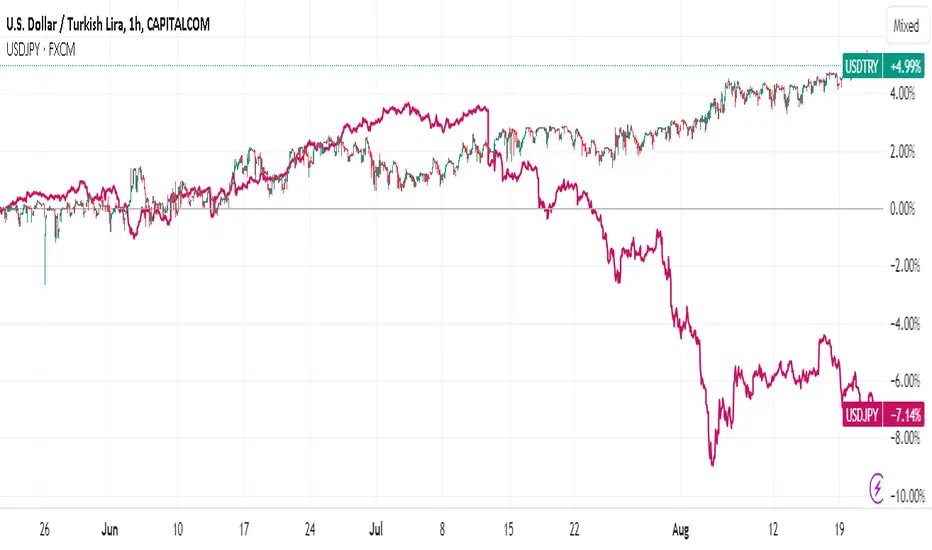
The once-dominant Japanese yen has historically been the preferred currency for carry trade strategies, where investors borrow low-interest-rate currencies to invest in higher-yielding ones. However, a significant shift is underway, as hedge funds increasingly turn to the US dollar as their borrowing currency. This strategic change is driven by a confluence of factors, including the US Federal Reserve's monetary policy stance, the weakening Japanese yen, and the allure of emerging-market currencies.
The Allure of Emerging-Market Currencies
Emerging-market currencies have long been a focal point for carry trade strategies, offering the potential for substantial returns. The relatively high interest rates in these economies, coupled with their often-growing economies, make them attractive investment destinations. However, the choice of borrowing currency plays a crucial role in determining the overall risk-reward profile of such trades.
The Yen's Diminishing Appeal
The Japanese yen has traditionally been a popular choice for carry trades due to its historically low interest rates. However, a combination of factors has eroded its appeal in recent years. The Bank of Japan's ultra-loose monetary policy, aimed at stimulating the economy, has kept interest rates exceptionally low. Moreover, the yen's weakness against other major currencies has increased the risk of exchange rate losses for investors who borrow in yen.
The Rise of the US Dollar
The US dollar, once a less common choice for carry trades, has gained prominence as a borrowing currency. Several factors have contributed to this shift. First, the US Federal Reserve's more hawkish monetary policy, characterized by interest rate hikes and a reduction in quantitative easing, has made the dollar a relatively higher-yielding currency. Second, the dollar's strength against other major currencies has reduced the risk of exchange rate losses for investors who borrow in dollars.
The Case of USDTRY
One notable example of the shift towards US dollar-funded carry trades is the USDTRY pair. The Turkish lira, with its relatively high interest rates, has been a popular target for carry trade investors. However, the increasing political and economic uncertainties in Turkey have made the lira a riskier investment. By borrowing in US dollars, investors can potentially benefit from the interest rate differential while mitigating some of the risks associated with the Turkish lira.
Challenges and Considerations
While the US dollar-funded carry trades offer potential benefits, they are not without risks. The US Federal Reserve's future monetary policy decisions, geopolitical events, and economic fluctuations in emerging markets can all impact the profitability of these trades. Additionally, the increasing popularity of carry trade strategies can lead to market volatility and potential
reversals.
Conclusion
The shift in carry trade strategies from the Japanese yen to the US dollar represents a significant development in the global financial markets. As emerging-market currencies continue to offer attractive investment opportunities, the choice of borrowing currency will remain a critical consideration for hedge funds and other investors seeking to capitalize on these trends. While the US dollar has gained prominence, the potential risks and challenges associated with carry trades should be carefully evaluated before making investment decisions.
Collecting Rollover while the TRY RangesThe CBRT has raised rates from 8.5% in June 2023 to currently standing at 50%. There was a recent CBRT meeting where rates where held at 50%. There has been a roll coaster for inflation YoY which was below 20% in 2020, rose as high as 36% in 2021, pushed up to 85.50% in 2022, dropped in 2023 to around 38% at its lowest, then pushed higher to standing at 69.8% currently. It is projected that inflation will push above the 70% lvl this year and eventually cap out and start pushing lower. The Lira is being hit hard and has lost over 80% of its value over five years due to the unorthodox method the President implemented.
But with this said, there are things going for the TRY, which is a nice carry trade (I'm in it to win it...corny (yeah I know)), with around an 18%-27% annualized gain (fluctuates), this could be some serious gains (and price has been ranging, so that is good). With the FED potentially go to lower rates in September and with the CBRT having rates at 50%, this could cause the TRY to either keep ranging or eventually push lower. But the CBRT might have to raise rates higher in order to fight inflation that is almost 20% higher than its interest rate. This makes the 30 lvl seem that much more plausible to be hit. Additionally, price is trading towards the 32 lvl and has attempted to trade below the 30 lvl a couple of times. So another hit to the 30 lvl support could potentially push it to my price target of around 27 (mean while I'll be able to collect some rollover). A standard lot holding this pair could bring in around $49 a day (depending on the rate for that day) which is a decent amount. The margin requirement for this pair, at least with my broker is 1:4, which means this pair is highly volatile and risky.
This pair can move thousands of pips in a matter of seconds and the spreads are sometimes outrageous. But, around a 1.2 micro lot would be less than $375 in margin, each pip would be a $0.01 move, and rollover per day earned would be around $0.56 a day.
The is a good chance that price will stay were it is at and push lower. The 33-35 lvl is the cap, but for price to push as high as 35, there would have to some strong catalysts to make that happen. I think this is all a self-fulling prophecy with all waiting to see when the FED will make its move. For now, the plan is to keep building in this pair, collect rollover, and wait until at least the 30 lvl is hit to make another decision on whether I want to see it play through to the 27 lvl.
USDTRY Inflationary uptrend still intact but buy on the right leThe USDTRY pair has almost doubled since our last buy signal (October 27 2022, see chart below):
This pair remains one of the most efficient long-term trades long-term as its inflationary uptrend remains intact. We won't turn buyers again however before a 1W MA50 (blue trend-line) test or a neutral 1W RSI (less than 50.00). Our next Target is 40.0000 (again on the 10-year Higher Highs trend-line).
-------------------------------------------------------------------------------
** Please LIKE ๐, FOLLOW โ
, SHARE ๐ and COMMENT โ if you enjoy this idea! Also share your ideas and charts in the comments section below! This is best way to keep it relevant, support us, keep the content here free and allow the idea to reach as many people as possible. **
-------------------------------------------------------------------------------
๐ธ๐ธ๐ธ๐ธ๐ธ๐ธ
๐ ๐ ๐ ๐ ๐ ๐
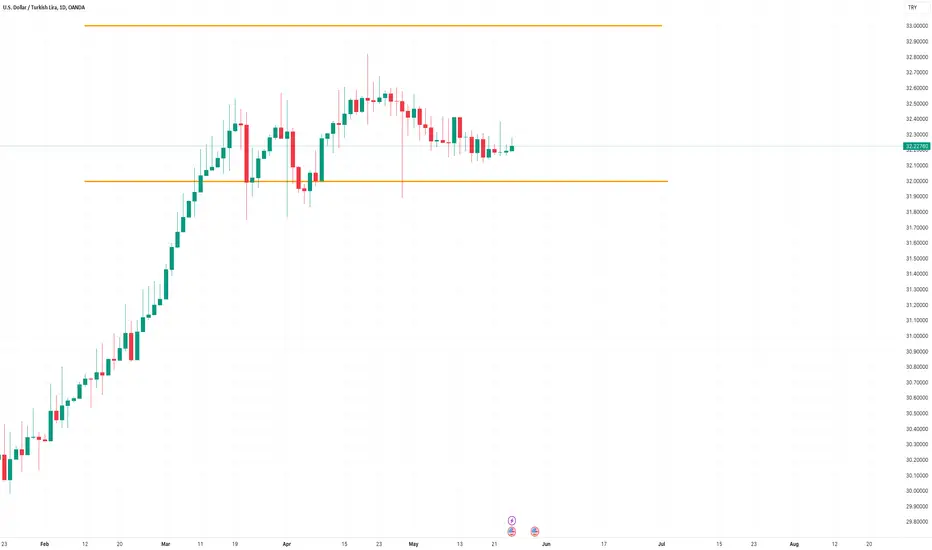
Trading Signal for USDTRYDirection: Sell
Enter Price: 32.54959
Take Profit: 31.996
Stop Loss: 32.55033
Justification for Forecast:
This trading signal has been generated using the EASY Quantum Ai strategy, which combines multiple technical indicators and market analysis to predict currency movements. The following factors were taken into account:
1. Market Trend Analysis: Recent analysis shows a downward trend in the USDTRY pair, confirming the potential for further decline.
2. Economic Indicators: Key economic data from both the United States and Turkey suggest a short-term depreciation of the USD against the TRY, supporting the sell direction.
3. Technical Indicators: The strategy uses a robust combination of RSI, moving averages, and volume metrics. These indicators currently signal bearish momentum.
4. Geopolitical Factors: Current geopolitical tensions and economic policies have influenced investor sentiment, leading to a sell-off in USDTRY.
This forecast is designed to help traders make informed decisions by leveraging the comprehensive analysis provided by EASY Quantum Ai strategy.