Britain Builds Steam Turbines Rolls-Royce Mini-Nuclear ReactorsBritish workers are set to manufacture steam turbines for Rolls-Royce’s planned fleet of small modular reactors (SMRs), in a move that promises to strengthen domestic manufacturing and reduce reliance on overseas suppliers for a critical piece of nuclear power equipment. Siemens Energy will produce the huge machines for the new generation of small modular reactors at its factory in Newcastle. The turbines will be used in the three Rolls-Royce-designed SMRs that are being built in Anglesey, as well as in further reactors that are set to be built in the Czech Republic and Sweden.
The decision marks a significant moment for British industry because it will be the first time in more than 20 years that large steam turbines have been made domestically. The expansion of the Newcastle factory will follow an investment understood to be worth tens of millions of pounds, and it is expected to create around 550 jobs. That combination of capital investment and skilled employment gives the announcement considerable weight, especially at a time when policymakers are focused on energy security, industrial capacity, and the resilience of supply chains.
The move also follows concerns raised by MPs that SMR components were set to be built abroad. Those concerns reflected a broader anxiety about whether Britain would capture the industrial benefits of its own nuclear ambitions or simply import the key parts from other countries. By choosing to manufacture the steam turbines in Newcastle, Siemens Energy and Rolls-Royce SMR are signalling that at least part of the supply chain will remain on British soil.
Rolls-Royce SMR said the decision by German engineering giant Siemens demonstrated how the company was “delivering its commitment to localisation, driving investment and re-shoring work that would have taken place overseas.” The phrase “re-shoring” is particularly important because it captures the idea of bringing back manufacturing activity that might otherwise have been located in another country. For supporters of domestic industry, that is a central part of the announcement’s appeal.
Rolls-Royce SMR is an independent company. It is majority owned by Rolls-Royce, but its investor base also includes Qatar and France’s Perrodo family. That structure means the business combines the heritage and engineering reputation of Rolls-Royce with additional international investment. The company’s chief executive, Chris Cholerton, framed the turbine decision as part of a longer industrial story. “We are building on a remarkable industrial legacy while creating and sustaining the skills and supply chain needed to deliver clean, secure and affordable energy for decades to come,” he said.
Darren Davidson of Siemens Energy also emphasised the wider significance of the work. “We’re preparing to manufacture the next generation of steam turbines for small modular reactors, supporting energy security, creating skilled jobs and helping power the UK’s future energy mix,” he said. His comments connect the project to three priorities that often appear together in debates about nuclear power: energy security, employment, and the transition to a lower-carbon energy system.
The Government awarded Rolls-Royce a contract to design and develop Britain’s first three SMRs last year. Those reactors will be built in Anglesey, North Wales, in a project aimed at proving the commercial viability of the still-nascent technology by the mid-2030s. Each reactor is expected to generate 470 megawatts of power. If the project succeeds, it could help establish small modular reactors as a viable option for producing reliable low-carbon electricity at a smaller scale than traditional large nuclear plants.
Rolls-Royce selected Siemens Energy as its supplier of steam turbines last year, but until now there had been uncertainty about where the key components would actually be manufactured. That uncertainty mattered because the location of manufacturing determines not only the direct economic benefits, such as jobs and investment, but also the strength of the domestic supply chain. The confirmation that the turbines will be built in Newcastle removes some of that ambiguity and gives the project a clearer industrial footprint.
The British company had faced a backlash earlier this year after it emerged that some other parts would be made overseas. Those parts included reactor pressure vessels that will be imported from either South Korea or the Czech Republic. That disclosure raised questions about how much of the SMR programme would genuinely support British manufacturing and how much would depend on foreign suppliers. The latest announcement does not answer every question about local content, but it does provide a notable counterweight by securing a high-value component for domestic production.
Taken together, the decision to build the steam turbines in Newcastle represents more than a single procurement choice. It is a signal about the kind of industrial ecosystem that Rolls-Royce SMR and its partners hope to create around small modular reactors. The project is still in its early stages, and the technology has yet to be proven commercially at scale. But the investment in the Newcastle factory, the creation of hundreds of jobs, and the return of large steam turbine manufacturing to Britain all suggest that the SMR programme is beginning to generate tangible industrial activity.
For the UK, the announcement touches on several important themes at once: the push to re-shore critical manufacturing, the desire to create skilled jobs in regions with strong industrial traditions, the need to strengthen energy security, and the ambition to develop a domestic nuclear supply chain. Whether those ambitions are fully realised will depend on the project’s execution over the coming years. For now, however, the decision to manufacture steam turbines in Newcastle gives the Rolls-Royce SMR programme a clearer domestic anchor and a more visible role in Britain’s industrial and energy future.
Rolls-Royce Holdings plc
No trades
No trades
In-depth trading ideas
$RR Cash Revival Puts Culture And Portfolio In The Spotlightolls-Royce’s transformation into a cash-generating business has brought both its corporate culture and portfolio strategy into sharp focus. Rolls-Royce Holdings (LSE:RR) is currently in the midst of a major internal overhaul led by CEO Tufan Erginbilgic, which emphasizes tighter operational controls, cultural change, and selective asset disposals.
Once characterized as a cash burner, the company has now repositioned itself as a reliable cash generator, with improvements in employee engagement and a heightened sense of urgency cited as critical drivers of this shift. This turnaround has drawn considerable attention from investors, who are now looking beyond short-term share price movements to assess the long-term durability of the business reset.
Best known for its civil aerospace and defence engines, Rolls-Royce is deeply embedded in long-term global trends related to travel, security, and energy systems. The latest phase of restructuring under Erginbilgic differs from previous efforts because it relies heavily on internal discipline, cultural transformation, and portfolio streamlining—rather than simply cutting headline costs. For investors, this places business fundamentals and the mechanics of cash generation at the heart of the story surrounding LSE:RR.
Looking ahead, the central questions are how far this renewed emphasis on returns, workplace culture, and divestments can drive the business, and how resilient these changes will prove across different industry cycles. The remainder of this article examines what is shifting inside Rolls-Royce, how the company is reshaping its portfolio, and what this could mean for long-term growth prospects and the overall risk profile.
⚖️ Price vs Analyst Target: At £12.61, Rolls-Royce is currently trading approximately 10.7% below the analyst price target of £14.13.
❌ Simply Wall St Valuation: The shares are trading 36.9% above the estimated fair value, which signals potential overvaluation.
✅ Recent Momentum: The stock has risen by 11.7% over the past 30 days, indicating strong short-term investor interest in the transformation narrative.
Key Considerations
📊 The transition from cash burner to strong cash generator—underpinned by cultural change and asset sales—places internal execution at the very core of the investment case.
📊 Investors should keep a close watch on cash flow, the pace of divestments, and whether future revenue and earnings align with current expectations, which are already reflected in the £12.61 share price and a price-to-earnings ratio of 17.8x.
⚠️ Forecast earnings are expected to decline by an average of 3.1% per year over the next three years, a trend that could test the true durability of this revival.
Up 1,000% in 5 years,UK government could send Rolls-Royce higherOver the past five years, Rolls-Royce (LSE: RR) shares have delivered a remarkable return of exactly 1,000%, according to my data provider. There’s something almost poetic about that perfectly round figure. However, the FTSE 100 stock has lost some of its momentum recently, declining 18% since the beginning of March. This pullback can be attributed to several factors, including rising jet fuel costs, the cancellation of various flight routes, and cautious forward guidance from GE Aerospace, a key rival in the widebody engine market.
Annual general meeting on the horizon
Arguably, what the share price needs right now is a positive catalyst. Rolls-Royce is set to hold its annual general meeting (AGM) tomorrow (30 April), and it’s possible that the company will issue a trading update confirming whether its full-year guidance remains on track — or not. Following that, the next major catalyst is likely to be the half-year report, due in late July. Historically, the stock has seen significant movement after interim results, mostly to the upside in recent years.
As a reminder, the company has guided for full-year underlying operating profit of £4bn to £4.2bn, and free cash flow of £3.6bn to £3.8bn. Rolls-Royce has built a reputation for setting ambitious targets and then comfortably exceeding them. But that may be becoming more difficult given the current challenging environment, which includes restricted airspace and a rising number of cancelled flights.
SMRs represent a massive opportunity
Clearly, the near-term outlook is tricky, and that adds a layer of risk. Nevertheless, as a shareholder who is more focused on the next decade than on the next few months, I remain very bullish — particularly when it comes to small modular reactors (SMRs), or mini nuclear reactors as they’re sometimes called. If Rolls-Royce succeeds in becoming a global leader in this field, as it expects to, the opportunity could be enormous. Just how large are we talking? The International Energy Agency (IEA) projects that total SMR capacity could reach 120 gigawatts by 2050, with more than 1,000 SMRs deployed globally. Cumulative investment in this space could top $670 billion by 2050 under the IEA’s more bullish scenario. Even the base case is substantial, with SMR capacity reaching 40 GW. CEO Tufan Erginbilgic estimates as many as 400 SMRs could be in operation by 2050. Whichever forecast you prefer, this is clearly a high-growth market. Each unit is reportedly expected to cost between £2bn and £3bn, though it’s worth noting that the technology has yet to prove it can operate at scale.
Government support building
It was therefore encouraging to read last week that UK government officials have been travelling across Europe to drum up business for Rolls-Royce’s SMR technology. According to The Telegraph, Business Secretary Peter Kyle has been holding discussions with Sweden and other European allies. Rolls-Royce SMR has already signed contracts with the UK and the Czech Republic to build mini nuclear reactors. In doing so, it has become the only company with multiple contractual commitments to deliver SMR units in Europe. To be fair, Rolls is already a finalist in Sweden alongside GE Vernova to supply its SMR technology to state-owned energy giant Vattenfall. But there is now talk that Germany is also considering SMRs as a way to strengthen its energy independence, particularly in response to expected energy market disruptions in 2026. If Rolls-Royce SMR can secure orders from other major European nations — especially Germany — the share price could receive a meaningful boost.
A dip-buying opportunity?
Even after its 18% decline, the stock is far from cheap. The forward earnings multiple currently stands at 29. However, for investors who are willing to look beyond the near-term uncertainties and focus on the longer-term potential — particularly in the SMR space — I believe Rolls-Royce is well worth a closer look.
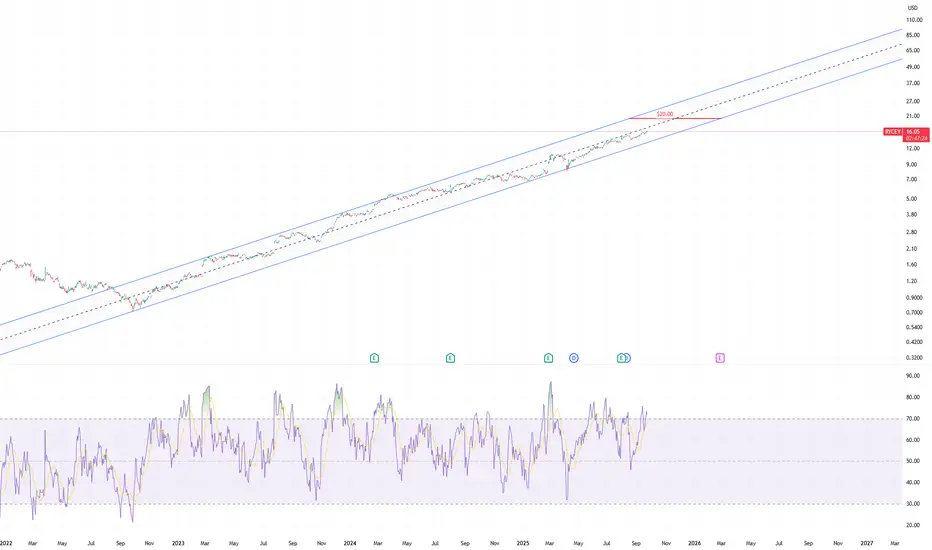
Week 17 of 52 — RYCEY: Strong trend… but cracks are starting to RYCEY is up over 170% since JAN25 — and that’s exactly why this moment matters.
After a move like that, most traders are still thinking the same thing:
“buy the dip, it always goes higher.”
But the chart is starting to tell a slightly different story.
We are now seeing:
→ Loss of momentum after multiple higher highs
→ A deeper pullback toward trendline support
→ Early signs that the trend is no longer as clean
This doesn’t mean the trend is over —it means the easy part might be.
Key level to watch: $13.50
This is where the next move likely gets decided.
If price holds this zone:
→ Expect a reaction
→ Potential continuation toward a new high
If price breaks below:
→ Structure weakens
→ Deeper correction becomes likely
Big picture
The trend is still technically bullish…
but sentiment is late, and momentum is fading.
That combination is where mistakes happen.
Key takeaway
Trend is your context.
Levels are your decision points.
Not financial advice. Just price action.
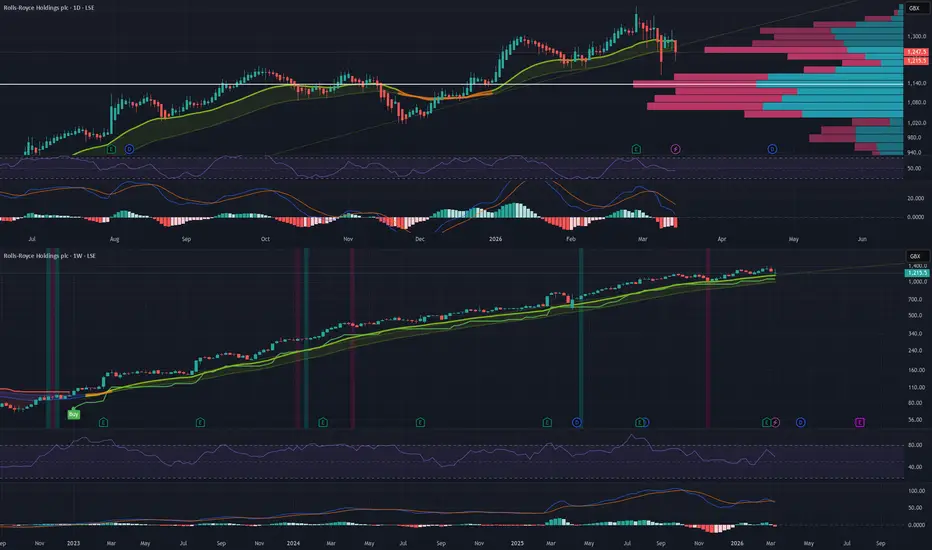
Rolls-Royce: The UK's Energy sector response to MSTR and NVIDIA?The weekly chart showing a straight trend up since October 2022 with gains so far of 1,628% over the past 178 weeks.
Insane and Boring. In other words, Perfect.
And with very little volatility along the way, compared to the USA's politically controversial/divisive Big-Tech performers.
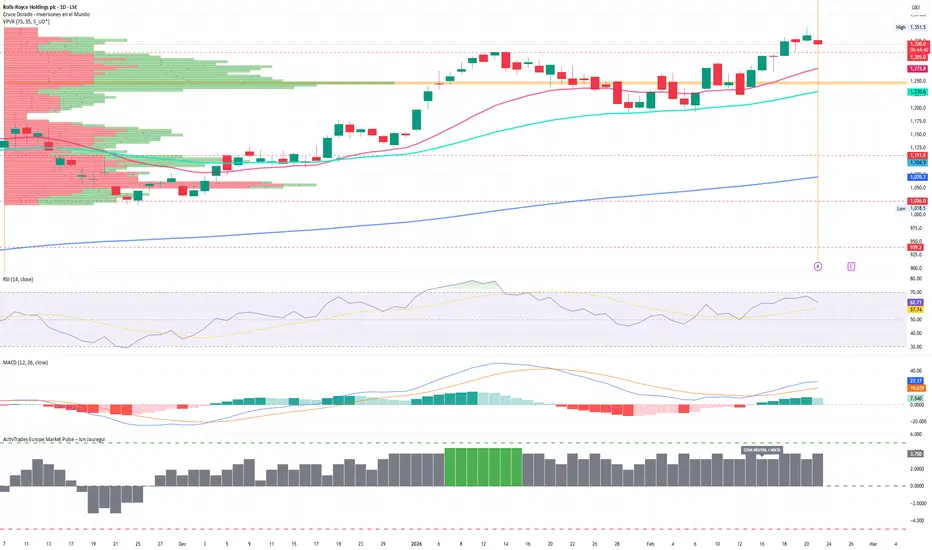
Rolls-Royce Accelerates: Million-Pound Buyback& Industrial ShiftRolls-Royce Accelerates: Million-Pound Buyback, Industrial Shift and Technical Strength at Highs
By Ion Jauregui – Analyst at ActivTrades
Rolls-Royce Holdings could announce, together with its annual results, a new share buyback program of up to £1.5 billion (≈ $2.0 billion), according to its latest report. This program would reinforce management's confidence in the company's cash-generating potential after a year with improved forecasts for operating profit (up to £3.2 billion) and free cash flow (£3.1 billion), and a buyback program already executed of £1.0 billion in 2025.
Production Relocation and Industrial Strategy
Beyond the financial component, Rolls-Royce has been adjusting its global industrial footprint. Historically concentrated in the United Kingdom and the U.S., the company has moved parts of its production and supply chain outside the United States to countries in Europe, Asia, and the Middle East to reduce exposure to trade tensions, manage costs, and gain preferential access to markets where demand for civil aviation and defense is accelerating. This diversification of operations is part of a broader plan for operational resilience and margin optimization.
In parallel with its financial discipline, Rolls-Royce Holdings has accelerated in recent years a strategic adjustment of its industrial footprint, moving part of its production and engineering capabilities outside its traditional centers in the United Kingdom and the United States. The group has consolidated in Singapore one of its main Asian hubs for manufacturing and assembling Trent engines, including the production of critical components such as titanium fan blades, while in India it has strengthened its technology center in Bengaluru and expanded agreements with local suppliers to increase the supply of aerospace components. In continental Europe, Germany continues to play a key role through its industrial subsidiary, especially in power systems and defense. This geographic diversification responds to a strategy aimed at improving margins, reducing geopolitical and commercial risks, and bringing production closer to markets with higher structural growth in civil aviation and defense spending, thus strengthening the resilience of its global supply chain.
Technical Analysis (Ticker AT: RR.UK)
On the British stock market, the stock’s technical behavior is supported by its optimism. Shares are trading in a clear long-term bullish structure, remaining above the main 50, 100, and 200 moving averages, which continue to slope upward, with the price pushed above the 100-day moving average, which supports around 1,200 pence. Both in the short and medium term, the trend is clearly bullish and near record highs, with Monday opening lower in the first hour of trading and a point of control (POC) around the current trading zone near 1,327 pence. The MACD is in positive territory, suggesting bullish momentum, although its histogram is negative, indicating possible exhaustion of strength and price consolidation in the current area. The RSI is currently in the mid-zone around 50%, without extreme overbought or oversold conditions, suggesting some neutrality. Current support levels are at 1,305 pence, with clear resistance at the high zone, as a free rise did not occur in Friday’s session or today’s.
In technical terms, the bullish momentum remains strong, although with signals that call for monitoring key levels:
Trend and Moving Averages
Moving averages (MA) from short to long term (MA50, MA100, MA200) show a bullish bias, with mostly positive crosses and prices above the reference averages, reinforcing the positive trend.
Momentum Indicators
The MACD is in positive territory, suggesting bullish momentum.
The RSI is around mid-levels (~50), without extreme overbought or oversold conditions, but close to a zone that deserves attention if it rises further.
Support and Resistance
Important pivot and resistance levels are around 1,305 and 1,200 pence per share.
The set of recent technical indications points to a general buy signal / bullish momentum, confirmed by multiple moving averages and positive momentum, although with risk of consolidation if the price approaches static resistance or if the RSI enters overbought zones.
Solid Cash Flow
Rolls-Royce combines strong cash flow with disciplined capital allocation (buybacks), an industrial strategy that reduces geopolitical risk, and a technical trend that remains predominantly bullish. Ultimately, Rolls-Royce is not only reinforcing shareholder returns through buybacks but also redefining its industrial positioning on a global scale. The combination of strong cash generation, production diversification, and technical strength in the market paints a constructive scenario for the stock. The key now will be to confirm that this international expansion and margin improvement translate into sustainable growth in the coming years, in an environment still marked by uncertainties. However, monitoring key resistance and support levels will be crucial to validate the continuation of the movement.
*******************************************************************************************
The information provided does not constitute investment research. The material has not been prepared in accordance with the legal requirements designed to promote the independence of investment research and such should be considered a marketing communication.
All information has been prepared by ActivTrades ("AT"). The information does not contain a record of AT's prices, or an offer of or solicitation for a transaction in any financial instrument. No representation or warranty is given as to the accuracy or completeness of this information.
Any material provided does not have regard to the specific investment objective and financial situation of any person who may receive it. Past performance and forecasting are not a synonym of a reliable indicator of future performance. AT provides an execution-only service. Consequently, any person acting on the information provided does so at their own risk. Political risk is unpredictable. Central bank actions can vary. Platform tools do not guarantee success.
Rolls-Royce Holdings: Wave Count AdjustedAfter Rolls-Royce shares recently surged and broke through resistance at €14.10, we have revisited our wave count and made some adjustments. We now primarily believe that the low of wave (4) in magenta was likely set at the end of November, forming a turquoise A-B-C three-wave move. In any case, the ongoing wave (5) in magenta should still have some upside potential before completing the larger cyclical wave I in beige.
Rolls-Royce is Going to the Moon (Literally)Its Friday night and here I am with nothing better to do than write an article on what I think is one of the most interesting companies on the market. I am absolutely enamored by Rolls-Royce for reasons I am going to explain in depth. I don't want my idea to be long and boring so I'm going to get straight to the point and explain as best as I can in a few paragraphs. There's a lot of information I want to share with you about this company so I will break the idea up into sections for an easier and more enjoyable reading experience.
Normally I would start my idea writing about the intrinsic value, I'm going to skip that because this company is incredibly overvalued as per the numbers I ran. By the end of this idea hopefully you might learn something new or find value in my writing, I am writing this idea for educational and entertainment purposes. In no way does this idea constitute financial advice but rather provide you with the all the information required to make intelligent and rational financial decisions based on facts, I am not one to be speculating about the market, I prefer to have good reasons to make investments.
As a capitalist, one of the most important things I think about before making a financial decision, is how does the company I am interested in make financial decisions. In this section I will write about how Rolls-Royce uses capital primarily to fund long-term strategic investments in R&D, advanced manufacturing, and new technologies (e.g., SMRs, electric systems), and for efficient working capital management to support day-to-day operations and a strong balance sheet.
A significant portion of capital is invested in R&D to maintain a competitive advantage and innovate. This includes developing new engine technologies (like the UltraFan and the Pearl engine family), improving engine efficiency and durability ("time on wing"), and exploring lower-carbon solutions such as sustainable aviation fuels (SAF), hybrid-electric propulsion, and small modular nuclear reactors (SMRs).
Rolls-Royce invests in property, plant, and equipment. Recent examples include investments in its manufacturing facilities (such as the £300 million investment at the Goodwood facility) to enhance capabilities for bespoke projects and improve operational efficiency.
The company focuses on the efficient management of short-term assets and liabilities to ensure robust liquidity and the ability to meet day-to-day expenses. Key aspects include:
- Inventory management: Balancing stock levels to support production and MRO (Maintenance, Repair, and Overhaul) services while avoiding excess inventory.
- Receivables collection and payables management: Optimizing cash flow by managing customer relations and supplier payments strategically. The business model for civil aerospace, where revenue comes from engine servicing based on flying hours (Long-Term Service Agreements), heavily influences its working capital dynamics and provides a stable cash flow stream.
Rolls-Royce makes strategic portfolio choices, using capital for acquisitions in key growth areas (e.g., a yacht automation business) and using proceeds from divestitures of non-core activities to reallocate resources to higher-return segments.
A primary goal is maintaining a strong balance sheet with an investment-grade profile. Once this strength is assured, capital is used for shareholder distributions, including reinstating and growing dividends and engaging in share buybacks (e.g., a £1 billion share buyback announced for 2025).
Rolls-Royce is currently executing a share buyback program to return up to £1 billion to shareholders. The program was announced on February 27, 2025, and is expected to be completed no later than December 31, 2025.
The buyback aims to repurchase up to £1 billion worth of shares by the end of 2025. As of July 31, 2025, £0.4 billion (£400 million) had been completed. The purpose is to reduce share capital and fulfill obligations from employee share plans, which should increase earnings per share. UBS AG London Branch is managing the purchases on the London Stock Exchange and other exchanges, operating under the authority granted at the 2024 Annual General Meeting. This share buyback is part of a larger capital return strategy, including a reinstated dividend, reflecting the company's financial turnaround.
Now I will write about what I find interesting to me about Rolls-Royce;
Rolls-Royce has a partnership with NASA and the UK Space Agency to develop micro-nuclear reactors for lunar habitation and exploration. While a full reactor is not yet built, the collaboration is focused on design, development, and testing phases to have a functional system ready for the Moon by the early 2030s.
Key details about the partnership include;
To provide a reliable, continuous, and powerful energy source for a future human lunar base, especially in permanently shadowed regions of the lunar South Pole where sunlight is scarce or non-existent. Rolls-Royce is developing a small, lightweight nuclear fission micro-reactor that measures about 1 meter wide and 3 meters long. This system would produce around 40 kilowatts (kW) of power, enough for a lunar outpost's life support, communications, and scientific experiments.
Roles in the lunar program;
Rolls-Royce: Responsible for the design and development of the reactor concept itself, leveraging its expertise from decades of building nuclear power plants for the UK's submarine fleet.
NASA: Leads the overall Fission Surface Power project and has awarded separate contracts to multiple industry partners (including Rolls-Royce North American Technologies, General Electric, and Brayton Energy) to develop specific components, such as power converters that turn the reactor's heat into electricity.
UK Space Agency: Provides significant funding to Rolls-Royce for research and development, aiming to get a demonstration model on the Moon by 2029 or the early 2030s.
A conceptual model of the micro-reactor has been unveiled. The focus is currently on detailed design stages and developing power conversion technology, with an open solicitation planned for Phase 2 of the project in 2025. The technology is seen as a crucial stepping stone not only for the Moon but also for powering human missions to Mars and for potential commercial and defense applications on Earth, such as providing clean energy to remote locations.
Under CEO Tufan Erginbilgiç, the company has undergone a "miraculous" transformation from a "burning platform" to a robust, cash-generating business. This has resulted in soaring profits, strong free cash flow, and a significantly strengthened balance sheet.
Rolls-Royce operates in industries with high barriers to entry due to the specialized technology, safety regulations, and huge capital requirements involved. Its large, established base of engines ensures a stable stream of aftermarket revenue.
Management has a history of setting conservative forecasts and then outperforming them, which suggests potential for future positive surprises for investors.
In summary, Rolls-Royce offers a compelling investment case for growth oriented investors willing to pay a premium for a high-quality company with a strong competitive position and clear catalysts for future growth.
Rolls Royce Bullish biasTechnical Structure
Trend: Overall bullish structure — higher highs and higher lows.
Support zone: Around $14.80–$15.00, aligned with the lower Quarter VWAP band.
Resistance zone: Around $16.50–$17.00, near previous swing highs.
Momentum: Stabilizing after a pullback; candles show smaller ranges, hinting at reduced volatility before a potential breakout.
Forecast (Blue Projection)
The blue arrows in your chart outline two possible bullish continuation scenarios:
Primary Scenario – Gradual Recovery and Breakout
Price may retest support near $15.00, forming a higher low.
Then a rebound toward $16.00–$16.50 could occur.
If momentum builds and volume increases, the price might break above $17.00, continuing the long-term uptrend.
Alternative Scenario – Extended Consolidation
If price remains capped below $15.80, a sideways phase between $15.00–$16.00 could develop before another breakout attempt later.
Summary
Trend: Bullish bias
Short-term view: Consolidation near VWAP support
Medium-term target: $16.50–$17.00
Key support: $14.80–$15.00
Risk: Breakdown below $14.80 would invalidate the bullish setup
ROLLS ROYCE WAS AN ABSOLUTE BUY AT 100 PSYCHOLOGICAL AREA Rolls Royce was an absolute buy at 100 psychologycal area last week,and in fact it reacted with an epic bounce.
By the way, looks like other juicy targets are still available for long term investors.
After a massive collapse in price started on january 2014, the price seems to have found a bottom last week.
Actually, we are still at prices seen even 15 years ago in 1996, so for investors who truly believe in the company, this looks like a great oppurtunity to accumulate some positions, without looking too much to the possible turbolences that we could see on next months.
In case the world would come close to an end(lol),there is also the support in green, that was the absolute bottom of the whole company history in 2003.
Rolls Royce PLC Macro Swing Short - Elliot Wave CountLooking for this impulsive wave 3 to end around 1189 and above. Once target zone is hit look for short setups. This could potentially be a year long swing short back down to previous ATH/400. Where again you could be looking for a potential swing long back up to ATH. Note Wave 3 are usually the most extended and impulsive wave. A wave 4 correction should be at least 1/3rd the length of Wave 3.
Rolls-Royce Wave Analysis – 29 August 2025
- Rolls-Royce reversed from round support level 1000.00
- Likely to rise to resistance level 1100.00
Rolls-Royce recently reversed from the support zone between the round support level 1000.00 (former resistance from July), support trendline of the daily up channel from May, lower daily Bollinger Band and the 50% Fibonacci correction of the upward impulse from July.
The upward reversal from this support zone stopped the earlier short-term ABC correction (ii).
Given the clear daily uptrend, Rolls-Royce can be expected to rise to the next resistance level 1100.00 (which stopped the earlier impulse wave i).
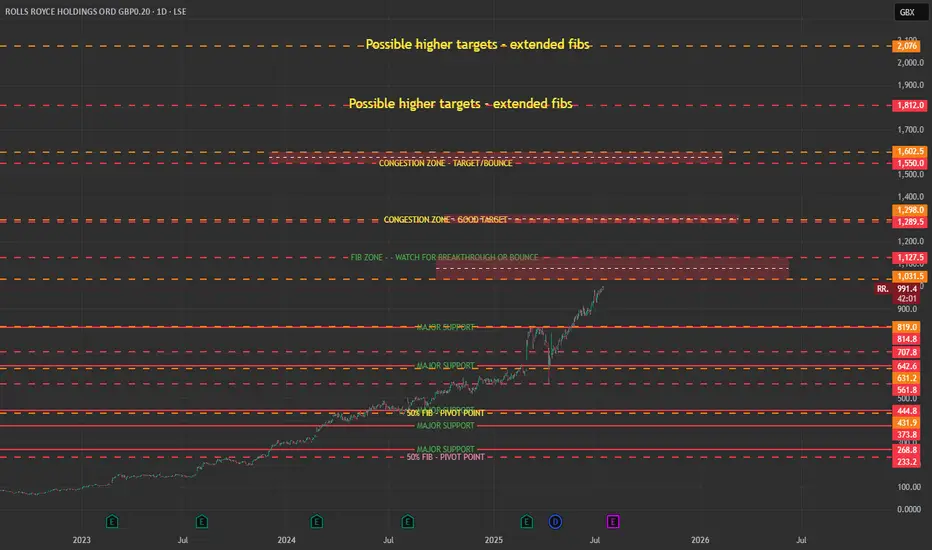
Rolls Royce on a MONSTER of a run.Shares are up roughly 1500% since November 2022 and my first thought was who is buying all these cars, but quickly realised that it was all the "other" engines and equipment that they produce and especially defense contracts that are powering this whopper of a rally.
Either way a truly monster run that might be about to continue after its recent pullback.
Worth a watch.
Market Watch: Rolls Royce📈 Since April, the stock has almost doubled, running in a very strong bull trend. Right now though, it looks like that move is pausing:
• Current resistance around 1111.5 vs. the previous high of 1109 → clear consolidation zone
• Loss of upside momentum with the daily RSI flattening
• Key support sits at 1051, with a notable gap between 1008–1037 (exhaustion gap or measuring gap?).
On the weekly chart, the trend is still very extended, underpinned by the 55-week moving average. We’ve often seen mean reversion back to the 20-week MA, which currently sits at 903.
🔎 Bottom line:
• This market remains in a bull trend above the 55-week MA
• A corrective dip lower is possible, but not necessarily a reversal
• A pullback to the moving average could actually be healthy.
👉 Watching closely for whether this is just consolidation — or the start of a bigger correction.
Disclaimer:
The information posted on Trading View is for informative purposes and is not intended to constitute advice in any form, including but not limited to investment, accounting, tax, legal or regulatory advice. The information therefore has no regard to the specific investment objectives, financial situation or particular needs of any specific recipient. Opinions expressed are our current opinions as of the date appearing on Trading View only. All illustrations, forecasts or hypothetical data are for illustrative purposes only. The Society of Technical Analysts Ltd does not make representation that the information provided is appropriate for use in all jurisdictions or by all Investors or other potential Investors. Parties are therefore responsible for compliance with applicable local laws and regulations. The Society of Technical Analysts will not be held liable for any loss or damage resulting directly or indirectly from the use of any information on this site.
Rolls-Royce – Alarm Bells Ringing: Ending Diagonal Risk3-Day Chart
PATTERN
• The rise from 6.58 € is unfolding as a corrective wave,
sketching a classic five-leg **Ending Diagonal**.
• Overlapping candles, slowing momentum and converging
trendlines confirm the terminal nature of the move.
KEY GUIDELINES
1. **White rising trendline** = last line of bullish defence.
2. A clean break of that line can launch a volatile,
stop-hunting **B-wave**—often beginning with either
a gap or a single long bar.
3. Precise prices on the sketch are **place-holders**;
the diagram shows structure only, not actionable levels.
TRADER NOTES
• While the trendline holds, the diagonal may extend a bit
higher, but reward-to-risk shrinks fast.
• Once support snaps, expect sharp whipsaws before any
sustained decline; size down and avoid heavy leverage
in this zone.
RR > Gate Closed >Recent price action suggests a potential double-bottom formation near the prior resistance level at the current low of circa 530's. A failure to break above this level could lead to further downside pressure, with the next support level anticipated around the psychological level of 500.😍
Will Rolls Royce print 60% correction to 180p?Since the long idea (linked below) price action has melted up 600% in only 21 months. Astonishing. A plethora of long ideas are now published, including on this platform.
The Motley Fool, July 11th - recommended buy
“Rolls-Royce’s share price looks very undervalued to me, with strong business growth prospects, and an investment-grade rating adding to the firm’s allure.”
People actually pay money for this rag. This analysis from WW is free.
Businessinsider, June 26th - According to TipRanks, RR stock has received a Strong Buy
“Deutsche Bank Stays Bullish on Rolls-Royce (RR) Amid Industry Headwinds”
It goes on..
“Menard is a five-star-rated analyst as per the TipRanks Star Ranking tool. Through this tool, TipRanks monitors the performance of many financial experts, ranking them based on their success rate, average returns, and statistical significance.”
It is fascinating to see so many turn bullish at this time. It is a reminder why so few traders (and hedge funds) succeed. Greed.
** The Technical Analysis **
On the above 3 week chart we have:
1) RSI touches 89.3 (blue line), it has never been at this level in the entire history of the business. I remind you this is a 3 week chart. The entire history is shown below. These are bubble levels of strength recorded on the RSI index.
2) RSI support prints breakout. Look left.
3) The Gravestone DOJI candlestick prints across multiple timeframes, including this chart.
4) Why 60% correction? Significant market corrections in the stock were always arrested at the same levels when looking left.
4a) Annual support (yearly candles).
4b) The Fibonacci 0.382. In 2016 the correction was even further, down to the 0.618
The orange line is where both those conditions 1st confirm.
Is it possible price action continues up like the financial rags claim? Sure.
Is it probable? 100% no.
Ww
RSI big picture 3 week
ROLLS-ROYCE HOLDINGS PLC*safe investment opportunity - low risk*
Each candle on the above chart represents 6-months of price action. You can be sure not many people are studying this time frame.
A new candle was printed at the close of 2020 following an astonishing 80% correction since mid-2014. We can see previous price action resistance from dot.com bubble is now winning strong support during the ‘everything bubble’ resulting in the printing of a Dragonfly DOJI candle. Cleary buyers were keen to get exposure to this oversold stock.
An ‘incredible buy’ opportunity is now indicated on the 10-day chart below following an oversold condition (orange column). Price action currently finds support in the bullish half of the Bollinger Band as volume increases.
A buy from 66-100p is amazing if you can get it.