XMR 3 Month Heikin Ashi Trend ChartWe have here a trend outlook chart for Monero on a 3 monthly timeframe (Heikin Ashi candlestick chart). XMR is one of a handful of high market cap coins which have showed signs of strength on a variety of indicators (despite high volatility with various other high market cap coins), including the positive MACD and RSI indicators as shown in this chart.
In addition, there has been significant buy volume in the 170 - 277 price range, as can be seen in the Price-Volume indicator to the right of the chart, keeping the price up.
Monero has withstood the political and economic turmoil in recent months making it a strong contender against some of the largest market cap coins. With the current price sitting at approximately USD$315, there is potential for further upside in the long-term.
_____________
This publication and the information contained in it are for educational purposes only, and is not meant to be nor does it constitute financial, investment, trading or other types of advice or recommendations.
In-depth trading ideas
Monero XMR price analysisLet’s close this trading week with a look at CRYPTOCAP:XMR — the last member of the old “privacy coin trio,” whose story developed very differently from CRYPTOCAP:ZEC and CRYPTOCAP:DASH
While ZEC and DASH spent years in something close to a coma, Monero kept moving higher. Maybe part of the reason is that CRYPTOCAP:XMR was also the coin that got banned and delisted the most.
And from here we enter the territory of assumptions. 🙂
#Monero has always had a very specific audience — privacy advocates, anonymity maximalists and, let’s say, people who don’t particularly enjoy having someone looking into their transactions.
So when we say “the price was kept in shape,” there’s quite a lot you could read into that — and not everything is something people like discussing openly.
But back to the chart.
Looking at #XMRUSD, it currently seems to us that as long as price trades below $666, the probability of a fairly deep correction looks higher than the probability of continued growth.
Under what exact “sauce” Monero could theoretically lose up to 2/3 of its market cap, and whether that will happen at all — we have no idea. 🙂
But this is crypto. Sometimes the move happens first, and only then does the market find a nice explanation for it.
And if you also look at which exchanges currently account for the largest spot volumes in CRYPTOCAP:XMR , there is at least some food for thought.
💬 Do you think CRYPTOCAP:XMR continues the privacy-coin story, or is a deeper correction coming this time?
______________
◆ Follow us ❤️ for daily crypto insights & updates!
🚀 Don’t miss out on important market moves
🧠 DYOR | This is not financial advice, just thinking out loud
Monero, Seems bold But it's in the chartsT1 = ~$4000
Why ? :
the cup and handle target that was form the first peak in 2017 and completed the cup in the 2021 cycle.
The handle of the formation is between the high of 2021 to the peak in 2025. now is it the break out ??
another confirmation of the same target
Why ?:
The target of the rising wedge from 2017 till the peak of 2025.
The target of the rising wedge, is the length of the first pullback (length of the bear market from the peak of 2017 till the bottom of 2018) extrapolate that from the current break out, you get the T2 of $4000 again .
That's it, that's the idea. Good night !
Monero and the Premium on Economic FlexibilityPersonal investment thesis and conditions for validity — 14 September 2026
I see Monero as a leading candidate for a monetary revaluation during a period of systemic disruption. My conviction is that markets underestimate the value of being able to hold and transfer an asset without depending on an intermediary’s permission or the stability of a particular monetary order. Under certain conditions, this flexibility could become valuable enough to make XMR one of the decades to come best-performing investments.
A hypothesis of systemic disruption
My starting hypothesis is that the economic, political and social resources sustaining major state structures are under increasing strain. Relatively linear projections of the future seem to underestimate the possibility of rapid regime changes: sovereign debt crises, devaluations, capital controls, military conflict and fragmentation of trade. This is my macroeconomic premise, not a demonstrated collapse or a certain timetable.
In this setting, the risk to wealth extends beyond falling prices. An asset can remain legally owned and retain a quoted price while becoming unusable for its owner. The ability to sell it, move the proceeds or pay a counterparty then becomes an economic property distinct from its stated value.
Privacy is the visible surface
To me, presenting Monero primarily as a tool against mass surveillance remains a surface-level, “normie” reading of what could be at stake. Privacy matters, but the potential issue goes beyond personal privacy: it concerns the continuity of economic agency when monetary systems compete, close themselves off or become disorganized.
What I seek is the ability to maintain an accessible reserve and settle an exchange between parties that no longer share the same infrastructure of trust. Privacy supports this function by reducing participants’ exposure. It forms part of a broader autonomy combining self-custody, mobility, neutrality and censorship resistance.
How the flexibility premium works
As long as banks, currencies and settlement systems function normally, their convenience dominates. The ability to operate without them may seem marginal. Once restrictions become effective, that fallback capability can be repriced abruptly. My bet is on this change in the value of freedom of action.
Reserve demand before widespread adoption
Monero does not need to replace national currencies to benefit from this dynamic. An individual might want a reserve to manage a transition; an entrepreneur might want a treasury balance to maintain certain payments. Larger organizations might seek a neutral settlement instrument between antagonistic jurisdictions. Their potential interest, however, establishes neither adoption nor legal immunity for transactions.
Demand to hold the asset could grow through both the number of participants and the amount each wishes to retain. The greater the perceived likelihood and duration of a blockage, the more desirable a precautionary reserve may become. Even a small allocation from the wealth concerned could represent substantial demand relative to the supply actually offered for sale.
From circulation to holding
A commercial network can then reinforce this demand. If a seller can pay some suppliers in XMR, there is less need to convert all revenue. Units become treasury balances, rather than merely a temporary conduit. Rising transaction activity is therefore insufficient: I am looking for a growing willingness to hold units between transactions.
A feedback loop could emerge: greater need attracts users and liquidity providers; they make access more practical; that improvement broadens usage and reserve demand. Price appreciation can attract talent and fund infrastructure, further strengthening the network’s usefulness. This loop remains reversible if confidence or usage declines.
Why an autonomous currency
The absence of a peg to a sovereign currency is central to my reasoning. A reserve-backed stablecoin retains dependencies on the monetary system and institutions supporting its backing. XMR held directly is not an issuer’s promise of repayment. This autonomy is the advantage I seek; volatility in its purchasing power remains a cost, not a virtue in itself.
Why Monero could fill this role
A combination of properties
I prioritize the combination of self-custody, digital mobility, mandatory transaction privacy and credible institutional neutrality. Monero seeks to bring these properties together. None is sufficient alone: owning keys does not make a public ledger private, and strong cryptography does not guarantee governance that withstands pressure.
From this perspective, my reservations about Zcash concern the pressure points created by organizations and the concentration of expertise around its development. This does not establish unilateral control over its consensus. Monero must face the same scrutiny: I do not equate an uncompromising community culture with verified decentralization.
Comparison with other assets
Physically held gold does not depend on a promise of repayment and works without a digital network. Its physical nature, however, complicates mobility and remote use. Land, machinery and businesses can retain productive utility, but remain exposed to territorial control and operating conditions. Deposits and bonds are claims against debtors. Equities are ownership rights, not disguised debt, although exercising those rights depends on an institutional framework.
Monero therefore does not replace every form of wealth protection. The role I assign it is that of a transferable, private monetary reserve in a world that remains connected but financially constrained. This differs from the lasting destruction of energy and telecommunications infrastructure.
Evidence of resilience already visible
The project’s persistence despite access restrictions, the existence of decentralized exchange solutions, usage in hostile environments and community funding are favorable indicators in my view. They suggest usefulness beyond the expectation of a higher price. They do not, however, measure demand lost after delistings or establish a worldwide share of darknet settlements.
Dynamic blocks allow capacity to adjust, without guaranteeing instant confirmations or unlimited capacity. Tail emission sustains miner compensation and a flow of new units; it does not guarantee that those units will be sold or that sufficient liquidity will exist. Developers’ awareness of technical limitations is positive only if it leads to verifiable fixes.
Why I see Monero as potentially the best bet
At present, Monero strikes me as potentially the best bet for the scenario I anticipate. This conviction comes from the convergence of a need that could suddenly grow in scale and infrastructure that already exists, is used and has been forced to adapt. I believe the market may undervalue this combination, although I do not have a demonstrated estimate of its fair value.
The breaks with normality I consider
A sovereign debt crisis could trigger withdrawal restrictions, capital controls and devaluation. In that case, holding wealth would no longer be enough: it would need to be accessible when ordinary channels become conditional. For an individual, an autonomous reserve could preserve the ability to meet living costs, relocate or finance a transition.
A generalized war could produce a war effort accompanied by exceptional financial restrictions, greater mobilization of private savings and inflationary pressures. I regard these as plausible scenarios, not decisions already made. They could rapidly change the relative value of an asset that can be held directly without a custodian.
The fragmentation of trade between blocs could multiply sanctions, exclusions from settlement systems and cross-border payment difficulties. Businesses, and potentially states, might then seek a neutral instrument for certain settlements or reserves. This is a hypothesis about demand; the technical possibility of a transfer removes neither legal obligations nor these actors’ other dependencies.
Finally, weakening public authority could coexist with increased surveillance and local insecurity. An entrepreneur would need to protect business activity against arbitrary intervention, exposure of financial flows and private predation. Privacy would then serve economic continuity, beyond personal discretion alone.
Why now
My bet is that these needs could converge before the market understands their significance. Monero already has a history of use and development; its autonomous infrastructure remains imperfect and could improve. I am interested in this transition from established utility in certain niches to a broader monetary role. Investment performance nevertheless depends on the price paid, timing and the network’s survival through that transition.
Neutrality as the cornerstone
Neutrality is the cornerstone of my flexibility premium. To serve as a settlement instrument between opposing parties, the network must credibly be usable without allegiance to a doctrine, a state or a particular organization’s interests. Privacy and mobility derive much of their value from this ability to be adopted by all sides.
Disagreement as a favorable signal
One of the strongest signals, in my view, is precisely the political and intellectual divergence I observe among Monero’s participants. People who do not share a vision of society can recognize a common interest in maintaining the protocol’s properties. This cooperation seems more significant to me than a community united solely by a political narrative or a promise of returns.
Sometimes heated funding debates can therefore be a sign of vitality when they result in useful work being funded and delivered. I see the possibility of a limited but robust agreement: preserving a shared tool without requiring agreement on everyone’s goals. This is my interpretation of the community, not an exhaustive measure of its diversity or proof that concentration is absent.
Some signals are already present
The resilience criteria are not merely a wish list for the future. Atomic swaps, continued development and community funding, alongside usage in hostile environments, indicate that some conditions are already present. I consider this an excellent signal: the project has begun building its response to real constraints.
I also observe exchange and merchant-acceptance initiatives that support my conviction. Their depth, repeat business and retention of treasury balances still need to be documented. I want to verify the expansion and robustness of practices already underway, rather than wait for usage to emerge from nothing.
An uncompromising position that allows correction
An uncompromising commitment to neutrality, privacy and censorship resistance seems necessary to prevent these properties from being sacrificed for short-term accessibility. That commitment must remain compatible with open technical criticism. A neutral network needs participants capable of changing its methods when doing so preserves its fundamental properties.
Technical debt and decentralized liquidity
Limitations recognized by developers
My conviction does not assume that Monero is technically complete. Privacy limitations, correlation risks, capacity constraints and software difficulties are among the issues researchers and developers must address. The FAQ acknowledges the possibility of bugs, and research publications examine the limits of existing protections.
It matters to me that this technical debt is identified and discussed by the people maintaining the protocol. I see such awareness as a better foundation for progress than claims of invulnerability. The value of this signal nevertheless depends on the ability to fund, review, test and deploy improvements: recognizing a weakness does not mean it has been fixed.
Atomic swaps as existing infrastructure
BTC–XMR atomic swaps already enable exchange without entrusting settlement to a custodial platform. They are a concrete first component of liquidity that depends less on major exchanges. Their availability does not automatically create offers, capital or a good user experience, but it provides a technical path for developing them.
The anticipated role of liquidity pools
I anticipate that decentralized automated market makers, or AMMs, could complement these exchanges by pooling liquidity reserves. Serai illustrates this direction: the project describes pools connecting Bitcoin, Ethereum and Monero, among others. At the time of writing, the pages consulted still describe features in the future tense; I therefore treat neither full availability nor the timetable as established.
These architectures introduce their own security assumptions. Serai describes custody through economically secured threshold multisignature wallets. Depositing into a pool is therefore not equivalent to retaining sole custody of XMR, and a cross-chain AMM is not equivalent to a bilateral atomic swap. Liquidity decentralization must be assessed through how it actually operates.
If these tools succeed and attract durable capital, they could reduce dependence on a few access points, facilitate exchange and support adoption. This is a potential driver of my scenario, with an initial component already in place. Liquidity inflows, pool security and resilience under stress remain the decisive developments to watch.
Limitations and conditions for validity
The scenario may be wrong or arrive too late
States may stabilize their finances, conflicts may remain contained and restrictions may remain tolerable. Foreign currencies, gold or competing infrastructure may absorb demand for autonomy. Even if my diagnosis of disruption is correct, nothing guarantees that Monero will capture most of the benefit or that its purchase price leaves sufficient room for returns.
Technology and people remain exposed
A privacy flaw, a consensus attack, compromised devices or concentrated development could undermine the intended function. AI could facilitate certain correlations, but its progress does not establish an ability to break all cryptography. The protocol’s censorship resistance removes neither coercion against individuals nor constraints on the goods and services exchanged.
Demand does not automatically create liquidity
A rush into XMR can raise the price while worsening execution conditions. Sellers, capital and exchange routes usable in both directions are necessary. Tail emission is not a supply that adjusts elastically to demand. A reserve may also lose substantial purchasing power before becoming useful: the absence of an issuer’s debt is not a guarantee of value.
The evidence remains partial
Transaction counts do not directly measure users, economic value exchanged or balances voluntarily held. Internal transfers and spam can distort the data. Funding a project does not guarantee delivery. Privacy makes some adoption metrics inherently difficult to establish; I must accept this uncertainty without turning it into favorable evidence.
What would strengthen or invalidate my conviction
Some of the signals I seek already exist: autonomous exchange routes, active community funding and usage under constraint. I consider this initial realization an excellent sign. I will track their expansion, exchange resilience under stress, repeat customers and the retention of balances during downturns. Contributor diversity and delivered fixes will help distinguish lasting resilience from a promise.
Conversely, adoption remaining mainly speculative, persistently impaired access, inadequate privacy or a decisive institutional dependency would weaken my thesis. My conviction is that the market may deeply undervalue this flexibility. For that intuition to become a successful investment, it must be matched by a technically credible, economically usable network acquired at a price consistent with the risks.
Sources and factual notes
Those words sets out a personal conviction and the conditions under which it would hold. The sources below support the technical mechanisms and factual distinctions; they establish neither the anticipated macroeconomic disruption nor future XMR performance.
1 Monero FAQ and technical specifications
www.getmonero.org
docs.getmonero.org
2 Monero Tail emission
www.getmonero.org
3 Monero Atomic swaps and community funding rules
www.getmonero.org
ccs.getmonero.org
4 Zcash Proposal process and organizational information
zips.z.cash
z.cash
5 Chainalysis Limitations of Monero data in the 2025 report
www.chainalysis.com
6 European Commission DAC8
taxation-customs.ec.europa.eu
7 Monero Research Lab and community publications
www.getmonero.org
www.getmonero.org
8 Serai and liquidity pool architecture
serai.exchange
github.com
Price history: www.coingecko.com
This is something that goes out of my regular activity here but remember "
The best traders in the game will always prioritize their intuition over apophenia
You don't like that answer?
Intuition isn't exotic enough to satisfy your curiosity?
It's the truth, and there is no other truth
I can't teach it to you, but you can find edge" _ GCR
XMR is at the lineXMR is at the waterline.
From Claude:
XMR/USD — Retesting the Line: Bounce or Breakdown?
Monero broke above this rising trendline around Sept 18–19, ran to a local double-top near $585–600, then spiked to $633.90 on the 21st before pulling back. Price is now sitting right back on that same line at $569 — a textbook breakout retest. Former resistance either holds as new support here, or it doesn't.
Bull case: Funding rate just hit its highest level since Sept 4, and open interest rose 18% (~$55M new inflow) over the past 24h — leveraged longs are building, and the Aroon indicator has bulls in control.
Bear case: Liquidity clusters sit below current price on the 1-month heatmap — a magnet that can pull price down toward them — and CMF has been quietly declining even as price rallied, hinting at distribution under the surface.
Key levels:
Support: $569 (the line, live) → $520–540 shelf → $484.20 swing low
Resistance: $585–600 → ~$611–613 (fib zone) → $633.90 spike high
Invalidation: A clean close below $569 with follow-through opens the door to $520–540.
Two-sided setup, not high conviction either way — watching how price behaves right at the line over the next few candles.
Not financial advice — sharing the level and the reasoning, not a signal.
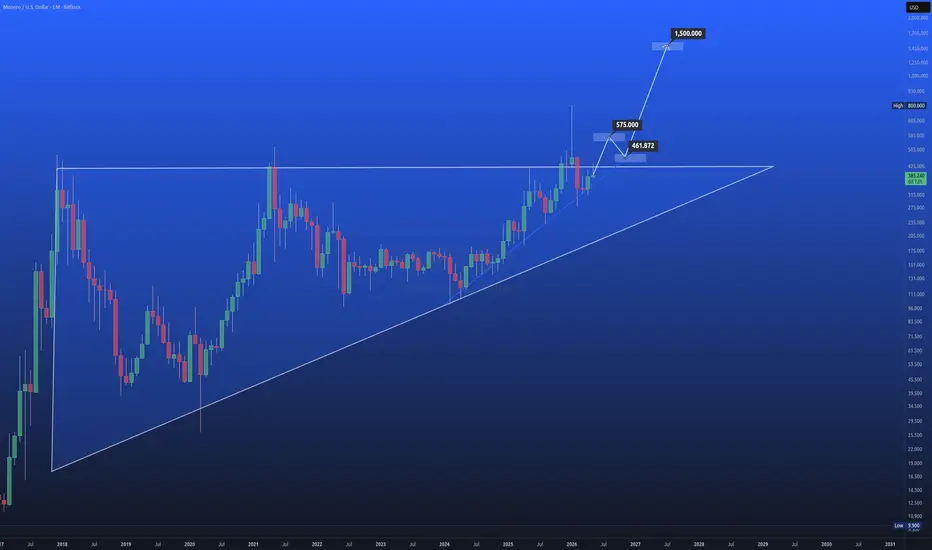
xmr the new slivermonaro has been out preforming every major coin out there.. btc is obviously in a bear market..as well as everything else but the one coin that is actually bullish is manero...from the high on btc we are down a crazy 26% more coming....ltc from high we are down a incredible 36%.. now xmr is only down 12% and is about to test a break out of this bullish ascending triangle..all indicator are bullish .. in short this looks like xmo has been forming a cup n handle just like silver for a incredible 9 years.. on regular scale 5 day, it does appear to be forming a inverted head and shoulders ..heres where things get interesting when we get conformation on the smaller time of a breakout this will explode and go parabolic. xmo would be the only crypto worth buying ,as soon as we get conformation i will immediately update you..hang on this possibly could be the next crypto silver..
XMRUSDT 3/SEPMonero (XMR) Analysis | Privacy Coins Narrative & Possible Scenarios
Privacy coins have recently become one of the strongest narratives in the crypto market, gaining more attention and increasing their market capitalization.
The main driver behind this trend could be related to rising geopolitical tensions, global conflicts, and increasing concerns around financial restrictions and privacy. Historically, during periods of uncertainty, demand for privacy-focused assets tends to increase as users look for more private and censorship-resistant financial solutions.
Among privacy coins, Monero (XMR) currently shows a stronger structure compared to Zcash (ZEC) from my perspective.
My first scenario for XMR is a continuation of the bullish movement toward the $652 resistance area. After reaching this zone, a temporary correction could occur before the market decides its next direction.
Considering the current geopolitical environment, global instability, and increasing demand for financial privacy, Monero could continue attracting market attention and potentially experience further growth.
The second scenario is a consolidation range between $528 and $311.
A weekly candle close and stabilization above the $528.32 level would increase the probability of this range scenario developing before the next major move.
Key Levels:
• Potential bullish target: $652
• Important weekly confirmation level: $528.32
• Possible consolidation range: $528 - $311
Due to the current popularity and strong narrative around privacy coins, the bullish trend may continue. Therefore, aggressive short positions against this trend in futures markets carry high risk and should be approached with caution.
Always manage risk properly and remember that market conditions can change quickly.
MONERO: $500 | the Bellwether of DeFi and BTC it can lead or it can signal ahead or maturity of market (crypto)
it gives a heads up for ALT Season
and incling when BTC is about to reset
Privacy is King
and MONERO covers both
Volatility and Pain in the neck on
storing backing up using wallet
not for everyone
yet only for serious players
who have seen BTC back in the day
STRATEGY: own it
xmr update quick update we are clearly looking at a breakout now happening but the next day will confirm if we will retrace or push thru to ath i will update as soon as we pass the old high ..or fall to support. my bias is new push will come to ath we are climbing with out any crazy swings slow and steady is what looks good
xmr updatewe are now witnessing the conformation of a break out for xmr
on my last update i said i will post as soon as we have conformation of a break out
we are in ath and in price discovery as xmr is now creeping up to the top ten market cap.
with this looking exactly like silver i can expect a rally to 2k
Zulfiqar and the slay of the dragonAnd here is the double-edged sword—
The one that, if gripped poorly, cuts the very person wielding it.
There is no better tool for dealing with the beast of this world.
They claim to desire freedom, yet fail to account for the weight that comes with it.
If you take up the sword Zulfiqar, ensure you never waver.
Maintain the distance between yourself, evil, and good.
And remember these words on the battlefield:
"In the light of duality, all truths are gray."
Wednesday Journal Session: Monero ideaThis is actually very interesting after our stop losses were getting hit, I immediately started thinking about this different and how Monero could actually drop back down to the $300 level
Through certain fundamentals I realized XMR was going through some sort of lawsuit phase and they could start receiving rejection back down to the $300 level.
I realize as well sometimes we feel way too early for things and can feel even unprepared.
The market does what it does best, but it can be measured through patterns and human psychology.
Sometimes we can be looking at the chart so technical that we forget to realize. About the fundamentals.
Buy the rumor and sell the news.
See buying the rumor and selling the news is all about knowing that when the rumor first drops we need to realize . . . that there may be a relief rally coming BEFORE the fall.
That's almost every great hero movie by the way!
As a trader when we pay little attention to these things we realized that we could be trading in euphoria and not from a logical standpoint. On how The big money actually moves.
One thing my mentors taught, results ALWAYS tell the story, and a major advantage to your success is knowing your market intimately.
So whatever you're trading make sure. You're looking at both sides and knowing that there are three parts to every situation. Their side, your side, and the truth.
Oh and what people say are the facts are all just speculation and opinion anyways.
Weak Altcoin Choices: Should You Buy $XMR and $ALGO Right Now?Next, we'll check some coins that are showing weak signs. Yesterday, XMR and ALGO were quite good candidates. But today, their chart situation has changed completely.
XMR dropped hard to 385 dollars. It lost an important support level at 400 dollars. Worse, it also fell below the MA200 line.
Monero to go back to lower bullish trend lineBearish now on Monero
The Point & Figure chart shows a vertical count going back to $205
Replaying the bar pattern from the early 2018-->2021 pattern shown in black gives this potential roadmap if history rhymes
This is triggered / activated if price breaks below $327 otherwise this could become an upside target which I will specify later if it happens
XMR | Day Chart** T.A explained **
Multiple Time-Frame Analysis; Color Code:
Strength favors the higher timeframe.
Yearly timeframe = black
Monthly timeframe = pink
weekly = grey
daily = red
4hr = orange
1hr = yellow
15min = blue
5min = green if they are shown. (Level visibility on intervals is set to timeframe the level was found on and below to keep chart view organized.)
Ranges defined
A Range = two or more consecutive color candles (2+ in a row, same color creates a range)
There are two types of ranges - Accumulation Ranges &
Distribution Ranges.
*A single candle is a range on a lower timeframe. Mark the candle and then find the range / level on a lower timeframe aka "Range Finding".
Some people use boxes and call this boxing finding the zone - supply & demand zones - and marking the entire range top to bottom. This is acceptable but introduces risk by increasing probability of orders getting filled.
Candle Science further defines the zone / range into levels. So. after finding a range, identify and label the first and last candle of the range.
This is Candle Science. Everything has a default expectation and users thinking is guided by IF/THEN statements.
Below are the default expectations for each range and the first and last candle within the range.
DISTRIBUTION RANGES:
When price is above a distribution range its default expectation is to support price accumulation.
The first distribution candle in a distribution range is labeled as the BackSide Candle (BS).
Expectation = strong reaction to price. Look for price action to create long wicks reaching to or away from level. A steep angle trend is expected to form so Fair Value Gaps are expected to form on the timeframe of the level and lower timeframes.
If a steep angle trend is not forming, and long wicks are not being created then the idea is that liquidity is not there, confidence in the level is low. Price Action may then be looking for more liquidity to and seek it out at the FrontSide Candle.
FrontSide (FS) Candle = The last distribution candle in a distribution range.
Expectation = create a low angle accumulation trend reversal.
3 bar reversal patterns laddering up
like the distribution candles are the rungs of an accumulation ladder. price uses the top side of the BackSide Candle or the top side of the FrontSide Candle as support. They are used in bull flags to break distribution trends.
IF price fails to gain a BackSide or FrontSide level THEN they act as RESISTANCE. But we will then train our eyes to look at the bottom side of Accumulation Ranges because they have a default expectation as Resistance.
When Price is below an accumulation candle, the bottom side of the accumulation candle is the level of resistance.
ACCUMULATION RANGES DEFINED:
Inverse BackSide Candle (Inv.BS) = the first accumulation candle in an accumulation range.
Expectation. = strong reaction to price. long wicks reaching to or away from level. Creates a steep angle distribution trend. Usually create F.V.G's and impulsive, volatile moves like the BackSide Candle.
Inverse FrontSide Candle (Inv.FS) = The last accumulation candle in an accumulation range.
Expectation = reversal, create a low angle distribution trend. The bottom side of the accumulation candles are used as resistance levels.
TOOLS USED:
Boxes - used to define a zone by marking the entire range (if its small) or just one entire candle or just the wick of the candle to define the zone.
Horizontal Ray tool - used to define the level.
levels when dashed lines are untested, active level where buyers or sellers are waiting to create a level of interest.
Tested levels are dotted lines. If used, they reference the range and could become Origin levels or R.a.t.s in the future (levels where new trends originate or where traders are using Rejection as A Target to scalp and reverse position - aka stoploss hunters; like the rats they are.
Again the color code:
Yearly timeframe color is Black
Monthly timeframe is color pink
weekly grey
daily is red
4hr is orange
1hr is yellow
15min is blue
5min is green if they are shown.
strength favors the higher timeframe.