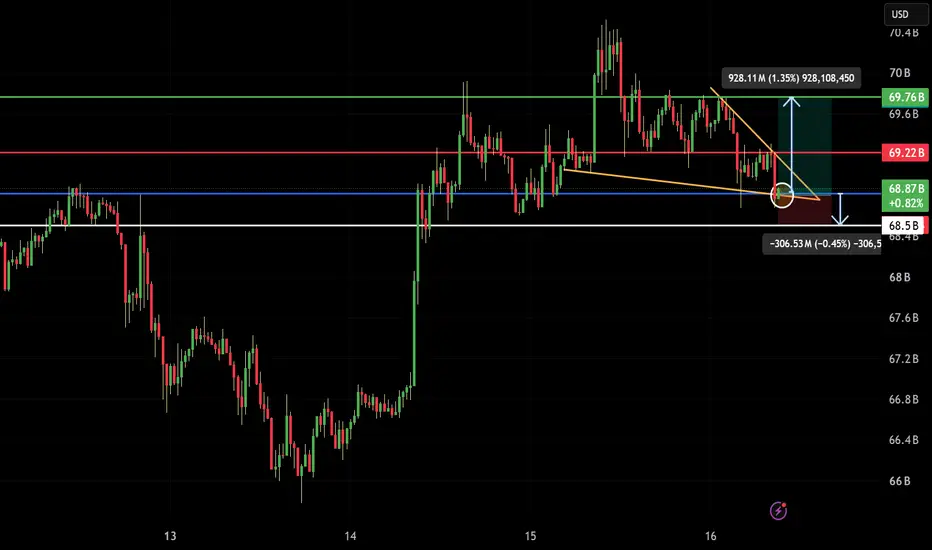
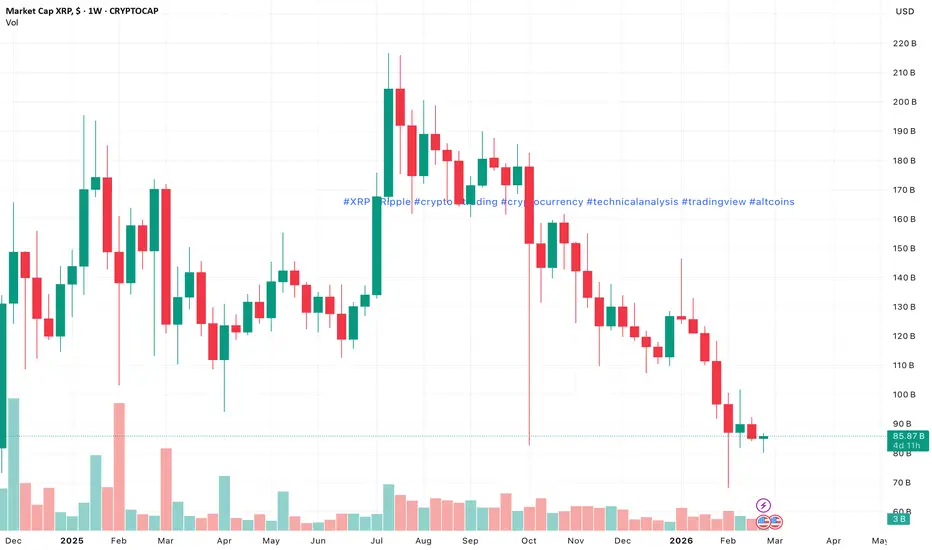
XRP: Trend Compression ContinuesXRP remains within a well-defined bearish market structure, with the dominant descending trendline continuing to cap recovery attempts. Although sellers retain control of the broader trend, recent price action suggests that downside momentum has moderated as buyers gradually establish a rising support structure.
Following the impulsive decline, the market has transitioned into a period of compression. Buyers have consistently defended higher lows, while sellers continue to protect lower highs beneath long-term trend resistance. This tightening structure reflects a market that is losing directional momentum rather than one that has already confirmed a trend reversal.
The primary scenario favours another recovery attempt while the rising support trendline remains intact. Continued buying interest could allow XRP to retest the dominant descending trendline, where the market will face its most important technical challenge. A successful move into this area would improve short-term momentum, but it would not confirm a bullish trend without a sustained break above resistance and the development of higher highs and higher lows.
The alternative scenario becomes increasingly relevant if buyers lose control of the current support structure. A decisive break below the rising trendline would invalidate the recent sequence of higher lows, strengthen bearish momentum, and increase the probability of trend continuation in line with the broader market structure.
For now, sellers continue to hold the structural advantage, while buyers are gradually improving short-term conditions from support. The market is approaching an important decision point where the next breakout from the current compression is likely to determine whether the recovery develops further or the prevailing bearish trend resumes.
Market Cap XRP, $
No trades
No trades
In-depth trading ideas
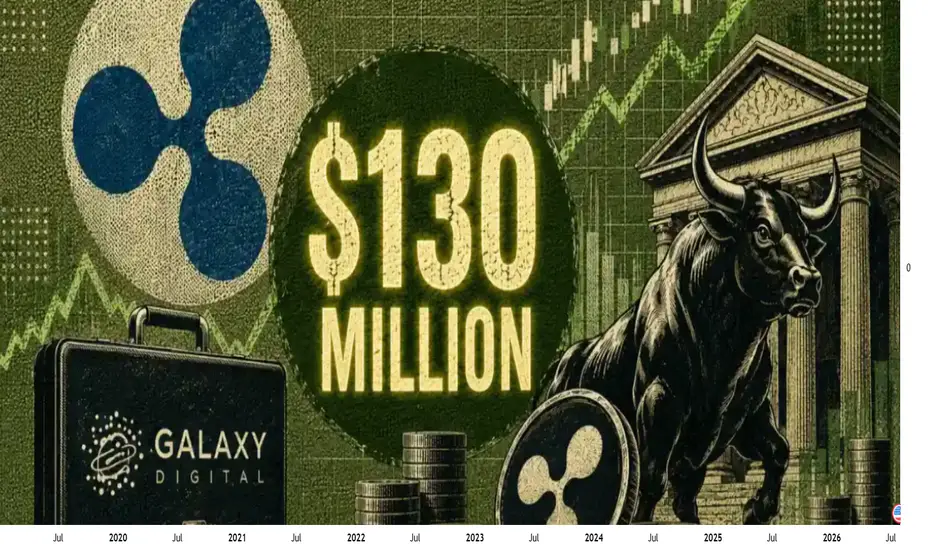
Ripple News: Court Clears $130M Ripple Share SaleLinqto has received U.S. Bankruptcy Court approval to sell approximately $130 million worth of private Ripple shares. The pre-IPO investment platform continues its Chapter 11 restructuring. This deal is part of a wider recovery process for thousands of customers who invested in private companies through the platform.
Major Institutions Buy Ripple Shares
The reported transaction includes Galaxy Digital buying $60 million in Ripple shares. Arrington Capital is buying $50 million. The Private Shares Fund is buying $16 million, and GAM Alternatives Lux is buying $4 million.
Ripple has reportedly waived its right of first refusal, allowing the transfers to proceed. The deal reflects continued institutional demand for exposure to Ripple’s private-market valuation. However, it does not mean Ripple is going public. The transaction has no direct impact on XRP holders or XRP ownership.
The proceeds will support customer recoveries as Linqto winds down its operations.
Linqto Bankruptcy Plan Was Backed by Customers
Linqto filed for Chapter 11 in July 2025 after new management uncovered potential securities-law violations dating back to 2020. This included issues involving the structure of special-purpose vehicles used for customer investments.
The platform had already shut down in March 2025. Its bankruptcy case involves investments linked to around 111 private companies, with the portfolio valued at more than $500 million.
On February 6, 2026, the court approved Linqto’s restructuring plan after roughly 95% of voting customers supported it. The plan offered customers recovery through a liquidating fund holding indirect private-company interests. Alternatively, it offered a publicly listed closed-end fund holding private shares, or a combination of both options.
Forge Dispute Threatens to Delay Customer Recoveries
The recovery process has now run into another legal challenge. According to Bloomberg Law, Linqto and its creditors have sued Forge Global Holdings. The private-market platform allegedly attempted to withdraw as trustee of the customer recovery trust just five days before Linqto planned to launch the trust on July 20.
Forge was expected to hold customer assets, manage transfers and help administer the recovery plan. According to the complaint, Forge cited demands from its new parent company, Charles Schwab, for its decision to back out.
Linqto and the Official Committee of Unsecured Creditors are asking the bankruptcy court to force Forge to honor its agreement. They want Forge to continue serving as trustee.
The dispute could delay asset transfers, increase legal costs and slow customer recoveries. For Linqto users with indirect exposure to Ripple, the case is about how and when their assets are administered. It is not about the validity of Ripple shares or the value of XRP itself.
XRP Price Prediction Today: Can Bulls Break $1.20XRP price today is trading above $1.10 after gaining nearly 4%, while Bitcoin has climbed back above $65,000. The recent recovery has improved market sentiment, but XRP still needs to move above $1.20 to confirm a stronger uptrend.
The $1.20 level has acted as a strong resistance in recent weeks.
According to analyst, a sustained move above this level could push XRP toward the next resistance zone between $1.24 and $1.28. A break above $1.29 would strengthen the bullish trend.
On the downside, XRP needs to stay above $1.13 to maintain the current recovery. A drop below $1.10 could erase recent gains.
XRP Price Rises as Funding Rates Fall
One unusual signal during the latest rally is the sharp drop in XRP funding rates.
Funding rates fell 240% in one day, even as XRP moved above $1.13. At the same time, trading volume increased 64% over the past 24 hours.
This suggests the price increase is being supported by spot buying rather than excessive leveraged trading, making the move appear healthier than a leverage-driven rally.
Whale Buying Continues
Large XRP holders added around 70 million XRP during the recent price recovery. Despite this accumulation, XRP has remained below $1.20, showing that buying pressure has not yet been strong enough to trigger a larger breakout.
Network Activity Remains Weak
Active XRP addresses have dropped to around 20,000, the lowest level in nearly a year. Lower network activity suggests fewer users are currently interacting with the XRP Ledger, even as the price attempts to recover. At the same time, new capital entering XRP remains limited, which has slowed upward momentum.
Key XRP Price Levels
$1.10 – Major support
$1.13 – Short-term support
$1.20 – Key resistance
$1.24-$1.28 – Next resistance zone
$1.29 – Level that could open the way for a stronger rally
XRP has started to recover, supported by higher trading volume and continued accumulation by large holders. However, the price remains below its key resistance, network activity is near a one-year low, and fresh buying remains limited. Holding above $1.13 and breaking $1.20 will be the next important signals to watch.
XRP Backs CLARITY Act: 'A Vote Against It Is Anti-ConsumerThe CLARITY Act is entering its final stage in the Senate. Ripple is making a strong case for why lawmakers should pass it. With President Donald Trump set to meet senators at the White House on Thursday to discuss the bill, the crypto industry is hoping to get it across the finish line. They hope to succeed before Congress begins its August 7 recess.
For Ripple, the bill isn’t just another piece of legislation. Instead, it’s about finally bringing clear rules to the U.S. crypto market.
Ripple: “Don’t Repeat the Same Mistakes”
Ripple’s Chief Legal Officer Stuart Alderoty warned that rejecting the CLARITY Act would only keep the current regulatory confusion alive.
“A vote against the CLARITY Act is a vote to leave the same unregulated conditions in place to be exploited by bad actors,” he said. “We’ve seen this movie. Let’s not watch the sequel.”
After spending four years fighting the SEC over XRP, Ripple says the industry needs clear laws. Rather than regulation through enforcement, they want clarity.
Consumer Protection Is the Main Focus
Ripple’s Head of U.S. Public Policy, Lauren Belive, says voting against the bill is “anti-consumer.” She argues that the same regulatory gaps that allowed the FTX collapse still exist today, leaving investors without clear protections.
According to Belive, the CLARITY Act would fix this by clearly dividing oversight between the SEC and CFTC. It would also set clear compliance standards. In addition, it would give consumers confidence about who regulates digital assets.
“Good actors will always do the right thing, but consumers deserve a level playing field,” she said, adding that opposing the bill simply preserves the status quo that failed investors.
Also Read : Why the CLARITY Act Still Hasn’t Passed?
Coinbase Wants Rules Locked Into Law
Coinbase also threw its support behind the bill. Speaking recently, the exchange’s Chief Policy Officer said regulators have already started adopting sensible crypto policies. However, Congress now needs to make them permanent.
“The policy changes have already occurred. We simply want the law to catch up,” he said, adding that the company is “very confident” the legislation will eventually pass.
One Last Hurdle
The biggest obstacle remains the ethics provisions. Democrats want tighter restrictions on public officials’ crypto business interests before offering the votes needed to reach the 60-vote threshold.
Still, there are signs of progress. Senator Thom Tillis said negotiators are “close” to a deal. Meanwhile, Senator Cynthia Lummis hinted that a revised draft could arrive soon. With Trump now directly involved in the discussions, the next few days could decide whether the CLARITY Act finally becomes the regulatory framework the U.S. crypto industry has been waiting for.
XRP Relative Strength Update (Daily)XRP/BTC
The daily structure is showing signs of improvement as the 20 EMA is crossing above the 50 EMA with increasing separation, suggesting relative strength is building in favor of XRP versus Bitcoin.
RSI: 61 — holding above the midpoint and showing positive momentum.
ROC: Rising — momentum continues to improve after recent stabilization.
Price is pushing higher relative to BTC as buyers continue to gain ground.
XRP/ETH
XRP has been outperforming Ethereum since May 17, 2026, and that leadership remains intact on the daily timeframe.
RSI: 60 — holding steady in bullish territory.
Relative trend remains constructive despite normal short-term fluctuations.
XRP continues to maintain its advantage versus ETH as momentum remains stable.
What I'm Watching 👀
🔹 XRP/BTC
Whether the 20 EMA can remain above the 50 EMA and continue expanding.
If RSI can hold above 60 or continue pushing higher.
Whether ROC continues to rise, confirming strengthening momentum.
🔹 XRP/ETH
Whether XRP can maintain leadership over ETH following its May 17th relative strength breakout.
If RSI remains above 60 and avoids a momentum rollover.
Whether relative price structure continues making higher highs and higher lows.
Market Perspective
Relative strength charts are not measuring whether XRP is going up or down in dollar terms. They measure where capital is flowing within the crypto market.
When XRP/BTC and XRP/ETH strengthen simultaneously, it can indicate that market participants are allocating capital toward XRP at a faster rate than Bitcoin or Ethereum. When both ratios weaken, it suggests capital is rotating elsewhere.
At the moment, both ratios are showing constructive momentum, but confirmation will come from whether these trends can continue to build over the coming sessions.
⭐ Final Clarity Note⭐ : This is a relative strength analysis, not a price prediction. The focus is on leadership, momentum, and capital rotation within the crypto market. Leadership can strengthen, weaken, or remain unchanged as new information enters the market. Always let structure guide the narrative, not the other way around.
Ripple CEO Challenges Jamie Dimon Over Crypto Regulation DebateRipple CEO Brad Garlinghouse has reignited the debate surrounding cryptocurrency regulation after criticizing JPMorgan CEO Jamie Dimon’s long-standing opposition to the digital asset industry. Speaking this week, Garlinghouse accused Dimon of misrepresenting the proposed Digital Asset Market Clarity Act, arguing that the legislation is designed to provide regulatory certainty rather than weaken compliance standards.
According to Garlinghouse, Dimon’s criticism reflects broader concerns among traditional financial institutions about protecting existing payment businesses. He suggested that major banks may view clearer crypto regulations as a competitive challenge to their established revenue streams, particularly in cross-border payments and digital financial services.
The comments have drawn significant attention as lawmakers continue advancing legislation that could reshape the regulatory landscape for cryptocurrencies in the United States.
What Is the Digital Asset Market Clarity Act?
The Digital Asset Market Clarity Act, commonly referred to as the CLARITY Act, is a bipartisan legislative proposal designed to establish a comprehensive regulatory framework for digital assets. Supporters believe the bill could bring long-awaited certainty to an industry that has faced years of regulatory ambiguity and enforcement-driven oversight.
One of the legislation’s primary goals is to clearly define which government agencies oversee different types of digital assets. Under the proposed framework, assets classified as digital commodities would primarily fall under the jurisdiction of the Commodity Futures Trading Commission (CFTC), while securities-like digital assets would remain under the oversight of the Securities and Exchange Commission (SEC).
As a result, businesses, developers, exchanges, and investors could gain clearer guidance regarding compliance requirements and regulatory responsibilities.
Garlinghouse Says the Bill Supports Innovation and Compliance
Garlinghouse argues that the CLARITY Act strengthens rather than weakens consumer protections. According to supporters of the legislation, the bill includes provisions related to customer asset segregation, operational transparency, disclosure requirements, anti-money laundering obligations, and market oversight.
Furthermore, advocates believe regulatory clarity could encourage innovation while allowing legitimate companies to operate with greater confidence. They argue that clear rules would help attract investment, support technological development, and reduce uncertainty for businesses building blockchain-based products and services.
From this perspective, the legislation aims to create a balanced environment where innovation and investor protection can coexist without excessive regulatory confusion.
Traditional Finance and Crypto Continue to Clash
The disagreement between Garlinghouse and Dimon reflects a broader tension that has existed between traditional finance and the cryptocurrency industry for years. Jamie Dimon has frequently expressed skepticism toward cryptocurrencies, questioning their long-term value and highlighting concerns about fraud, compliance, and financial stability.
Meanwhile, many crypto industry leaders argue that digital assets represent an important evolution of financial infrastructure. They believe blockchain technology can improve efficiency, reduce costs, and expand access to financial services globally.
As crypto adoption continues growing, debates over regulation, market structure, and competition between traditional institutions and digital asset companies are expected to intensify further.
SEC’s Evolving Approach to Crypto
Recent regulatory developments have also shifted the conversation. Under its current leadership, the SEC has adopted a more clarity-focused approach toward digital assets compared to previous years. Regulators have increasingly emphasized rulemaking, guidance, and classification frameworks rather than relying primarily on enforcement actions.
Additionally, recent regulatory guidance has outlined distinctions between digital securities, digital commodities, stablecoins, and other blockchain-based assets. Supporters believe these efforts complement the goals of the CLARITY Act by helping establish clearer compliance pathways for market participants.
Consequently, many industry observers see both legislative and regulatory developments moving toward a more structured framework for digital assets in the United States.
What This Means for the Crypto Industry
If ultimately approved, the CLARITY Act could become one of the most significant pieces of cryptocurrency legislation in U.S. history. Clear regulatory boundaries may encourage greater institutional participation, improve investor confidence, and provide businesses with a more predictable operating environment.
At the same time, critics continue raising concerns about potential regulatory gaps and the effectiveness of oversight mechanisms. As lawmakers debate final provisions, both supporters and opponents remain actively engaged in shaping the bill’s future.
For now, the public disagreement between Garlinghouse and Dimon highlights the growing importance of crypto regulation as digital assets become increasingly integrated into the broader financial system. The outcome of this legislative debate could play a major role in determining how the U.S. approaches blockchain innovation and digital finance in the years ahead.
RLUSD Crosses $1.7 Billion as XRP Sentiment Hits Extreme FearRLUSD, Ripple’s dollar-backed stablecoin, just crossed $1.7 billion in market cap. At the same time XRP sentiment has hit extreme fear levels, trading volume has collapsed compared to 2025, and retail investors are openly frustrated with months of sideways price action between $1.11 and $1.67.
What $1.7 Billion in RLUSD Actually Signals
RLUSD’s growth is being driven by integration into Ripple’s On-Demand Liquidity framework, where financial institutions use it for cross-border payment corridors that require price stability rather than a volatile bridge asset.
The dollar peg is the feature, not a limitation. For banks and payment providers executing high-volume settlements, predictability is non-negotiable. RLUSD provides that. The $1.7 billion milestone represents real institutional adoption of Ripple’s payment infrastructure, not community enthusiasm.
The uncomfortable truth for XRP holders is that RLUSD scaling does not automatically translate into XRP price appreciation. XRP’s value in this framework comes from asset velocity and market-making demand, not from RLUSD transaction volume. The two assets serve different functions within the same system.
Why the Fear Is Hitting Hard Right Now
XRP has dropped 11.6% since May 14. It has been rangebound between $1.11 and $1.67 since February. Trading volumes in 2026 are dramatically lower than the activity seen throughout 2025. Santiment data shows crowd sentiment has turned sharply negative with bearish comments nearly overwhelming bullish ones across social platforms.
Retail investors are exhausted. Institutional adoption is accelerating. That gap between what is happening on-chain and what is happening to the price is the source of the frustration.
Every previous period of prolonged sideways action eventually resolved with a sharp breakout. Whether this cycle repeats depends on catalysts that are largely external to sentiment.
The Technical Structure That Has Analysts Watching
Crypto analyst EGRAG Crypto has mapped a descending broadening wedge in XRP’s price structure, built on three progressively deeper lows at $1.61, $1.37, and $1.11 between April 2025 and February 2026.
The pattern carries a 53% probability of resolving upward toward the $7 to $11 range according to EGRAG’s analysis. The trigger is a break above $3, which serves as the upper trendline of the structure. Until that level breaks, the pattern remains unresolved.
The downside is equally specific. A loss of $1.11 critical support opens a path toward $0.32, a level that would represent a full reset of the post-SEC-ruling gains.
Near term, analysts see XRP trading in the $1.40 to $1.60 range as the most probable outcome if current conditions persist into the coming weeks.
The Disconnect That Defines This Moment
Institutional infrastructure is being built. RLUSD is growing. Over 300 institutional players are connected to Ripple’s network. The CLARITY Act is advancing through the Senate with a 75% probability of becoming law in 2026.
None of that has moved the price in a bullish way yet. The gap between the building and the pricing is where the frustration lives. It is also, historically, where the opportunity sits before the market catches up to what has already been built underneath it.
Ripple’s RLUSD Hits $1.76B ATH While PayPal’s Stablecoin StallsRipple’s RLUSD stablecoin has reached a new all-time high supply of nearly $1.76 billion. It is extending its rapid growth streak as institutional demand for regulated digital dollars accelerates. The latest on-chain data shows Ripple RLUSD Stablecoin supply climbing above previous highs recorded just a day earlier. This highlights aggressive minting activity and expanding market adoption.
Meanwhile, competitors including PayPal’s PYUSD and World Liberty Financial’s USD1 appear to be losing momentum after earlier growth surges. The divergence is fueling fresh debate across Stablecoin news circles about whether Ripple’s stablecoin strategy could emerge as one of the biggest winners of 2026.
RLUSD Growth Accelerates Across Ripple Ecosystem
According to recent blockchain data, Ripple RLUSD Stablecoin supply now sits around $1.76 billion. That marks another record after briefly crossing the $1.65 billion level earlier this month. The growth reflects increasing usage across exchanges, institutional settlement platforms, and cross-border payment systems tied to Ripple infrastructure.
Most RLUSD supply currently operates on Ethereum. While the remaining portion circulates on the XRP Ledger. This dual-chain structure gives institutions access to Ethereum-based liquidity. It still leverages Ripple’s native blockchain ecosystem for fast and low-cost settlement. Recent exchange listings also helped boost adoption. RLUSD is now supported across several major trading venues. It opens access to spot markets, collateral services, and payment integrations. In addition, Ripple continues expanding RLUSD’s role in tokenization, remittances, and enterprise finance.
PayPal’s PYUSD and USD1 Lose Momentum
While RLUSD pushes higher, PayPal news today has focused on slowing growth surrounding PYUSD. Although PYUSD remains larger overall, recent on-chain activity suggests its expansion has cooled significantly during May 2026. Analysts also observed slower minting volumes and weaker growth momentum compared to earlier quarters.
World Liberty Financial’s USD1 stablecoin has shown similar patterns. After rapid expansion earlier this year, supply growth appears to have flattened. As traders rotate back toward larger and more liquid stablecoins. This shift highlights how the stablecoin market is becoming increasingly competitive. Established players like USDT and USDC still dominate globally. However, Ripple RLUSD Stablecoin is carving out a growing niche among institutions seeking compliance-focused infrastructure.
Why RLUSD’s Growth Matters
The recent surge strengthens Ripple’s broader push into regulated blockchain finance. RLUSD is backed one-to-one by U.S. dollar reserves and cash equivalents. Ripple has also emphasized regulatory alignment and transparency as core selling points. That positioning matters as governments worldwide increase scrutiny over stablecoins.
At the same time, Ripple news coverage increasingly highlights RLUSD as a core settlement asset inside Ripple’s payment ecosystem. Some financial institutions now appear to use RLUSD directly for settlements instead of relying entirely on XRP. This creates both opportunities and debate within the XRP community regarding the long-term balance between XRP utility and RLUSD adoption.
Impact on Investors and Developers
For investors, RLUSD’s rising supply signals growing liquidity, stronger market confidence, and deeper institutional participation. However, analysts caution that supply growth alone does not guarantee long-term demand. Traders will continue monitoring reserve transparency, redemption activity, and adoption metrics closely. For developers, RLUSD provides a fast and compliant stablecoin option for payments, DeFi, and tokenized real-world asset projects. Lower transaction costs on XRPL may also encourage more builders to create multi-chain applications around Ripple infrastructure.
Outlook for Ripple’s Stablecoin Push
The latest milestone reinforces Ripple’s growing influence in the stablecoin market. At the same time, PayPal news today continues focusing on PYUSD’s slower momentum. Ripple RLUSD Stablecoin growth remains one of the strongest trends in stablecoin news this quarter. The next major question is whether RLUSD can maintain this pace and eventually challenge the industry’s top-tier stablecoins over the coming year.
XRP Is the World Bridge Currency,’ Says LIFTT Capital’s TedAt Hederacon, an official side event to Consensus 2026 in Miami, Ted from LIFTT Capital was asked one question about XRP and his answer was three words. ‘World Bridge Currency,’ he said.
Ted’s explanation starts with a simple observation about where the financial world currently sits. PayPal, Cash App, and every major payment platform operate as closed loops. Money goes in, money stays inside. Moving value between these walled gardens is slow, expensive, and dependent on intermediaries that add friction at every step.
The solution he described is interoperability, the ability for these closed systems to connect and exchange value seamlessly. And in his view, the bridge currency that enables that connection is XRP.
“I am not talking about a coin. I am not talking about a dollar. I am not talking about an exchange note,” Ted said. “Currency is the purest form of money and that is what we are going to be seeing with XRP.”
Where RLUSD Fits In
One of the most common debates inside the XRP community is whether RLUSD, Ripple’s dollar-backed stablecoin, competes with or complements XRP. Ted was direct about where he stands.
For XRP to function as a global bridge currency at scale, it needs a stable layer that provides liquidity without price volatility during settlement. RLUSD provides that stability. XRP provides the bridge. The two are designed to work together rather than compete.
He pointed to Brad Garlinghouse and Monica Long having publicly stated that Ripple is actively arranging for XRP to serve as the world bridge currency, describing it not as hype but as observable direction.
“Brad Garlinghouse said it on stage at XRP Las Vegas. We are moving toward a multi-chain world,” Ted said. “That is not tribalism. That is where the technology is actually going.”
Goldman Sachs Dumps $154M XRP ETF — Keeps $700M in BitcoinGoldman Sachs just revealed a significant repositioning in crypto markets. The bank’s Q1 2026 13F filing, submitted to the SEC on May 15. It shows Goldman completely exited its approximately $154 million XRP ETF position during the first quarter. It also fully liquidated its Solana ETF holdings and slashed its Ethereum ETF exposure by roughly 70%.
Meanwhile, Goldman retained its substantial $700 million Bitcoin ETF stake, untouched. The message from Wall Street’s most influential bank is clear. Bitcoin stays. Altcoin ETFs go. Goldman Sachs news today reshapes the institutional narrative around XRP ETF inflows and altcoin positioning heading into Q2.
What the 13F Filing Actually Shows
Goldman entered XRP and Solana ETF positions in late 2025, briefly becoming one of the largest institutional holders of the XRP ETF at approximately $154 million. That position is now completely gone. The Solana ETF holding followed the same fate, fully liquidated by March 31, 2026. The Ethereum picture is also deteriorating. Goldman cut its Ethereum ETF exposure by approximately 70%. This signals reduced conviction in ETH as an institutional allocation vehicle compared to Bitcoin.
Bitcoin ETF news today from Goldman tells a different story entirely. The $700 million Bitcoin ETF position remained intact throughout Q1, unchanged despite the broader altcoin ETF exits. That divergence is significant. Goldman is not retreating from crypto. It is concentrating in Bitcoin while rotating away from altcoin ETF products.
The infrastructure pivot is equally telling. Goldman increased stakes in Circle, Galaxy Digital, and Coinbase during Q1. The companies that generate revenue from crypto activity regardless of which specific tokens perform. Simultaneously, it reduced holdings in Strategy, IREN, Bit Digital, and Riot. They are pulling back from both the leveraged Bitcoin treasury model and crypto mining exposure.
Reading Between the Lines
13F filings carry important limitations. They reflect positions as of March 31, already six weeks old by publication. They reveal what Goldman held, not why. However, the pattern tells a coherent story. Goldman’s initial XRP and Solana ETF positions likely served as liquidity facilitation or exploratory trading. Rather than long-term strategic allocations. When those products did not demonstrate the sustained institutional demand Goldman required, the exit followed quickly. The move toward Circle, Coinbase, and Galaxy reflects a preference for regulated infrastructure businesses with durable revenue models. Over direct exposure to volatile altcoin price movements.
What This Means for Investors
For XRP ETF inflows today, trackers, Goldman’s exit is a short-term sentiment headwind. One of the largest institutional holders selling its entire position in a single quarter creates genuine supply pressure. However, it does not invalidate the broader XRP institutional adoption thesis. Royal Bank of Canada, multiple European asset managers, and U.S. wealth platforms are simultaneously building positions.
For Bitcoin ETF news today followers, Goldman’s unwavering $700 million position reinforces Bitcoin’s dominant institutional allocation status. When the most sophisticated Wall Street firms choose between holding Bitcoin or altcoin ETFs through uncertainty, Bitcoin wins every time. Goldman’s Q2 filing will be worth watching. If infrastructure positions in Circle and Coinbase expand further, the institutional playbook for crypto exposure is becoming very clear. Own the picks and shovels, hold Bitcoin, trade the rest.
XRP and the Consolidation Enigma: Why Good News StillThe cryptocurrency market is once again going through one of its most frustrating phases for retail investors. Despite a wave of positive regulatory developments in Washington and historic changes within the United States financial structure, major digital assets have responded with apathy. For the XRP community, which has spent years waiting for a definitive catalyst, the current price weakness once again highlights one of the oldest rules in financial markets: “buy the rumor, sell the news.”
In one of his latest analyses, YouTuber and financial educator Oscar Ramos directly addressed this collective frustration dominating social media and crypto forums. From a pragmatic perspective, Ramos argues that the current correction does not necessarily invalidate the long-term bullish scenario, but instead represents a technical phase that often precedes a much larger move. According to his interpretation, the lack of immediate market reaction to seemingly bullish news has more to do with institutional dynamics and macroeconomic conditions than with any structural weakness in the crypto ecosystem itself.
Regulatory Progress and the Market’s Paradox
On paper, recent developments appeared to create the perfect conditions for a massive rally across the digital asset market. The U.S. Senate Banking Committee advanced discussions surrounding the CLARITY Act, legislation designed to establish clearer definitions regarding which digital assets should operate under banking supervision and which qualify as utility tokens. This legislative process follows the earlier approval of the GENIUS Act in the House of Representatives, which passed with overwhelming bipartisan support by 294 votes to 134.
The urgency behind these regulatory efforts is far from accidental. During the first half of 2026, tokenized Real-World Assets (RWAs) surpassed $26 billion distributed across blockchain networks, nearly quadrupling the figures recorded a year earlier. This explosive growth explains why Washington is increasingly focused on creating a legal framework capable of integrating digital assets into the traditional financial system. Academic research published by King’s College London argues that the main regulatory challenge is no longer about stopping crypto expansion, but rather about determining how traditional finance and blockchain infrastructure will coexist within the same legal architecture.
Despite these seemingly bullish developments, markets reacted in the opposite direction. Bitcoin temporarily lost the $82,000 level, while XRP pulled back after briefly reaching local highs near $1.56. According to Oscar Ramos, this contradiction has a relatively simple explanation: large institutions and hedge funds usually position themselves long before positive news becomes official. By the time retail investors enter the market driven by excitement, major players often use that incoming liquidity to take profits.
The Silent Accumulation Behind XRP’s Consolidation
XRP’s price action has remained trapped within a sideways range for several months, a consolidation pattern that began forming at the end of January. For many retail investors, this lack of direction has created psychological exhaustion and growing frustration. However, Ramos insists that the real market activity is happening far away from the charts observed by retail traders.
According to the analyst, much of the institutional accumulation is taking place through OTC (Over-The-Counter) transactions, meaning private deals that do not immediately impact public order books. This mechanism allows large funds and market makers to acquire millions of tokens without triggering sharp price movements visible to the broader market. As a result, the market may appear “dead” on the surface while a major accumulation phase quietly unfolds underneath.
This dynamic also aligns with the broader evolution of the global financial infrastructure. Technical studies published by MDPI estimate that the migration toward blockchain-based real-time settlement systems could generate more than $12 billion in annual savings for the U.S. financial system compared to traditional ACH networks. At the same time, financial giants such as JPMorgan Chase continue expanding hybrid institutional digital money solutions, reinforcing the idea that public and private blockchains will eventually coexist within a unified financial ecosystem.
For Ramos, this context helps explain why XRP continues attracting institutional attention despite its temporary price weakness. Rather than signaling a lack of interest, the prolonged consolidation phase could actually represent the final stage before a far more aggressive expansion move.
Kevin Warsh, the Federal Reserve, and Macroeconomic Pressure
Another major factor behind the recent volatility is the leadership transition at the Federal Reserve. The departure of Jerome Powell and the arrival of Kevin Warsh have introduced a completely new macroeconomic backdrop for global markets.
Warsh, historically known as a monetary “hawk” due to his criticism of large-scale quantitative easing policies, recently surprised Wall Street with a thesis centered around technological productivity. His argument suggests that the expansion of technologies such as artificial intelligence could boost economic growth without generating equivalent inflationary pressures, potentially allowing the Federal Reserve to aggressively reduce its balance sheet.
The debate has already gained traction within institutions such as London School of Economics, where economists warn that a rapid balance sheet reduction could significantly alter global liquidity conditions. For risk assets, including cryptocurrencies, this creates an environment of heightened sensitivity and volatility.
The recent correction in XRP and Bitcoin cannot be viewed in isolation. It coincided with a sharp selloff in Wall Street that erased more than $1 trillion in market capitalization across indices such as the S&P 500 and the NASDAQ Composite. Part of this downward pressure also came from a reassessment of expectations surrounding the artificial intelligence sector, as institutional investors increasingly questioned whether the massive investments made over recent years can translate into sustainable near-term revenues.
Final Reflection
Despite the visible frustration among retail investors, Oscar Ramos believes XRP’s structural outlook remains strong. From his perspective, the consolidation phase observed since the beginning of the year does not signal collapse, but rather a transition period within a market still heavily influenced by macroeconomic forces, institutional positioning, and global liquidity adjustments.
Financial history repeatedly shows that periods of market apathy often precede the most explosive moves. While retail traders focus on daily price fluctuations, institutions typically operate with much longer investment horizons and quieter accumulation strategies. In that context, XRP’s current consolidation may not represent structural weakness at all, but instead the calm before a new expansion cycle driven by regulatory clarity, institutional adoption, and the modernization of the global financial system.
Did XRP Just Build the First Private Layer for Bank TransactionsPrivacy was the one thing institutions could not work around on public blockchains. Banks cannot expose transaction sizes. Treasurers cannot expose positions. Compliance teams cannot reveal client identities in open ledgers. That constraint has kept institutional adoption of public blockchains limited, until now.
The XRP Ledger has quietly become the first public blockchain with a functioning native privacy layer built for institutional use. It happened in two moves that most people missed. Ripple news today connects dots that change how XRPL should be understood entirely.
What Actually Happened on XRPL
On March 25, 2026, DNAOnChain executed the first-ever zero-knowledge proof transaction on the XRP Ledger testnet. Real genomic data was verified on-chain. Zero information was exposed. That was the proof of concept. Then in April 2026, XRPL integrated Boundless, a zero-knowledge proving network. That brought native ZK proof verification directly to the ledger at the protocol layer.
The mechanics are straightforward but powerful. Sensitive data is converted into a cryptographic ZK proof. The proof is verified on-chain. The original data is never exposed. In practical terms, a bank can prove KYC compliance without revealing a client’s passport. A treasurer can prove sufficient funds without revealing a balance. A hospital can verify a patient identity without exposing medical records.
DNAOnChain did not stop at one transaction. They deployed a full identity infrastructure on XRPL with five core functions: ZK proof verification execution, on-ledger identity settlement, proof-based access control, protocol-level economic incentives, and privacy-preserving finality.
Why This Changes XRPL’s Institutional Value Proposition
The institutional traction on XRPL was already building before this development. SBI Holdings in Japan, Zand Bank in the UAE, Archax in the UK, and Guggenheim Treasury Services in the U.S. have collectively deployed over $550 million. All across the XRPL ecosystem initiatives. Ripple President Monica Long had previously identified decentralized digital identity as a major use case for the XRP Ledger. DNAOnChain made that vision operational. There is also a forward-looking security dimension. ZK proofs are built on cryptography considered quantum-resistant or upgradable to post-quantum standards. It gives XRPL a security architecture that Bitcoin and Ethereum’s current frameworks do not offer.
Ripple Prime Adds $200M in Institutional Firepower
Meanwhile, Ripple announced a $200 million debt facility from Neuberger Specialty Finance. The asset-based investment arm of Neuberger, which manages $570 billion globally. The facility supports Ripple Prime, the institutional prime brokerage platform acquired for $1.25 billion in 2025. That has tripled revenue year over year since the acquisition.
Noel Kimmel, President of Ripple Prime, was direct about the purpose. “This facility enables us to grow alongside our clients by delivering increased margin capacity, greater responsiveness, and improved capital efficiency,” he said.
What This Means for Investors and Developers
For XRP investors, these two developments together- native ZK privacy and a $200 million institutional lending facility. It represents XRPL expanding from a payments rail into a full-stack institutional financial infrastructure platform. For developers, XRPL now offers something no other public blockchain provides at the protocol level. Confidential transfers, decentralized identity, KYC compliance, and ZK proof verification in a single integrated environment. The build surface just expanded dramatically. XRP is currently trading at $1.45, up 0.32% in 24 hours. The privacy layer underneath it just became significantly more valuable.
Ripple Plans A Future-Proof XRP Ledger Against Quantum ThreatsThe race against quantum computing has officially begun. As blockchain technology grows stronger, so do the risks that threaten its foundation. Ripple has stepped forward with a bold vision. The company now plans to transform the network into a Quantum-resistant XRP Ledger before the decade ends. This move signals urgency and long-term thinking.
Quantum computing does not pose an immediate danger today, but experts expect rapid breakthroughs. These machines could break traditional cryptographic systems that secure blockchain networks. Ripple acknowledges this risk and aims to stay ahead. Its roadmap does not just react to threats. It prepares for a future where quantum attacks become real.
The plan introduces a structured approach with four phases. Each phase addresses a specific layer of risk and readiness. Ripple also includes an emergency backup strategy called Q-Day readiness. This step ensures the network can react quickly if the quantum computing threat accelerates faster than expected.
Understanding The Rising Quantum Computing Threat In Crypto
Blockchain security depends on cryptographic algorithms. These algorithms protect wallets, transactions, and identities. Today’s systems rely on mathematical problems that classical computers cannot easily solve. However, quantum machines could change that balance completely.
The quantum computing threat focuses on breaking private keys. Once compromised, attackers can access funds without permission. This risk applies to many blockchains, including XRP. Ripple recognizes that waiting could expose users to massive vulnerabilities.
The urgency grows as research advances in quantum technology. Governments and tech giants invest heavily in this field. That makes the transition to post-quantum cryptography not just optional, but necessary. Ripple’s proactive stance reflects this growing industry concern.
Ripple’s Four-Phase Plan To Build A Safer XRP Ledger
Ripple has outlined a clear roadmap to achieve a Quantum-resistant XRP Ledger. The strategy focuses on gradual transformation instead of sudden disruption. The first phase begins with research and testing. Ripple will evaluate quantum-safe cryptographic algorithms. This step ensures compatibility with existing systems. Developers will also analyze performance impacts during this stage.
The second phase introduces optional upgrades. Users and developers can adopt new security features voluntarily. This stage allows the ecosystem to adjust without pressure. It also helps identify potential challenges early. The third phase moves toward wider adoption. Ripple will encourage migration to quantum-safe accounts. The network will start favoring stronger cryptographic standards. This stage strengthens overall security without forcing immediate changes.
The final phase completes the transition. At this point, the XRP Ledger upgrade becomes fully quantum-resistant. Legacy systems will phase out, ensuring maximum protection against future risks.
Why Ripple’s Strategy Signals A Broader Industry Shift
Ripple’s initiative highlights a growing trend across the blockchain space. More projects now recognize the quantum computing threat as a serious concern. This move could influence other networks to act faster. If Ripple succeeds, it may set a benchmark for quantum readiness. Competitors might follow similar paths to remain secure.
The push for post-quantum cryptography will likely accelerate innovation. It could also lead to new standards across the industry. This shift ensures that blockchain technology evolves alongside emerging risks.
The Road Ahead For A Quantum-Resistant XRP Ledger
Ripple’s roadmap extends to 2028, but the journey starts now. Each phase builds toward a secure and future-ready network. The Quantum-resistant XRP Ledger represents more than an upgrade. It reflects a long-term vision for blockchain resilience.
The success of this plan depends on execution and adoption. Users, developers, and validators must support the transition. Collaboration will ensure a smooth shift toward stronger security.
As quantum technology advances, the crypto industry must adapt. Ripple has taken an early step in that direction. Its proactive approach could shape the future of blockchain security.
XRP Price Prediction: Analyst Sees Bullish Structure IntactXRP slipped below $1.46 over the weekend, a level that analysts had flagged as the most critical line for the token heading into the final stretch of April. The move was not entirely unexpected on the charts, but the catalyst that pushed it through was geopolitical rather than technical.
The important support to watch now is $1.41. As long as XRP holds that level, the analyst believes a broader bullish structure remains intact. Below that, $1.37 represents the 30-day rolling VWAP, a level that could come into play if genuinely bad news hits. A move all the way back to $1.31 is considered unlikely under current conditions.
To the upside, reclaiming $1.46 is the prerequisite for any meaningful rally. A clean break above that level would open the path toward $1.55 to $1.57.
The Short-Term Expectation
The honest near-term outlook is one of range-bound consolidation. The analyst described the most likely scenario as XRP drifting lower within the $1.35 to $1.46 range, finding support somewhere in that band, stabilising and then potentially mounting another attempt at the upper boundary.
A breakout above $1.46 remains possible but would require a continuation of the bullish fundamentals seen last week, including strong XRP ETF inflows and improving sentiment. Negative Bitcoin funding rates and the current uncertainty environment make that combination less likely in the immediate term.
What Is Working in XRP’s Favour
Despite the short-term weakness, several factors are pointing in the right direction. XRP ETF flows came in strongly last week. The XRP to Bitcoin ratio appears to have bottomed, which the analyst described as a meaningful signal for the token’s relative strength going into May.
The fundamentals, he said, are uncertain rather than negative. That distinction matters. Uncertain conditions can resolve either way. The bias for later in April and into May remains cautiously bullish if the macro environment cooperates.
Evernorth Advances XRPN Nasdaq Listing with XRP TreasuryEvernorth has filed an updated Form S-4 with the U.S. Securities and Exchange Commission, clearing a key step in its merger with Armada Acquisition Corp II. The objective is to go public on Nasdaq under the ticker XRPN, marking a significant milestone in the process.
This filing is more than just paperwork—it represents regulatory progress, transparency, and alignment with U.S. securities laws. For investors, such steps reduce uncertainty and signal that the company is moving closer to becoming a publicly traded entity.
A New Institutional Model Built Around XRP
The merged company is expected to operate as a treasury firm centered on XRP. Instead of focusing purely on services or infrastructure, it will hold XRP as a core balance sheet asset—similar to how some public companies hold Bitcoin.
Backed by support from Ripple Labs, the strategy includes building large-scale XRP reserves and deploying capital in a structured way. This positions XRPN as a potential institutional gateway, offering indirect exposure to XRP through traditional equity markets.
Such a model could appeal to investors who want crypto exposure but prefer regulated, stock-market-based instruments over direct token ownership. It also strengthens XRP’s narrative as a long-term financial asset rather than just a transactional token.
Market Impact and the Bigger Financial Shift
If the Nasdaq listing is completed, it could have meaningful implications for XRP. A publicly traded treasury company holding large reserves may reduce circulating supply while simultaneously increasing accessibility for investors. This combination can influence both liquidity and price dynamics over time.
More broadly, this move reflects a growing trend—crypto assets integrating into traditional financial structures. Public companies holding digital assets are becoming more common, and each new entrant strengthens the bridge between Wall Street and blockchain.
The bigger picture is clear: the lines between crypto and traditional finance are fading. Evernorth’s XRPN initiative is not just another listing—it’s part of a structural shift in how investors access and interact with digital assets.
XRP Adoption Accelerates With Record Holders And Rising Network The crypto market has entered another phase of renewed optimism, and XRP stands at the center of this momentum. Recent on-chain data reveals a powerful shift in user activity and investor interest. The XRP network growth continues to gain traction as key metrics hit levels not seen in weeks.
Data from Santiment shows that the XRP Ledger recorded a sharp increase in daily participation. Active addresses climbed to a five-week high, signaling stronger engagement from both retail and institutional players. This surge reflects growing confidence in the network’s long-term potential.
At the same time, XRP’s price performance adds to the bullish narrative. The token jumped more than 14 percent and moved above the $1.60 mark. This combination of rising price and expanding network activity suggests that the current rally may have stronger fundamentals than previous short-term spikes.
Active Addresses Spike as User Engagement Strengthens
One of the clearest indicators of XRP network growth lies in the rise of active addresses. The network recorded 46,767 active addresses, marking its highest level in over a month. This increase signals that more users actively interact with the blockchain, not just holding assets but also transacting.
A rise in XRP active addresses often reflects genuine demand rather than speculative hype. Users engage with the network for payments, transfers, and decentralized applications. This trend shows that XRP continues to build utility beyond simple price movements.
Growing participation also strengthens network security and liquidity. When more users interact with the ecosystem, it creates a healthier environment for sustained expansion. This development supports the broader narrative of increasing XRP adoption across different use cases.
XRP Price Surge Reflects Strengthening Market Sentiment
The recent XRP price surge adds another layer of momentum to the story. The token climbed over 14 percent and crossed the $1.60 level, attracting fresh attention from traders and analysts. This move signals renewed bullish sentiment across the crypto market.
Price growth backed by strong on-chain activity often proves more sustainable. In this case, XRP network growth aligns closely with its price movement. This alignment suggests that the rally builds on real demand rather than temporary speculation.
Traders now watch key resistance levels closely. If XRP maintains its current momentum, it could push toward higher price zones. However, market volatility remains a factor, and short-term corrections may still occur.
Can XRP Maintain This Momentum Going Forward
The big question now revolves around sustainability. Can XRP maintain its current growth trajectory, or will the momentum slow down? While the recent data looks promising, the crypto market often experiences rapid changes.
Continued growth in XRP active addresses and holder count will play a critical role. If these metrics keep rising, they could support further price appreciation. On the other hand, a decline in activity might signal weakening momentum.
Market conditions will also influence XRP’s path. Broader crypto trends, macroeconomic factors, and investor sentiment all shape future performance. Despite these variables, the current data points toward a strong foundation.
Final Takeaways On XRP’s Latest Breakout
XRP stands out as one of the most active assets in the current crypto cycle. The combination of rising activity, growing adoption, and a strong price rally creates a compelling narrative.
The latest surge in XRP network growth shows that the asset continues to attract both users and investors. As long as these trends remain intact, it could maintain its position as a key player in the evolving digital asset landscape.
XRP/USD — Consolidation Continues as Market Waits for Breakout XRP/USD remains inside a long-term descending channel, although price action has stabilized recently within a narrow consolidation range of 1.4400–1.3350. The pair has not yet confirmed a breakout, indicating that traders are waiting for new market catalysts before committing to a directional move.
⸻
Market Structure
The broader trend remains bearish, but the current consolidation may act as a flag pattern, which often precedes the continuation of the prevailing trend.
Technical indicators show mixed signals:
• Bollinger Bands: Flat (low volatility phase)
• Stochastic: Turning upward (short-term bullish momentum possible)
• MACD: Stable in negative territory
• Weekly Bollinger Bands: Still pointing downward
Overall, the structure suggests the market is compressing before a larger move.
⸻
Key Levels
🔹 Resistance
• 1.6420
• 1.9531
• 2.3437
🔹 Support
• 1.1718
• 0.7812
• 0.5859
⸻
Trading Plan
🔻 Primary Scenario — Bearish Continuation
• Sell below: 1.1718
• Entry: 1.1700
• Targets: 0.7812 → 0.5859
• Stop-loss: 1.4450
• Timeframe: 5–7 days
A confirmed breakdown below 1.1718 would signal a continuation of the broader downtrend.
🔺 Alternative Scenario — Trend Reversal
• Buy above: 1.6420
• Entry: 1.6440
• Targets: 1.9531 → 2.3437
• Stop-loss: 1.4200
A sustained move above the 1.5625–1.6420 resistance zone would invalidate the bearish setup and open the path toward higher Fibonacci targets.
⸻
Outlook
XRP remains trapped in a consolidation phase inside a larger bearish structure. Until the market breaks either 1.1718 support or 1.6420 resistance, price action is likely to remain range-bound.
Bias: Bearish within the broader trend
Breakout trigger: 1.1718 or 1.6420
XRP/USD — Bearish Structure Holds Below 1.37XRP/USD continues to trade within a descending channel, extending its pullback in line with broader market weakness. The pair is hovering near 1.3671 (Murray ), a pivotal level that price has so far struggled to reclaim sustainably.
⸻
Macro Pressure Weighs on XRP
Digital assets remain under pressure due to:
• Elevated geopolitical risk (US–Iran tensions)
• New 15% US import tariffs adding trade uncertainty
• Rising probability of prolonged restrictive Fed policy
• January unemployment at 4.3%, inflation still above target
Additional selling pressure emerged after 31M XRP were transferred to Binance, typically associated with potential distribution. While Ripple ETFs recorded modest inflows ($2.25M), sentiment remains weak:
• Fear & Greed Index: 11 (extreme fear)
Regulatory clarity via the CLARITY Act remains delayed, limiting upside catalysts.
⸻
Technical Structure
• Trend: Long-term bearish (descending channel intact)
• Bollinger Bands: Flattening (short-term consolidation)
• MACD: Negative territory
• Stochastic: Near oversold
• Weekly bias: Bearish (Bands trending lower)
⸻
Key Levels
🔹 Support
• 1.3671
• 0.9765
• 0.7812
🔹 Resistance
• 1.6420
• 1.9531
• 2.3437
⸻
Trading Plan
🔻 Primary Scenario — Breakdown Continuation
• Sell below: 1.3671
• Entry: 1.3220
• Targets: 0.9765 → 0.7812
• Stop-loss: 1.5700
• Time horizon: 5–7 days
A confirmed consolidation below 1.3671 reinforces bearish continuation.
🔺 Alternative Scenario — Reversal Setup
• Buy above: 1.6420
• Entry: 1.6500
• Targets: 1.9531 → 2.3437
• Stop-loss: 1.4200
A breakout above 1.6420 would invalidate the channel structure and signal a medium-term shift.
⸻
Outlook
Until XRP reclaims 1.5625–1.6420, the broader structure favors sellers. The 1.3671 level remains the key trigger.
Bias: Bearish below 1.6420
Invalidation: Sustained move above 1.6420
XRP’s move towards Wave 5 Last night was brutal.
Hopefully none of you were caught up in that crazy dump.
Gold and silver were at all-time highs when sell-offs amounting to over $3 trillion occurred in a matter of minutes.
It was bound to happen.
Stocks and crypto also lost hundreds of billions.
But guess what, you XRP HODLers? It only means we are getting much closer to that pivot point we have been eagerly waiting for.
It pays to be patient
XRP’s chart looks close to a bounce.
Zooming out we see long-term support at around the $1.61 mark. This has already been tested twice back in April 2025 and October 2025.
It offers the perfect bounce set-up for the next leg up.
Elliott wave breakdown
XRP completed its Wave (4) correction at $1.94 following the most recent down trend. It respected the classic 38.2% Fibonacci retracement from Wave (3)'s lowest wick.
Following the recent sharp sell-off, we now may be completing Subwave (iii) of Wave (5).
Zooming into the smaller time frame we can chart Wave (5)’s Subwave (i) exhibiting a sharp drop post Wave (4)’s $1.94 to $1.86. This is followed its Subwave (ii)’s brief pop to $1.89.
We are currently thrusting lower into Wave (5)’s Subwave (iii), which should be the longest among its Elliot sub waves. This is estimated to extend down to $1.69.
Its Subwave (iv) could be at the $1.71 area before heading further down to complete Subwave (v) at $1.61.
This completes the larger Wave (5) and aligns with key long-term support of $1.61, which again has been tested twice last year.
Expect a bounce to the upside once price touches this area.
Price Targets & Invalidations
XRP’s daily Stochastic RSI’s %K line has been dipping in and out below the 20 range since January 16, 2026. An upward move is coming soon but patience is required while the Elliot Waves reach its completion.
Invalidation is a break below $1.45.
If everything plays out however, expect a short bounce from around $1.61 to $2.10. Price target to $2.45 comes next.
CLARITY Act Could Unlock Ripple’s Bank CharterRipple is playing the center stage of regulation in crypto in the U.S. The recent post notes that the enactment of the Digital Asset Market CLARITY Act into law became an important move that can accelerate the banking ambition of Ripple. In particular, the focus has changed to Ripple National Trust Bank (RNTB). This proposed organization would run on a national trust bank charter. That would be a significant change in the position of Ripple. Consequently, the holders of XRP are keeping a close eye.
Ripple Bank Charter in the World
Ripple already submitted an application in the form of a national trust bank. The software is aimed at a trust service and not conventional retail banking. But the consequences are much further than custody. An effective charter might have a direct connection to Federal Reserve payment rails. Thus, Ripple would minimize the use of intermediaries. It would also enhance the compliance status within the U.S. financial systems. XRP, in its turn, can become much more involved in regulated payments.
CLARITY Act
The CLARITY Act will establish a clear jurisdiction between SEC and CFTC. It would also standardize the classification of digital assets. Regulatory ambiguity would reduce rapidly in case it was signed into law. Such transparency may eliminate hurdles that delay the process of charter approvals. As a result, the RNTB application by Ripple might be taken through regulators with ease. Nevertheless, the legislation is not signed yet, as of February 12, 2026. Timing remains uncertain.
Entering Post-SEC Strategy
This is a step that is in line with the broad strategy of Ripple that had a long struggle with SEC. Instead of opposing regulation, Ripple is swimming into it. The company is aggressively establishing itself within the American financial structure. The change would be formalised by banking status. In the meantime, the XRP would have a better chance of receiving more favorable legal treatment and have more institutional credibility. Such a consensus may alter the perceptions of the banking and business sectors towards the concept of XRP-based infrastructure.
The markets are measured despite the optimistic atmosphere. Traders know the distinction between speculation and law. Nothing will be guaranteed until the CLARITY Act is signed. It is still subject to several regulatory gates. Even so, the setup is clear. Policy momentum is building. Ripple is prepared. For XRP, this is not hype. It is a regulatory turn taking in developments.