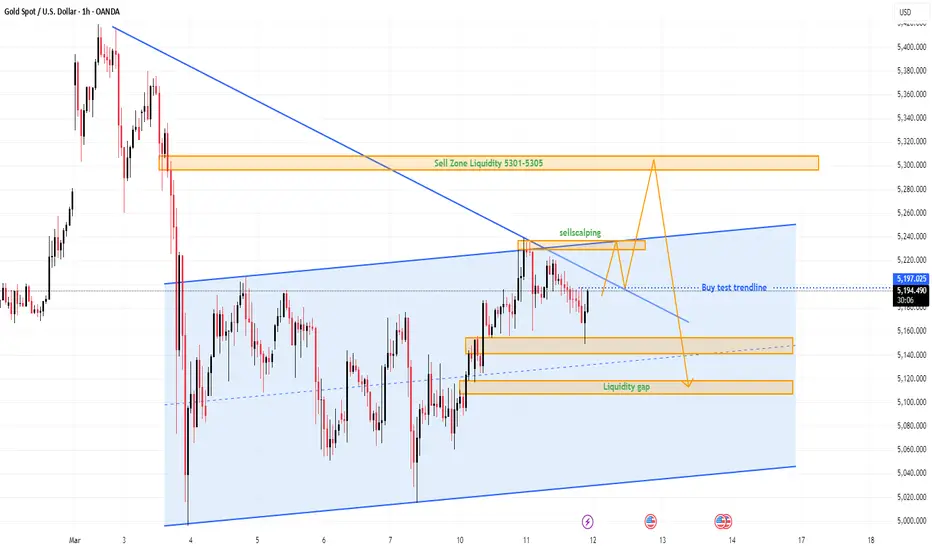
XAUUSD H1: DXY Surges to 100.28XAUUSD H1: DXY Surges to 100.28, Gold Loses Short-Term Support as Bearish Pressure Builds
Gold is showing a clear loss of momentum after the DXY surged to 100.28 during the European session, reinforcing renewed strength in the US Dollar. As the Dollar strengthens, gold is coming under heavier selling pressure, and the chart now reflects a market that is no longer in balance. On the H1 timeframe, price has started to slip below key short-term support, while the recent bullish structure is weaken
Trend Line Break
XAUUSD (H4) — Wave 5 Down Isn’t Done YetGold still hasn’t cleared the noise: wave 5 lower remains on the table, and the safest trigger is a break of the lower trendline
The market is in a difficult phase right now. Political tension and tariff pressure are pulling capital in different directions, the USD is seeing cross-currents, and gold is no longer behaving like a clean safe-haven asset. That is why price action looks noisy: wide swings, weak follow-through, and low confidence in each bounce.
For Kelly, this is not the kind of ma
XAUUSD Builds Pressure for a BreakoutGold Remains Compressed in a Tight Range, but the EMA Structure Still Favors a Bullish Breakout
Gold is now trading in a contracting price range, with price squeezed between a descending trendline from the recent highs and a rising trendline from the latest swing low. This kind of structure usually signals that the market is approaching a decisive move. At this stage, the key is not to anticipate too early, but to wait for a clear confirmation candle breaking the trendline before validating the
Part 1 Ride The Big Moves Types of Options
A. Call Options
Gives the buyer the right to buy an underlying asset at a strike price.
Profitable when the asset price goes up.
Example: Buy a call on Stock X with a strike of ₹100. If stock rises to ₹120, you can buy at ₹100 and sell at ₹120.
B. Put Options
Gives the buyer the right to sell an underlying asset at a strike price.
Profitable when the asset price goes down.
Example: Buy a put on Stock Y with a strike of ₹150. If stock falls to ₹130, you can sell at ₹150 and pro
XAUUSD (H1) — CPI stayed steady USD lost momentum, and Gold is still building a continuation structure to the upside
US CPI held steady at 2.4% in February, right in line with expectations. That matters because it did not give the USD a fresh bullish catalyst. Instead, the market is reading it as a “no new hawkish shock” print, which keeps pressure off Gold in the short term.
At the same time, the chart is already showing something important: Gold is not trading like a market preparing to break down. It is holding its rising
XAUUSD H1: DXY Loses Momentum at 99.7While Gold Holds Firm Above EMA Support and Prepares for a Potential Upside Extension
Gold is entering a very important phase, where the fundamental backdrop remains mixed, yet the technical structure is still holding up well. The failure of the DXY to sustain strength around 99.7, following the sharp collapse in oil prices, has slightly eased pressure on gold. However, the larger macro headwind still comes from the Federal Reserve, as real policy rates remain positive, meaning the environment
Part 1 Technical Analysis VS. Institutional Option Trading Strategies in Options Trading
Options are versatile instruments, allowing traders to employ a variety of strategies for speculation, income generation, or hedging:
Protective Put: Buying a put option to protect an existing stock holding against downside risk.
Covered Call: Selling a call option while holding the underlying asset to earn premium income.
Straddle: Buying both a call and a put option at the same strike price and expiration to profit from significant volatility, regardless of di
XAUUSD (H1) -Two trendlines, one decision zone Gold is building a step-by-step recovery toward 5,30x
Gold isn’t moving in a straight line today — it’s moving like a market that’s preparing. The sharp drop in crude oil helped risk sentiment stabilize and made it harder for the USD to stay strong. With DXY slipping below 99, gold gets a short-term window to grind higher.
But this is still a data-sensitive day. Existing Home Sales and ADP can quickly change USD momentum, so the cleanest approach is to trade structure and liquidity reactions,
BUY TODAY SELL TOMORROW for 5%DON’T HAVE TIME TO MANAGE YOUR TRADES?
- Take BTST trades at 3:25 pm every day
- Try to exit by taking 4-7% profit of each trade
- SL can also be maintained as closing below the low of the breakout candle
Now, why do I prefer BTST over swing trades? The primary reason is that I have observed that 90% of the stocks give most of the movement in just 1-2 days and the rest of the time they either consolidate or fall
Trendline Breakout in JPOLYINVST
BUY TODAY SELL TOMORROW for 5%
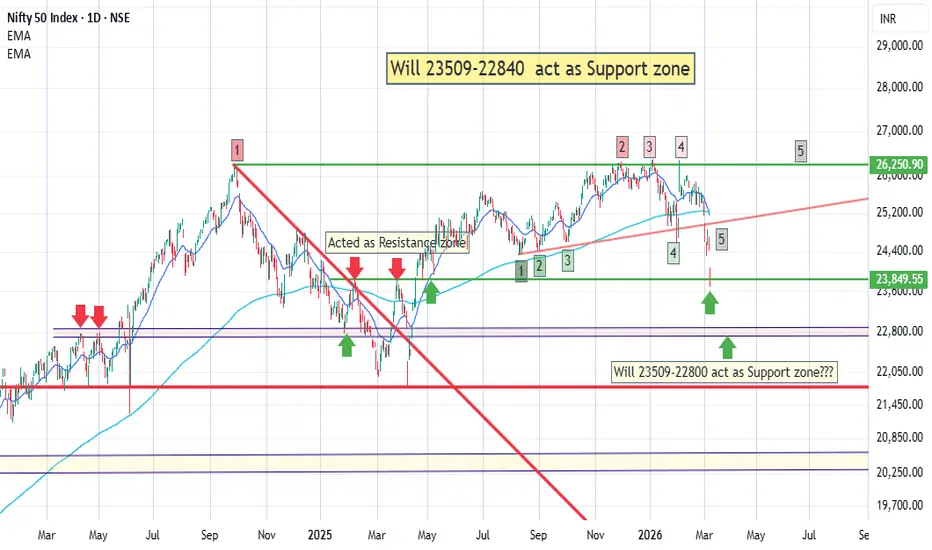
Will 23509-22840 act as support zone- Nifty is trading below 21 day EMA which is below 63 day EMA and has also broken below 200 day EMA
- Nifty has followed the 2-3-5 rule where it take 2 points to create a trend line... 3 to confirm and take the trade and on the 5th attempt it weakens and breaks the trend. The strength of the Support is reflected with fading green color.
- At current levels Nifty is is looking weak
- Markets are oversold (and can remain oversold and fall even further)
- however it is important to note, at curre
Part 1 Support and Resistance Call Option
A call option gives the buyer the right to buy an asset at a fixed price (called the strike price) before the option expires.
Example:
If a trader believes a stock price will rise, they may buy a call option. If the price increases above the strike price, the trader can profit.
NaukriThough it has broken weekly trendline from past 10+ year however this is a good example of mean reversal due to oversold setup on daily chart.
we do expect supply may come from higher levels 1110-1260
RSI is also in oversold zone on weekly chart.
therefore in short term we may expect some favorable news may come but smart money may use it differently.
*Disclaimer*: View that I have shared is only for learning & educational purpose and not buy or sell recommendation. I am not a SEBI register
DXY (D1) — “Trendline Break ConfirmedUSD is back in control, and the next leg could be strong”
DXY has just delivered a clean technical shift: price broke the descending trendline and is now holding above the breakout area. This kind of move is often more than a short-term bounce — it usually signals a regime change, where the market starts re-pricing USD strength on a medium-term horizon.
With political tension rising, risk appetite tends to tighten. In those environments, capital often rotates into defensive positioning — and t
XAUUSD (H1) — NFP Day Sell remains the main plan while price stays below the descending trendline
Today is an NFP session, and gold often whipsaws both sides before the real direction shows up. So instead of guessing tops/bottoms, the focus is on levels + reaction.
On H1, the structure is still under pressure: price remains below the descending trendline, and the bounces so far look like technical pullbacks within a short-term bearish phase.
Key zones on the map
Sell zone (primary focus)
Around 5,150 – 5,165 (s
Part 4 Technical Analysis VS. Institutional TradingPremium
To buy an option contract, you pay money called Premium.
Example:
Premium for 22,000 CE = ₹120
Lot size = 50
Total cost = 120 × 50 = ₹6000
Premium is influenced by:
Market direction
Volatility
Time left to expiry
Premium decays every day—this is called Time Decay (Theta).
Part 1 Technical Analysis VS. Institutional Trading What Are Options?
Options are financial contracts between two people:
A buyer (who pays premium)
A seller/writer (who receives premium)
These contracts are based on an underlying asset like Nifty, Bank Nifty, Sensex, stocks, etc.
An option gives the buyer a right, not an obligation, to buy or sell the underlying at a fixed price before expiry.
The seller has the obligation if the buyer exercises the right.
Part 3 Learn Institutional Trading Common Options Strategies
Options allow traders to build strategies for various market conditions:
1. Covered Call
An investor owns a stock and sells a call option to generate extra income.
2. Protective Put
Buying a put option to hedge against potential losses in a stock you own.
3. Straddle
Buying both a call and a put with the same strike price and expiration to profit from significant price movement in either direction.
4. Iron Condor
A strategy combining multiple options to profit