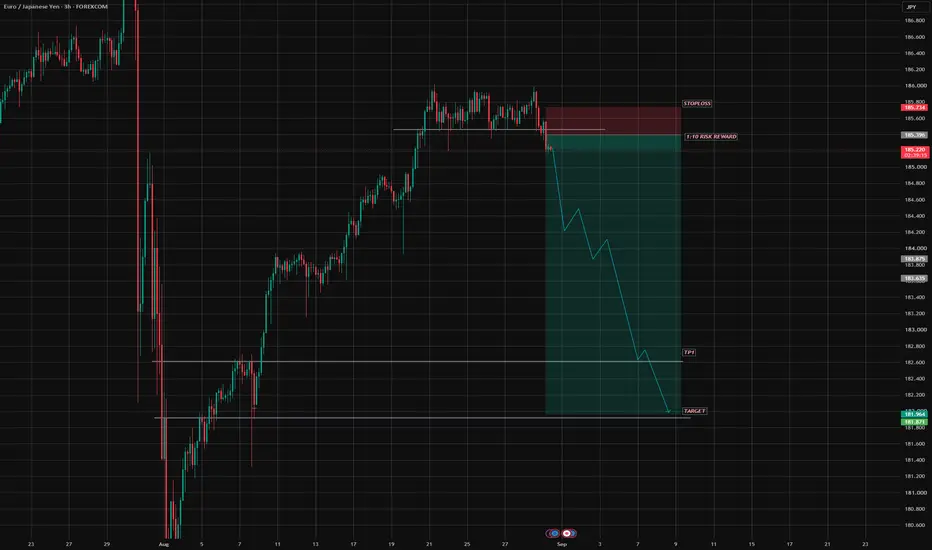
EURJPY SHOWING A GOOD DOWN MOVE WITH 1:10 RISK REWARD EURJPY SHOWING A GOOD DOWN MOVE WITH 1:10 RISK REWARD
DUE TO THESE REASON
A. its following a rectangle pattern that stocked the market
which preventing the market to move any one direction now it trying to break the strong resistant lable
B. after the break of this rectangle it will boost the mar
Euro / Japanese Yen
No trades
No trades
Peers for comparison
Pair info
The Euro vs. the Japanese Yen. The Yen is a historically low-yielding currency, influencing traders to borrow cheaply in JPY to purchase higher-yielding currencies, including EUR. Because of this the pair is sensitive to broad-based market sentiment trend swings. Volatility may be found in news related to the Eurozone debt crisis and from the Bank of Japan’s anti-deflation policy efforts introduced in 2013.
EURJPY TRADEEHere i have applied MS, LQ, and PROPER RISKMANEGEMENT, SO IM HOPING YOU APPLY YOUR OWN RISKMANAGEMNT HERE, it's a 1:8 rr trade, and my stategy have 40-50% win ratio, here also im targeting the liquidity above and waiting for the OB to hit, and in daily timeframe if you see, it has moved down alot, s
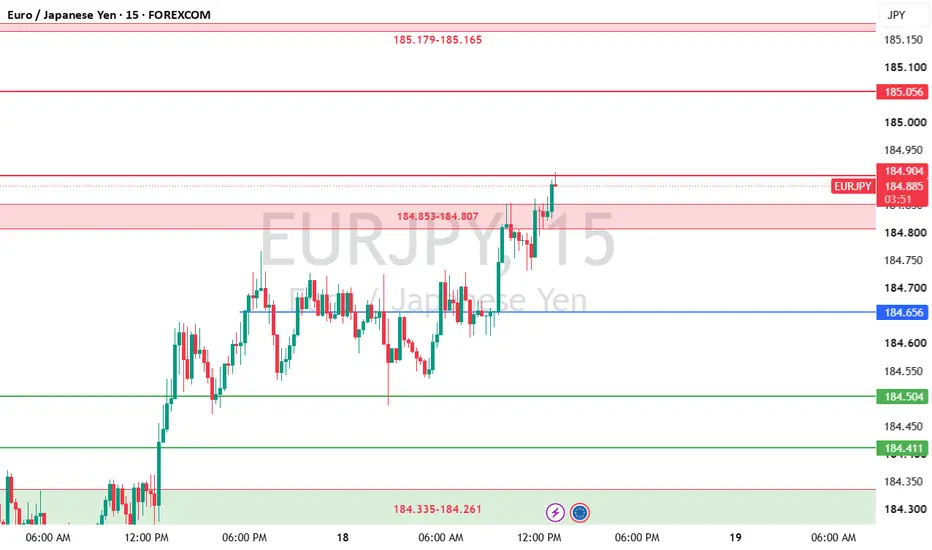
EUR/JPY 15M Intraday (18/08/2026) – Retest & Continuation to 185Date: August 18, 2026
The EUR/JPY 15-minute chart displays a decisive bullish market structure, characterized by higher highs and higher lows following a breakout from prior consolidation. Price action reflects strong buying momentum after clearing the key intermediate level at 184.656, rallyin
Day 4 - The 30 trade SeriesIn this series, we'll scan the markets each day in search of a very specific trend continuation setup. The objective is simple: take only 30 A+ quality trades that meet our criteria—no forcing setups, no unnecessary trades.
Once all 30 trades are completed, we'll analyze the results, review the sta
EURJPY LONG Over the past two days, EUR/JPY has shown bullish price action. Although the overall daily trend remains somewhat choppy—as reflected by the moving averages—there is still potential for another push higher and a sweep of the previous day's high, with the next key target around **185.867**.
For toda
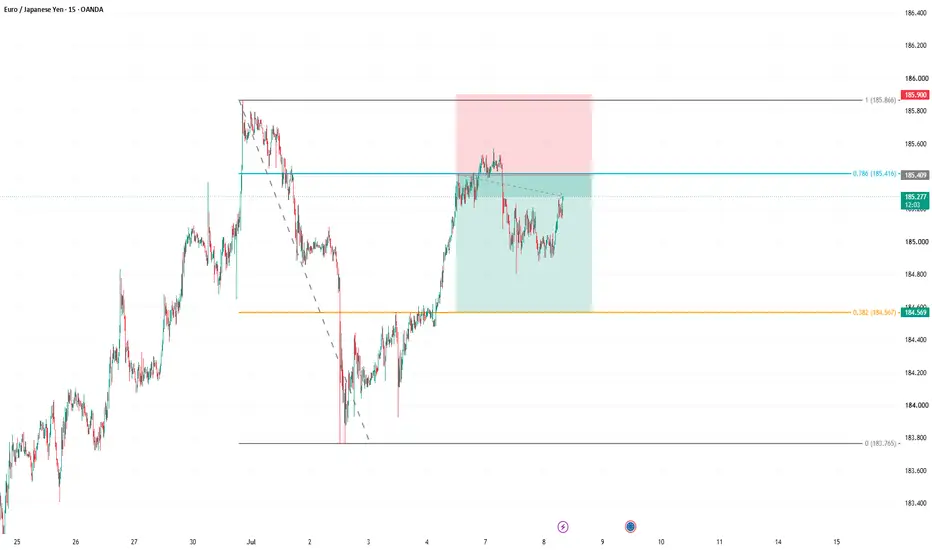
EURJPY Bearish SMC Setup | Internal Order Block + IDM Rejection This chart presents a potential bearish Smart Money Concepts (SMC) setup on EURJPY (1H).
Analysis Overview
✅ Internal Order Block (I-OB) identified
✅ Internal Inducement (I-IDM) formed
✅ Price revisiting the bearish Order Block
✅ Looking for rejection from the Order Block
✅ Target is the previous d
See all ideas
Summarizing what the indicators are suggesting.
Oscillators
Neutral
Oscillators
Neutral
Summary
Neutral
Summary
Neutral
Summary
Neutral
Moving Averages
Neutral
Moving Averages
Neutral
Displays a symbol's price movements over previous years to identify recurring trends.
Frequently asked questions
Today, EUR/JPY rate is 174.655 JPY.
For broader market analysis, dive into the technicals on the EURJPY live chart and read the latest EURJPY news:
– Dollar at 19-month high as data, policymakers cement December rate hike bets
– Dollar holds near 19-month high as data supports case for US rate hikes
– JAPAN OCT IMPORT VALUE FROM CHINA HITS RECORD HIGH OF 2.84 TRLN YEN AS IMPORTS RISE IN CHIP-MAKING EQUIPMENT, NON-FERROUS METALS, HEAVY MACHINERY
Markets don't sleep, here's what's going on with EURJPY at the moment:
– Dollar at 19-month high as data, policymakers cement December rate hike bets
– Dollar holds near 19-month high as data supports case for US rate hikes
– JAPAN OCT IMPORT VALUE FROM CHINA HITS RECORD HIGH OF 2.84 TRLN YEN AS IMPORTS RISE IN CHIP-MAKING EQUIPMENT, NON-FERROUS METALS, HEAVY MACHINERY
See more updates in real-time with our News Flow.
The safest way to trade EURJPY is through a reliable broker. Create an account, fund it, and place a buy order.
You can trade EURJPY directly from TradingView:
– Choose a broker: Explore our supported trading partners and pick one that fits your needs
– Compare options: View available brokers side by side to evaluate fees and features
– Connect your account: Open Supercharts, click "Trade", select your broker, and log in
– Start trading: Place orders without leaving the chart
Tip: If you're new to trading, try paper trading first — it lets you practice strategies in real market conditions without risking funds.
It's worth checking EURJPY rate change for various periods to get the full picture:
– 1 day — −0.37%
– 1 week — −1.46%
– 1 month — −1.24%
EURJPY's all-time low was 88.888 JPY (Oct 26, 2000), and its highest price is 188.233 JPY (Jul 30, 1990). Track the dynamics with the latest forex news right on TradingView.
– 1 day — −0.37%
– 1 week — −1.46%
– 1 month — −1.24%
EURJPY's all-time low was 88.888 JPY (Oct 26, 2000), and its highest price is 188.233 JPY (Jul 30, 1990). Track the dynamics with the latest forex news right on TradingView.
When trading EURJPY, one should keep in mind many factors.
First, analyze the fundamentals:
– Macroeconomic data: Inflation, GDP, employment, and other key indicators in the economies behind both currencies
– Central bank policy: Interest rate decisions and monetary policy from the respective central banks
– Market sentiment: Check what other traders anticipate
– News flow: Geopolitical events and economic releases
Then check technical ratings:
– Today — strong sell
– 1-week — sell
– 1-month — neutral
Identify the trend, watch key levels (support and resistance), consider volatility and upcoming economic events. Then, you'll be closer to an informed decision.
EURJPY is a minor currency pair (also known as a cross pair), meaning it includes two major currencies but doesn't involve the US dollar.
What it means for traders:
– No USD exposure: Reflects the relative strength of two non-USD economies
– Lower liquidity than major pairs: Generally traded less than major currency pairs, but still widely available
– Potentially wider spreads: Trading costs may be higher than for major pairs
What to keep in mind about cross pairs:
– Region-focused moves: Often influenced by economic data and monetary policy in the two regions involved
– Direct currency comparison: Useful for comparing currencies without the influence of the US dollar
– Different volatility profile: May behave differently from major pairs, especially during regional events
Track rate movements on the EURJPY chart and follow the latest forex news to stay informed.
EURJPY volatility measures how much the exchange rate fluctuates over time, i.e. how quickly and how strongly it moves up or down.
The current volatility rating is 0.58%.
What it means for traders:
– Higher volatility: Larger and faster price swings → higher risk and opportunity
– Lower volatility: More stable price movement → smaller trading ranges
– Market behavior: Volatility often increases during major economic news or central bank decisions
Volatility helps traders estimate risk and position sizing. It's also useful for adapting strategies to market conditions.
How to use volatility:
– Compare volatility across other currency pairs
– Combine with technical analysis (trends, support/resistance)
– Monitor economic events that may increase market movement
EURJPY is quoted as how many JPY (quote currency) it takes to buy one EUR (base currency).
For example, if the pair trades at 1.50, it means 1 EUR = 1.50 JPY.
What can influence the rate:
– Supply and demand: Driven by trade, investment flows, and speculation
– Economic data: Inflation, GDP, employment reports
– Central bank policy: Interest rates and monetary decisions
Follow these and more events in the Economic Calendar.