British Pound / Australian Dollar
No trades
No trades
Peers for comparison
Pair info
The British Pound vs. the Australian Dollar. Due to its relatively higher interest rates and its correlation to global equity markets, the Australian Dollar is often referred to as a risk currency. Mining, which is Australia’s largest economy sector, has been negatively affected by a slowdown in the global commodity super cycle and a decline in China’s growth.
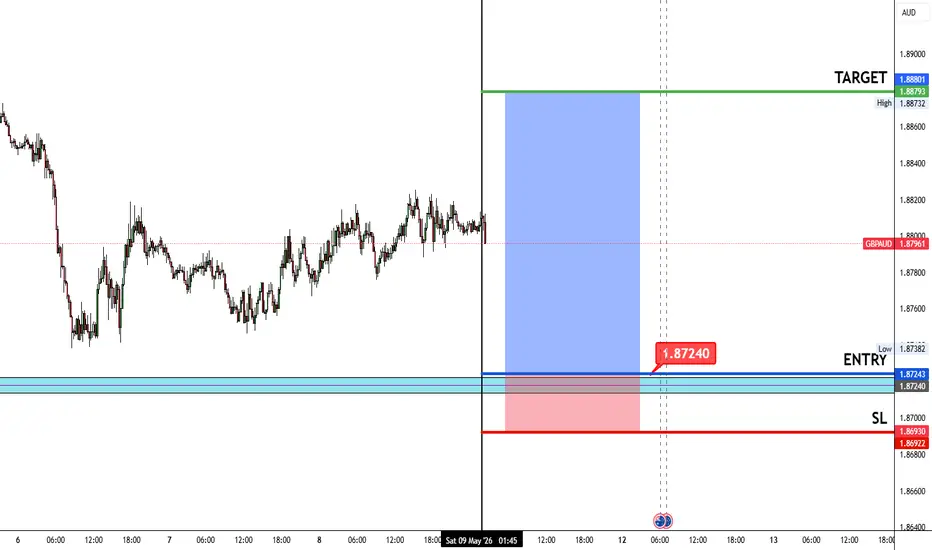
GBPAUD TRADEEEHere i have applied MS, LQ, and PROPER RISKMANEGEMENT, SO IM HOPING YOU APPLY YOUR OWN RISKMANAGEMNT HERE, it's a 1:5-6 rr trade, and my stategy have 40-50% win ratio, here also im targeting the liquidity below and waiting for the OB to hit, so with that all of that i have provided this trade, thank
Day 2 - The 30 trade Series In this series, we'll scan the markets each day in search of a very specific trend continuation setup. The objective is simple: take only 30 A+ quality trades that meet our criteria—no forcing setups, no unnecessary trades.
Once all 30 trades are completed, we'll analyze the results, review the sta
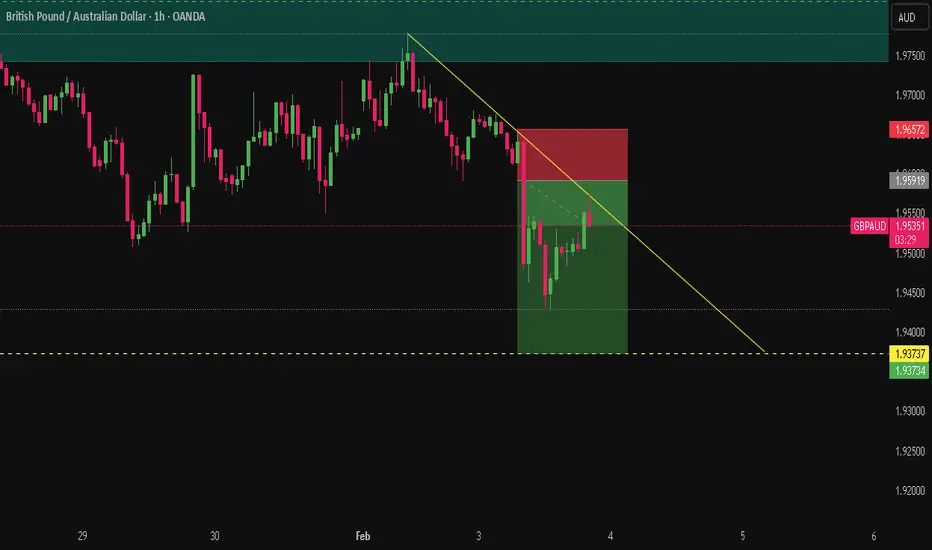
GBP/AUD Analysis: Bearish Momentum Accelerates on Hawkish RBAFresh Selling Level_ At CMP
The GBP/AUD currency pair is experiencing significant selling pressure on the 1-hour timeframe as the Australian Dollar strengthens following a hawkish interest rate decision. The pair is currently trading at 1.95423, down approximately 0.58% from the daily open.
See all ideas
Summarizing what the indicators are suggesting.
Oscillators
Neutral
Oscillators
Neutral
Summary
Neutral
Summary
Neutral
Summary
Neutral
Moving Averages
Neutral
Moving Averages
Neutral
Displays a symbol's price movements over previous years to identify recurring trends.
Frequently asked questions
Today, GBP/AUD rate is 1.97025 AUD.
For broader market analysis, dive into the technicals on the GBPAUD live chart.
The safest way to trade GBPAUD is through a reliable broker. Create an account, fund it, and place a buy order.
You can trade GBPAUD directly from TradingView:
– Choose a broker: Explore our supported trading partners and pick one that fits your needs
– Compare options: View available brokers side by side to evaluate fees and features
– Connect your account: Open Supercharts, click "Trade", select your broker, and log in
– Start trading: Place orders without leaving the chart
Tip: If you're new to trading, try paper trading first — it lets you practice strategies in real market conditions without risking funds.
It's worth checking GBPAUD rate change for various periods to get the full picture:
– 1 day — −0.45%
– 1 week — +0.99%
– 1 month — +3.23%
GBPAUD's all-time low was 1.43807 AUD (Mar 12, 2013), and its highest price is 3.03930 AUD (Sep 28, 2001). Track the dynamics with the latest forex news right on TradingView.
– 1 day — −0.45%
– 1 week — +0.99%
– 1 month — +3.23%
GBPAUD's all-time low was 1.43807 AUD (Mar 12, 2013), and its highest price is 3.03930 AUD (Sep 28, 2001). Track the dynamics with the latest forex news right on TradingView.
When trading GBPAUD, one should keep in mind many factors.
First, analyze the fundamentals:
– Macroeconomic data: Inflation, GDP, employment, and other key indicators in the economies behind both currencies
– Central bank policy: Interest rate decisions and monetary policy from the respective central banks
– Market sentiment: Check what other traders anticipate
– News flow: Geopolitical events and economic releases
Then check technical ratings:
– Today — buy
– 1-week — buy
– 1-month — buy
Identify the trend, watch key levels (support and resistance), consider volatility and upcoming economic events. Then, you'll be closer to an informed decision.
GBPAUD is a minor currency pair (also known as a cross pair), meaning it includes two major currencies but doesn't involve the US dollar.
What it means for traders:
– No USD exposure: Reflects the relative strength of two non-USD economies
– Lower liquidity than major pairs: Generally traded less than major currency pairs, but still widely available
– Potentially wider spreads: Trading costs may be higher than for major pairs
What to keep in mind about cross pairs:
– Region-focused moves: Often influenced by economic data and monetary policy in the two regions involved
– Direct currency comparison: Useful for comparing currencies without the influence of the US dollar
– Different volatility profile: May behave differently from major pairs, especially during regional events
Track rate movements on the GBPAUD chart and follow the latest forex news to stay informed.
GBPAUD volatility measures how much the exchange rate fluctuates over time, i.e. how quickly and how strongly it moves up or down.
The current volatility rating is 0.54%.
What it means for traders:
– Higher volatility: Larger and faster price swings → higher risk and opportunity
– Lower volatility: More stable price movement → smaller trading ranges
– Market behavior: Volatility often increases during major economic news or central bank decisions
Volatility helps traders estimate risk and position sizing. It's also useful for adapting strategies to market conditions.
How to use volatility:
– Compare volatility across other currency pairs
– Combine with technical analysis (trends, support/resistance)
– Monitor economic events that may increase market movement
GBPAUD is quoted as how many AUD (quote currency) it takes to buy one GBP (base currency).
For example, if the pair trades at 1.50, it means 1 GBP = 1.50 AUD.
What can influence the rate:
– Supply and demand: Driven by trade, investment flows, and speculation
– Economic data: Inflation, GDP, employment reports
– Central bank policy: Interest rates and monetary decisions
Follow these and more events in the Economic Calendar.