Health Care Sector Breaks Out as Defensive Rotation Trade BuildsMoney Rotates Into Health Care as Defensive Appeal Returns
Health care has re-entered the market conversation over the past month as investors search for shelter from a choppier, more expensive technology trade. Bloomberg reported in mid July that a compelling case is building for health care to be among the biggest winners of a rotation into defensive sectors, noting that pressures which had weighed on the group, including policy uncertainty, slow earnings growth and a weaker dollar, are fading while artificial intelligence adoption is increasingly viewed as an added tailwind for diagnostics, drug discovery and hospital administration.
The positioning data backs up the narrative. Bank of America's July fund manager survey found that global asset allocators increased their exposure to health care more than any other sector or asset class last month, and State Street Investment Management upgraded the sector from neutral to positive heading into the third quarter after nearly a year on the sidelines. UBS also pointed to the July 1 expansion of Medicare coverage for obesity treatments as a near term demand catalyst, noting that Eli Lilly estimates around 20 million additional patients could now be eligible.
Company specific news has reinforced the sentiment shift. Vertex Pharmaceuticals announced on July 1 that the FDA expanded approval of its gene therapy Casgevy to children as young as two with sickle cell disease or transfusion dependent beta thalassemia, adding roughly 5,500 eligible pediatric patients in the United States. Merck also reported positive late stage trial results for its ulcerative colitis candidate tulisokibart and secured additional approvals for Keytruda in earlier stage cancers. Trade related pressure has eased as well, with pharmaceutical import tariffs reportedly capped near 15% under recent trade arrangements, removing a headwind that hurt the sector last year.
Not every headline has been supportive. Mid July also brought a sharp single day pullback led by hospital and equipment names, with HCA Healthcare and GE HealthCare both falling more than 6% on the same session, a reminder that policy risk around reimbursement rates, drug pricing legislation such as the Inflation Reduction Act and payer cost containment can still hit the tape quickly. Readers should keep an eye on upcoming earnings from major insurers and pharmaceutical companies, along with any fresh commentary on drug pricing policy, since these remain the swing factors that could either extend or stall the current rotation.
What the Market Has Done
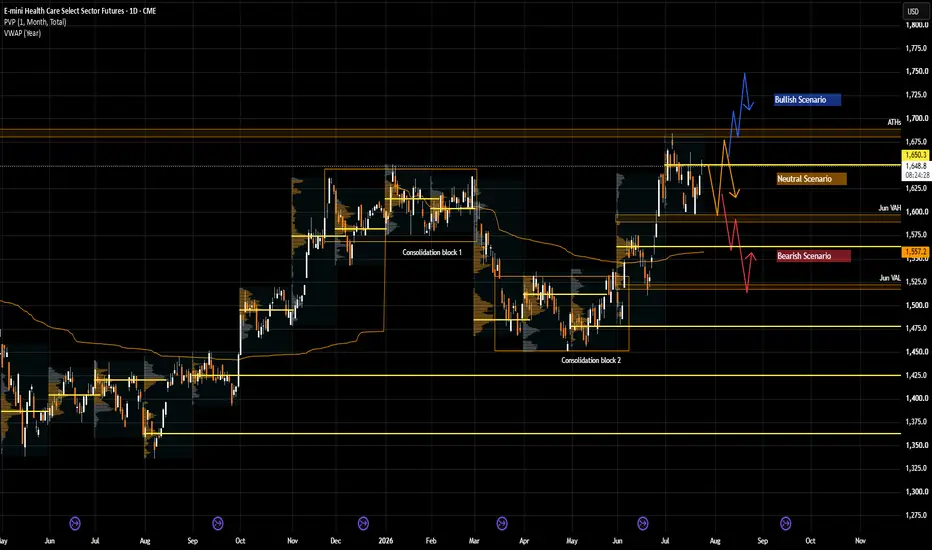
Market broke out from consolidation block 2 in June and has since rallied back to the 1680 area, ATHs.
The rally swept through consolidation block 1 on the way up.
Since reaching the 1680 area, the market has rotated two-way between 1680 and the 1600 area, which lines up with the June VAH..
Price action suggests the market is working to establish value higher within this new range.
What to Expect in the Coming Weeks
The key level to watch remains 1600, the June VAH.
Neutral Scenario
Expect two-way consolidation to continue within the current range between 1600 and 1680, the ATHs, as the market works to build value higher before any further directional resolution.
A likely trigger for this scenario is a quiet stretch of mixed earnings and no major new policy headlines, keeping positioning balanced.
Bullish Scenario
The first clue of a bullish resolution is buyers stepping up bids within the current range and compressing price against 1680, ATHs.
A breakout and acceptance above 1680 would open the door to new ATHs, with century and mid-century targets such as 1700 and 1750 in view.
A possible trigger includes stronger than expected Q2 earnings from major pharmaceutical and insurance names, or further favorable developments around Medicare coverage expansion and GLP-1 demand.
Bearish Scenario
The first clue of a bearish resolution is each rotation higher being capped by sellers stepping down offers and compressing prices back toward 1600.
A breakdown and acceptance below 1600 would suggest a return into the June VA, with a move down to 1563, the June point of control, where buyers are expected to defend. Failure to hold there opens further downside toward 1525, the June VAL.
A possible trigger includes renewed drug pricing legislation risk, disappointing earnings from key sector heavyweights, or a broader flight back into technology and growth names that reverses the current defensive rotation.
Conclusion
Health care sits at an interesting crossroads heading into the back half of the year. Technically, the sector has broken back to ATHs and is now working through a two-way range between 1600 and 1680, a level structure that should offer traders a clear roadmap regardless of which way the next move unfolds. Fundamentally, the sector is enjoying a genuine tailwind from institutional rotation, easing trade tensions, expanding Medicare coverage and a steady stream of regulatory approvals, though drug pricing policy and payer cost pressures remain wildcards that can spark sharp single day moves. With 1600 acting as the pivotal line in the sand, how do you think health care resolves from here, does it grind out new highs or slip back into the June range?
Disclaimer: Past performance is not necessarily indicative of future results. Trading futures involves substantial risk of loss and is not appropriate for all investors. This content is intended for informational and educational purposes only and does not constitute trading advice or a solicitation to buy or sell any futures contract. Trade your own plan and manage risk.
Acronyms:
C - Composite
w - Weekly
m - Monthly
VA - Value Area
VAH - Value Area High
VAL - Value Area Low
VPOC - Volume Point of Control
LVN - Low Value Node
LVA - Low Value Area
HVN - High Value Node
HVA - High Value Area
SP - Single print
ATH - All time high
XXX
E-mini Health Care Select Sector Futures
No trades
No trades