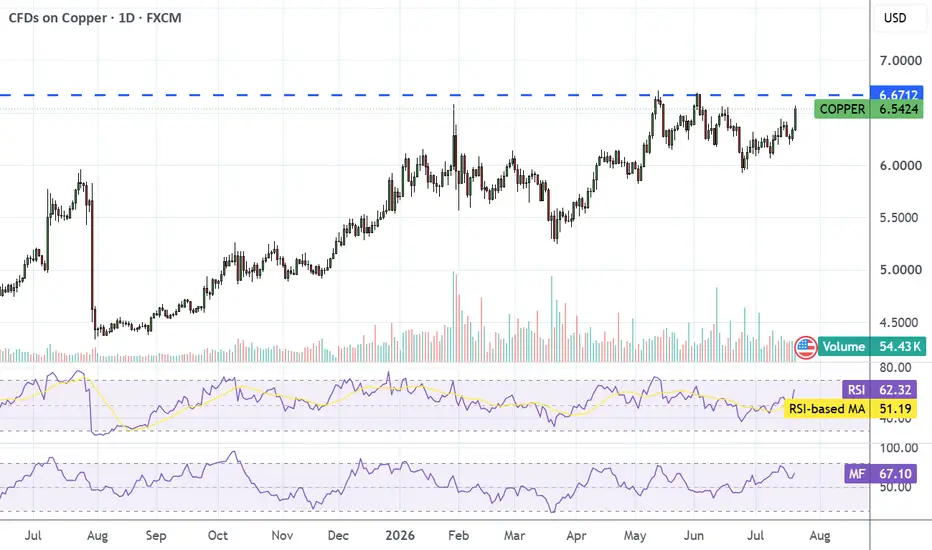
COPPER ISN'T JUST A METAL. ITS A LIQUIDITY SIGNALCopper has just reclaimed a resistance trendline that capped every major rally for nearly two decades.
The first chart shows the long-term structure.
Every rejection from this trendline led to a meaningful slowdown in global growth expectations. Today, that same structure has flipped into support
Profile
Copper is an essential industrial metal used worldwide. Copper prices are followed in financial markets around the globe and the metal is growing in popularity. Copper is widely used in construction and because of its electrical properties is found in wires and circuit boards. Copper is mined in open mines around the world, with Chile and the United States leading in overall copper production. The demand for copper is increasing as countries such as China and India continue to develop, while the supply remains tight. The growing demand and constrained supply is likely to keep copper prices volatile in the near future. Copper prices are commonly quoted in USD.
Potential bullish bounce?Copper is falling toward the support level, which aligns with the 38.2% Fibonacci retracement and could bounce from this level to our take profit.
Entry: 6.2121
Why we like it:
There is a pullback support level that aligns with the 38.2% Fibonacci retracement.
Stop loss: 6.0919
Why we like it:
The
Copper: 18 months in the making ; The chart says buy?The video is an analysis of Copper, along with the trade setup I created on 1 July 2026, the day after the US Commerce Department released its recommendation regarding Section 232 refined copper tariffs to the White House ; the event that has been years in the making. Given the Goldman Sachs' upgrad
Copper:Tariff decision made. Exhaustion or buying opportunity?Copper arrives in July at an inflection point that has been building in the market over the past eighteen months. The US Commerce Department delivered its Section 232 recommendation on a tariff on refined copper to the White House on June 30, and the result is critical. If approved, a tariff of 15%
Equal Highs, Weak RSI: Copper Signals Bearish ContinuationHi Guys 👋
Lets look at the Copper Chart 👀
📌 By analyzing the daily chart of Copper against the US Dollar, we can observe the convergence of price highs, followed by the formation of equal highs, and ultimately the breakdown of the most recent low. This price behavior reflects a Wyckoff distribution
Market DNA Copper Cycle 4 Fractal 2 ObservationTitle:
Market DNA – Cycle4 Fractal 2 Structural Observation
Sub-title:
Multi-Asset Structural Progression (Fractal 1 → 2 → 3)
Metadata:
• Date: 2026-06-26 10:45 EST
• Assets: Copper (Copper)
• Cycle IDs: 4
1- Context
This document presents a structural observation across multiple Market DNA cycles.
See all ideas
Displays a symbol's price movements over previous years to identify recurring trends.
Frequently asked questions
There are several ways to buy copper. The most straightforward option is to purchase the physical metal from metal dealers or hardware suppliers. It's relatively uncommon for investors, as storage and transportation can be costly and time-consuming.
There are simpler ways to gain exposure to copper:
- Copper futures, which provide exposure to copper's price without owning the metal itself and are traded on commodity exchanges such as COMEX.
- Copper ETFs, such as the United States Copper Index Fund (CPER), which offer easier market access and can be explored using the ETF Screener.
- Mining stocks, which allow you to invest in companies that produce copper, such as BHP Group.
In any case, investing in copper on global markets requires a brokerage account. You can choose a broker that fits your needs from our brokers list, connect your account, and start trading directly on TradingView.
There are simpler ways to gain exposure to copper:
- Copper futures, which provide exposure to copper's price without owning the metal itself and are traded on commodity exchanges such as COMEX.
- Copper ETFs, such as the United States Copper Index Fund (CPER), which offer easier market access and can be explored using the ETF Screener.
- Mining stocks, which allow you to invest in companies that produce copper, such as BHP Group.
In any case, investing in copper on global markets requires a brokerage account. You can choose a broker that fits your needs from our brokers list, connect your account, and start trading directly on TradingView.
Copper reached its all-time high on May 13, 2026 with the price of 6.7120 USD, and its all-time low was 1.9360 USD and was reached on Jan 15, 2016. View more price dynamics on the copper price chart.
Besides copper, traders often watch several other precious metals:
- Gold: The most widely recognized precious metal, used as a hedge against inflation and currency risk
- Silver: Known for both industrial use and investment, silver is more volatile than gold and often moves in correlation with it
- Platinum: Widely used in the automotive sector; its price can be influenced by supply constraints and industrial demand
- Palladium: Key for catalytic converters in vehicles, palladium is highly sensitive to automotive market trends and environmental regulations
Traders track these metals for portfolio diversification or hedging against inflation.
- Gold: The most widely recognized precious metal, used as a hedge against inflation and currency risk
- Silver: Known for both industrial use and investment, silver is more volatile than gold and often moves in correlation with it
- Platinum: Widely used in the automotive sector; its price can be influenced by supply constraints and industrial demand
- Palladium: Key for catalytic converters in vehicles, palladium is highly sensitive to automotive market trends and environmental regulations
Traders track these metals for portfolio diversification or hedging against inflation.
Traders track copper prices because it's a key industrial metal, and its price reflects the state of global manufacturing and construction. Rising copper prices often signal strong economic activity, while falling prices can indicate weakening demand.
Copper is also widely traded on major exchanges, making it a useful asset for hedging and portfolio diversification. Its sensitivity to economic cycles helps traders anticipate broader market trends and adjust their strategies accordingly.
On TradingView, you can monitor the live copper chart, follow the latest news, and track events that may influence prices using the Economic Calendar, from inflation data to central bank announcements.
Copper is also widely traded on major exchanges, making it a useful asset for hedging and portfolio diversification. Its sensitivity to economic cycles helps traders anticipate broader market trends and adjust their strategies accordingly.
On TradingView, you can monitor the live copper chart, follow the latest news, and track events that may influence prices using the Economic Calendar, from inflation data to central bank announcements.
Copper can be a potential investment, but its effectiveness, like that of any asset, depends on how well you understand what drives its price and the role it plays in your portfolio.
Because copper is used across a wide range of industries, its price is closely tied to global economic activity. Investors seeking exposure to industrial growth, electrification, and long-term infrastructure trends often find copper attractive. By studying the factors that influence copper prices, they may benefit from favorable market movements.
However, copper remains a commodity, which makes it volatile. Prices can fluctuate due to changes in demand from major consumers, supply disruptions, or shifts in broader market sentiment. As a result, traders often view copper as a diversification tool rather than a core holding.
Before investing, take time to analyze the market. Track price movements on the copper chart to identify trends, and follow global news and economic events, such as interest rate decisions or inflation reports, that may influence copper prices.
Because copper is used across a wide range of industries, its price is closely tied to global economic activity. Investors seeking exposure to industrial growth, electrification, and long-term infrastructure trends often find copper attractive. By studying the factors that influence copper prices, they may benefit from favorable market movements.
However, copper remains a commodity, which makes it volatile. Prices can fluctuate due to changes in demand from major consumers, supply disruptions, or shifts in broader market sentiment. As a result, traders often view copper as a diversification tool rather than a core holding.
Before investing, take time to analyze the market. Track price movements on the copper chart to identify trends, and follow global news and economic events, such as interest rate decisions or inflation reports, that may influence copper prices.
Yes — copper is included in several major commodity indices. Here are a few that you can track to stay on top of copper dynamics:
- Bloomberg Commodity Index (BCOM), a global benchmark providing exposure to energy, agricultural commodities, and metals, including copper. It is reweighted and rebalanced annually on a price-percentage basis
- The S&P Goldman Sachs Commodity Index (GSCI), a well-known, production-weighted benchmark reflecting the global commodity market. It's built with highly liquid commodity futures and offers diversification by keeping its correlation to other asset classes relatively low.
- Bloomberg Commodity Index (BCOM), a global benchmark providing exposure to energy, agricultural commodities, and metals, including copper. It is reweighted and rebalanced annually on a price-percentage basis
- The S&P Goldman Sachs Commodity Index (GSCI), a well-known, production-weighted benchmark reflecting the global commodity market. It's built with highly liquid commodity futures and offers diversification by keeping its correlation to other asset classes relatively low.
Traders track copper because it's often considered a key economic indicator. Demand for copper reflects industrial activity, especially in construction, manufacturing, and electronics, so price movements can signal shifts in the global economy.
Copper is also highly liquid, meaning it's easy to trade, and it often reacts quickly to changes in supply, geopolitical tensions, and trade policies. This responsiveness can create opportunities for both short-term trading and longer-term strategies.
In addition, copper is included in various commodity indices, meaning its price can influence portfolios tied to broader commodity performance.
You can also follow copper trading ideas to see how other traders are approaching the market and find inspiration for your own strategies.
Copper is also highly liquid, meaning it's easy to trade, and it often reacts quickly to changes in supply, geopolitical tensions, and trade policies. This responsiveness can create opportunities for both short-term trading and longer-term strategies.
In addition, copper is included in various commodity indices, meaning its price can influence portfolios tied to broader commodity performance.
You can also follow copper trading ideas to see how other traders are approaching the market and find inspiration for your own strategies.
Copper is a reddish-brown metal known for its high electrical and thermal conductivity. It has been used for thousands of years in tools, construction, and electrical wiring, and its ability to conduct electricity efficiently makes it a key material in electronics and renewable energy technologies such as solar panels and electric vehicles.
As a commodity, copper is actively traded on global markets. Traders buy and sell copper futures on exchanges like the London Metal Exchange (LME), COMEX, and the Shanghai Futures Exchange. Copper prices are sensitive to supply-and-demand dynamics and global economic trends, making the metal a key barometer of industrial activity.