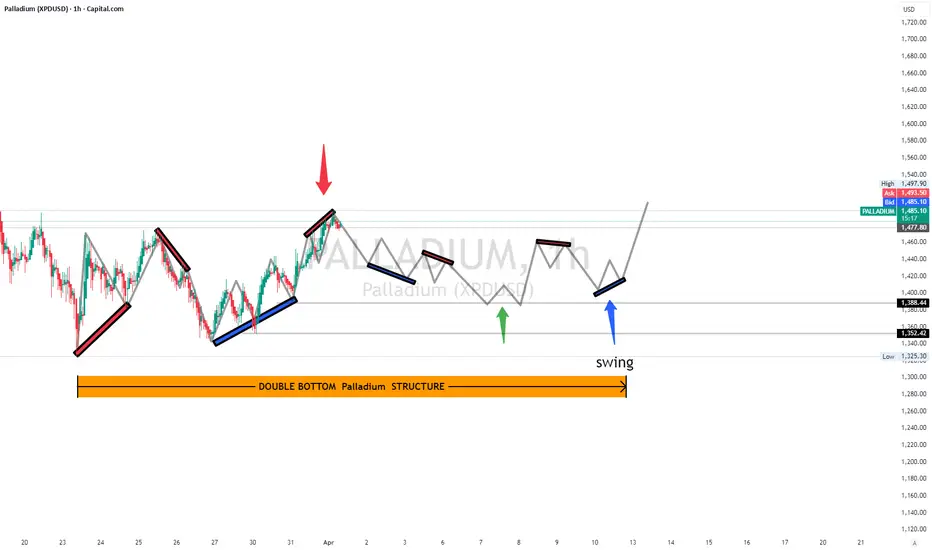
CFDs on PalladiumCFDs on PalladiumCFDs on Palladium

CFDs on Palladium

No trades
No trades

Key data points


Volume
Previous close
Open
Day's range
 –

See all ideas 

Displays a symbol's price movements over previous years to identify recurring trends.

Frequently asked questions


Buying palladium can be done in several ways, depending on whether you want to own the physical metal. Investors who prefer tangible assets can purchase physical palladium in the form of bars or coins from reputable dealers. In this case, however, you'll need to account for additional costs such as storage and insurance, as palladium can be sensitive to environmental conditions.

For traders and investors who don't require physical delivery, a range of financial instruments offers easier access. Palladium futures allow speculation on price movements but involve higher risk due to leverage. Palladium ETFs, which you can browse in the ETF Screener, provide a more accessible and liquid way to track palladium prices, while shares of mining companies offer indirect exposure and may benefit from both metal prices and company performance.

In any case, investing in palladium on global markets requires a brokerage account. You can choose a broker that fits your needs from our brokers list, connect your account, and start trading directly on TradingView.
Palladium reached its all-time high of 3,410.254 USD on Mar 7, 2022, and its all-time low of 158.000 USD on Oct 28, 2008. Explore more price history on the palladium price chart.
Besides palladium, traders often watch several other precious metals:

- Gold: The most widely recognized precious metal, used as a hedge against inflation and currency risk
- Silver: Known for both industrial use and investment, silver is more volatile than gold and often moves in correlation with it
- Platinum: Widely used in the automotive sector; its price can be influenced by supply constraints and industrial demand
- Copper: While technically a base metal, it's often monitored alongside precious metals because of its economic sensitivity and industrial demand

Traders track these metals for portfolio diversification or hedging against inflation.
Traders track palladium prices because the metal is vital to the automotive industry, where it's used in catalytic converters, tying demand closely to global car production and emissions regulations. Its limited supply and role as a precious metal also make palladium a useful indicator of industrial activity and a potential hedge against inflation or market volatility.

On TradingView, you can monitor the live palladium chart, follow the latest news, and track events that may influence prices using the Economic Calendar — from inflation data to central bank announcements.
Palladium can be a potential investment option for those looking to diversify their portfolios with exposure to precious metals, though it tends to be more volatile than gold or silver. Its price is largely driven by industrial demand — especially from the automotive sector, where palladium is used in catalytic converters to reduce emissions.

As a result, palladium prices often fluctuate with changes in vehicle production, environmental regulations, and supply constraints, particularly from major producing regions such as Russia and South Africa. While the metal has experienced periods of strong price growth, it's also prone to sharp corrections. For this reason, many investors choose palladium as a smaller component of a diversified portfolio rather than a core holding.

Before investing, take time to analyze the market. Track price movements on the palladium chart to identify trends, and follow global news and economic events — such as interest rate decisions or inflation reports — that may influence palladium prices.
Yes — palladium is included in several major commodity and precious metal indices that track its price or provide exposure to the platinum-group metals market.

Two notable examples are the Bloomberg Global Commodity Palladium ER Index and its Total Return (TR) version. The ER Index reflects changes in palladium futures prices only, while the TR Index also accounts for collateral returns, offering a broader view of overall investment performance.

These indices may also be included in wider commodity benchmarks such as the Bloomberg Commodity Index or S&P GSCI, which track a diversified basket of commodities, including metals, energy, and agricultural products.
Traders and investors track palladium primarily because it's a key industrial metal with significant exposure to the automotive and electronics sectors. Its price is heavily influenced by supply-and-demand dynamics, and limited global supply can lead to sharp price swings, making palladium attractive for both short-term trading and longer-term investment strategies.

In addition, palladium is often viewed as a precious-metal hedge and a diversification tool. Like gold and platinum, it can help manage risk in commodity or equity portfolios. Investors monitor its price trends, futures contracts, and related indices to navigate market volatility, hedge exposure to industrial demand shifts, or pursue speculative opportunities.

You can also follow palladium trading ideas to see how other traders are approaching the market and find inspiration for your own strategies.
Palladium is a rare, silvery-white metal from the platinum group, valued for its resistance to corrosion and its ability to absorb hydrogen. It's used in electronics, jewelry, and especially in catalytic converters, where it helps reduce vehicle emissions.

As a commodity, palladium's price is driven primarily by industrial demand — mainly from the automotive sector — and by limited supply from key producers such as Russia and South Africa. It's traded globally as both an essential industrial metal and a store of value, with traders gaining exposure through physical metal, palladium futures, or stocks of mining companies.