Peers for comparison


Key stats


Market capitalization
‪78.63 M‬ USD
Fully diluted market cap
‪125.70 M‬ USD
Circulating supply
‪62.55 B‬
Max supply
‪100.00 B‬
Total supply
‪100.00 B‬
Open interest
Liquidations (24h)
Funding rate

Crypto info


Category
Cryptocurrencies
Contract
Source code
Explorers
Community

Open interest


Open interest
Price

Liquidations


Long
Short
Price

See all ideas 

Summarizing what the indicators are suggesting.
Oscillators
Neutral
Oscillators
Neutral
Summary
Neutral
Summary
Neutral
Summary
Neutral
Moving Averages
Neutral
Moving Averages
Neutral
Displays a symbol's price movements over previous years to identify recurring trends.

Frequently asked questions


The current price of Reserve Rights (RSR) is 0.001231 USD.

For broader market analysis, dive into the technicals on the RSR price chart and read the latest Reserve Rights news:
– Reserve Rights: Upbit opens RSR spot trading in KRW and USDT markets - 12 Oct 2026
– Reserve Rights: RSR holders pick High burn gauge in quarterly vote - 25 Sep 2026
– Reserve Rights: First RSR Burn Gauge Vote Opens - 18 Sep 2026
The current circulating supply of Reserve Rights (RSR) is ‪100.00 B‬, representing all coins available for trading.

Circulating supply differs from total supply (the number of coins that currently exist, including those not actively traded) and max supply (the maximum number of coins that will ever exist), and is used to calculate market capitalization.

To get a wider picture of the market, check out coins with the highest circulating supply. Also, check the list of coins with the lowest number of tokens in circulation.
It's worth checking RSR price change for various periods to get the full picture:
– 1 day — −2.55%
– 1 week — −8.25%
– 1 month — −31.20%

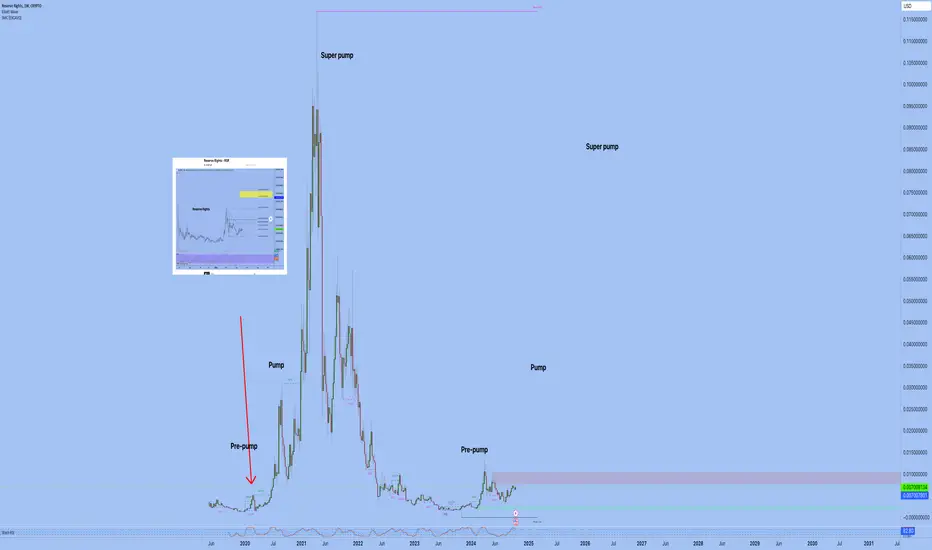
Reserve Rights's all-time low was 0.001041 USD (Jul 1, 2026), and its highest price is 0.011500 USD (May 9, 2025). Find more dynamics in the Crypto Heatmap and on the RSR price chart.
Reserve Rights is a volatile asset, and investing in it carries both potential risks and rewards. It may not be suitable for every investor. Before investing, consider the following:
– Volatility: Cryptocurrency prices can change rapidly. Conduct technical analysis, review fundamental and market information before making a decision.
– Security: Use reputable exchanges and secure wallets to help protect your assets. Explore reliable brokers and research any service provider before using it.
– Trading strategy: Different approaches carry different levels of risk. Learn how spot and derivatives markets work, follow crypto news, explore the Crypto Screener, and review community trading ideas.
– Diversification: Spreading investments across multiple assets may help reduce concentration risk.
– Long-term perspective: Some investors choose to hold cryptocurrencies for the long term to weather short-term price fluctuations.
Sentiment around Reserve Rights means the overall market mood — whether traders are feeling bullish, bearish, or neutral.

Here's what you can explore to better understand RSR sentiment:
– Volume, ‪6.55 M‬ USD: Higher volume often signals strong interest and conviction behind price moves
– Transaction volume, $‪1.40 M‬: Shows how much value is being transferred across the network
– Active addresses, 290: Rising activity can indicate growing usage and engagement
– Social sentiment: Community discussions and tone can reflect retail trader expectations
– News Flow: Positive or negative headlines can quickly shift market sentiment

No single metric defines sentiment — it's a combination of stats. See more of them in our Crypto Coins Screener.
Reserve Rights has the limit of ‪100.00 B‬ coins. No matter how the currency evolves, no new coins will be released after this number is reached.

What you need to remember about max supply:
– Defined by protocol: The limit is set in the Reserve Rights's rules or smart contract
– Issuance over time: New coins may be released gradually (e.g., mining, staking, emissions)
– Scarcity factor: A max supply can increase scarcity compared to coins with no limit

What it means:
– As issuance slows or stops, supply growth decreases
– Price may be influenced by demand relative to the max supply

Read more about crypto metrics to catch price changes before they happen.
Reserve Rights (RSR) reached its highest price of 0.011500 USD on May 9, 2025.

View more Reserve Rights dynamics on the RSR price chart and scan other coins to find out what crypto hits its all-time high.
The current market capitalization of Reserve Rights is ‪77.00 M‬ USD.

Here are a few numbers to better understand RSR dynamics:
– RSR current price — 0.001231 USD
– RSR circulating supply — ‪100.00 B‬
– RSR daily trading volume — ‪6.55 M‬ USD

Check out our crypto market cap charts and large-cap crypto coins to make more informed decision on crypto market.
Reserve Rights (RSR) trading volume over the past 24 hours is ‪6.55 M‬ USD. This reflects the total amount traded across major exchanges.

Higher trading volume typically indicates stronger market activity and can confirm price trends, while lower volume may suggest weaker momentum. Comparing current volume to recent averages can help assess whether market interest is increasing or declining.

Stay on top of the market by exploring the most traded cryptocurrencies and following the latest crypto news.
Buying Reserve Rights depends on your goals, risk tolerance, and understanding of the market. Crypto markets are famous for their volatility, that's why we always recommend you studying all the available stats before adding crypto assets to your portfolio. One of them is technical ratings — a score that suggests buying or selling an asset.

Reserve Rights's ratings are:
– Today: sell
– 1-week: sell
– 1-month: sell

Worth considering before buying
– Investment horizon
– Risk tolerance
– Overall portfolio fit

Potential market scenarios
– Price growth during strong demand
– Declines during corrections or negative news
– Short-term volatility

Find inspiration in Reserve Rights trading ideas and keep track of what's moving crypto markets with our crypto news feed.
Reserve Rights activity can be viewed through several address metrics:
– Active addresses: 290 (sent or received RSR in a given period)
– Newly funded addresses: 95 (recently received RSR for the first time)

Note that one user can control multiple addresses, so this does not equal the number of users.

Active addresses are often used as an indicator of network activity — higher numbers can suggest increased usage, while lower activity may indicate reduced demand.

For active trading, you may want to explore coins with the most daily active addresses and most transactions.
Sentiment around Reserve Rights varies and changes with market conditions, news, and price trends.

How to gauge trader sentiment:
– Trading ideas: See how traders analyze RSR, including bullish and bearish setups
– Minds: Follow real-time opinions, reactions, and discussions
– Crypto Coins Screener: Set up the Sentiment filter to see traders' attitudes across the market

What to look for:
– Common trends in sentiment (bullish vs bearish)
– Key price levels and scenarios traders are watching
– Reactions to news or market events
Reserve Rights transaction volume is ‪1.14 B‬, with a total value of $‪1.40 M‬.

What does it mean?
– High volume: Indicates stronger network usage and market activity
– Low volume: May signal reduced demand or quieter conditions

Remember: transaction volume doesn't reflect the number of users or transactions. For a comprehensive analysis you'll need more numbers:
– Active RSR addresses: 290

Explore more Reserve Rights stats in our Crypto Coins Screener.
The safest way to buy Reserve Rights is through a well-known and reliable crypto exchange. Create an account, fund it, and place a buy order.

You can trade Reserve Rights directly from TradingView:
– Choose an exchange: Explore our supported trading partners and pick one that fits your needs
– Compare options: View available exchanges side by side to evaluate fees and features
– Connect your account: Open Supercharts, click "Trade", select your exchange, and log in
– Start trading: Place orders directly from the chart

Tip: If you're new to trading, try paper trading first — it lets you practice strategies in real market conditions without risking funds.