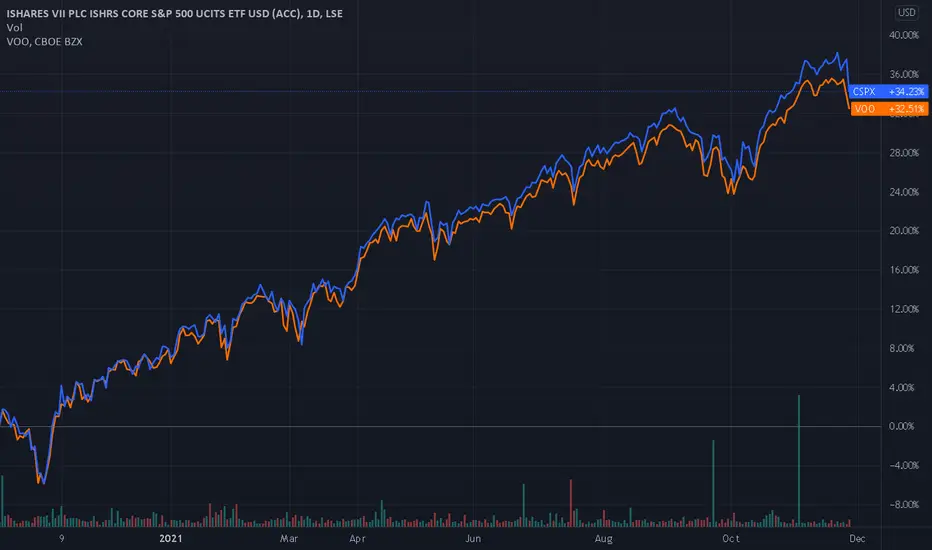
iShares Core S&P 500 UCITS ETFiShares Core S&P 500 UCITS ETFiShares Core S&P 500 UCITS ETF

iShares Core S&P 500 UCITS ETF

No trades
No trades

Peers for comparison


Key stats


Assets under management (AUM)
‪135.43 B‬ EUR
Fund flows (1Y)
Dividend yield (indicated)
Discount/Premium to NAV
Shares outstanding
‪191.08 M‬
Expense ratio
0.07%

Fund info


Brand
iShares
Home page
Inception date
May 19, 2010
Structure
Irish VCIC
Index tracked
S&P 500
Replication method
Physical
Management style
Passive
Dividend treatment
Reinvests
Primary advisor
BlackRock Asset Management Ireland Ltd.
ISIN
IE00B5BMR087
FIGI
BBG002CV3XZ9
Identifiers
ISIN IE00B5BMR087
CFI code
CEOGEU
The investment objective of the Fund is to deliver the net total return performance of the Benchmark Index (being the S&P 500 Index), less the fees and expenses of the Fund.

Classification


Asset Class
Equity
Category
Size and style
Focus
Large cap
Niche
Broad-based
Strategy
Vanilla
Geography
U.S.
Weighting scheme
Market cap
Selection criteria
Committee
What's in the fund
Exposure type
StocksBonds, Cash & Other
Electronic Technology
Technology Services
Finance
Breakdown by region
97%2%
Top 10 holdings

See all ideas 

Displays a symbol's price movements over previous years to identify recurring trends.

Frequently asked questions


An exchange-traded fund (ETF) is an investment product that holds a basket of assets such as stocks, bonds, futures, or other instruments, and trades on an exchange like a regular stock.

Why investors use ETFs:
– Easy way to gain exposure to sectors like stocks, bonds, real estate, or crypto
– Lower barrier to entry compared to buying individual assets
– Can help reduce volatility through diversification

Explore the largest ETFs: they are considered the most trusted and secure and will help you start your journey on the ETF markets.
Markets don't sleep, here's what's going on with SXR8 at the moment:
– REG - iShares VII SP500£ - Dividend Declaration
– REG - iShares VII S&P500$ - Net Asset Value(s)
– REG - iShares VII SP500£ - Net Asset Value(s)

See more updates in real-time with our News Flow.
The safest way to buy SXR8 is through a reliable broker. Create an account, fund it, and place a buy order.

You can trade SXR8 directly from TradingView:
– Choose a broker: Explore our supported trading partners and pick one that fits your needs
– Compare options: View available brokers side by side to evaluate fees and features
– Connect your account: Open Supercharts, click “Trade”, select your exchange, and log in
– Start trading: Place orders directly from the chart

Tip: If you’re new to trading, try paper trading first — it lets you practice strategies in real market conditions without risking funds.
SXR8 follows the S&P 500.

ETFs usually track some benchmark seeking to replicate its performance and guide asset selection and objectives.

Indices usually act as such benchmarks by tracking a group of companies or specific sectors, giving a broad view of market performance.
The fund's management style is passive, aiming to replicate the performance of the S&P 500 by holding the same assets in similar proportions.

What it means:
– Index tracking: Mirrors the composition and weight of the underlying index
– Low turnover: Fewer trades compared to active funds
– May be more cost-efficient: Passive approach typically results in lower fees (expense ratio)

Combine this knowledge with other metrics:
– SXR8 AUM — ‪135.43 B‬ EUR
– SXR8 NAV — 707.00 EUR
– SXR8 expense ratio — 0.07%

Explore more details in the Profile section.
SXR8 invests in stocks. See more details in our Profile section.
No, SXR8 isn't leveraged, meaning it doesn't use borrowings or financial derivatives to magnify the performance of the underlying assets or index it follows.
No, SXR8 doesn't pay dividends to its holders.
SXR8 shares are issued by BlackRock, Inc.
SXR8 started trading on May 19, 2010. The launch date marks the fund's first day on the exchange and the start of its publicly available price history.

The age of a fund can be useful when evaluating its track record, as older funds typically provide more historical data for analyzing performance across different market conditions.