US Government Bonds 2 YR Yield
No trades
No trades
Compare with US 2Y
Gold Breaks Higher While Treasury Yields Stay Below ResistanceAn interesting divergence is developing.
Both 10Y and 30Y Treasury yields remain below their marked resistance levels, while Gold has already broken above its corresponding short-term level.
If yields continue to stall or turn lower, that could provide further support for Gold’s recovery. A decisi
Fed Chasing after 2-Year Yields May Result in Additional UpsideWhen the Fed starts chasing after the 2-Year treasury yield with the Federal Funds Rate, it usually chases it approximately 1.00% to 3.00% higher.
Looking at the 7 times in the past when this occurred, 5 of those times resulted in the 2-Year yield continuing its ascent. 2 of those times, in 1996 an
The Interest Rates That Matter to High FinanceUS market bond yields have recently reached new highs amid uncertainty surrounding inflation prospects, geopolitics, monetary policy, and public debt.
However, it is important to keep in mind that market bond yields have different roles and meanings depending on their maturity, i.e. their time hori
2Y Yield: Daily Velocity vs Multi Year MomentumDaily Chart: Velocity vs Structural Pullback
Persistent shallow corrections:
In strong trend regimes, textbook bearish RSI divergences routinely fail to generate meaningful reversals. Instead of a price collapse, the indicator burns off overbought readings through sideways consolidation or shallow
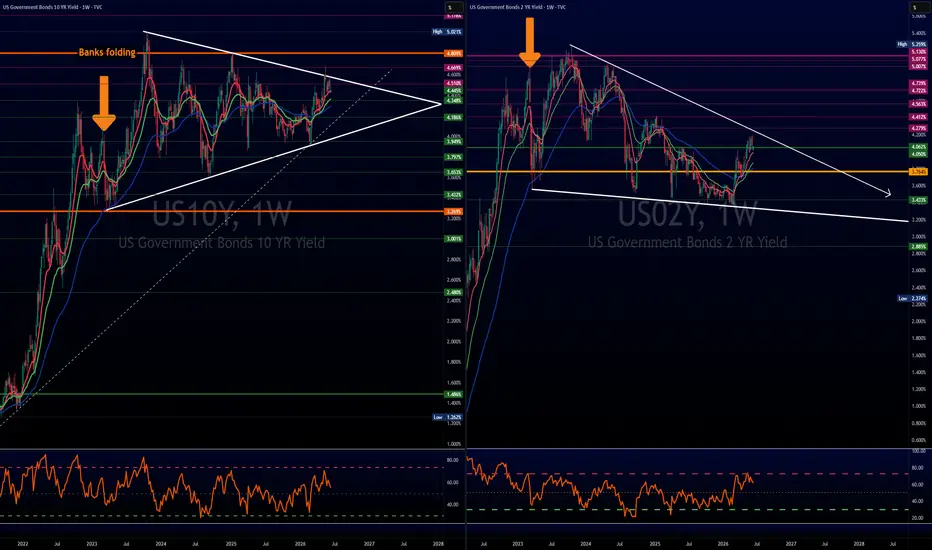
Bond Yields TalkingThe macro yield landscape is undergoing a massive regime transition
We are moving from the vertical momentum of 2022 to 2023 into an ultra compressed, multi year consolidation phase
Both the TVC:US02Y & TVC:US10Y are choking at critical structural boundaries
Let’s dive in👇
The Short End:
Gold Sell-Off Explained: When Real Yields Overpower Safe-Haven Gold is falling even as geopolitical risk remains elevated - a useful reminder that gold does not trade on fear alone.
In this Errante Analysis & Education session, Ali Mortazavi, our head of education, examines why the current decline is being driven primarily by rising real yields, a stronger U.S.
Yields Surging in Tandem: Extended Momentum Test Key CeilingReality Check
We’ve been bullish on Yield. Many posts on that. However, our earlier expectation for a temporary pause or consolidation across treasury yields simply did not play out. Instead of cooling off, upside momentum accelerated sharply, blowing straight through intermediate levels much faster
US 2 Yr: The Macro Dilemma Between Two TimeframesThe crowd expects rates to surge. While long duration yields climb under supply pressure, the front end tells a different story. The weekly and monthly charts show two distinct phases playing out.
Weekly Picture: Room For A Pullback
The latest rally ran straight into the upper channel line and stal
What Can Help You Anticipate the Fed’s Next Rate Move?⏱️ Reading time: 4 minutes
One of the most useful macro questions for traders is not where is the federal funds rate today? but what is the bond market expecting the Fed to do next?
One way to study this is to compare 2-year ( TVC:US02Y ) and 10-year ( TVC:US10Y ) Treasury yields .
📊 What
See all ideas
A graphical representation of the interest rates on debt for a range of maturities.
Frequently asked questions
Today, United States 2 Year Government Bonds trade at 99'31'3.
To better understand recent market moves, explore the US02Y chart and keep up with the latest bond market and macroeconomic news:
– US yields rise with falling oil, strong data and midterm elections in focus
– Treasury Yield Edges Higher Ahead of Midterm Election Results
– Dollar drifts on Mideast, midterm risks; Aussie and yuan dip
The current yield is 4.635%.
Yield represents the return investors earn from holding the bond. It typically rises when interest rate or inflation expectations increase and falls when demand for government bonds strengthens.
Explore Yield Curves to compare government bond yields across maturities and track changes in the fixed-income market.
Government bonds are issued with different maturities and are generally grouped into three categories:
– Short-term: Up to 3 years
– Medium-term: 4 to 10 years
– Long-term: More than 10 years
Maturity can affect a bond's yield, interest rate sensitivity, and risk profile. Longer-term bonds often offer higher yields, but their prices may fluctuate more as interest rates change.
For example, United States 2 Year Government Bonds are considered short-term bonds with a maturity of 2 years.
You can gain exposure to United States 2 Year Government Bonds through a bank, broker, government bond program, or other fixed-income investment products, depending on your location and available services.
You can also trade US02Y directly from TradingView:
– Choose a broker: Explore our supported trading partners and pick one that fits your needs
– Compare options: Review available brokers side by side to evaluate fees and features
– Connect your account: Open Supercharts, click “Trade”, select your broker, and log in
– Start trading: Place orders directly from the chart
Tip: If you're new to trading, try paper trading first. It lets you practice strategies in real market conditions without risking funds.
Government bonds are debt securities issued by governments to raise funds. Investors who buy them lend money to the government in exchange for regular interest payments and the return of principal at maturity.
Government bonds are widely used as benchmarks for interest rates and economic expectations. While they are generally considered lower-risk investments, their prices and yields can still change as market conditions evolve.
Bond symbols often indicate the issuing country and maturity. For example, US02Y represents US government bonds with a maturity of 2 years.
The maturity date is when a bond's principal is repaid to investors. For United States 2 Year Government Bonds, the maturity date is Oct 31, 2028.
Government bonds typically pay interest (coupons) until maturity, when investors receive the final interest payment along with the return of principal. Time to maturity is an important factor in assessing a bond's interest rate sensitivity and risk profile.
Use the Bond Screener to filter bonds by maturity date, yield, and other key metrics.