Australian Dollar/Canadian Dollar
No trades
No trades
Peers for comparison
Pair info
The Australian Dollar vs. the Canadian Dollar. Both of these currencies are regarded as commodity currencies and are considered to be a relatively stable currency pair. The CAD fortunes are closely related to the U.S. because it is their largest trading partner and neighbor. The AUD is more effected by its alignment with Australia and emerging Asian markets.
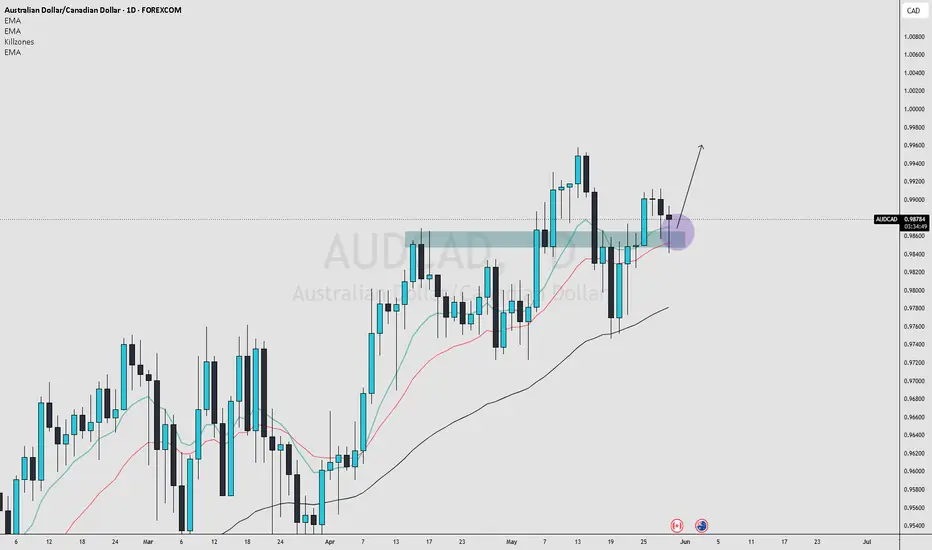
AUDCAD Bullish Movement expectedAfter a long consolidation on Daily Timeframe its time to ride the trend by putting stop loss at 1 which is a psycological level.
I will place two Buy Limit orders at the same entry level:
Once TP1 is hit, I will move the SL of the remaining trade to Breakeven and let the second position run towar
AUDCAD TRADEEE Here i have applied MS, LQ, and PROPER RISKMANEGEMENT, SO IM HOPING YOU APPLY YOUR OWN RISKMANAGEMNT HERE, it's a 1:5 rr trade, and my stategy have 40-50% win ratio, here also im targeting the liquidity above and waiting for the OB to hit, so with that all of that i have provided this trade, thank y
AUDCAD TRADEHere i have applied MS, LQ, and PROPER RISKMANEGEMENT, SO IM HOPING YOU APPLY YOUR OWN RISKMANAGEMNT HERE, it's a 1:4 rr trade, and my stategy have 40-50% win ratio, here also im targeting the liquidity below and waiting for the OB to hit, and in daily timeframe if you see, it has moved up alot, so
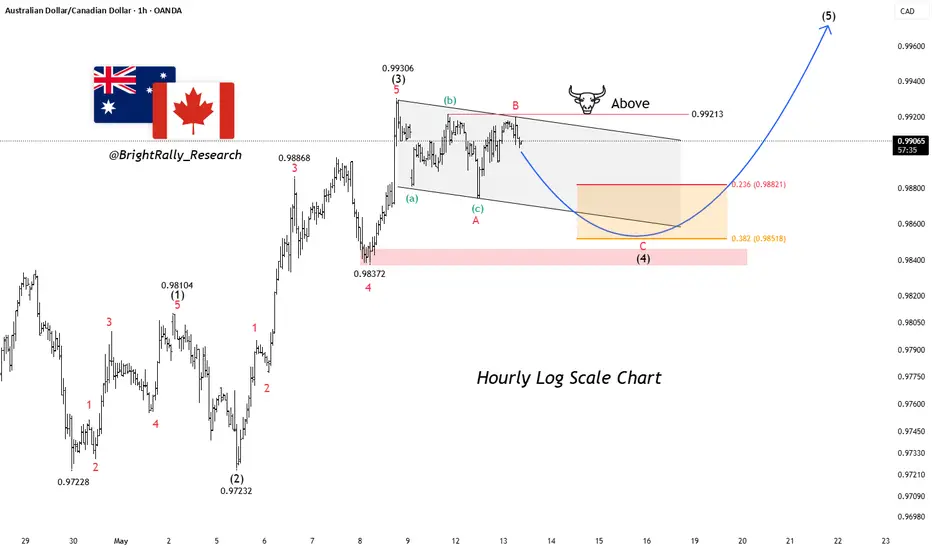
AUDCAD: Corrective Dip May Fuel Next Rally
AUDCAD on the 1H chart is still trading within a corrective structure after the strong rally to the 0.9930 high. Instead of continuing higher immediately, the price began moving within a falling channel, indicating that momentum has slowed in the short term. The current structure looks more like
AUDCAD BUY SETUP🚨 AUDCAD BUY SETUP 🚨
📍 Demand Zone Reaction Trade
💥 Strong Bounce from Key Level
📊 Market Showing Buyer Strength
💡 Entry Plan:
➡️ Price returns to demand zone
➡️ Wait for rejection confirmation
➡️ Execute BUY with discipline
🎯 Target:
📈 Previous High / Liquidity Area
🛑 Stop Loss:
🔻 Below Strong
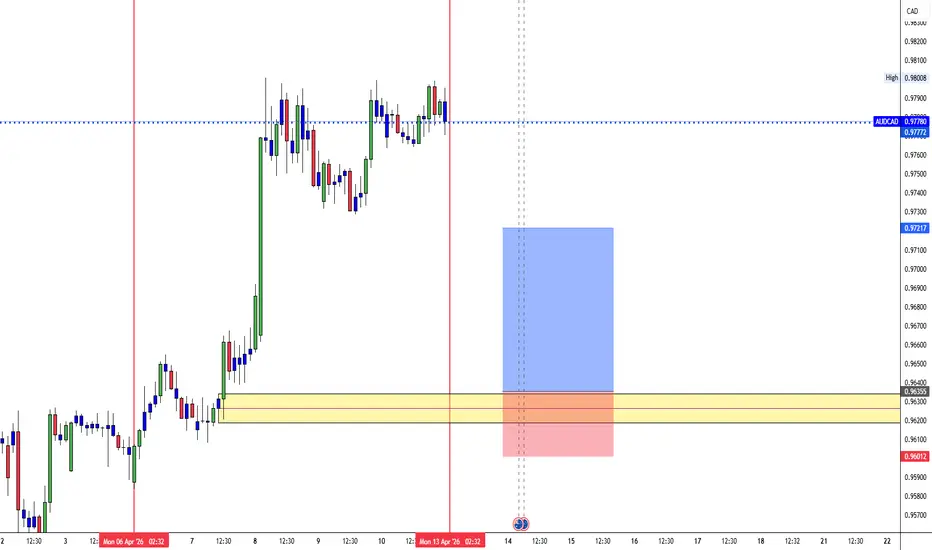
AUDCAD Ready to Explode from Demand Zone ,AUDCAD is approaching a strong demand zone on HTF — clean setup forming 💎
🔍 Market Structure:
Strong bullish impulse
Fresh demand zone (unmitigated)
Expecting continuation after retracement
🎯 TRADE PLAN:
✅ Buy Entry: 0.9620 – 0.9635 zone
🛑 Stop Loss: 0.9600 (below demand zone)
🎯 Target 1: 0.9725
See all ideas
Summarizing what the indicators are suggesting.
Oscillators
Neutral
Oscillators
Neutral
Summary
Neutral
Summary
Neutral
Summary
Neutral
Moving Averages
Neutral
Moving Averages
Neutral
Displays a symbol's price movements over previous years to identify recurring trends.
Frequently asked questions
Today, AUD/CAD rate is 0.95386 CAD.
For broader market analysis, dive into the technicals on the AUDCAD live chart and read the latest AUDCAD news:
– Feel the global growth: Australian dollar rises to highest in 15 months
– May forex seasonals: It's not time to sell the US dollar just yet
– ForexLive Asia-Pacific FX news wrap: Japan ‘wholesale’ inflation highest in 16 months
Markets don't sleep, here's what's going on with AUDCAD at the moment:
– Feel the global growth: Australian dollar rises to highest in 15 months
– May forex seasonals: It's not time to sell the US dollar just yet
– ForexLive Asia-Pacific FX news wrap: Japan ‘wholesale’ inflation highest in 16 months
See more updates in real-time with our News Flow.
– Feel the global growth: Australian dollar rises to highest in 15 months
– May forex seasonals: It's not time to sell the US dollar just yet
– ForexLive Asia-Pacific FX news wrap: Japan ‘wholesale’ inflation highest in 16 months
See more updates in real-time with our News Flow.
The safest way to trade AUDCAD is through a reliable broker. Create an account, fund it, and place a buy order.
You can trade AUDCAD directly from TradingView:
– Choose a broker: Explore our supported trading partners and pick one that fits your needs
– Compare options: View available brokers side by side to evaluate fees and features
– Connect your account: Open Supercharts, click "Trade", select your broker, and log in
– Start trading: Place orders without leaving the chart
Tip: If you're new to trading, try paper trading first — it lets you practice strategies in real market conditions without risking funds.
It's worth checking AUDCAD rate change for various periods to get the full picture:
– 1 day — −0.02%
– 1 week — −1.63%
– 1 month — −3.01%
AUDCAD's all-time low was 0.71640 CAD (Oct 8, 2008), and its highest price is 1.10260 CAD (Nov 28, 1996). Track the dynamics with the latest forex news right on TradingView.
– 1 day — −0.02%
– 1 week — −1.63%
– 1 month — −3.01%
AUDCAD's all-time low was 0.71640 CAD (Oct 8, 2008), and its highest price is 1.10260 CAD (Nov 28, 1996). Track the dynamics with the latest forex news right on TradingView.
When trading AUDCAD, one should keep in mind many factors.
First, analyze the fundamentals:
– Macroeconomic data: Inflation, GDP, employment, and other key indicators in the economies behind both currencies
– Central bank policy: Interest rate decisions and monetary policy from the respective central banks
– Market sentiment: Check what other traders anticipate
– News flow: Geopolitical events and economic releases
Then check technical ratings:
– Today — strong sell
– 1-week — sell
– 1-month — buy
Identify the trend, watch key levels (support and resistance), consider volatility and upcoming economic events. Then, you'll be closer to an informed decision.
AUDCAD is a minor currency pair (also known as a cross pair), meaning it includes two major currencies but doesn't involve the US dollar.
What it means for traders:
– No USD exposure: Reflects the relative strength of two non-USD economies
– Lower liquidity than major pairs: Generally traded less than major currency pairs, but still widely available
– Potentially wider spreads: Trading costs may be higher than for major pairs
What to keep in mind about cross pairs:
– Region-focused moves: Often influenced by economic data and monetary policy in the two regions involved
– Direct currency comparison: Useful for comparing currencies without the influence of the US dollar
– Different volatility profile: May behave differently from major pairs, especially during regional events
Track rate movements on the AUDCAD chart and follow the latest forex news to stay informed.
AUDCAD volatility measures how much the exchange rate fluctuates over time, i.e. how quickly and how strongly it moves up or down.
The current volatility rating is 0.43%.
What it means for traders:
– Higher volatility: Larger and faster price swings → higher risk and opportunity
– Lower volatility: More stable price movement → smaller trading ranges
– Market behavior: Volatility often increases during major economic news or central bank decisions
Volatility helps traders estimate risk and position sizing. It's also useful for adapting strategies to market conditions.
How to use volatility:
– Compare volatility across other currency pairs
– Combine with technical analysis (trends, support/resistance)
– Monitor economic events that may increase market movement
AUDCAD is quoted as how many CAD (quote currency) it takes to buy one AUD (base currency).
For example, if the pair trades at 1.50, it means 1 AUD = 1.50 CAD.
What can influence the rate:
– Supply and demand: Driven by trade, investment flows, and speculation
– Economic data: Inflation, GDP, employment reports
– Central bank policy: Interest rates and monetary decisions
Follow these and more events in the Economic Calendar.