European traders shouldn't need two apps to trade bitcoin & NVDA⚠️ Available only to eligible residents of participating European countries.
Written by Erald Ghoos, CEO of OKX Europe
Most Europeans keep money spread across several apps: a bank, a broker they log into twice a year, and something for crypto. Each holds a slice of the same money and none of them speak to each other. Crypto and equities ended up in separate boxes because they developed under separate rulebooks. That's an inheritance, and it's a poor reason to keep two accounts open in 2026 when you can have everything in one app that provides full portfolio visibility and instant switching strategies between asset classes when market conditions change.
Bitcoin and NVIDIA now trade in the same OKX account, off the same balance. So does a position on OpenAI before it goes public.
Pre-IPO: OpenAI and Anthropic
OpenAI and Anthropic don't have tickers yet. Anthropic raised $65bn in May at a $965bn valuation, and OpenAI closed $122bn in March at $852bn: two of the largest private raises in history. Positions on both have been available offshore and on DeFi platforms for a while. From today, European traders can take a view on a regulated platform instead.
We've opened pre-IPO markets on OKX, starting with Pre-IPO X-Perps on both companies. Long or short on the implied valuation of a private company, up to 10x leverage, in and out whenever you want. Both markets are live with liquidity deep enough to trade at size.
These markets have been largely unavailable to European traders on traditional brokerage and other regulated platforms. So the two most talked-about companies in AI have been, for most Europeans, something to read about rather than something to have a position on. We'll keep adding in-demand Pre-IPO markets as they become relevant.
Stocks that don't keep market hours
We've also launched Tokenized Stocks for Europeans. With 100 markets on day one: SpaceX, Google, NVIDIA, Palantir, the SPY and QQQ ETFs, and more added every week. They track the underlying share price and they trade 24/7.
US exchanges open at 15:30 CET and close at 22:00. A European trader's whole working morning runs with those markets shut, and anything breaking after the New York close lands late in our evening. Trading round the clock means you can act on Tuesday's news on Tuesday, or on what happened overnight before the market opens.
You can buy, sell and convert these tokens if all you want is exposure. Or you can work them in a live market, with limit, market, stop, TWAP and Iceberg orders.
One balance
A stock position on OKX can collateralise an X-Perps trade. It can sit inside a DCA bot to average in over weeks, or a Grid bot to work a range while you're doing something else. Same order types, same bots and the same margin as the crypto beside it, next to spot, Earn and Pay in a single account. And if you'd rather hold the token yourself, supported tokens can be withdrawn on-chain, including to a self-custody wallet. Keeping that door open is deliberate.European traders shouldn't have to put up with stripped-back products or unregulated platforms to reach the markets they care about. Pre-IPO markets opened in several places this year and European customers were left out of most of them, which pushes people towards venues nobody here supervises. The appetite is not in question: X-Perps volume in Europe has grown fourfold since the beginning of July.
The stock list grows every week. The pre-IPO list grows as new companies get big enough to argue about. One account. Whatever you want to trade in it.
This content is provided for informational purposes only and may cover products that are not available in your region. It does not constitute investment or financial product advice, nor it is a recommendation or solicitation to buy or sell financial instruments or to engage in any specific trading strategy.
Trading in financial instruments involves a significant risk of loss and may not be suitable for all investors. If you invest in X-Perps or other derivatives you may lose some or all of the money you invest. X-Perps are leveraged instruments; leverage can amplify both gains and losses. The value of investments and any income derived from them can go down as well as up, and you may not recover the amount originally invested. Pre-IPO X-Perps provide no ownership or economic claim in the referenced company; their price may differ materially from private valuations or any IPO price, and an IPO may be delayed, cancelled or never occur. Tokenized Stocks provide no direct ownership or shareholder rights. Company names do not imply affiliation or endorsement. Past performance is not a reliable indicator of future results. You should carefully consider your investment objectives, level of experience, and risk appetite before engaging in any trading activity.
OKX Europe Markets Ltd ("OEM"), which is authorised and regulated by the Malta Financial Services Authority (MFSA) under the Investment Services Act (Chapter 370 of the Laws of Malta).
© 2026 OKX. This article may be reproduced or distributed in its entirety, or excerpts of 100 words or less of this article may be used, provided such use is non-commercial. Any reproduction or distribution of the entire article must also prominently state: “This article is © 2026 OKX and is used with permission.”
Permitted excerpts must cite to the name of the article and include attribution, for example “Article Name, , © 2026 OKX. Some content may be generated or assisted by artificial intelligence (AI) tools. No derivative works or other uses of this article are permitted."
Disclaimer
This content is provided for informational purposes only and may cover products that are not available in your region. It is not intended to provide (i) investment advice or an investment recommendation; (ii) an offer or solicitation to buy, sell, or hold crypto/digital assets, or (iii) financial, accounting, legal, or tax advice. Crypto/digital asset holdings, including stablecoins, involve a high degree of risk and can fluctuate greatly. You should carefully consider whether trading or holding crypto/digital assets is suitable for you in light of your financial condition. Please consult your legal/tax/investment professional for questions about your specific circumstances. Information (including market data and statistical information, if any) appearing in this post is for general information purposes only. While all reasonable care has been taken in preparing this data and graphs, no responsibility or liability is accepted for any errors of fact or omission expressed herein.
Digital Assets subject to volatility and not insured. Not financial/investment advice. Not all products and services offered in all regions. Exclusions and T&Cs apply.
© 2026 OKX. This article may be reproduced or distributed in its entirety, or excerpts of 100 words or less of this article may be used, provided such use is non-commercial. Any reproduction or distribution of the entire article must also prominently state: “This article is © 2026 OKX and is used with permission.” Permitted excerpts must cite to the name of the article and include attribution, for example “Article Name, , © 2026 OKX.” Some content may be generated or assisted by artificial intelligence (AI) tools. No derivative works or other uses of this article are permitted. Markets That Don't CloseGlobal financial markets are starting to catch up with what crypto has known for a long time: there is no longer a market open. US equities trade 32.5 of the week's 168 hours . The other 135.5 hours don't stop existing; in fact, they're when earnings drop, the Fed speaks, wars start and chains keep settling. The question for traders isn't when the market is open or when prices are moving, it's when they're allowed to respond.
Trading hours are a legacy of physical floors, paper settlement and human clerks. Each of these constraints has been engineered away, but the hours stayed because of the plumbing behind them (clearing, settlement and custody) hadn't caught up.
Even without crypto, the 9:30am bell had already lost its meaning. US stocks trade overnight from 8pm and in pre-market from 4am — by the time the bell rings, price has been forming for hours. The bell no longer starts the trading day. It just concentrates it. Extended-hours activity was over 11% of US equity volume as of early 2025 , and the pre-market session has grown fifteenfold since 2019, with NYSE Arca now the single largest venue for pre-market liquidity . As around-the-clock trading makes the opening bell less relevant, the closing bell becomes more important, not as the end of trading, but as the moment the market establishes its official daily benchmark.
The most-traded asset class in the world, foreign exchange (FX), abandoned the market open decades ago (and trades ~$9.5T a day ). It runs from Sunday evening to Friday evening ET with no bell and no auction , and nobody calls FX exotic. Despite being fully electronic and globally distributed, these markets still stop for the weekend. That 48-hour gap is a settlement and plumbing constraint, not a liquidity one: crypto is the only major asset class that has actually solved it.
We know many tail events happen on weekends, outside the eyes of the traditional markets: geopolitics, hacks, policy leaks, bank failures. The result is a gap: a Friday close, a weekend of information, a Monday price you couldn't act on.
Crypto has no gap because it has no close. Price absorbs news as it lands, which is the difference between extending hours and removing them. Markets that don't close also don't play catch-up; risk is repriced in real-time rather than accumulated.
While many venues claim 24/7 markets, almost none can claim depth at 3am on a Sunday. Even bitcoin has a falling share of volume happening after traditional market hours; amid the increase of ETF trading, bitcoin's share of weekend trading fell from 24% in 2018 to 16-17% in 2024 . Uptime has become universal; depth has not. OKX's user base spans every time zone; someone's morning is always someone else's night.
You can see it in our own book: nearly half of all Stock X-Perps volume on OKX — 49.6% over the last eight weeks — traded outside US cash hours, while Wall Street was shut . Our users span every time zone, meaning the book stays active outside market hours (in all geographies) — which supports more consistent execution off-peak. Open hours are simply a policy, and increasingly table stakes; liquid hours are where OKX differentiates itself as a truly global exchange.
And while our markets never sleep, we know that you have to. The answer is delegation: recurring buy for accumulation, Grid Bot for ranges, and DCA for structured entries. Advanced order types like icebergs, TP/SL and OCO let intent execute at 4am without you watching. Automation is how you stay present across the 135.5 hours you were previously shut out of.
References
New York Stock Exchange, trading hours and holiday calendar. www.nyse.com
NYSE Research, “The early bird gets the worm: a new normal in off-hours U.S. equities trading,” 11 February 2025. www.nyse.com
NYSE Research, “The early bird gets the worm: a new normal in off-hours U.S. equities trading,” 11 February 2025. www.nyse.com
Bank for International Settlements, Triennial Central Bank Survey: OTC foreign exchange turnover in April 2025, 30 September 2025. www.bis.org
CME Group, CME Globex FX trading hours: Sunday 5:00pm to Friday 4:00pm CT.
Kaiko Research, June 2024, as reported in The Block, “As spot ETFs grow, bitcoin liquidity transforms from 24/7 to traditional Monday-Friday trading,” 28 June 2024. www.theblock.co
OKX internal data.
Disclaimer
This content is provided for informational purposes only and may cover products that are not available in your region. It is not intended to provide (i) investment advice or an investment recommendation; (ii) an offer or solicitation to buy, sell, or hold crypto/digital assets, or (iii) financial, accounting, legal, or tax advice. Crypto/digital asset holdings, including stablecoins, involve a high degree of risk and can fluctuate greatly. You should carefully consider whether trading or holding crypto/digital assets is suitable for you in light of your financial condition. Please consult your legal/tax/investment professional for questions about your specific circumstances. Information (including market data and statistical information, if any) appearing in this post is for general information purposes only. While all reasonable care has been taken in preparing this data and graphs, no responsibility or liability is accepted for any errors of fact or omission expressed herein.
Digital Assets subject to volatility and not insured. Not financial/investment advice. Not all products and services offered in all regions. Exclusions and T&Cs apply.
© 2026 OKX. This article may be reproduced or distributed in its entirety, or excerpts of 100 words or less of this article may be used, provided such use is non-commercial. Any reproduction or distribution of the entire article must also prominently state: “This article is © 2026 OKX and is used with permission.” Permitted excerpts must cite to the name of the article and include attribution, for example “Article Name, , © 2026 OKX.” Some content may be generated or assisted by artificial intelligence (AI) tools. No derivative works or other uses of this article are permitted.  Education
The New Money Curriculum: Students want crypto taught in collegeNine in ten college students said their school should teach crypto and blockchain. Most schools don't.
New OKX research found 90% of students and 87% of parents believed colleges should cover crypto and blockchain in financial education. This was not a soft preference: 27% of students and 32% of parents said it should be a requirement , not an elective.
The supply side has not caught up. A 2025 study in the Information Systems Education Journal reviewed 533 U.S. universities with AACSB-accredited business schools and found approximately 28% offered blockchain courses. Demand was close to universal, yet just over a quarter of the institutions offered formal coursework. Students turned elsewhere to learn.
The syllabus lost to the feed
About one-third (33%) of students named social media or influencers as their most important source for learning about crypto. Just 7% named school, teachers or professors. Students were nearly 5x more likely to learn about digital assets from a feed than from a faculty member.
The rest of their education was scattered: financial advisors (17%), crypto platforms and apps (12%), parents or family (10%), friends or peers (10%) and traditional news (6%). No single credentialed source came close to social media.
Parents followed a different path entirely. Crypto platforms and apps ranked first at 21%, followed by financial advisors at 19%, social media at 17%, friends or peers at 12% and traditional news at 11%. Students were about twice as likely as parents to lean on social media, 33% versus 17%.
Two generations, two curricula.
Students hold the knowledge edge, and both sides know it
More than half (53%) of students said college students understood crypto better than their parents did. Fifty-one percent of parents agreed. Only 14% of students and 13% of parents said parents understood it better.
That agreement was rare in intergenerational finance, and it was changing behavior at home. Forty-seven percent of students said they had taught a parent or guardian something about crypto or investing, and 43% of parents confirmed it happened. About 1 in 4 students said they had specifically taught their parents about crypto.
Parents were willing to act on that expertise. Fifty-six percent said they would definitely or probably let their college-aged child make a crypto transaction on their behalf. Actual behavior trailed the trust: only 9% of students said they had ever done it.
But knowing more did not translate into the final say. Thirty-six percent of students said they should have the greatest influence over their first investment decisions, more than twice the 16% who chose their parents. Parents saw it differently: 29% said the student should lead, while 30% said parents or family should. The knowledge gap and the authority gap were pointing in opposite directions.
Normalization, with guardrails
The stereotype of crypto as a young person's gamble did not survive contact with the data. More than half (52%) of students described buying crypto as a long-term investment, while just 6% called it a hobby, a gap of nearly 9x. Parents tracked closely at 48% versus 9%. Both generations had moved crypto out of the entertainment column and into the portfolio column.
Acceptance was not the same as maximalism: 89% of students said at least some allocation to crypto could be responsible, while 11% said the appropriate allocation was zero. Broad acceptance paired with measured allocations shows how crypto is maturing as an asset class within household decision-making.
The regret question was more revealing still. Asked what today's college students would most regret not owning, 27% of students said real estate, ahead of AI and technology stocks (23%), the S&P 500 (20%) and Bitcoin (17%). Parents also ranked real estate first at 26%, with Bitcoin close behind at 24%.
Real estate was the only asset that ranked first with both generations. Crypto and AI dominated the headlines. Housing still dominated the anxiety.
And the paycheck itself is now in scope, with 56% of students saying they would definitely or probably accept a job paying 20% of their salary in Bitcoin. Surprisingly, 62% of parents would support their college-aged child taking that arrangement. Parents were, on this question, slightly more permissive than the students themselves.
Why this matters
A generation is forming lifelong financial habits around digital assets, while the institutions meant to teach them are still deciding whether to offer the course. When formal education is absent, the vacuum is filled by whoever posts most often.
Closing that gap is not solely a university problem. Exchanges are now the most common way parents learn about this asset class, and the third most common for students. That places responsibility on the platforms themselves.
Serious infrastructure is more than matching engines, custody and uptime. It is clear disclosure, honest risk framing and education that treats users as people making long-term decisions rather than short-term trades. The demand signal here is unambiguous. Nine in ten wanted this taught. The question facing both universities and the industry is who is prepared to teach it well.
Disclaimer
This content is provided for informational purposes only and may cover products that are not available in your region. It is not intended to provide (i) investment advice or an investment recommendation; (ii) an offer or solicitation to buy, sell, or hold crypto/digital assets, or (iii) financial, accounting, legal, or tax advice. Crypto/digital asset holdings, including stablecoins, involve a high degree of risk and can fluctuate greatly. You should carefully consider whether trading or holding crypto/digital assets is suitable for you in light of your financial condition. Please consult your legal/tax/investment professional for questions about your specific circumstances. Information (including market data and statistical information, if any) appearing in this post is for general information purposes only. While all reasonable care has been taken in preparing this data and graphs, no responsibility or liability is accepted for any errors of fact or omission expressed herein.
Digital Assets subject to volatility and not insured. Not financial/investment advice. Not all products and services offered in all regions. Exclusions and T&Cs apply.
© 2026 OKX. This article may be reproduced or distributed in its entirety, or excerpts of 100 words or less of this article may be used, provided such use is non-commercial. Any reproduction or distribution of the entire article must also prominently state: “This article is © 2026 OKX and is used with permission.” Permitted excerpts must cite to the name of the article and include attribution, for example “Article Name, , © 2026 OKX.” Some content may be generated or assisted by artificial intelligence (AI) tools. No derivative works or other uses of this article are permitted. Education 
Crypto Cards are Going Mainstream in Europe⚠️ Available to eligible EEA residents only
Written by Erald Ghoos, CEO of OKX Europe
For much of crypto's history, success was measured by how many people were buying, trading and holding digital assets. Today, a different question is becoming just as important: how are people actually using them?
At OKX, we're beginning to see the answer in the everyday purchases our European customers make.
Spending on crypto-linked cards across the industry reached a new all-time high of $759 million in July. At OKX, we're seeing that momentum first-hand. This summer, the amount customers spent using the OKX Card across Europe grew 280% year over year , while transactions increased 178% . That growth came even as Bitcoin remained roughly 26% below where it started the year . In other words, Card usage continued growing without rising crypto prices providing the obvious tailwind. That suggests customers are increasingly using the Card for its everyday utility, rather than simply spending more when crypto markets are rising.
Across Germany, the Netherlands, Poland and France, adoption has accelerated sharply. Between May and July, the number of users spending on groceries increased 221% , while the number using their Card for transport and fuel increased 263% .
That's significant because groceries, public transport and fuel aren't occasional crypto purchases. They're ordinary expenses. They tell us much more about how a payment product fits into someone's life than a one-off high-value transaction.
We're seeing more customers reach for their OKX Card for the things they pay for every week, and those customers are also putting more of their everyday spending through it. That suggests two things are happening at the same time: adoption is broadening, and usage is deepening .
Poland may offer an early indication of what more mature everyday Card usage could look like. Groceries, transport and utilities (household bills such as gas, water, electricity) already represent 31.7% of OKX Card spending in Poland , compared with 22.2% in the Netherlands, 20.4% in Germany and 14.1% in France. Groceries are also the most consistent everyday category across all four markets, accounting for between 9.5% and 19.3% of total spending .
The wider industry is moving in the same direction, providing another signal that digital assets are moving beyond portfolios and into everyday financial life. For us, that's the more interesting story behind the numbers.
People don't need another way to pay. They need a reason to choose it.
Consumers don't need another card that simply lets them pay. The cards already sitting in their wallets do that perfectly well. For a new generation of payment products, the opportunity is to create more value around a transaction without making the act of paying any more complicated.
That's where we believe the OKX Card is different.
Rather than moving money out of OKX and into a bank account whenever they want to spend it, users can keep eligible assets within the OKX ecosystem. Before they spend, eligible USDG, a US dollar-backed stablecoin , can be put to work through Pay Boost at 3.5% APY, with rewards generated through DeFi . Put simply, eligible funds don't necessarily have to sit idle while users wait to spend them. When they're ready to pay, users can earn 2%-10% cashback on eligible everyday purchases , while zero added fees make the Card particularly useful when spending across currencies.
We're also looking at expenses people already have and asking how the Card can make those work harder. Through special offers, eligible users can receive 50% rebates on subscriptions such as Netflix and ChatGPT , turning recurring payments into another opportunity to get value back.
The reason to choose the OKX Card, then, isn't that it changes the act of paying. It's that it can create more value around it.
Using the OKX Card doesn't require customers to learn a new way to pay . The payment itself remains familiar: users can pay through Mastercard, Apple Pay or Google Pay, just as they would with another payment card. But the experience surrounding that payment is designed to do more.
It's not about changing how people pay. It's about making the money behind every payment work harder.
Bridging the gap between holding and everyday life
Users can choose to fund their Pay account with traditional currencies such as euros, eligible stablecoins, digital assets designed to maintain a stable value, or other supported crypto , giving them greater flexibility over what sits behind the payment. Eligible USDG can be put to work through Pay Boost before spending. When it's time to make a purchase, the experience is the one consumers already understand: pay through Mastercard, Apple Pay or Google Pay.
Eligible purchases can earn cashback, while special offers can extend that value to recurring spending on services such as ChatGPT, Claude and Netflix.
For customers who qualify for OKX VIP status through deeper engagement with the platform , higher cashback rates and enhanced Card benefits can make the Card a tangible extension of their existing relationship with OKX. The benefits of deeper engagement don't have to stop when someone finishes a trade. They can follow users into their everyday financial lives.
That's the principle behind the wider proposition: the more you engage with OKX, the more value you can unlock, when you trade, when you hold and when you spend . For users, that means fewer disconnected experiences. Trading, earning and spending can increasingly work together rather than requiring separate platforms for each part of their financial lives.
Traditional bank cards are primarily built to help you spend. The OKX Card is designed to make that spending work harder by bringing together earning opportunities, cashback, zero FX fees and special offers within the same ecosystem.
No single feature defines that experience. It's the way they work together that matters.
For crypto to become useful in everyday life, people shouldn't have to learn a new way to pay . They can still tap their phone or card through Mastercard, Apple Pay or Google Pay. The difference is that they have more choice over the assets behind that payment, and more opportunities to get value from them before, during and after they spend.
That's the opportunity we see for the OKX Card.
Not to convince people to pay differently.
But to give them more choice, more utility and more value when they pay the way they already do.
⚠️ Available to eligible EEA residents only
Disclaimer
This content is provided for informational purposes only and may cover products that are not available in your region. It is not intended to provide (i) investment advice or an investment recommendation; (ii) an offer or solicitation to buy, sell, or hold crypto/digital assets, or (iii) financial, accounting, legal, or tax advice. Crypto/digital asset holdings, including stablecoins, involve a high degree of risk and can fluctuate greatly. You should carefully consider whether trading or holding crypto/digital assets is suitable for you in light of your financial condition. Please consult your legal/tax/investment professional for questions about your specific circumstances. Information (including market data and statistical information, if any) appearing in this post is for general information purposes only. While all reasonable care has been taken in preparing this data and graphs, no responsibility or liability is accepted for any errors of fact or omission expressed herein.
Digital Assets subject to volatility and not insured. Not financial/investment advice. Not all products and services offered in all regions. Exclusions and T&Cs apply.
© 2026 OKX. This article may be reproduced or distributed in its entirety, or excerpts of 100 words or less of this article may be used, provided such use is non-commercial. Any reproduction or distribution of the entire article must also prominently state: “This article is © 2026 OKX and is used with permission.” Permitted excerpts must cite to the name of the article and include attribution, for example “Article Name, , © 2026 OKX.” Some content may be generated or assisted by artificial intelligence (AI) tools. No derivative works or other uses of this article are permitted.  Education
X-Perps: A More Powerful Way to Trade, Now Live in Europe⚠️ Eligible EEA residents only — 18+, advanced verification required.
📣 Announcement + explainer — not a trade idea.
This chart is the BTC X-Perp — a MiFID-regulated Bitcoin futures contract, now tradable directly on OKX<>TradingView in the EEA. It's new here, so here's the 2-minute version.
What's an X-Perp?
"Expiry Perp" — a leveraged contract that tracks Bitcoin's price. You trade the move; you don't own the coin.
Long or short — profit either direction, or hedge spot without selling it
Up to 10x leverage — more exposure per euro of margin (amplifies losses too)
Multi-asset margin — BTC, ETH, SOL, stablecoins, even EUR or USD
The contract in numbers:
0.01 BTC size — USD-margined, cash-settled
Tracks a multi-exchange BTC index — no single-venue anomalies
Funding every 8h keeps price anchored to spot (paid between longs and shorts, not to the platform)
24/7 trading , one expiry: 28 Mar 2031
Negative balance protection — you can't lose more than your collateral
Vs. what you already trade:
Spot : adds shorting + leverage; you give up ownership, funding costs apply
Classic futures : no quarterly rollovers — one contract, five years out
Standard perps : same trading feel, but MiFID-regulated in the EEA, not offshore
CFDs : exchange-traded pricing and deep liquidity, not dealer spreads
If you can trade perps, you can trade this. The 2031 expiry is structural — most positions run days or weeks, not years.
Also new on TradingView in Europe via OKX: SPCX (SpaceX) + the Magnificent 7, SPY & QQQ, Gold, Silver, WTI & Brent — plus BTC, ETH, SOL, XRP and more. Low-latency engine, deep liquidity, 1:1 Proof of Reserves, 120M+ traders worldwide.
Connect once, trade from the chart:
Open the Trading Panel on this chart
Select OKX as broker → Log in
Connect → Authorize
👉 New to X-Perps on TradingView (EEA)? Here's a simple guide for European traders HERE
👉 No OKX account? Create one (EEA — KYC + appropriateness test). New to leverage? Try demo trading first.
👉 Trading Gold, Oil or Silver as an X-Perp? Here's everything you need to know HERE
⚠️ Available to eligible EEA residents only. Expiry Perps are leveraged derivatives; leverage amplifies gains and losses, which can occur quickly — these products may not be suitable for all investors. Funding costs and liquidation risk apply; monitor your margin and consider stop-losses. OKX Europe Markets Limited is authorised and regulated by the Malta Financial Services Authority under the Investment Services Act. OKX Europe Limited is authorised as a Crypto-Asset Services Provider under MiCA (Chapter 647, Laws of Malta). This is an announcement, not investment advice. Education 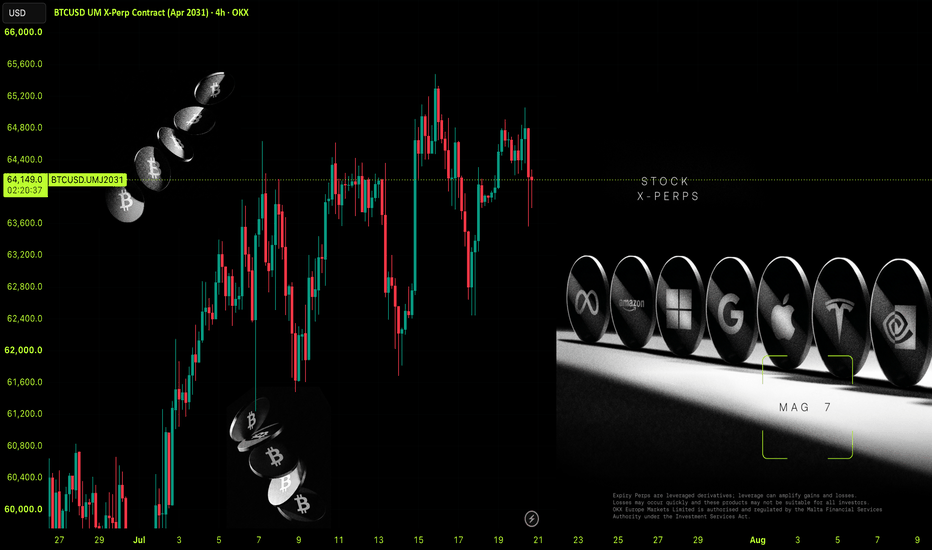
OKXIDEAS contestCheers to all traders out there!
Today we are kicking off our OKXIDEAS Trade Ideas contest!
All you need to do is publish a trading idea with the tag " OKXIDEAS " and make it go viral!
The top 10 best and most popular submissions will share a 13 ETH Prize Pool + Trading View Premium plans + OKX Product Partnership Wildcards!
1st Prize
2 ETH
1 year TradingView Premium Plan
OKX Product Partnership Wildcard, giving you the exclusive privilege to have your future ideas published on the OKX Ideas feed, a chance for an appearance on the Web3 Breakdowns Podcast, prefunded trading accounts, OKX swag and more.
2nd - 3rd Prize
2 ETH each
6-month TradingView Premium Plan
Get shortlisted for a Product Partnership Wildcard
4th - 5th Prize
1 ETH each
6-month TradingView Pro Plus Plan
Get shortlisted for a Product Partnership Wildcard
6th - 10th Prize
1 ETH each
6-month TradingView Pro Plan
The Rules
1. Connect your OKX account to your Trading View account.
2. Post your best crypto trade idea with the OKXIDEAS tag.
IMPORTANT : make sure you use an OKX price feed, e.g. OKX:ETHUSDT or your idea will not be eligible to win the prizes.
3. Your idea's time horizon can be anything from one week all the way up to several years in duration. Be sure to respect TradingView's House Rules and add a solid description that explains the reasoning behind your idea.
4. Once you have published your idea, it's time to make people notice it! Share it on social media and make as many people engage with it as possible to increase its popularity on TradingView. Feel free to also update your idea whenever you want.
You can follow other submissions by searching TradingView for ideas with the OKXIDEAS tag.
Submissions close on May 11th at 10:00 am UTC . Winners will be selected within 14 days after the contest ends and we will reach out to the 10 lucky ones via direct message on TradingView.
We will be judging ideas based on three criteria: popularity, the quality of the idea/explanation, and conformity with the campaign rules.
Only one entry per user - if you post multiple ideas from your account, or through multiple accounts, only the highest ranking one will be considered!
Let's see your crypto trading ideas go viral!
OKX Team.