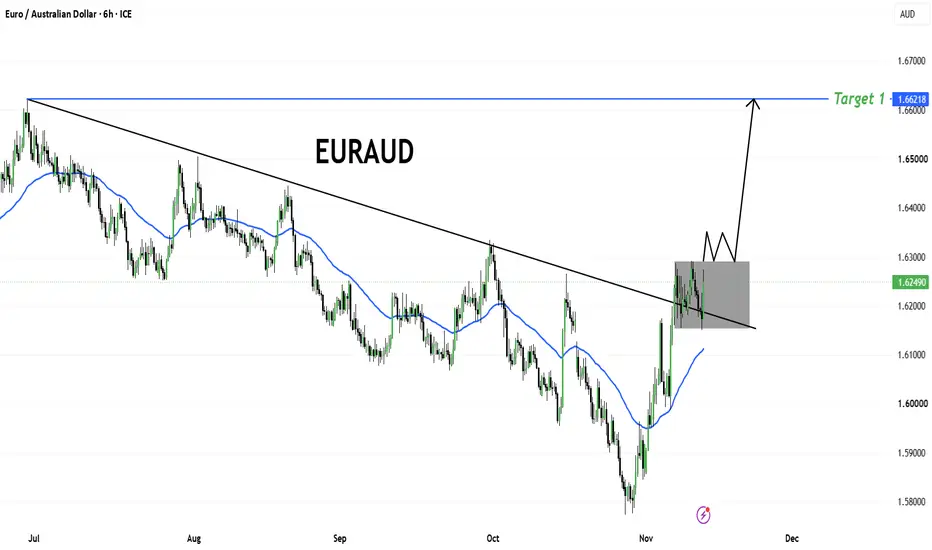
EURAUD; Heikin Ashi Trade Idea📈 HEY TRADERS!
Here’s a fresh outlook from my trading desk.
________________________________________
🧩 MY TRADING APPROACH
I trade high-probability Supply & Demand zones using Heikin Ashi charts on the 4H timeframe.
🧠 Mechanical, structured, and clean.
❌ No fixed sessions or overanalyzing.
❌ No scal
Euro / Australian Dollar
No trades
No trades
Peers for comparison
Pair info
The Euro vs. the Australian Dollar. This pair is considered to be a great barometer for global risk. In 2012, during the European sovereign debt crisis the EURAUD reached its low. Since then, due to the European Central Bank’s policy of Outright Monetary Transactions (OTM or the “whatever it takes” measure ) the pair has recovered substantially.
EURAUD 1H: Breakout Retest – 2 Buy Zones, 175 PipsEURAUD is bullish on the 1H chart and pulling back into the 1.6500 level it broke on Friday. I want to buy a dip into 1.6505–1.6522 (zone 1) or 1.6462–1.6480 (zone 2), targeting about 175 pips higher at 1.6690.
✅ The confluences
- Break and retest: 1.6500–1.6509 capped the pair three times on Frida
EURAUD 1H: Aussie Jobs Miss – 2 Buy Zones for 155 PipsEURAUD is bullish on the 1H chart after Australia's jobs miss pushed it out of a two-day range. It trades near 1.6395, and I want to buy a dip into 1.6365–1.6385 (zone 1) or 1.6340–1.6358 (zone 2), aiming for about 155 pips.
✅ The confluences
- Resistance turned support: 1.6350–1.6360 capped the pa
EURAUD Will Keep Growing!
HI,Traders !
#EURAUD is trading in a strong Uptrend
and the price just Made a massive bullish
Breakout of the falling Resistance line and
the Breakout is confirmed So after a potential
pullback We will be expecting a Further bullish
continuation !
Comment and subscribe to help us grow !
EURAUD | Potential Bullish Breakout SetupAfter an extended bearish trend, EURAUD is showing signs of a potential trend reversal. Price has staged a strong recovery from the 1.5800 region, breaking above the 50-period moving average and now challenging a major descending trendline that has been acting as dynamic resistance since July.
Curr
EURAUD, Bullish Continuation OutlookOANDA:EURAUD
4H Market Analysis 📊
🟢 Structural Development: The market has established a bullish structure through successive BOS formations, indicating a clear shift towards buyer dominance.
🏦 Mitigation Zone: The highlighted mitigation block represents a potential retest area, where previous p
See all ideas
Summarizing what the indicators are suggesting.
Oscillators
Neutral
Oscillators
Neutral
Summary
Neutral
Summary
Neutral
Summary
Neutral
Moving Averages
Neutral
Moving Averages
Neutral
Displays a symbol's price movements over previous years to identify recurring trends.
Frequently asked questions
Today, EUR/AUD rate is 1.64600 AUD.
For broader market analysis, dive into the technicals on the EURAUD live chart and read the latest EURAUD news:
– Australia, NZ dollars track Wall Street futures higher, but risks linger
– Australian dollar hits 11-month low, kiwi at six-year trough
– Australian dollar falls after weak jobs data, bonds rally on rate cut hopes
Markets don't sleep, here's what's going on with EURAUD at the moment:
– Australia, NZ dollars track Wall Street futures higher, but risks linger
– Australian dollar hits 11-month low, kiwi at six-year trough
– Australian dollar falls after weak jobs data, bonds rally on rate cut hopes
See more updates in real-time with our News Flow.
– Australia, NZ dollars track Wall Street futures higher, but risks linger
– Australian dollar hits 11-month low, kiwi at six-year trough
– Australian dollar falls after weak jobs data, bonds rally on rate cut hopes
See more updates in real-time with our News Flow.
The safest way to trade EURAUD is through a reliable broker. Create an account, fund it, and place a buy order.
You can trade EURAUD directly from TradingView:
– Choose a broker: Explore our supported trading partners and pick one that fits your needs
– Compare options: View available brokers side by side to evaluate fees and features
– Connect your account: Open Supercharts, click "Trade", select your broker, and log in
– Start trading: Place orders without leaving the chart
Tip: If you're new to trading, try paper trading first — it lets you practice strategies in real market conditions without risking funds.
It's worth checking EURAUD rate change for various periods to get the full picture:
– 1 day — +0.57%
– 1 week — +2.12%
– 1 month — +3.73%
EURAUD's all-time low was 1.16051 AUD (Aug 2, 2012), and its highest price is 2.11260 AUD (Oct 8, 2008). Track the dynamics with the latest forex news right on TradingView.
– 1 day — +0.57%
– 1 week — +2.12%
– 1 month — +3.73%
EURAUD's all-time low was 1.16051 AUD (Aug 2, 2012), and its highest price is 2.11260 AUD (Oct 8, 2008). Track the dynamics with the latest forex news right on TradingView.
When trading EURAUD, one should keep in mind many factors.
First, analyze the fundamentals:
– Macroeconomic data: Inflation, GDP, employment, and other key indicators in the economies behind both currencies
– Central bank policy: Interest rate decisions and monetary policy from the respective central banks
– Market sentiment: Check what other traders anticipate
– News flow: Geopolitical events and economic releases
Then check technical ratings:
– Today — buy
– 1-week — neutral
– 1-month — neutral
Identify the trend, watch key levels (support and resistance), consider volatility and upcoming economic events. Then, you'll be closer to an informed decision.
EURAUD is a minor currency pair (also known as a cross pair), meaning it includes two major currencies but doesn't involve the US dollar.
What it means for traders:
– No USD exposure: Reflects the relative strength of two non-USD economies
– Lower liquidity than major pairs: Generally traded less than major currency pairs, but still widely available
– Potentially wider spreads: Trading costs may be higher than for major pairs
What to keep in mind about cross pairs:
– Region-focused moves: Often influenced by economic data and monetary policy in the two regions involved
– Direct currency comparison: Useful for comparing currencies without the influence of the US dollar
– Different volatility profile: May behave differently from major pairs, especially during regional events
Track rate movements on the EURAUD chart and follow the latest forex news to stay informed.
EURAUD volatility measures how much the exchange rate fluctuates over time, i.e. how quickly and how strongly it moves up or down.
The current volatility rating is 0.91%.
What it means for traders:
– Higher volatility: Larger and faster price swings → higher risk and opportunity
– Lower volatility: More stable price movement → smaller trading ranges
– Market behavior: Volatility often increases during major economic news or central bank decisions
Volatility helps traders estimate risk and position sizing. It's also useful for adapting strategies to market conditions.
How to use volatility:
– Compare volatility across other currency pairs
– Combine with technical analysis (trends, support/resistance)
– Monitor economic events that may increase market movement
EURAUD is quoted as how many AUD (quote currency) it takes to buy one EUR (base currency).
For example, if the pair trades at 1.50, it means 1 EUR = 1.50 AUD.
What can influence the rate:
– Supply and demand: Driven by trade, investment flows, and speculation
– Economic data: Inflation, GDP, employment reports
– Central bank policy: Interest rates and monetary decisions
Follow these and more events in the Economic Calendar.