NZD/CHF Tactical long trade ### NZD/CHF — Potential Countertrend Correction (1H)
NZD/CHF has experienced strong bearish displacement, pushing the Daily RSI(2) into extreme oversold territory.
I'm anticipating a potential liquidity sweep below the recent lows, followed by a short-term bullish correction toward overhead supply
New Zealand Dollar/Swiss Franc
No trades
No trades
Peers for comparison
NZDCHF — BULLISH OUTLOOK | TARGET 0.4720🇳🇿 NZDCHF — BULLISH MARKET STRUCTURE | UPSIDE EXPANSION
NZDCHF is displaying a promising bullish recovery, with buyers gradually establishing control following a significant decline from previous higher levels.
The recent price action indicates a strong recovery, supported by consecutive bullish m
NZDCHF Bearish ContinuationNZDCHF has been showing strong bearish momentum, with price making a sharp impulsive move lower.
After such an aggressive move, we're seeing a much quieter market, with neither side making significant progress. Price became more choppy, with smaller candles and some back-and-forth movement as the ma
NZDCHF: Will Start Falling! Here is Why:
The recent price action on the NZDCHF pair was keeping me on the fence, however, my bias is slowly but surely changing into the bearish one and I think we will see the price go down.
Disclosure: I am part of Trade Nation's Influencer program and receive a monthly fee for using their TradingView
Bullish rise?NZD/CHF could fall toward the pivot and could bounce toward the 1st resistance, which is a pullback resistance.
Pivot: 0.45901
1st Support: 0.45366
1st Resistance: 0.46609
Disclaimer:
The opinions given above constitute general market commentary and do not constitute the opinion or advice of IC
NZDCHF bearish biasLooking at the this pair i see two scenarios.
* Scenario A - Yellow line (deeper retracement)
* Scenario B - Blue line (break & retest)
Scenario A - The objective is to use the retracement to obtain a better risk to reward position while trading the direction of the prevailing bearish structure.
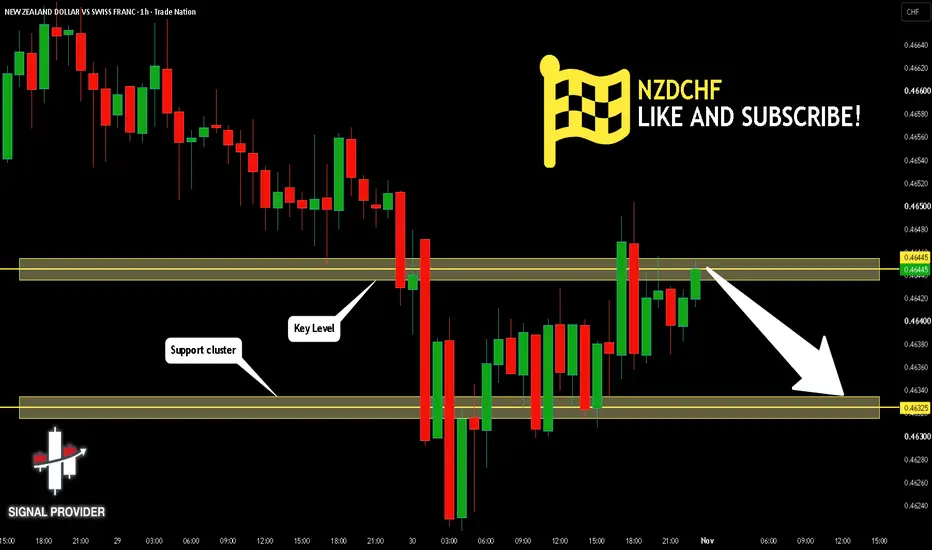
NZDCHF Will Fall! Short!
Please, check our technical outlook for NZDCHF.
Time Frame: 1h
Current Trend: Bearish
Sentiment: Overbought (based on 7-period RSI)
Forecast: Bearish
The market is trading around a solid horizontal structure 0.464.
The above observations make me that the market will inevitably achieve 0.463 lev
Bullish rebound?NZD/CHF is falling toward the support level, which is a pullback support, and could bounce from this level to our take profit.
Entry: 0.45958
Why we like it:
There is a pullback support level.
Stop loss: 0.45607
Why we like it:
There is a pullback support level.
Take profit: 0.46401
Why we like i
More downside ahead?NZD/CHF is rising toward the pivot, which is a pullback resistance, and could reverse toward the 1st support.
Pivot: 0.46391
1st Support: 0.45941
1st Resistance: 0.46625
Disclaimer:
The opinions given above constitute general market commentary and do not constitute the opinion or advice of IC Ma
Pullback resistance ahead?NZD/CHF is rising toward the pivot, which is a pullback resistance that aligns with the 50% Fibonacci retracement and could reverse from this level to the 1st support level, which is a pullback support.
Pivot: 0.46818
1st Support: 0.46335
1st Resistance: 0.47270
Disclaimer:
The opinions given ab
See all ideas
Summarizing what the indicators are suggesting.
Oscillators
Neutral
Oscillators
Neutral
Summary
Neutral
Summary
Neutral
Summary
Neutral
Moving Averages
Neutral
Moving Averages
Neutral
Displays a symbol's price movements over previous years to identify recurring trends.
Frequently asked questions
Today, NZD/CHF rate is 0.46334 CHF.
For broader market analysis, dive into the technicals on the NZDCHF live chart.
The safest way to trade NZDCHF is through a reliable broker. Create an account, fund it, and place a buy order.
You can trade NZDCHF directly from TradingView:
– Choose a broker: Explore our supported trading partners and pick one that fits your needs
– Compare options: View available brokers side by side to evaluate fees and features
– Connect your account: Open Supercharts, click "Trade", select your broker, and log in
– Start trading: Place orders without leaving the chart
Tip: If you're new to trading, try paper trading first — it lets you practice strategies in real market conditions without risking funds.
It's worth checking NZDCHF rate change for various periods to get the full picture:
– 1 day — 0.00%
– 1 week — +0.84%
– 1 month — −0.72%
NZDCHF's all-time low was 0.44743 CHF (Nov 13, 2025), and its highest price is 0.97858 CHF (Jul 25, 2007). Track the dynamics with the latest forex news right on TradingView.
– 1 day — 0.00%
– 1 week — +0.84%
– 1 month — −0.72%
NZDCHF's all-time low was 0.44743 CHF (Nov 13, 2025), and its highest price is 0.97858 CHF (Jul 25, 2007). Track the dynamics with the latest forex news right on TradingView.
When trading NZDCHF, one should keep in mind many factors.
First, analyze the fundamentals:
– Macroeconomic data: Inflation, GDP, employment, and other key indicators in the economies behind both currencies
– Central bank policy: Interest rate decisions and monetary policy from the respective central banks
– Market sentiment: Check what other traders anticipate
– News flow: Geopolitical events and economic releases
Then check technical ratings:
– Today — sell
– 1-week — sell
– 1-month — sell
Identify the trend, watch key levels (support and resistance), consider volatility and upcoming economic events. Then, you'll be closer to an informed decision.
NZDCHF is a minor currency pair (also known as a cross pair), meaning it includes two major currencies but doesn't involve the US dollar.
What it means for traders:
– No USD exposure: Reflects the relative strength of two non-USD economies
– Lower liquidity than major pairs: Generally traded less than major currency pairs, but still widely available
– Potentially wider spreads: Trading costs may be higher than for major pairs
What to keep in mind about cross pairs:
– Region-focused moves: Often influenced by economic data and monetary policy in the two regions involved
– Direct currency comparison: Useful for comparing currencies without the influence of the US dollar
– Different volatility profile: May behave differently from major pairs, especially during regional events
Track rate movements on the NZDCHF chart and follow the latest forex news to stay informed.
NZDCHF volatility measures how much the exchange rate fluctuates over time, i.e. how quickly and how strongly it moves up or down.
The current volatility rating is 0.30%.
What it means for traders:
– Higher volatility: Larger and faster price swings → higher risk and opportunity
– Lower volatility: More stable price movement → smaller trading ranges
– Market behavior: Volatility often increases during major economic news or central bank decisions
Volatility helps traders estimate risk and position sizing. It's also useful for adapting strategies to market conditions.
How to use volatility:
– Compare volatility across other currency pairs
– Combine with technical analysis (trends, support/resistance)
– Monitor economic events that may increase market movement
NZDCHF is quoted as how many CHF (quote currency) it takes to buy one NZD (base currency).
For example, if the pair trades at 1.50, it means 1 NZD = 1.50 CHF.
What can influence the rate:
– Supply and demand: Driven by trade, investment flows, and speculation
– Economic data: Inflation, GDP, employment reports
– Central bank policy: Interest rates and monetary decisions
Follow these and more events in the Economic Calendar.