DEX Screener: a way to decentralize your trades and investments
With the DEX Screener, you can access the decentralized universe and discover promising crypto pairs that may have been off your radar. With thousands of unique tokens and pools available, this tool allows you to scan multiple decentralized exchanges, track pair performance in real time, and select the best opportunities aligned with your strategy.
CONTENTS:
- What is the DEX Screener?
- DEX Screener vs CEX Screener
- How to access the DEX Screener
- How to use the DEX Screener
What is the DEX Screener?
There are thousands of cryptocurrencies in the screener, many of which trade directly against one another. This results in tens of thousands of trading pairs across numerous platforms. Due to varying liquidity depth and pool dynamics, the exact same pair can show different prices, volumes, and spreads across different decentralized exchanges.
The DEX Screener helps you find the most suitable exchange for your trading strategy by comparing crypto pair performance across venues. This is especially useful for identifying arbitrage opportunities or when searching for unique, newly launched tokens that are only available on a few decentralized platforms.
With this tool, you gain access to key exchange and liquidity pool metrics, all updated in real time.
DEX Screener vs CEX Screener
The primary distinction between the DEX and CEX Screeners lies in what you analyze: trading pairs listed on Decentralized Exchanges (DEXs) versus Centralized Exchanges (CEXs). Each tool is crafted to meet the requirements of different trading styles, as these exchange types possess unique advantages and operational approaches.
- DEXs offer self-custody, unrestricted participation, and early access to newly launched tokens. If you value privacy and direct control over your assets, a decentralized platform is often the better fit.
- CEXs deliver deep liquidity, narrower spreads, faster execution, and advanced order types. Operating within regulatory frameworks, they offer customer support and identity verification (KYC), making them well-suited for active traders and fiat onboarding.
| Feature | Decentralized exchanges (DEXs) | Centralized exchanges (CEXs) |
| Asset Custody | Complete ownership of your holdings and private keys via non-custodial wallets. | The platform secures your coins. No private key or wallet management required. |
| Access & Privacy | Direct wallet-based trading without registration, approvals, or KYC procedures. | Operating under regulatory boundaries with mandatory KYC and geographic restrictions. |
| Token Selection | Early access to emerging, unlisted tokens and niche liquidity pools. | Selective listing criteria that help protect against shady pump-and-dump schemes. |
| Trading Mechanics | Automated Market Maker (AMM) pools allow earning fee shares (with impermanent loss risk). | Faster order execution, deep liquidity, narrower spreads, and reduced slippage. |
| Fiat & Support | Limited direct fiat onboarding; no centralized customer support for account recovery. | Easier to buy/withdraw fiat via credit cards/bank transfers with customer support available. |
| Advanced Tools | Swap-based execution; advanced order types depend on specific protocol features. | Extensive features including limit/stop orders, leverage, and derivatives. |
Since trading and investing frequently require flexible approaches, many traders utilize both screeners simultaneously to track metrics tailored to different assets.
How to access the DEX Screener
From the main page, click the Products dropdown in the top navigation menu, hover over Screeners, and select DEX pairs.
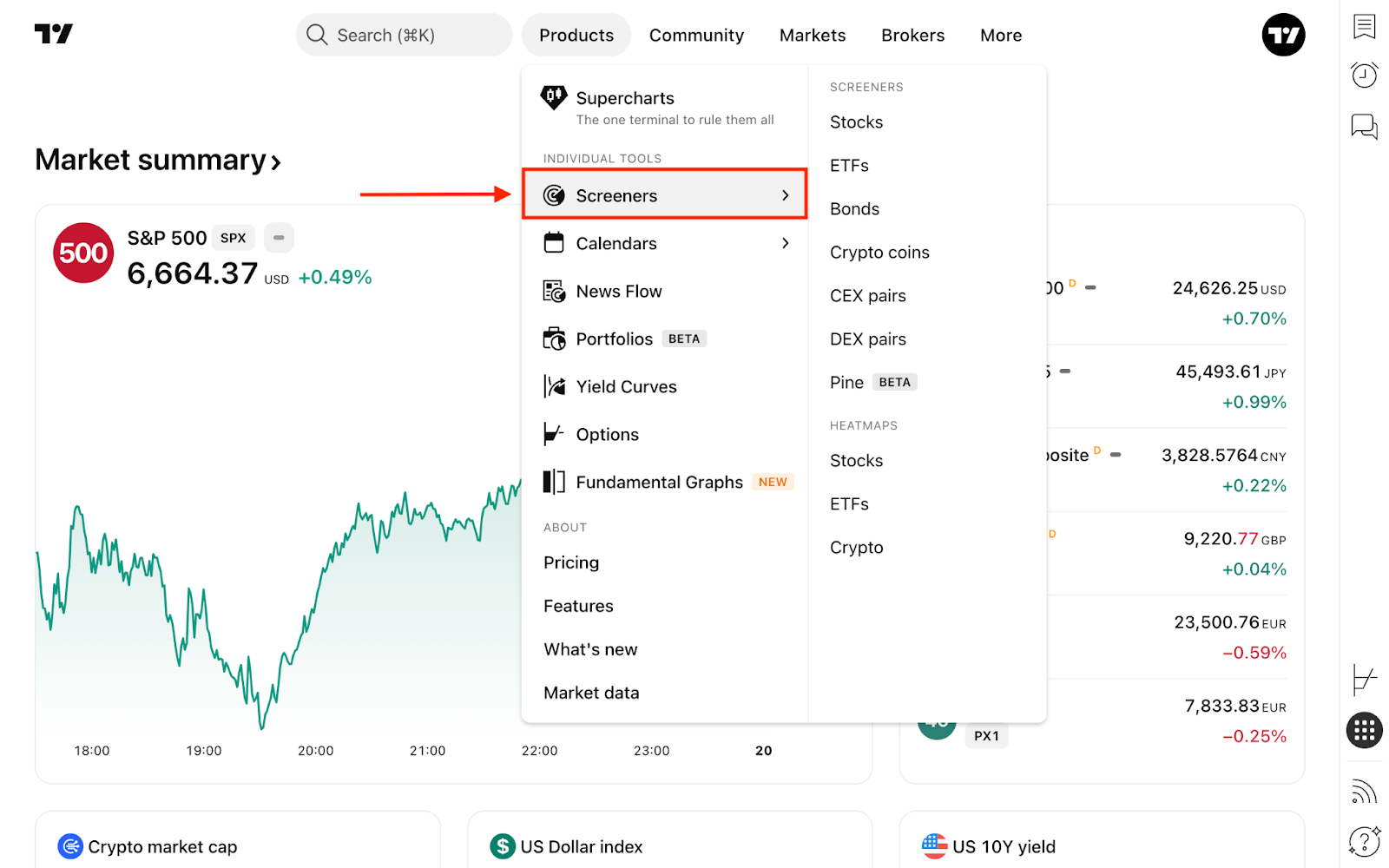
Alternatively, you can access it directly from Supercharts. On the right-hand toolbar, click Products → Screeners. If another screener is currently active (like the Stock Screener), simply click its name at the top and switch to the DEX Screener.
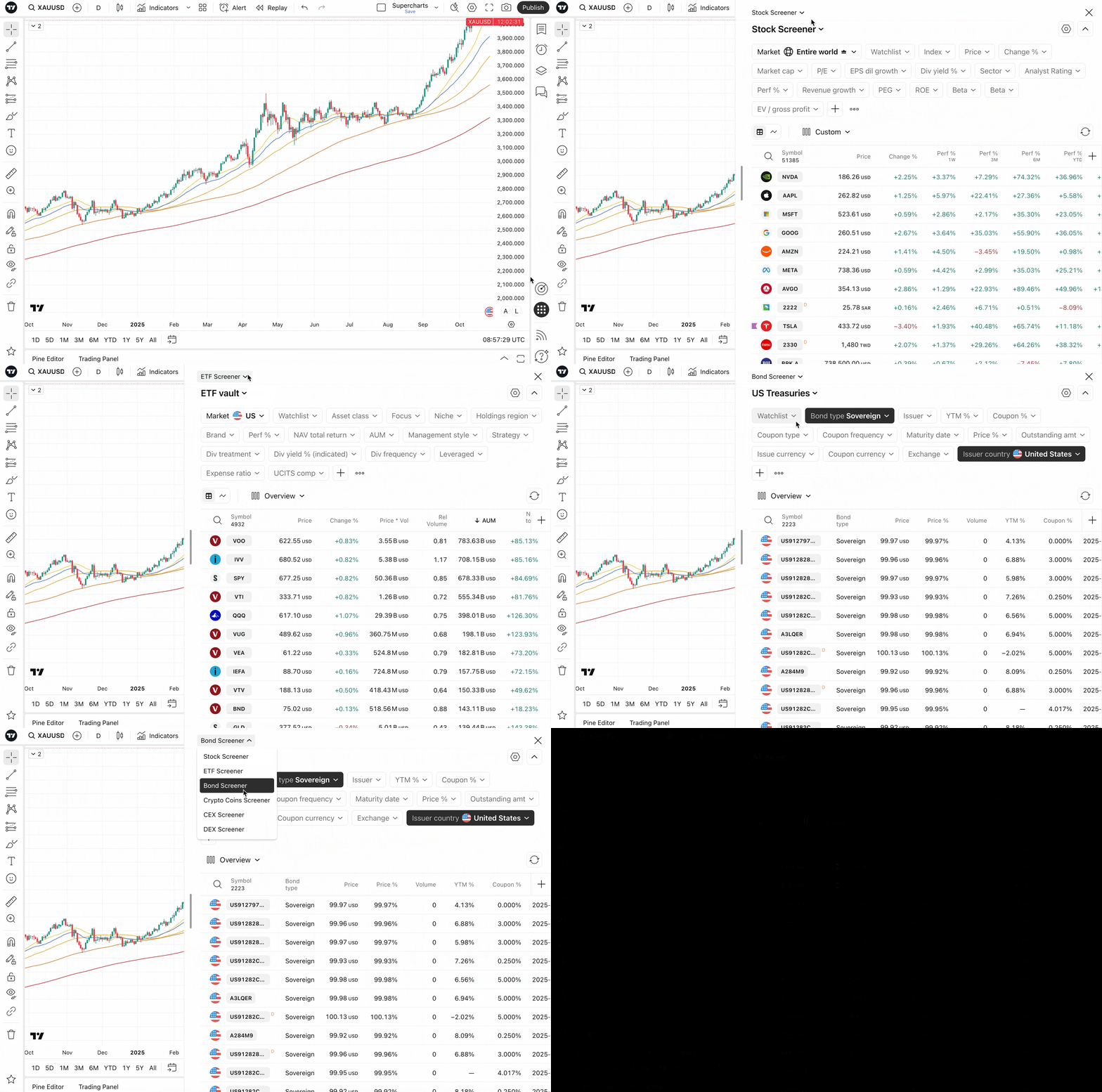
Both options lead to the exact same tool with identical functionality. Choose whichever workflow you prefer, then filter, scan, and pick the pairs that interest you most.
How to use the DEX Screener
When you open the screener, you will see all crypto pairs available on TradingView that trade on major decentralized exchanges, sorted by default by their 24-hour trading volume.
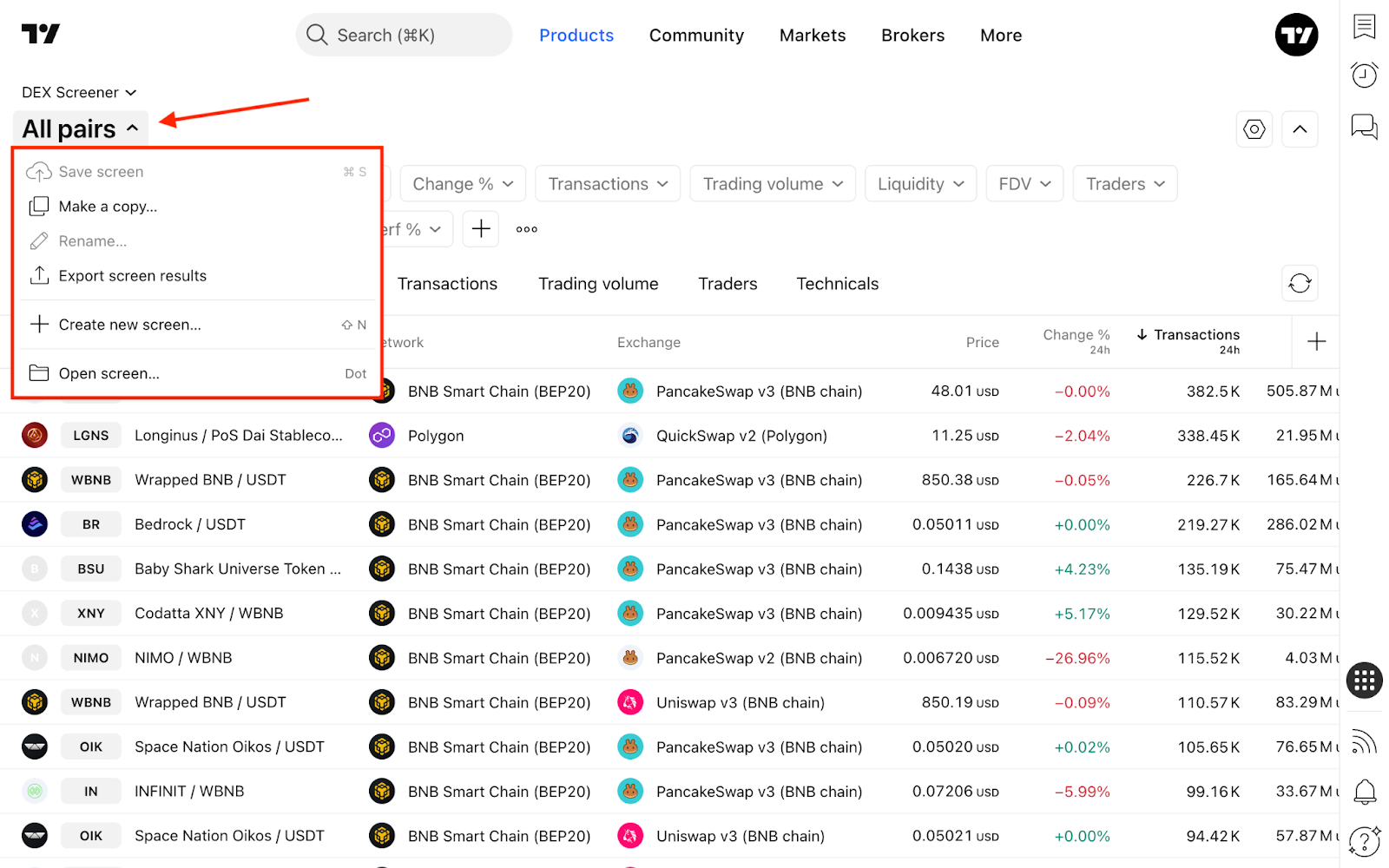
You can easily change this sorting method or apply default filter sets to customize your discovery process. To do this, click the current screen name (e.g., All pairs) in the top-left corner and select Open screen…
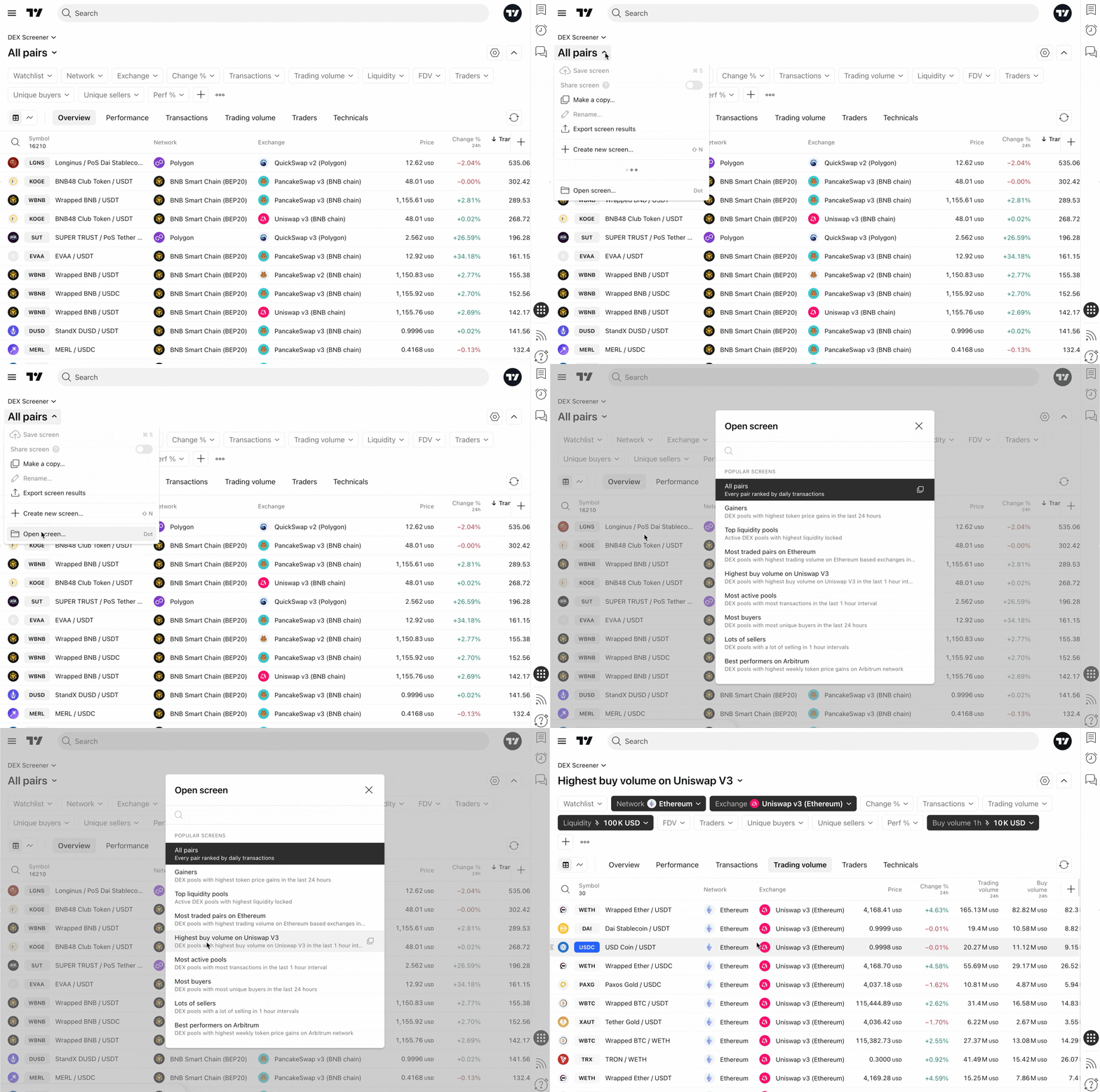
Like all TradingView screeners, you can create and save your own custom screens for future analysis. Simply set your desired filters, click the blue Save button, and give your template a name.
In this same dropdown menu, you can access recently used screens, export your results as a CSV file, or start a completely new screen.
On the right side of the screen, you will find the Screener settings. Here you can customize visual preferences (toggling symbol logos, descriptions, and currencies) and adjust the auto-refresh rate.
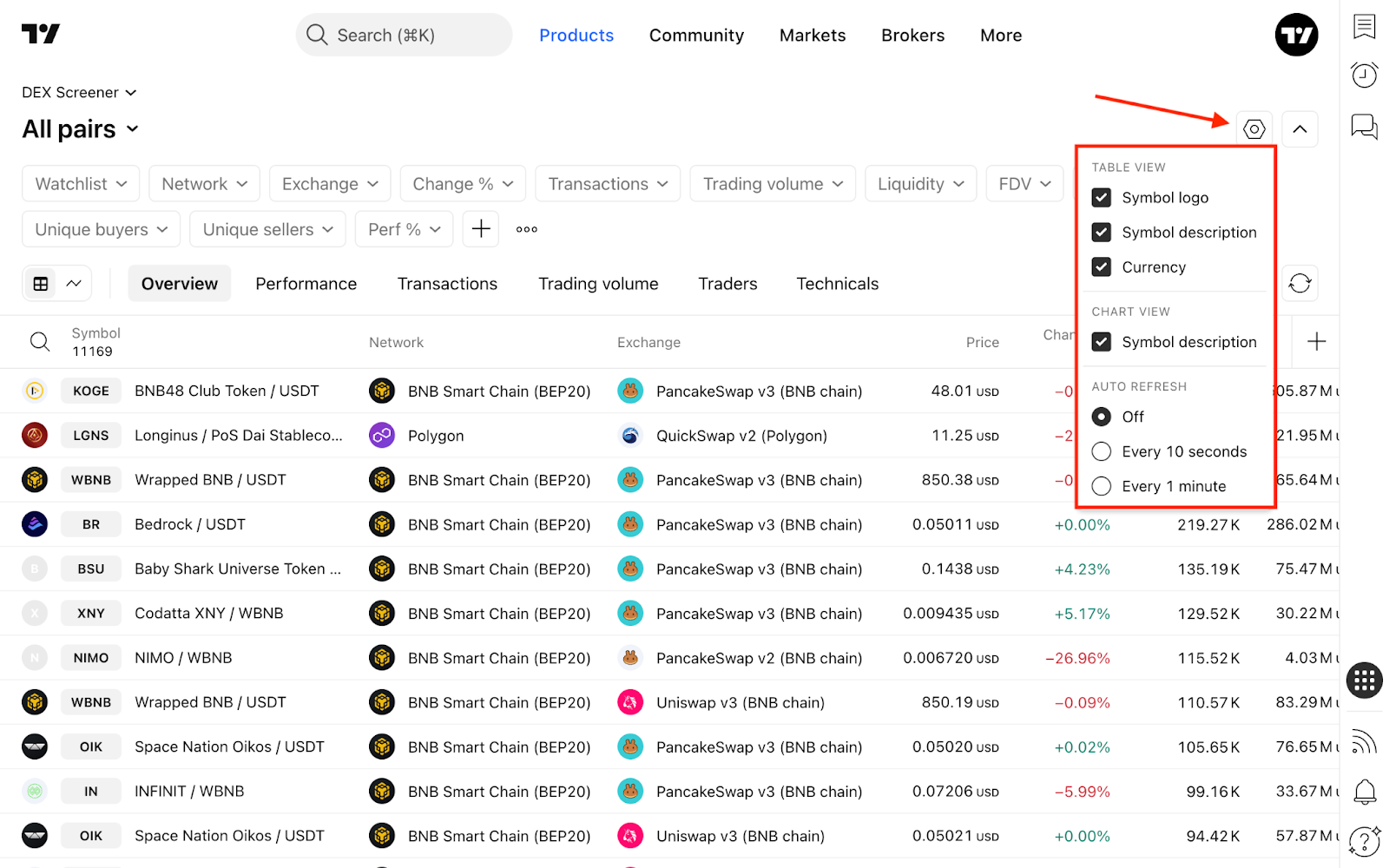
Once your screener is perfectly configured, click the Hide filters button to collapse the top panel, maximizing your workspace to view and analyze more liquidity pools at once.
Filters
Filters are specific conditions a pair must meet to appear in your data table. You can select and adjust these criteria in the filter editing dialog.
To add new filter conditions, click the + button or press Shift + F.
- Pool info: Exchange details, fully diluted valuation (FDV), liquidity depth, and underlying blockchain network data.
- Market data: Core metrics covering price action, trading volume, volatility, and historical performance.
- Trading activity: Filters based on transaction counts, unique buyers, unique sellers, and buy/sell ratios.
- Technicals: Technical indicators that can be applied directly as filtering parameters.
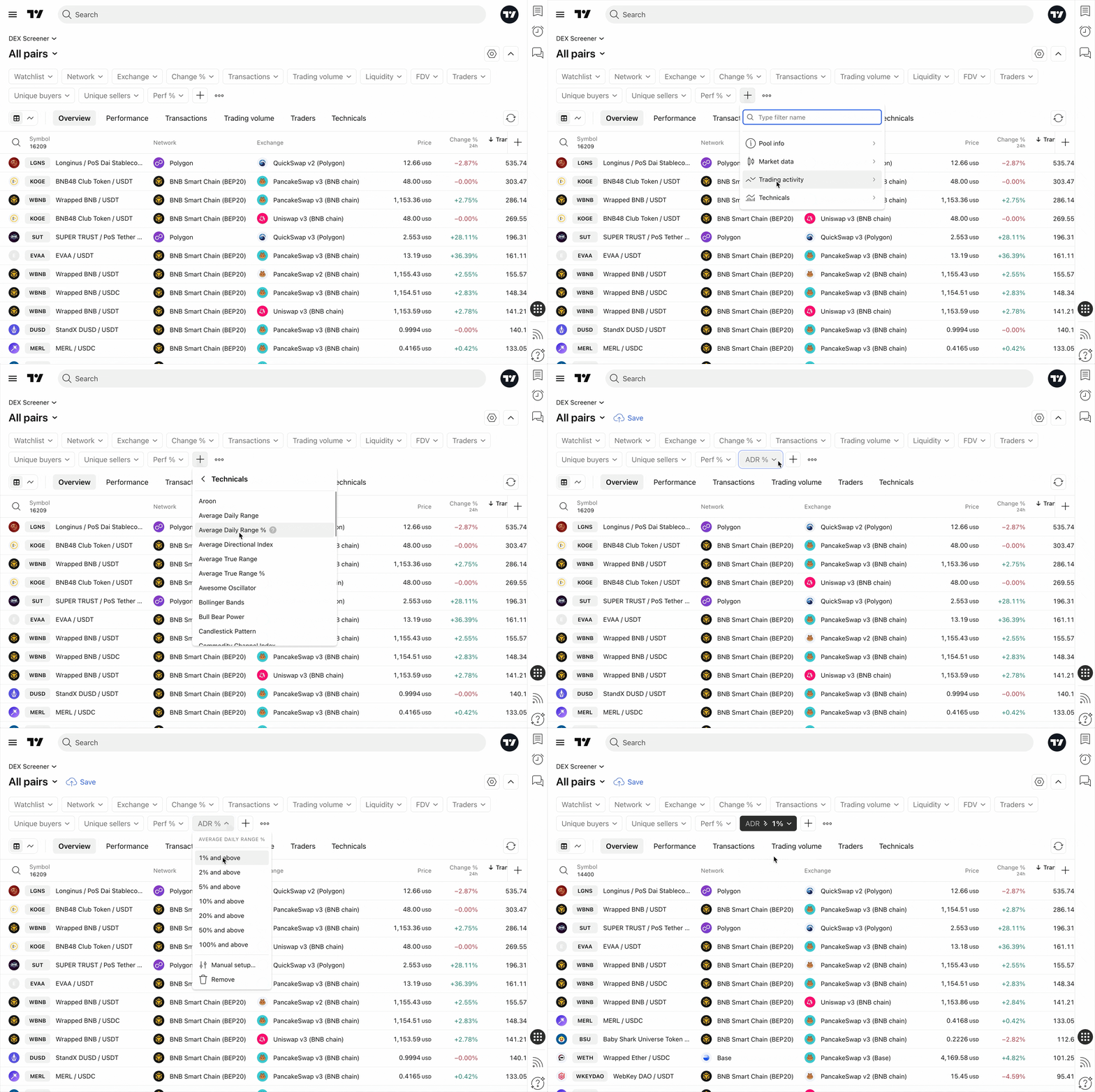
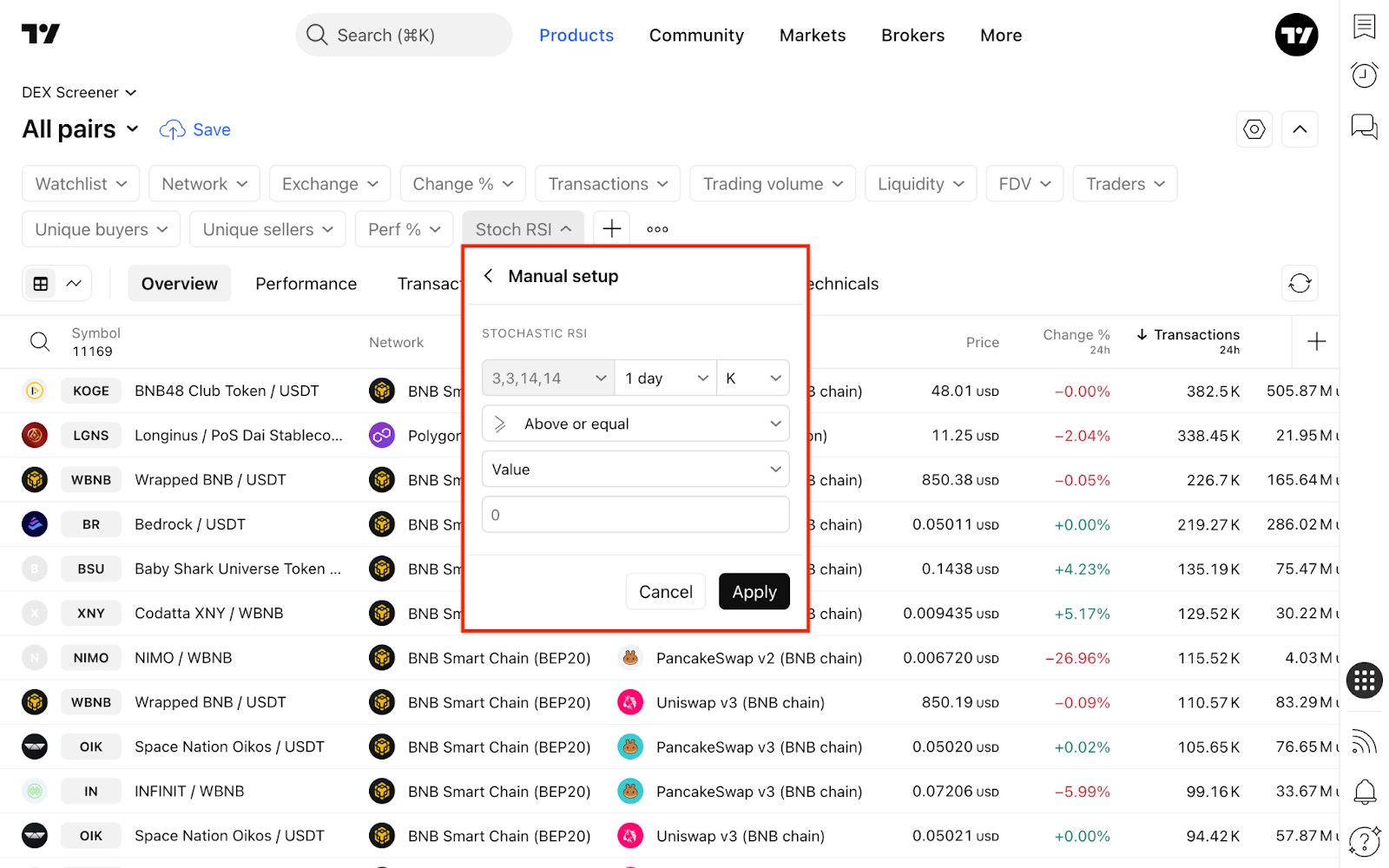
For many technical indicators — such as RSI, Stoch RSI, Momentum, EMA, SMA, and Keltner Channels — you can access an expanded set of customizable parameters to fine-tune your scan.
Column sets
Below the filters, you will find column sets. Each set groups data relevant to a specific type of analysis. You can always add a custom column set using the + button on the right.
Here is a breakdown of the default column configurations:
- Overview: Key DEX data, including the network, exchange name, price, total liquidity, and fully diluted valuation (FDV).
- Performance: A historical view of the pair's gains and losses across multiple time horizons.
- Transactions: Detailed network activity showing total transaction counts, buy/sell breakdown, and liquidity changes.
- Trading volume: Buy and sell volume metrics categorized across different timeframes.
- Traders: Data tracking the number of unique buyers and sellers over specific intervals.
- Technicals: A broad overview of oscillators, moving averages, and momentum indicators.
Oh, and one more decentralized thing…
With the DEX Screener, you can analyze data across various liquidity pools and evaluate tokens based on their core performance metrics. Customize your workspace with targeted filters to suit your decentralized trading strategy, and complement your analysis by exploring community crypto trading ideas on TradingView to catch potential market gainers early.
Also read: