Government bonds
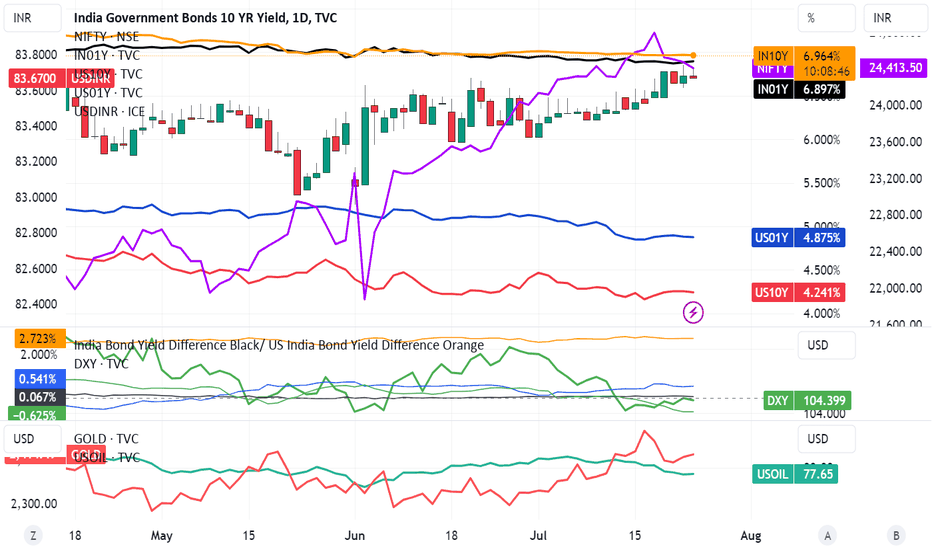
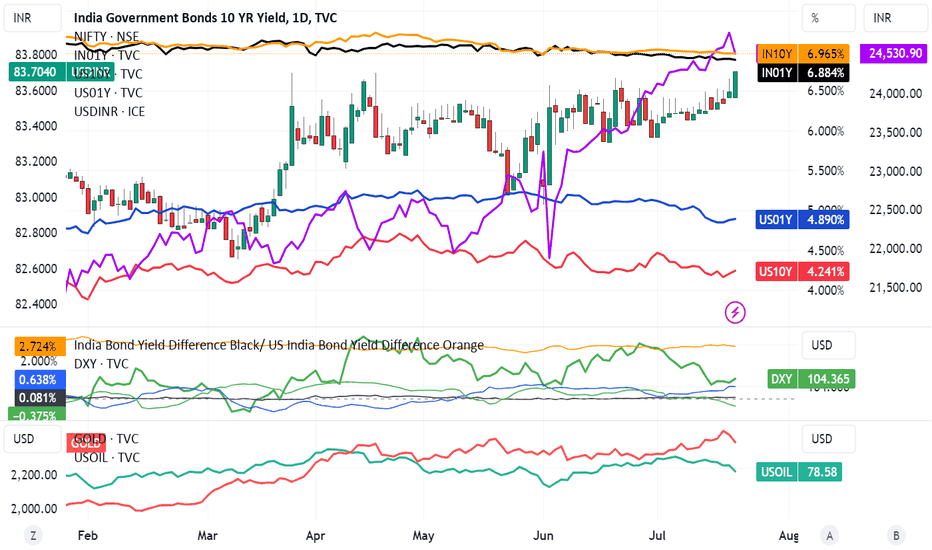
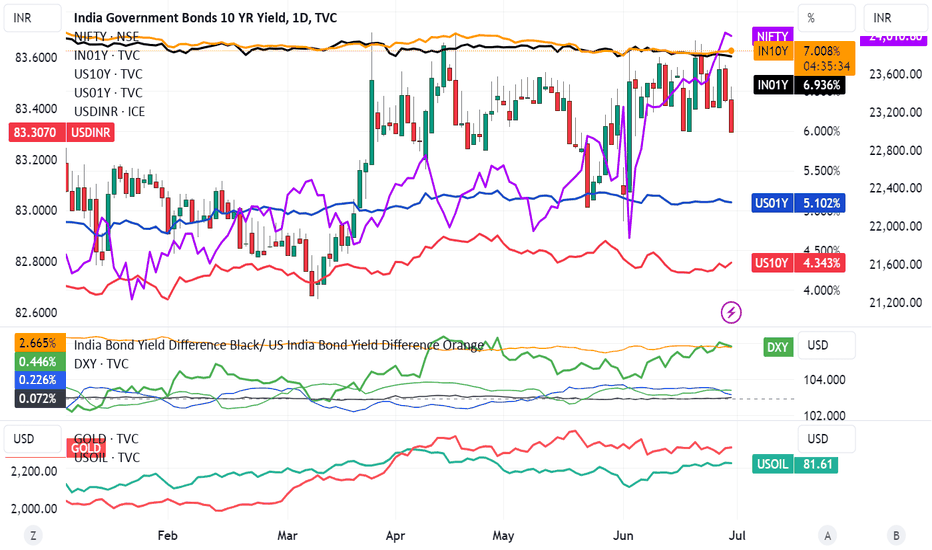
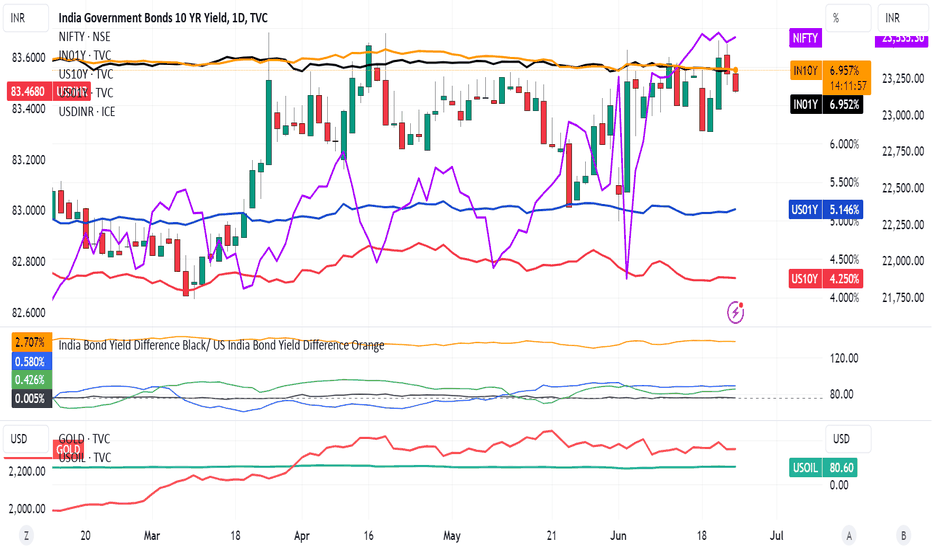
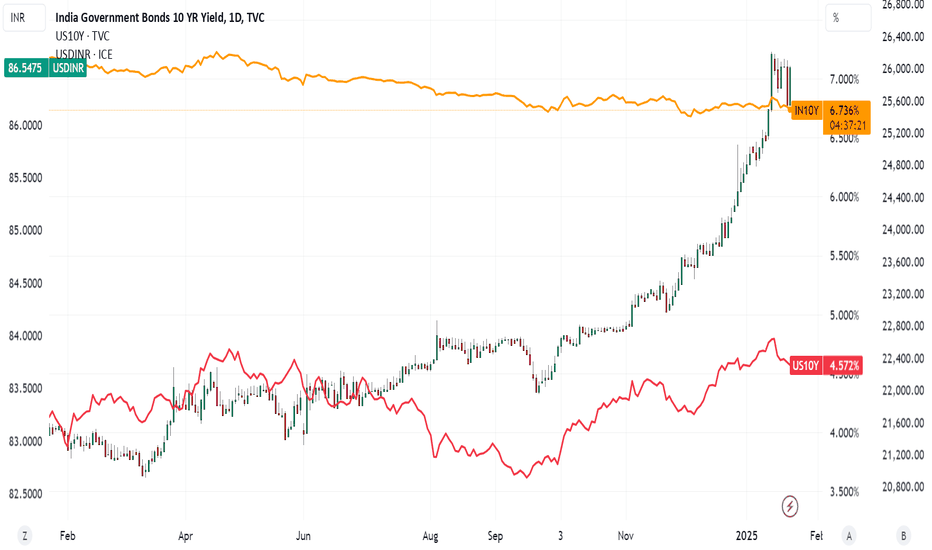
Shrinking Bond Yield Differentials leading to fall in Rupee India has over the past year. by design, maintained a low interest rate environment. This has led to interest rate differentials shrinking between US and Indian bonds. While low interest rates in India are an indicator of a strong economy, a falling interest rate differential leads to capital flow out of India, thereby hurting the Rupee.
Its Budget Season in India, and at such a time if the equity markets are falling and so is the Rupee, then popular opinion gets shriller.
Hence this video to calm the nerves of investors by looking at the deeper data trends rather then falling prey to mindless cacophony.
RBI will NOT be cutting rates but rather will hike 'em in futureRBI ain't gonna be cutting rates in future also
just simply study this graph
India 1 Year Govt Bond Yield (Blue)
India Interest Rates (Red)
I'm expecting #IN01Y to shoot up📈 to 7% +
I expect RBI to be late to hike rates instead
Bond Yields decide RBI Rate Policy, not the other way
Meaning Market will tell RBI what to do
So study Bond Yields instead and what drives Bond Yields
US10Y Analysis : Possibility of higher for longer
Historical Context and Key Observations :
From its peak in 1981 (~15%), the US10Y yield entered a multi-decade downtrend, consistently staying below its 20-month, 50-month, and 200-month moving averages due to disinflationary pressures and accommodative monetary policies. However, after reaching historic lows (~0.5%) in 2020 amid COVID-19-induced easing, the yield saw a sharp reversal, breaking above these key averages for the first time in over four decades, signaling a potential structural shift. Currently, the yield remains firmly above the 20M (4.19%), 50M (3.07%), and 200M (2.57%) moving averages, with their steep upward slopes highlighting the strong bullish momentum.
Technical Analysis :
The US10Y yield has shown a strong bullish reversal, breaking above the 20M, 50M, and 200M moving averages for the first time in over four decades, with the 20M forming a "golden cross" above the 50M and 200M, signaling robust momentum. The MACD is in positive territory with a rising histogram, further confirming the long-term trend reversal since 2021. Key support levels lie at the 50M (~3.07%) and 200M (~2.57%) moving averages, while resistance may emerge near the psychological 5% level, last seen consistently in 2007. Despite the parabolic rise from 2020 lows, consolidation or a pullback may occur before the uptrend resumes.
Fundamental Factors Driving Yields :
The US10Y yield has reversed its decades-long downtrend since 2020, driven by inflationary pressures from post-pandemic recovery, fiscal stimulus, and supply chain disruptions, prompting aggressive Federal Reserve rate hikes and expectations of "higher for longer" policies. Strong economic growth and resilient labor markets have reduced demand for safe-haven assets like Treasuries, while increased U.S. debt issuance and global liquidity tightening further contribute to rising yields. Currently above key moving averages (20M, 50M, and 200M), the yield signals strong bullish momentum, though near-term consolidation or pullbacks may occur before the uptrend resumes.
Conclusion :
The US10Y yield appears to be in the early stages of a structural shift from its decades-long downtrend. Key technical signals, including the break above long-term moving averages and bullish momentum in the MACD, suggest that the upward trend may continue. However, near-term consolidation is possible, especially given the sharpness of the recent rise.
Potential Scenarios:
1. Bullish Case: Sustained economic resilience, sticky inflation, or additional Fed rate hikes could push yields toward 5% or beyond.
2. Bearish Case: A dovish Fed pivot, recession risks, or flight-to-safety events could see yields retesting support at the 50M and 200M moving averages.
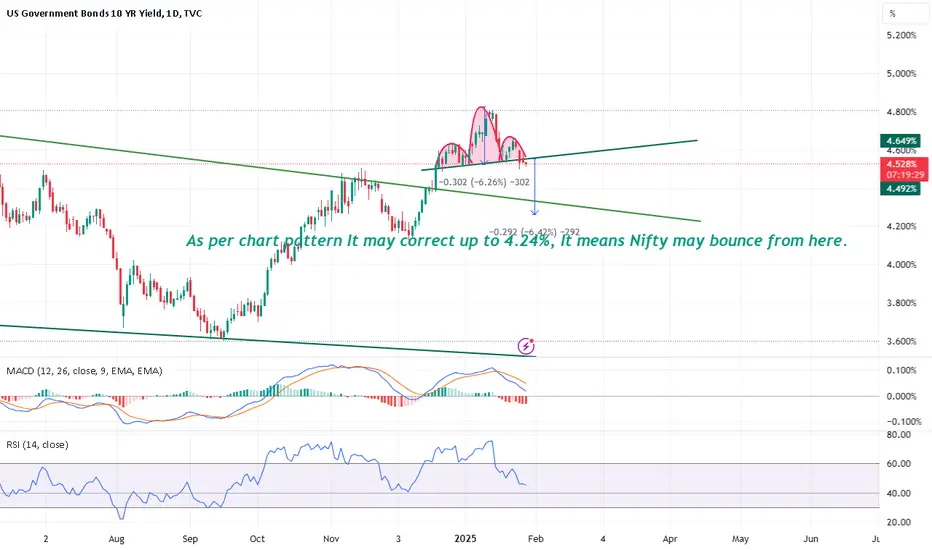
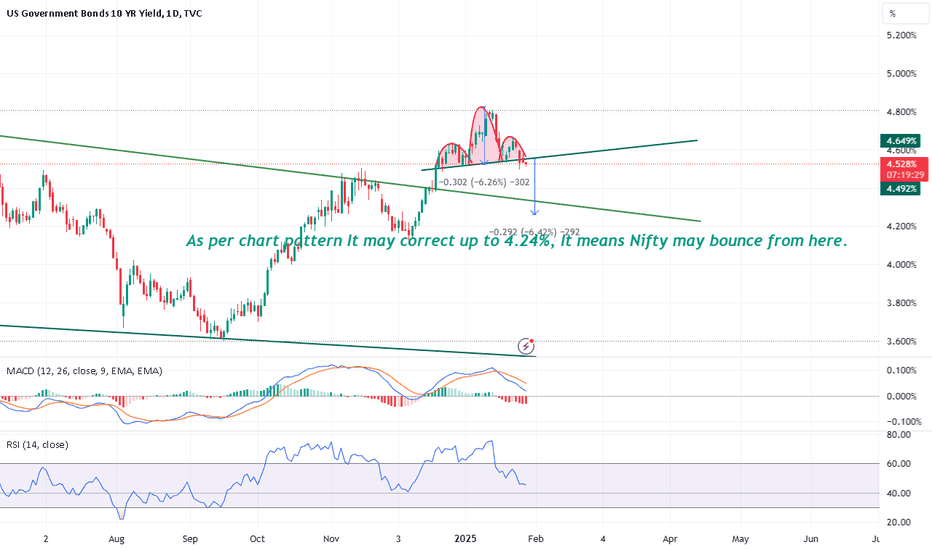
US10Yrs. Bond Yield parallel channel. Nifty up move confirmationUS Government 10Yrs. Bond Yield trading in parallel channel. After fake break out it come down in channel again. As per chart it may correct up to 4%,3.79% and 3.06% level soon.
It has inverse relation with index, so nifty and bank nifty may give good up move in next 2-3 months as both charts suggested also the same.
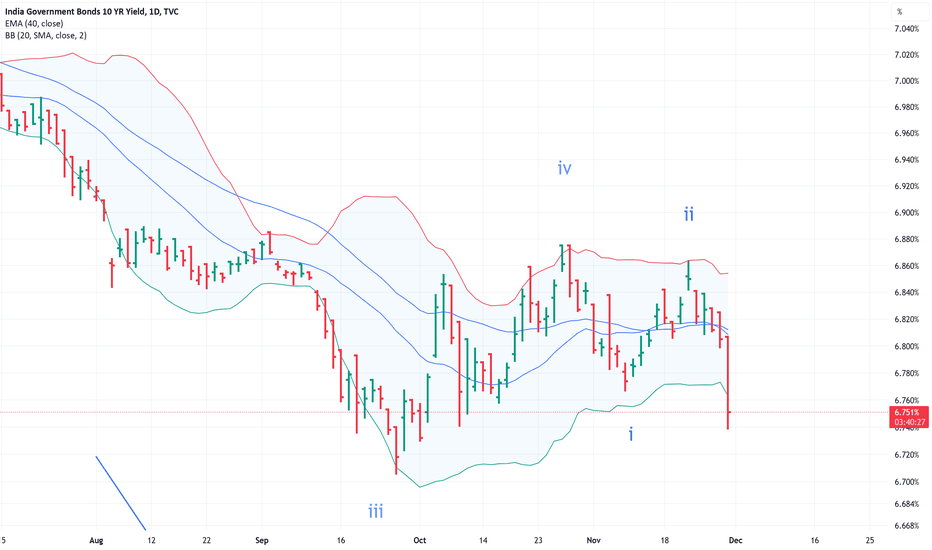
Falling 10 year GSECs driving rate cut expectationsAfter today's weak GDP print the Indian 10 year GSEC yields fell sharply in anticipation of rate cuts from the RBI, and this saw the rupee weaken as well in after trade. Does this mean that the RBI is going to cut interest rates at the up coming rate setting meeting? It is a tight rope walk but who knows they went neutral last time and might as well toe the line.
US 10 YEAR YIELD NEXT WHATUS 10 year yield now encountering 2 heavy supply zones.once it is taken out then it may target my SL HUNTING LINE at 4.68.
only if it reverses below the blue line & break the TL and atleast stays for 1/2 days it will become bearsih.
but again support zone is at 4.388.
For me it will go and touch the SL hunting line first.
lets see
Fed Rate Cut and Impact on India's Bond Yields, INR and EquitiesThis video gives an overview of how Indian economy performed during the post covid era, vis-a-vis other countries and using that performance as a benchmark, it explains that as US starts to cut rates, how Indian economy, bonds, currency and equities will likely perform
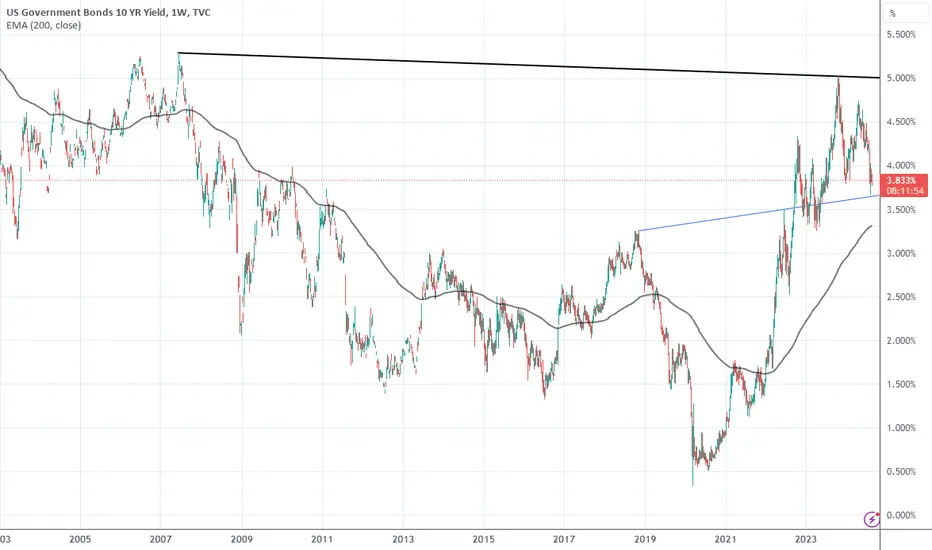
#US10Y YIELD - TESTING MAOR SUPPORT - YIELD PAIN STILL LEFT?????As we can see, US 10y yield is retesting major support, which was held last time. If this holds then we are about to retest the recent highs in coming months. Major resistance 5.00. Break below 3.2 levels will start new downtrend otherwise we are heading much higher.
Fingers Crossed!!! I feel we are in for a bumpy ride ahead.
India's 78th Independence Day Special - Economy Remains StrongJai Hind!
Its been 8 months into 2024, and in spite of all the global turbulence, Bharat, i.e. India, continues to remain a steady ship. This video reflects upon our history and learns from it to taking a peek into the future to be prepared for it.
Jai Hind!
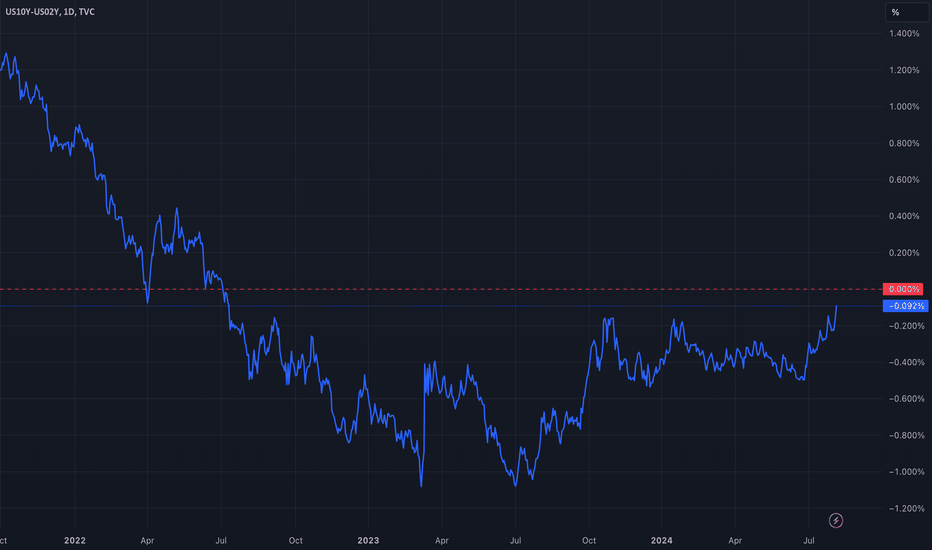
Recession Risks and Market CautionIn July 2022, we saw the yield curve (US 10-year Treasury vs the US 2-year Treasury) go negative. It’s been in that zone ever since, and now, as we approach the two-year mark, we’re on the brink of positive territory.
An inverted yield curve has a well-documented history of signalling recession. When you factor in the PMI readings dropping below 50, rising unemployment rates, and NASDAQ already in correction mode with a 10% drop from its peak, the message is clear.
So, what’s the takeaway? The indicators are pointing towards a potential recession and bear market. It’s wise to proceed with caution as these signals suggest we might be heading into choppy waters.
Budget Analysis: Mother of Bull Markets Coming... The Government has managed to keep the fiscal math under control. More capex, less borrowing, reduced revenue deficit - all make up for a sound platform on which the economic development can take off.
As and when the global economy picks up and India gets a ratings upgrade, expect yields to cool down even more and equity markets to shoot through the roof.
If you can't read this from yesterday's budget, you are losing on a giant of an opportunity.
How To Read Budget (ii) - Government Debt and its implicationsThe Government is running a revenue deficit budget and hence it has to resort to borrowing. But apart from borrowing for revenue expenditure, it also needs to borrow for capex. Thus year after year the Government keeps borrowing and this keeps increasing the debt burden.
This video explains Government debt and how it is used and what can be the implications of debt, if used correctly or is used otherwise.
How To Read Budget (i) - Receipts and ExpendituresWhere doe the Government earn from and where does it spend - thats what the budget document tells us.
This video touches these aspects of the budget document - Revenue Receipts, Revenue Expenditure, Capital Receipts, Capital Expenditure, Revenue Deficit, Fiscal Deficit and expenses like interest and pensions
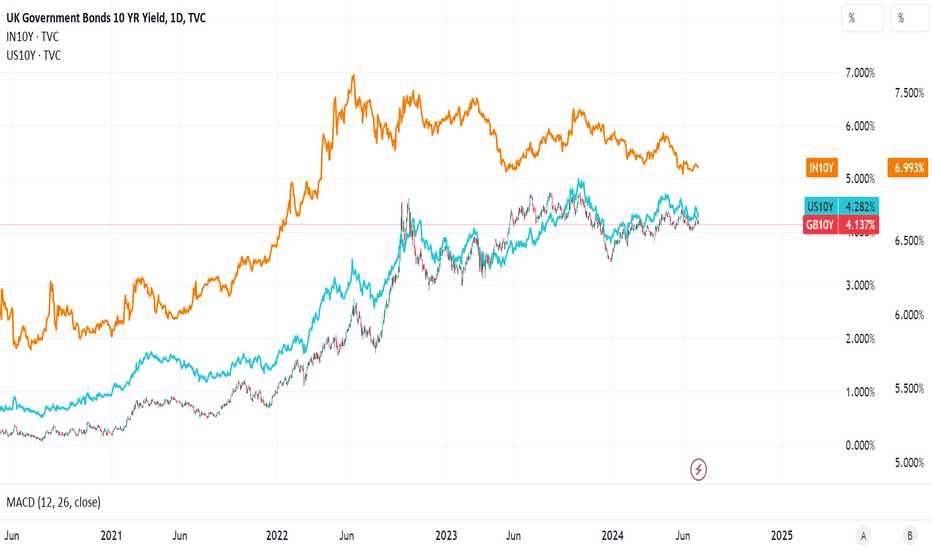
Liz Truss, Rishi Sunak, Starmer - Lessons for India from UKIndian Budget will be presented in Jul 2024. This will be a coalition government budget, hence there is a chance of the government going populist and yielding to coalition partners demands. Indian government has done a fabulous job in the last decade of maintaining the public finances in a strong position.
This video tries to highlight where we stand due to our correct economic policies of the last decade - including a once in a century pandemic - against the global backdrop
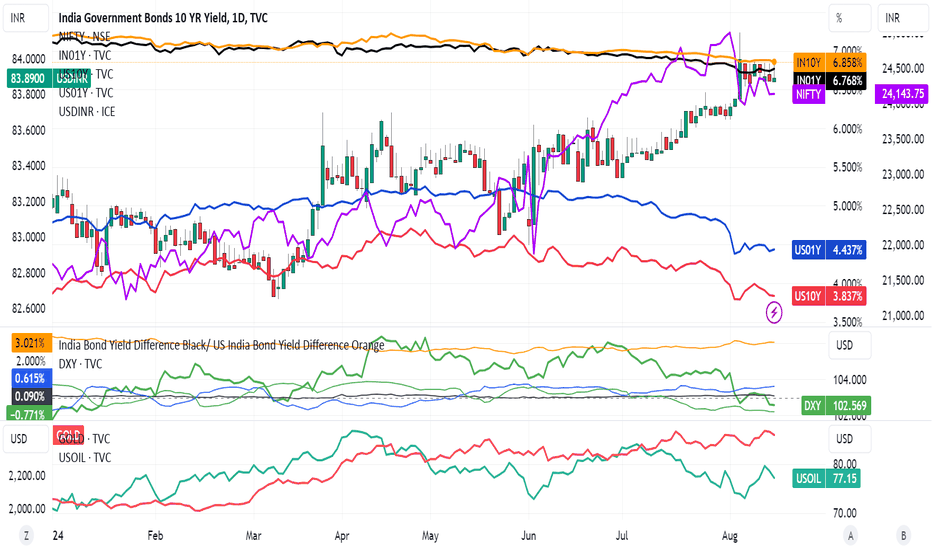
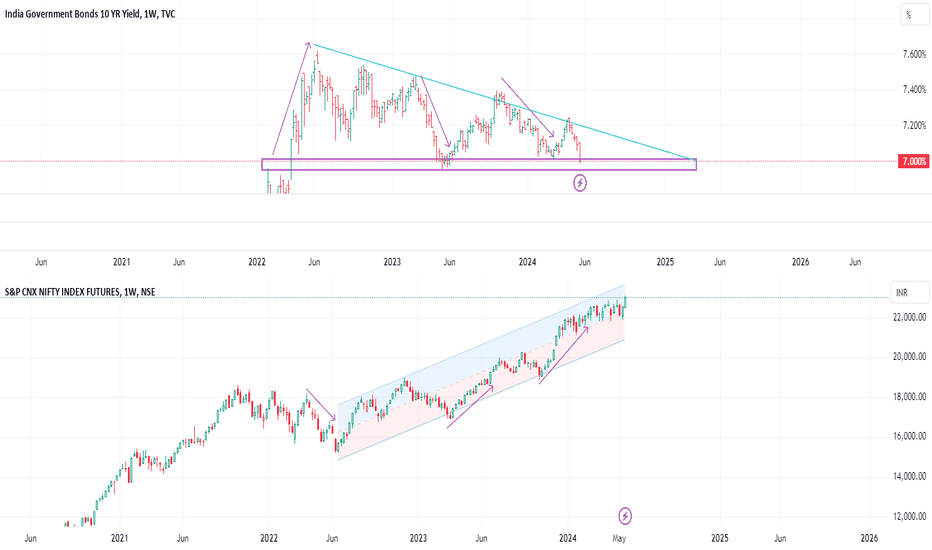
Predicting Nifty direction looking at India Govt 10Y Bond YieldWe can see an interesting correlation between t NSE:NIFTY1! he and the $TVC:IN10Y.
See the charts. The top chart is showing India Govt 10 Yr Bond Yield (IN10Y) and the below chart is current Nifty Future.
The IN10Y is making lower highs while our Nifty is making higher highs.
In the chart with purple color mentioned the direction. We can see whenever the IN10Y is gong up, Nifty is going down and vice versa.
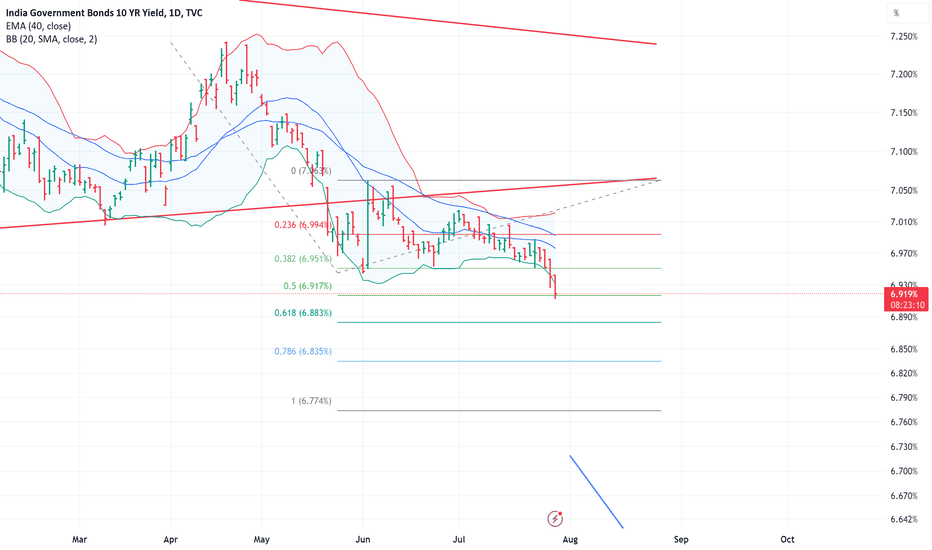
The purpose of the study is to understand the recent Reserve Bank of India (RBI) highest ever dividend to Indian Govt. As we can see the IN10Y is negotiating it's long term support of around 7.00/6.95 level. (695-700 basic points, bp). And we can see the Nifty is at ATH (23K).
Due to the high dividend of RBI naturally the Govt needs less money to be borrowed from money market through CGs and t-bills. Hence it will push the demand for the existing bonds higher, thus resulting a lower bond yield. If it breaks the 6.95 level in Weekly chart, it will see more downfall, resulting more upside to the Nifty.
Enjoy the show.
A bond market rally is now clearAfter rising inside a channel, the US 10-year bond yields are breaking the rising channel for wave B on the downside. This confirms the start of wave C down for bond yields. In terms of levels, it means eventually going back to maybe 3% in the US 10-year note, as wave C will break the neckline at 3.8%. So this will be a multi-month decline in bond yields, resulting in a long bond rally. We broke the rising channel at 4.45% so that is the key resistance here.