Our opinion on the current state of PEPKORH(PPH)Pepkor Holdings (PPH), previously known simply as Pep, is a South African retail group predominantly owned by Steinhoff International, which holds 71.01% of its shares. Following the collapse of Steinhoff due to accounting irregularities, Pepkor rebranded to distance itself from the negative publicity associated with its parent company. Pepkor operates several well-known retail brands, including Ackermans, PEP Stores, Bradlows, and HiFi Corporation.
The share price experienced significant volatility, dropping as low as R10 in May 2020 during the height of the COVID-19 pandemic. However, it subsequently staged a remarkable recovery, more than doubling in value. The company capitalized on this recovery by raising R1.9 billion through an accelerated book-build, which was used primarily to reduce debt as a precautionary measure.
In February 2022, Pepkor announced its acquisition of 87% of Brazilian clothing retailer Avenida, aiming to expand its footprint in the South American market. However, in April 2022, the company faced challenges when its Isipingo distribution center sustained significant damage from flooding in the Natal area, although it reported adequate insurance coverage for the losses incurred.
For the six months ending March 31, 2024, Pepkor reported a 9.5% increase in revenue, while headline earnings per share (HEPS) declined by 3.8%. The company attributed the revenue growth to market share expansion and recovery in retail gross profit margins, particularly with its Avenida operations.
Looking ahead, in a trading statement for the year ending September 30, 2024, Pepkor estimated HEPS would fall between a loss of 132.5c and 146.5c, compared to a loss of 140.8c in the previous year. The group recognized a significant R2.7 billion impairment of goodwill and intangible assets during this period.
Technically, the share has been trading sideways and downward since November 2021, indicating potential vulnerability to economic conditions, particularly lower levels of consumer spending. However, the company was recently added to the JSE Top 40 index, replacing Amplats, which is expected to enhance its visibility and attract increased institutional interest. Despite the challenges, Pepkor is viewed as a good quality investment with opportunities for growth, especially as it continues to expand its retail offerings. Our opinion on the current state of ENXGROUP(ENX)The enX Group (ENX) is a diversified industrial group in South Africa, offering products and services in petrochemicals, fleet management, logistics, and industrial sectors. The group includes Austro, which distributes woodworking equipment and tools, and New Way Power, which manufactures, installs, and maintains diesel generators. Its fleet division provides fleet management, logistics, and vehicle tracking, while ENX Petrochemicals markets oil lubricants, plastics polymers, rubber, and specialty chemicals across Southern Africa.
Since 2019, enX has been strategically divesting non-core assets to focus on growth opportunities and reduce debt. Key disposals include Eqstra, its fleet management company, sold to Bidvest for R3.1 billion, and its British fork-lift and container business sold for GBP31 million. The proceeds from these sales have supported debt reduction and funded special dividends, such as the 200c per share dividend following the sale of the EIE group in April 2022 and a 150c dividend in August 2022.
In its results for the year to 31st August 2024, enX reported a 3% drop in revenue, with headline earnings per share (HEPS) from continuing operations down by 11%. While volumes in toll blending for lubricants and polyethylene in chemicals increased, lower base oil and chemical prices impacted average selling prices.
With an average daily trading volume of nearly R180,000, enX remains relatively practical for private investors. The company’s focus on essential industries, along with selective acquisitions and divestments, positions it to benefit from economic improvements in South Africa and overseas markets. Our opinion on the current state of EXEMPLAR(EXP)Exemplar (EXP) is a real estate investment trust (REIT) specializing in rural shopping centers, leveraging its partnership with McCormick Property Development. Since listing on the JSE in 2018, Exemplar has developed a unique portfolio of 26 shopping malls primarily located in rural and high-density urban areas, such as Alexander Township and Chris Hani Crossing, with a gross lettable area of over 414,555 square meters. The company’s asset base is valued at just over R5 billion, with an additional R10 billion in properties under development.
Under CEO James McCormick, who brings over 35 years of experience in South African property development, Exemplar has adopted a niche approach that aligns well with South Africa's population distribution and retail demand. With a tenant mix focused on essential services, the company has shown resilience against economic disruptions, including those brought by COVID-19.
For the six months ending 31st August 2024, Exemplar reported a 9.79% increase in revenue and a significant 28.48% rise in headline earnings per share (HEPS). Its net asset value (NAV) per share grew by 6.43% to 1526c, reflecting the company’s strong performance and growth potential. However, from a private investor’s perspective, the limited daily trading volume of Exemplar shares makes it challenging to consider as a liquid and practical investment option. Our opinion on the current state of REDEFINE(RDF)Redefine (RDF) is South Africa's second-largest real estate investment trust, with assets valued at R72.9 billion and a market capitalization of R25.1 billion. The company primarily holds industrial and office properties and has investments in Poland, the UK, and Australia. Its significant exposure to South African office space makes it sensitive to the South African economy and political developments, including elections.
Despite these challenges, Redefine remains stable and well-managed, trading well below the book value of its assets. The company is pursuing a controlling interest in the Polish property company, EPP, expanding its international footprint. For the fiscal year ending 31st August 2024, Redefine reported a 7.5% increase in revenue and a 57.3% rise in headline earnings per share (HEPS). Management anticipates a gradual property cycle recovery in FY25, contingent on easing interest rates.
Technically, the stock has faced a prolonged decline from its high of 1250c in April 2015, bottoming at 159c with the COVID-19 pandemic's impact. Though it has partially recovered, it has moved sideways and downward since late 2021. Redefine trades at around 64% of its net asset value (NAV), suggesting that it may be oversold and undervalued. However, its high loan-to-value (LTV) ratio is a potential concern for investors seeking stability. Our opinion on the current state of MC-MINING(MCZ)MC Mining, previously known as Coal of Africa, is a small metallurgical coal company with a primary producing mine, Uitkomst, and several development projects, including the Makhado project, the Vele colliery, and MbeuYashu. Makhado, located in Limpopo, is the company’s flagship project. Expected to operate as an opencast mine with a projected 16-year lifespan, it aims to produce 800,000 tons of hard coking coal and 1 million tons of export thermal coal annually. Makhado’s viability improved after acquiring necessary surface rights in 2019. With partial funding from the Industrial Development Corporation (IDC), MC Mining still requires additional financing to bring Makhado into production.
The company holds a 69% stake in Baobab Mining and Exploration, which owns Makhado. Earlier this year, Goldway Capital secured a takeover with shareholder acceptance exceeding 83%. On 24th June 2024, MC Mining announced that CEO Godfrey Gomwe would step down by the end of the month.
In financial results for the year ending 30th June 2024, MC Mining reported an 18% drop in revenue and an after-tax loss of $14.6 million (3.54c per share), partially due to increased non-cash charges. Coal production at Uitkomst fell by 35% in the first quarter of FY2025, with high-grade coal sales halved compared to the same period.
MC Mining remains a high-risk investment with its volatility, limited liquidity (trading only around R12,000 worth of shares daily), substantial debt, and the inherent uncertainties of mining development. The stock spiked temporarily in mid-2022 but has since returned to lower trading levels. Our opinion on the current state of OCEANA(OCE)Oceana is Southern Africa's largest fishing company, with additional interests in the US through its subsidiary, Daybrook Fishing, based in Louisiana. Listed on both the JSE and Namibian stock exchange, Oceana produces a range of fish products, including canned fish, fish meal, fish oil, hake, mackerel, lobster, and squid. The company operates under government-issued quotas, which are periodically influenced by regulations, including Black economic empowerment initiatives, and is also impacted by weather conditions affecting fish stock availability.
In the financial results for the six months ending 31st March 2024, Oceana reported a 12% increase in revenue and an 84.6% rise in headline earnings per share (HEPS). This growth was primarily driven by Daybrook Fishing's record earnings and improved canned food sales for Lucky Star in the second quarter. For the full year ending 30th September 2024, Oceana projected a HEPS increase of between 15% and 19%. It noted that the prior year's profit increase was significantly influenced by the disposal of CCS, which impacted earnings per share but not headline earnings.
Oceana’s share price has been trending sideways to downward since January 2023, trading on a relatively low price-to-earnings (P:E) ratio of around 6.39. The company remains fundamentally strong, though it is subject to volatility due to weather and regulatory factors. Oceana’s new CEO has indicated interest in expanding into aquaculture, though competition restrictions limit opportunities within South Africa. Additionally, Oceana obtained a secondary listing on the A2X exchange on 27th March 2023, offering more trading options for investors. Our opinion on the current state of RAINBOW(RBO)Rainbow is a newly listed poultry company covering all stages of chicken production, from broilers to processing. It was unbundled from RCL Foods in June 2024, with RCL shareholders receiving one Rainbow share for every RCL share they held. The poultry industry, known for its tough market conditions, presents significant challenges, including high working capital requirements for stock and debtors, reliance on large unionized workforces, and competition from cheap imports. Additionally, it faces disease risks like Newcastle disease, which can result in significant losses.
In its financial results for the year ending 30th June 2024, Rainbow reported a profit attributable to shareholders of R180.2 million, reversing a loss of R259.5 million in the previous year. This equates to headline earnings per share (HEPS) of 20.26 cents, up from a prior loss of 30.66 cents. Revenue also increased by 7.9%, with basic earnings per share (EPS) moving to 20.25 cents, compared to a loss of 29.15 cents in the previous period.
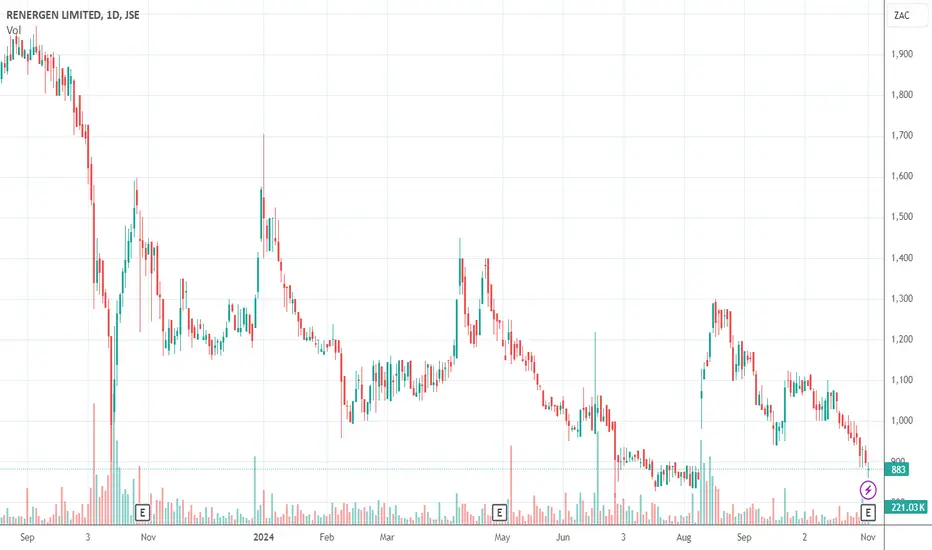
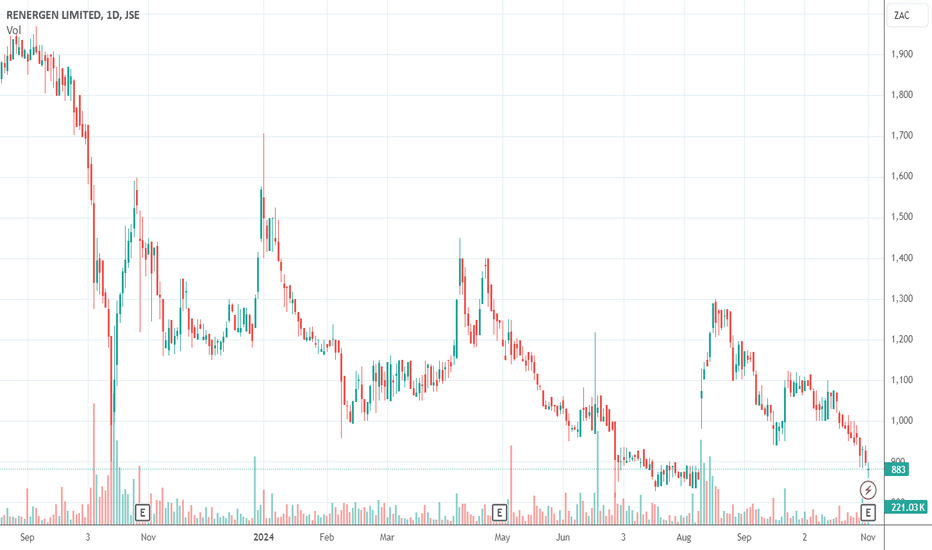
Given its recent listing on the JSE, there isn’t yet sufficient trading history for a reliable technical analysis. However, the financial turnaround suggests an improvement in operational efficiency or market conditions. Rainbow remains in a challenging industry with inherent risks, but the initial profitability indicators may draw interest from investors seeking exposure in the sector. Our opinion on the current state of RENERGEN(REN)Renergen (REN), an alternative energy company, focuses on renewable projects in Africa and has invested in liquefied natural gas (LNG) and helium. Since listing on the JSE in 2015, the company has faced financial challenges, with its share price reflecting continued losses. Despite this, Renergen has managed significant milestones, including a R125 million rights issue to secure additional financing and an IPO on the ASX, which was oversubscribed. The company holds claims of proven helium reserves exceeding 6 billion cubic feet and has received substantial funding, including $750 million from Standard Bank and the International Development Finance Corporation to support its Virginia Gas project.
For the six months ending 31st August 2024, Renergen reported a slight increase in revenue to R25.6 million, up from R23.8 million, but a widening headline loss per share to 45.73 cents from 29.87 cents in the prior period. The loss was attributed to increased operating costs, including higher employee expenses, depreciation, professional fees, insurance, maintenance, and interest expenses, alongside a lower deferred tax credit. These were somewhat offset by other operating income, mainly from foreign exchange gains.
Although Renergen began producing liquid helium for sale as of August 2024, which initially boosted the share price, the rally was short-lived. Given its volatile nature and continued losses, Renergen presents a high-risk, speculative opportunity. We advise investors to exercise caution and consider waiting for a more sustained upward trend before further investigation. R
Our opinion on the current state of SEPHAKU(SEP)Sephaku (SEP) operates within South Africa's construction materials sector, focusing on ready-mixed cement products and other cement supplies for the industry. The company owns 100% of Metier Mixed Concrete and holds a 36% stake in Sepcem, with Dangote owning the remaining 64%. Sephaku's performance is closely tied to the state of the construction industry, which has faced challenges in recent years.
In its financial results for the year ending 31st March 2024, Sephaku reported an 18.6% increase in revenue and a rise in headline earnings per share (HEPS) to 25.71 cents from 9.66 cents in the previous year. The company highlighted that Métier had repaid its term loan, replacing it with an unutilized overdraft facility by the end of FY 2024. To support its fleet and loader renewal program, instalment sales liabilities increased to R65 million, compared to R47 million in the prior year. Finance charges saw a reduction from R13.3 million to R11.6 million, driven by a decrease in total debt.
In its trading statement for the six months ending 30th September 2024, Sephaku projected a HEPS increase of between 72% and 87%, noting improved performance from Sephaku Cement and steady results from Métier Mixed Concrete. While the share has experienced a decline and sideways movement since October 2021, it is showing signs of stabilization, finding support around 85 cents. Given its current trading volume averaging R220,000 per day, it remains a feasible option for private investors, especially as it trends upward following the latest results. Our opinion on the current state of ASTRAL(ARL)Astral Foods (ARL) is South Africa's leading poultry producer, with substantial operations in broiler processing, breeding stock supply, day-old chick production, and animal feed production through its subsidiary, Meadowfeeds. It processes 4.4 million broilers per week and is a key supplier in the domestic poultry sector. The company’s performance is tied to weather conditions, feed costs (primarily maize), and the impact of international poultry imports, which make up around 30% of South African consumption and create price competition.
In its interim results to 31st March 2024, Astral reported revenue growth of 4% and a significant increase in headline earnings per share (HEPS) to 884c from 163c in the previous period, with the Poultry Division returning to profitability. Cash generation was strong, with an operating profit increase of 461.2% to R550 million. In its trading statement for the full year ending 30th September 2024, Astral projected HEPS between 1853c and 1985c, a notable recovery from a loss of 1324c the previous year.
Despite ongoing challenges, including rising maize and fertilizer costs due to the Ukraine conflict, electricity and water issues, and recent avian flu outbreaks, the share has shown resilience. Technically, it broke through a long-term downward trendline on 20th May 2024 at 15470c and is currently trading upward at 17395c. Astral’s management appears strong, and the stock remains attractive at these levels, though it is exposed to commodity price risks and industry-specific challenges. Our opinion on the current state of ENXGROUP(ENX)The enX Group (ENX) is a diversified industrial company catering to the petrochemical, fleet management, logistics, and industrial sectors. It includes divisions such as Austro, which distributes wood-working equipment, and New Way Power, which provides diesel generators. Its fleet division focuses on fleet management, logistics, and vehicle tracking, while ENX Petrochemicals markets lubricants, polymers, rubber, and chemicals in Southern Africa.
The company has actively streamlined its operations, selling off several non-core assets, including Eqstra in 2019 and EIE Group in April 2022, which allowed for debt reduction and special dividends for shareholders. The company also completed the sale of Eqstra Investments in June 2024, resulting in another special dividend of R5.00 per share.
In its results for the six months ending 29th February 2024, enX reported revenue up by 5% and headline earnings per share (HEPS) up 110%. Growth was driven by increased volumes in polyethylene, specialty chemicals, and generator sales, especially to data centers, though lower base oil pricing impacted average selling prices.
In a trading statement for the year ending 31st August 2024, enX estimated HEPS growth between 77% and 87%, but a decline of 6% to 16% for continuing operations. The share trades an average of R188,000 daily, making it viable for private investors, with potential upside from any economic recovery in South Africa. Our opinion on the current state of ENXGROUP(ENX)The enX Group (ENX) is a diversified industrial company catering to the petrochemical, fleet management, logistics, and industrial sectors. It includes divisions such as Austro, which distributes wood-working equipment, and New Way Power, which provides diesel generators. Its fleet division focuses on fleet management, logistics, and vehicle tracking, while ENX Petrochemicals markets lubricants, polymers, rubber, and chemicals in Southern Africa.
The company has actively streamlined its operations, selling off several non-core assets, including Eqstra in 2019 and EIE Group in April 2022, which allowed for debt reduction and special dividends for shareholders. The company also completed the sale of Eqstra Investments in June 2024, resulting in another special dividend of R5.00 per share.
In its results for the six months ending 29th February 2024, enX reported revenue up by 5% and headline earnings per share (HEPS) up 110%. Growth was driven by increased volumes in polyethylene, specialty chemicals, and generator sales, especially to data centers, though lower base oil pricing impacted average selling prices.
In a trading statement for the year ending 31st August 2024, enX estimated HEPS growth between 77% and 87%, but a decline of 6% to 16% for continuing operations. The share trades an average of R188,000 daily, making it viable for private investors, with potential upside from any economic recovery in South Africa. Our opinion on the current state of SALUNGANO(SLG)Salungano, formerly Wescoal, focuses on coal mining and trading, producing 300 million tons annually from five mines, with mining contributing 82% of its revenue. It began production in 2021, primarily supplying Eskom from its Moabsvelden mine. The company also owns 50% of Arnot Mine and is exploring ways to diversify within the energy sector.
For the six months ending 30th September 2024, Salungano reported revenue down 30% and a headline loss of 90c per share, worsened from a 19.64c loss in the previous period. Its net asset value dropped significantly to 37c per share from 178c. Operations have continued with only one Eskom contract, supplying through rectification into the Neosho contract from its Elandspruit and Vanggatfontein Collieries.
The company faced internal instability, with three directors resigning in July 2023, leading to a sharp share price decline. Consequently, on 21st August 2023, the JSE suspended trading in Salungano shares. While the company has completed and published its financial reports, it must still apply for the lifting of the suspension. Our opinion on the current state of SHOPRIT(SHP)Shoprite (SHP) is Africa's largest grocery retailer and consumer goods company. Despite facing intense price competition, which has limited supermarkets' ability to pass on price increases, the company has shown resilience. Its share price, which fell from R275 in March 2018 to around R100 in July 2020, has since recovered, as the company stands to benefit from improvements in the South African economy. Chair Christo Wiese maintains effective control with 42% through his deferred shares, although his ordinary shareholding has reduced to just over 10%.
In recent years, Shoprite has refocused its African operations, exiting Uganda, Madagascar, Nigeria, and Kenya, and in South Africa, acquired 56 Cambridge and Rhino stores from Massmart, reflecting a strategic shift towards consolidating core operations. Despite disruptions from unrest and looting, which affected 119 stores, the company reported 12% growth in merchandise sales and 7.2% increase in headline earnings per share for the year to June 2024.
In the latest quarter ending 30th September 2024, Shoprite's sales grew 10.4%, with South African supermarket sales up 11.4% and selling price inflation at 2.6%. The company also reopened its share buy-back program, purchasing R997 million in shares.
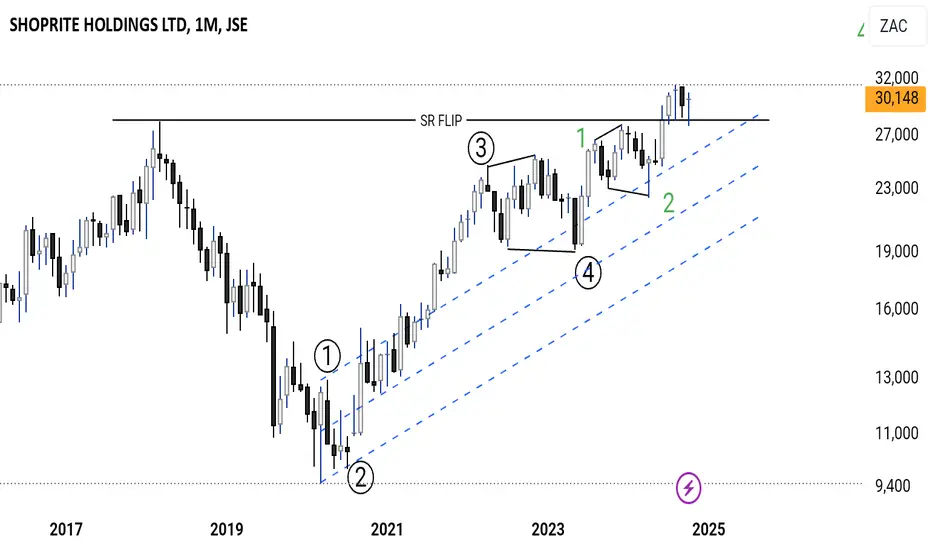
Technically, after breaking above its 200-day moving average in September 2020 at 11696c, Shoprite's share price has climbed to 30551c—a remarkable 161% increase. With continued growth from new store openings and ongoing investment in digital, supply chain, and sustainability, Shoprite is expected to further capitalize on South Africa’s economic recovery, as loadshedding eases and with possible political shifts such as a government of national unity (GNU). Our opinion on the current state of VUNANI(VUN)Vunani (VUN) is a black-owned financial services group with operations across asset management, investment banking, property, stockbroking, and coal mining. The company's coal interests have recently benefitted from increased coal prices, adding resilience to their diversified portfolio. However, in its latest six-month results to 31st August 2024, Vunani reported a decline in revenue to R327.8 million (from R336.7 million) and headline earnings per share (HEPS) down to 6.7c (from 18.2c in the previous period). The company attributed these declines to challenging global and domestic economic conditions, worsened by geopolitical tensions in Ukraine and the Middle East, which have impacted business confidence.
For private investors, a longstanding issue with Vunani has been its low trading volume. Recently, this liquidity has reduced even further, making it challenging for private investors to enter or exit positions practically.  Long
Long
Our opinion on the current state of PPCPPC is a leading manufacturer and supplier of cement, aggregates, ready-mix, lime, limestone, and fly-ash in Africa, with operations in South Africa, Botswana, the DRC, Zimbabwe, Rwanda, and Ethiopia. The company operates eleven cement factories with a combined production capacity of 11.5 million tons. PPC's Mooiplaas quarry in Gauteng is the largest aggregates producer in South Africa, and it runs twenty-six batching plants for ready-mix across South Africa and Mozambique.
PPC has taken several financial steps to stabilize its position. It successfully renegotiated lending terms, thus avoiding a highly dilutive rights issue, and has implemented cost-cutting measures. PPC hasn’t declared dividends in the last five years due to financial pressures. However, it announced a special dividend of 33.5c per share following the sale of its 51% stake in Cimerwa in Rwanda on 28th August 2024.
Revenue and Earnings:
- For the year ending 31st March 2024, PPC reported revenue up 20.6% and headline earnings per share (HEPS) of 19c, compared to a loss of 20c in the prior year.
- In a 4-month update to 31st July 2024, PPC reported revenue down 2.1% and group EBITDA margin reduced from 15.9% to 13.7%.
- For the six months to 30th September 2024, HEPS is expected between 20c and 23.5c.
Challenges and Opportunities:
- PPC faces ongoing carbon tax costs and competitive pressures from foreign imports, which might reduce its pricing advantage unless tariffs are increased.
- The company is benefiting from South Africa’s localisation policy, which mandates government purchases of locally produced cement.
- PPC has reduced its debt by 20% and has conducted a R200m share buy-back.
Technically, PPC has been in an upward trend since October 2022. The special dividend and positive impact from government infrastructure projects provide potential support for continued growth, particularly if the new government of national unity (GNU) initiates further economic reforms or infrastructure projects. The anticipated reduction in interest rates could also support the company’s financing costs and consumer demand. Our opinion on the current state of PICKNPAY(PIK)Pick 'n Pay (PIK) is a long-established retail grocery chain with a strong presence in South Africa and several stores across Africa. Founded by Raymond Ackerman in 1967, the brand once dominated South Africa's grocery retail space before being overtaken by competitors like Shoprite/Checkers. The company has brought Sean Summers back as CEO, hoping to leverage his leadership from his previous tenure (1999–2007) to steer Pick 'n Pay toward renewed growth and stability.
In its latest results for the 26 weeks ending 25th August 2024, Pick 'n Pay reported:
- Turnover up 3.7%
- Headline loss of 136.6c per share (versus a previous 117.48c loss)
- Trading losses in its Pick 'n Pay business increased by 9.1% to R718.9 million, attributed to margin contraction in the gross profit for H1 FY25.
However, the company noted positive growth in its Clothing and Online divisions and improvements in company-owned supermarkets. The partnership with Mr. D and Takealot could be instrumental in catching up in the online retail space, an area that has become increasingly important for retailers worldwide.
To strengthen its financial position, Pick 'n Pay held an oversubscribed rights issue in mid-2024 to raise R4 billion. Although this caused an initial share price dip on 17th July 2024, it allowed the company to progress plans to separately list Boxer. Technically, the stock has been in a downward trend since 2016, but recent indicators, including a 200-day moving average break on 27th May 2024 at 2558c, suggest a possible new upward trend. As of the end of October 2024, shares were trading around 2640c, reflecting cautious optimism. Despite these developments, the share remains risky, given the continued competitive pressures and challenging market conditions. Our opinion on the current state of BALWIN(BWN)Balwin Properties (BWN) is a South African developer focusing on secure sectional title properties, recently diversifying into renting out properties to generate a more stable income stream. The company is leveraging solar power and internet fiber installations to add value to its developments. Initially listed at R10 per share, it now trades around 270c. Given the significant challenges in South Africa's property market due to tough economic conditions and a recession, Balwin’s move into rentals could provide steady income to offset fixed costs and contribute to profitability.
Balwin holds 25% of Balwin Rental, which has the option to purchase up to 4544 units developed by Balwin, helping stabilize revenue. The company is also expected to list Balwin Rentals eventually. A significant project for Balwin is the Mooikloof Mega City, a R44 billion public-private partnership aimed at the gap housing market (for those earning between R3,500 and R22,000 per month). Launched on 4th October 2020, this project initially boosted Balwin’s share price by 13%.
In the six months to 31st August 2024, Balwin reported:
- Revenue down 28%
- Headline earnings per share (HEPS) down 57%
- Net asset value (NAV) rose 3% to 875c per share
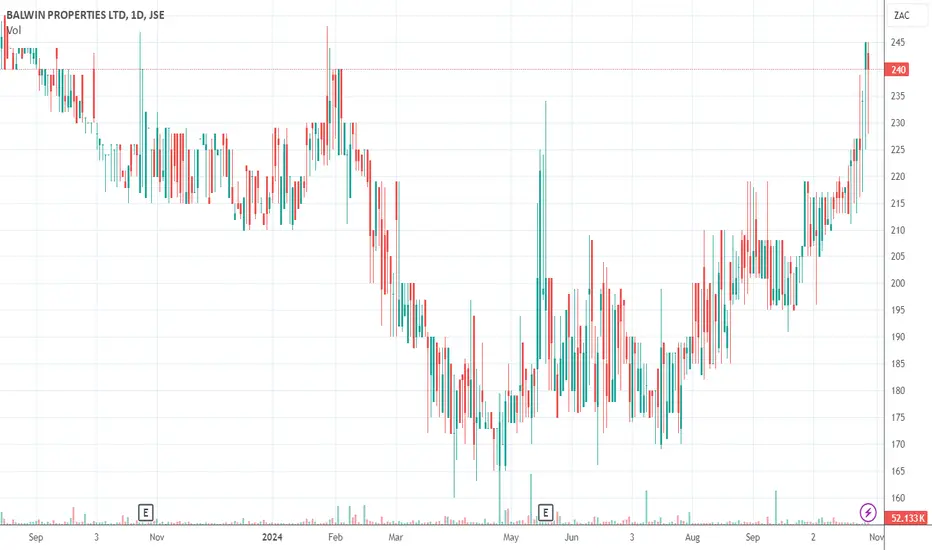
The company cited high interest rates as a significant pressure on the residential property sector. Technically, the share had been in a long-term downward trend but broke upward through its trendline on 27th September 2024 at 218c per share and has since moved up to 245c. Trading at 28% of its NAV, the share appears undervalued, and Balwin could see continued recovery as the broader economy stabilizes. B

 Short
Short
Our opinion on the current state of TFGThe Foschini Group (TFG) is a prominent international retailer with 28 fashion brands and 4083 trading outlets across 32 countries. TFG's successful expansion into Australia with the Retail Apparel Group (RAG) acquisition in 2017 (for over $300 million) sets it apart, as many South African retailers, such as Woolworths, have struggled in that market. TFG has maintained RAG’s success by allowing its Australian management team autonomy rather than attempting to manage it from South Africa.
Historically, TFG has maintained strong performance in South Africa’s highly competitive clothing retail industry, despite challenges from both international brands and local retailers.
In its year-end results to 31st March 2024, TFG reported:
- Revenue up 8.9%
- Headline earnings per share (HEPS) up 0.2%
- Cash retail turnover up 9.9%, making up 82.3% of total retail turnover
- Online retail turnover up 22%, contributing 9.9% to group retail turnover
- Gross profit increased by 8.6% to R27 billion
In a trading update for the 21 weeks to 24th August 2024, TFG saw a 3.5% decline in sales but reported a 100-basis point increase in gross margin. Key growth areas included:
- Online sales up 7.8%, now 10.8% of total sales, driven by a 42.7% increase in South Africa via the Bash platform
- Cash sales contribute 73% to TFG Africa sales and 81.2% to total group sales
TFG’s diversification overseas offers a significant rand-hedge advantage, balancing the effects of South Africa's economic cycles. The company has demonstrated resilience and effective management, especially as the share entered a new upward trend in June 2023 despite challenges like rising interest rates and loadshedding. We consider TFG one of the best-managed retail clothing companies and a solid long-term investment, suitable for accumulation on weakness.
On 27th October 2024, TFG announced the acquisition of White Stuff, a UK fashion and lifestyle retailer, furthering its international diversification. Our opinion on the current state of DIS-CHEM(DCP)Dis-Chem Pharmacies (DCP), which listed in November 2016, is a prominent competitor to Clicks (CLS) in the pharmaceutical, medicine, and beauty products markets. The business is led by the Saltzman family, with a significant stake held through a private company, Ivlyn. In August 2021, Ivlyn announced a reduction in its stake by selling 7.5% of its shares via a bookbuild, distributing 3.75% to selected management (with a 10-year lock-in) and 10.5% to a BEE consortium. This adjustment left the Saltzman family's interest at 31.4%. Ivan Saltzman recently stepped down as CEO, and Rui Morais has taken over the role.
Upon listing, Dis-Chem aimed to expand its footprint beyond its initial 108 stores to potentially match Clicks' ambition to reach up to 1200 stores nationwide. This expansive "blue sky" growth potential has contributed to Dis-Chem's high valuation, with a P/E ratio of 21.67. The company has since grown to over 254 pharmacies across the country, opening 10 to 20 new stores per year. The aftermath of COVID-19 has also opened opportunities for lower rental spaces in malls, further supporting its expansion.
The company has diversified through acquisitions, including Springbok Pharmacy, Quenets, and Baby City (acquired in 2020 for R430 million), and expanded into healthcare insurance by acquiring 25% of Kaelo Holdings. With increasing health-conscious consumer behavior, the company has benefited from higher sales of vitamins and immunity-boosting products.
For the six months ending 31st August 2024, Dis-Chem reported:
- Revenue up 9.6%
- Headline earnings per share (HEPS) up 16.3%
The company attributed its earnings growth primarily to Group payroll cost containment through its staffing framework 1.0, which contributed to a 17.5% growth in operating profit. This effective cost management has bolstered Dis-Chem’s performance, affirming its position as a solid blue-chip investment.
Technically, the share had been moving sideways and downward since forming a double top in April 2022. A break through the 200-day moving average on 3rd November 2023 at 2525c per share signaled a positive trend. The share has since increased to 3600c, suggesting momentum that aligns with Dis-Chem’s long-term growth potential.