Our opinion on the current state of TFGThe Foschini Group (TFG) is an international retailer of 28 fashion brands. It has 4,083 trading outlets in 32 countries around the world, with divisions in London and Australia, aside from its extensive presence in the South African market. One of the notable achievements of TFG is its successful business establishment in Australia, where many other retailers (like Woolworths) have failed. TFG bought the Retail Apparel Group (RAG) in Australia for just over $300 million in 2017. TFG has allowed the Australian management team virtual autonomy in managing the business and has not attempted to manage it from South Africa.
Over the long term, TFG has been a consistent performer in one of the most difficult industries in South Africa, with stiff competition from overseas brands and local clothing retailers. In its results for the year to 31st March 2024, the company reported revenue up 8.9% and headline earnings per share (HEPS) up 0.2%. The company said, "Cash retail turnover increased by 9.9% compared to the prior period and now contributes 82.3% to total Group retail turnover. Online retail turnover increased by 22.0% and now contributes 9.9% to total Group retail turnover. The Group maintained its gross margin percentage and increased gross profit by 8.6% to a record R27.0 billion in line with the growth in retail turnover."
We regard TFG as the best of the retail clothing companies, and it is well diversified overseas, which gives it a rand hedge element. Retail is normally very much impacted by the business cycle, but the TFG board has shown its ability to manage the business profitably in many difficult environments where others have failed. Following COVID-19, the share moved up steadily until October 2022, when it began to reflect the impact of rising interest rates and loadshedding on the South African consumer.
We believe that this remains a very well-managed company which should be accumulated on weakness. Our opinion on the current state of NOVUS(NVS)Novus (NVS) is South Africa's largest printing company with 11 printing plants. Until recently, it had the monopoly contract to do all of Media24's printing. However, from 1st April 2018, that contract was reduced to roughly 58% of Media24's printing, and the price paid by Media24 for printing was also reduced. The company appointed a new CEO, Neil Birch, who decided to abandon acquisitions in the short term to focus on consolidating the business and improving its operating performance. The board may also consider selling the company's tissue business. Novus has a level 4 BEE status but will need to improve that to become more competitive.
On 12th August 2022, the company announced that it would acquire 75% of Pearson South Africa. In its results for the six months to 30th September 2023, the company reported revenue up 36.8% and headline earnings per share (HEPS) of 28.77c compared with 2.89c in the previous period. The company said, "The financial results for the six months ended 30 September 2023 ("period") improved when compared to the prior period, largely through the inclusion of the results of Maskew Miller Learning Proprietary Limited ("MML") in the Education segment."
In a trading statement for the year to 31st March 2024, the company estimated that HEPS would improve by at least 1000% compared with the 7.35c loss in the previous year. Technically, the share price fell steadily since listing in March 2015 until March 2021. Then it began to move up and it currently trades at 54% of its NAV. We suggested waiting for a convincing break up through a 65-day moving average before investigating further. That happened on 8th October 2020 at 88c, and the share has since moved up to 535c. The share trades about R263,000 worth of shares a day, which makes it practical for private investors.
Novus appears to be on a recovery path with significant improvements in financial performance and a strategic focus on consolidating and enhancing its core operations. The acquisition of Maskew Miller Learning and the strong growth in the education segment are positive indicators. However, potential investors should keep an eye on the company's ability to maintain and further improve its market position and BEE status, as well as any strategic moves regarding its tissue business. Our opinion on the current state of KIBO(KBO)Kibo (KBO) is an African-oriented energy exploration company listed on the AIM (Alternative Investment Market) on the London Stock Exchange and on the Alt-X (Alternative Exchange) on the JSE. The company began exploration activities in Tanzania (100% of the Mbeya project in coal and other minerals which has been disappointing) but has since expanded to have interests in Mozambique (65% of the Benga coal power station, which they said in announcements on 30th January 2019 and 9th May 2019 was progressing well) and Botswana (85% interest in the Mabasekwa coal power project).
In its results for the six months to 30th June 2023, the company reported a loss of GBP1.8 million compared to a loss of GBP1.9 million in the previous period. The company said, "During July 2023, MED finalised and entered into a definitive and binding Joint Venture Agreement (‘JVA’) with an institutional investor-led consortium, with an initial expected total investment value of c. £5.9 million. The completion date of the JVA has since been extended twice due to unforeseen circumstances."
The main problem with this share is that it is extremely thinly traded, which precludes it for private investors. It is also in one of the riskiest areas of investment—energy exploration—and it is running at a loss. We can see no benefit in buying this penny stock unless you want to speculate.
On 7th June 2024, the company announced, "Partly conditional fundraise with gross proceeds of £500,000 raised at a placing price of 0.015p. Mohammed Ashraf proposed to join Kibo as Executive Director and Chief Executive Officer."
Overall, Kibo presents a high-risk investment opportunity in a volatile and speculative sector. The lack of liquidity in the share and ongoing financial losses make it unsuitable for most private investors. However, those with a high risk tolerance and an interest in speculative opportunities might consider it, keeping in mind the significant risks involved. Our opinion on the current state of ARCINVEST(AIL)African Rainbow Capital (AIL) is a BEE investment company that was formed in 2015 and listed on the JSE in September 2017. Since its formation, AIL has invested in more than forty listed and unlisted investments across a wide range of industries, including telecommunications, mining, construction, energy, property, agriculture, insurance, asset management, and banking. ARC Investments is 44.4% effectively owned by African Rainbow Capital Proprietary Limited (ARC), which in turn is 100% owned by Ubuntu-Botha Investments Proprietary Limited (UBI). UBI effectively owns 51.2% of ARC Investments. AIL is thus owned through Ubuntu-Botha Investments by the Motsepe family through their trusts.
In the South African context, AIL has a significant advantage in finding suitable companies in which to invest because it can offer them a solid, reliable BEE shareholder. AIL has benefited from an investment by Sanlam and owns a stake in the Sanlam subsidiary, Santam. The company acquired 100% of TymeDigital, which has launched a digital bank in partnership with Pick 'n Pay. It offers digital banking, especially for those who cannot afford normal banking, via their phones, and had the distinction of being the only bank in South Africa not to charge transaction fees. It competes with other new banks in South Africa like Discovery Bank and Bank Zero.
AIL has taken a hit on its investment in EOH (which may now be improving) but has done well in most other areas. Roughly half of the AIL portfolio is in what it describes as "early lifestyle stage businesses" such as TymeBank, Rain, and Kropz. These investments are seen as disruptive in their sectors but will take time to mature. It also owns 7% of Afrimat, having reduced its stake from 18.4%.
If there is a criticism of this investment holding company, it must be its lack of focus. It appears to be invested in a very diverse range of industries without significant synergies or economies of scale. The need of most South African companies to have a stable BEE partner gives it an edge in finding and negotiating good deals, but its lack of focus may eventually become a problem.
The share trades at a fraction of its intrinsic NAV. It was 59% of its NAV after falling about 25% in the last six months to 2023. The discount makes it good value and may result in "unbundling" some of that value into the hands of shareholders in due course. The directors have said that they will consider delisting from the JSE if the discount persists because the listing cannot be used to raise further capital at current share prices.
On 21st November 2023, the company announced a rights issue to raise R742.35 million. Shareholders will get 11.06579 new shares for every 100 shares that they hold at a 7.32% discount to the volume-weighted average price on 10th November 2023. In its results for the six months to 31st December 2023, the company reported intrinsic net asset value (NAV) up 12.9% to 1115c per share. The company said, "ARC Fund acquired investments amounting to R632 million, as part of its strategy to support the existing investments where there are expansion plans and to grow financial services. These transactions included additional investments in Rain, Tyme Global, and Kropz. The ARC Fund’s net fair value gains amounted to R784 million. The main driver in these gains is an increase from the Financial Services portfolio."
In an update for the three months to 31st March 2024, the company reported steady growth in RainOne and sales of 80,771 tons of phosphate concentrate at Kropz. Bluespec performed as expected, and Ooba maintained market share. The company said, "The Tyme Group has a customer base of 12.4 million across South Africa and the Philippines, with 9.2 million TymeBank customers and 3.2 million GoTymeBank customers. The group onboards approximately 450,000 new customers monthly, with 250,000 for GoTymeBank and 200,000 for TymeBank."
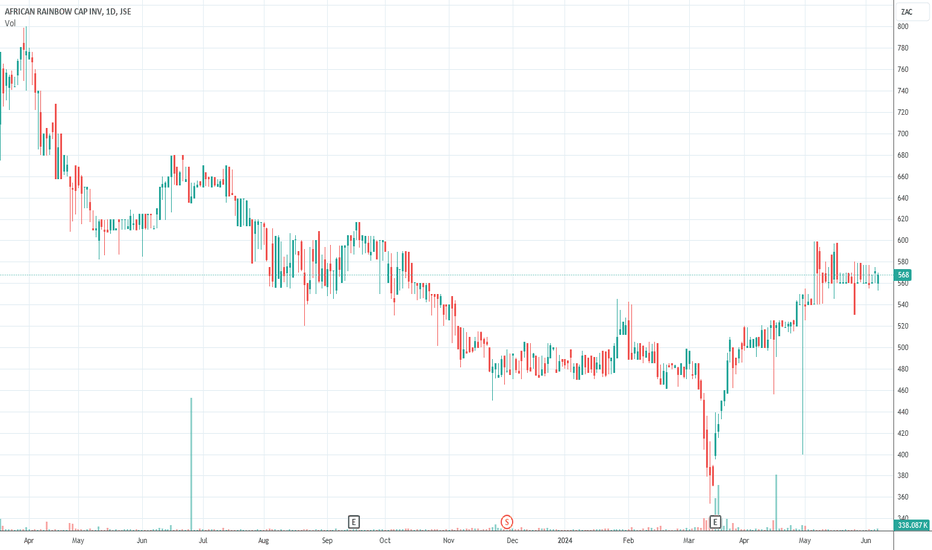
The share still trades for much less than half its net asset value (NAV). Technically, the share has been falling since March 2023. We recommended applying a 200-day moving average and waiting for a clear upside break before investigating further. That break came on 26th April 2024 at 544c per share. Since then, the share has moved up to 570c.
Overall, African Rainbow Capital appears to be an undervalued investment holding company with a diverse portfolio and significant potential. However, investors should be aware of the company's broad focus and potential volatility. The recent rights issue and improvements in key investments suggest a positive outlook. A
 Long
Long
 Long
Long
 Long
Long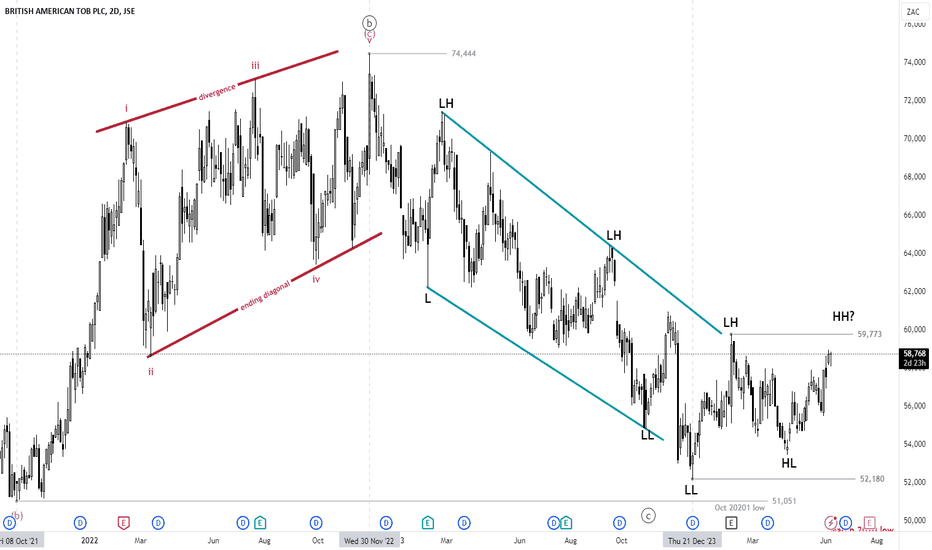
 Long
Long
 Long
Long
 Long
Long
Long 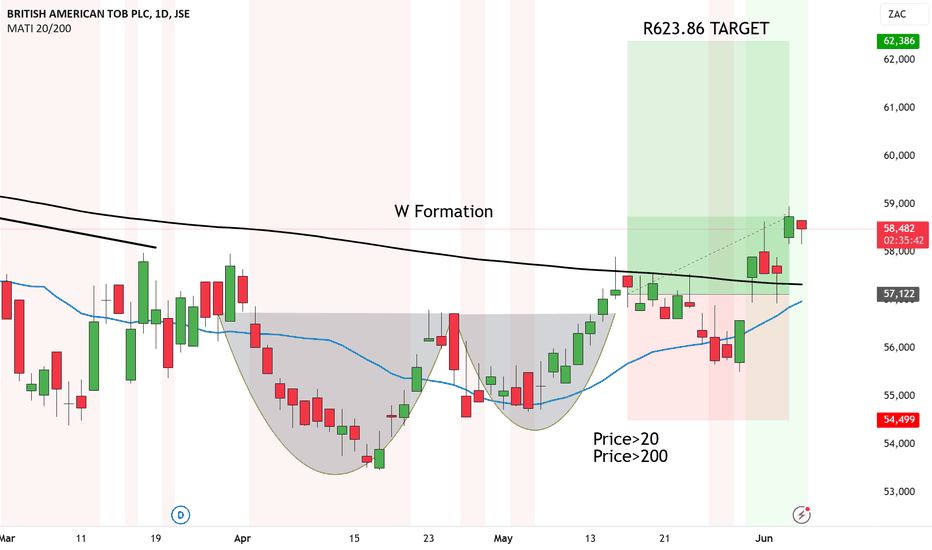
Our opinion on the current state of CAPPREC(CTA)Capprec (CTA) is a fintech company offering payments and payment infrastructure as well as software and services. Patrice Motsepe's African Rainbow Capital (ARC) owns a stake in the company. The payments side of the business is handled through African Resonance and Dashpay, while the software side involves systems development and consulting. The company owns 17.5% of Resonance Australia, a startup business. All the major banks in South Africa are among its clients.
In its results for the year to 31st March 2024, the company reported revenue up 19% and headline earnings per share (HEPS) up 83%. The company said, "Strong progress arising from new and diversified revenue streams - R123 million investment in future revenue opportunities - Successful integration of the Dariel acquisition - R320 million cash generated from operations, up 75% - Continued growth in the terminal estate, up 9% to 357,000 - Multiple terminal tenders awarded post year-end."
The share now trades at a P:E of 8.67. Roughly R1.3 million worth of shares change hands each day, making this share quite feasible for private investors. The company appears to be well-managed, profitable, and cash-flush, which means that it is beginning to attract institutional interest.
Technically, the share has been in a downward trend since January 2022, and we advise waiting for a break up through its downward trendline, which does not look like it will happen anytime soon.
Overall, Capprec presents a promising investment opportunity with strong financial performance and growth prospects. However, potential investors should monitor the technical trends and wait for a clear upward signal before considering entry. C

Our opinion on the current state of COPPER360(CPR)Copper 360 describes its business as follows, "The Copper 360 business is focused on (a) processing historical mined copper rock dumps through a process of environmental clean-up, and (b) mining surface and shallow copper resources." The company has acquired (through SHIP) an extensive database from companies such as American Mining Conglomerate Newmont and Global Gold Company Gold Fields who worked the district before.
In its results for the year to 31st August 2023, the company reported a loss of R4.9 million compared with a loss of R31.6 million in the previous period. The company said, "Our loss has narrowed as production ramps up and capital expenditure comes to an end. The post-period acquisition of Nama Copper Resources Proprietary Limited ("Nama Copper") further ensures we remain on track to deliver significantly improved production with a major reduction in execution build and delivery risk. The 2025 FY will see the Company target EBITDA in excess of R650 million together with major resource upgrades to improve mining flexibility and growth."
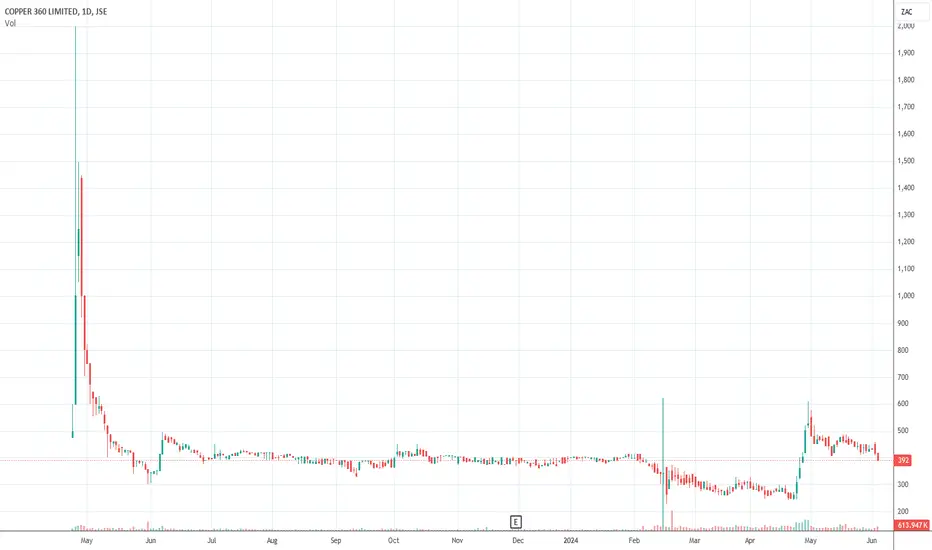
On 21st December 2023, the company announced that it had raised a total of R274 million to fund the Nama copper acquisition and production growth at Rietberg mine. The share listed on 12th April 2023, closing at 500c. Since then, it has drifted down to 371c, which does not bode well. We suggest that this is a risky commodity operation and that you should wait for the share price to at least settle down before investigating further.
On 19th February 2023, the company announced that it had raised just less than R100 million by selling shares. On 27th March 2024, the company announced that it had signed a memorandum of understanding with Far West Gold Recoveries. The CEO said, "Copper 360 estimates that there are approximately 50 to 60 million tonnes of dump material with grades varying between 0.18% and 1.5% copper in the dumps with the potential to contain 450,000 tonnes of copper metal in situ."
On 16th May 2024, the company announced that Shirley Hayes had been appointed as executive chairperson with immediate effect. On 24th April 2024, the company reported that it had produced 136 tons of copper concentrate from the Northern Cape and that the grade was more than 30%.
In a trading statement for the year to 29th February 2024, the company estimated that it would make a headline loss of between 10.5c and 12c per share compared with a loss of 0.27c in the previous period. Technically, the share has been moving sideways and downwards since it listed in April 2023. It is a risky commodity share and very volatile.
Overall, Copper 360 presents a high-risk, high-reward scenario typical of commodity shares. Investors should be cautious and consider the volatility and risk factors before making any investment decisions. The company's plans for growth and production improvement are promising, but it remains to be seen if they can deliver on these targets. Our opinion on the current state of PAN-AF(PAN)Pan African Resources (PAN) is a London- and JSE-listed re-treatment gold producer. With its Elikhulu plant, it will be able to produce about 700,000 ounces of gold a year at a cost of about R450,564 per kilogram, against a current gold price of close to R1 million. This means that over its life, it will produce revenue of approximately R15 billion, of which R5.3 billion will go back into the economy in the form of mine expenses, creating a highly profitable entity with minimal risks. It will also employ 350 people. The company has approved the construction of a 10 MW solar power plant.
In its results for the six months to 31st December 2023, the company reported gold production up 6.7% and all-in sustaining costs (AISC) of $1287 per ounce (against a gold price of just over $2000). Headline earnings were up 46.4% and earnings per share (EPS) was up 46.1%. The company said, "Liquidity remains healthy, with access to immediately available cash of US$31.3 million (2022: US$33.9 million) and undrawn facilities of US$86.4 million (2022: US$52.1 million) at the reporting period-end."
In a revised production guidance for the year to 30th June 2024, the company said it expected to produce between 186,000 and 190,000 ounces at an all-in-sustaining cost of between $1325 and $1350 per ounce. On 4th June 2024, the company announced that it signed a five-year wage deal with the National Union of Mineworkers (NUM) for an increase of 5.3% per annum over the period.
Technically, the share has been in an upward trend since its low of 288c in June 2023. We see this as a good operation, but volatile, which means considerable risk. We would advise investors to be cautious, but with the gold price having broken convincingly above long-term resistance at $2060, it could be a good speculation. Our opinion on the current state of RCLRCL Foods (RCL) is a large producer of food, sugar products, and chicken in South Africa, owned 80.4% by Remgro. The company owns a number of very well-known South African brands such as 5 Star maize meal, Farmer Brown, and Yum Yum peanut butter. It competes with overseas imports of sugar, chicken, and other foods. The company was impacted by the listeriosis outbreak, which damaged the market for processed meats and caused costs estimated at about R158 million. Additionally, the company has been affected by the weak economy, low consumer spending, and high unemployment.
RCL Foods, through the SA Poultry Association, is petitioning the International Trade Administration Commission (ITAC) for an 82% increase in the tariffs on imported chicken. On 2nd December 2020, the company announced that Remgro had increased its stake by buying 100 million shares at R8.05 each. On 29th March 2023, the company announced that it had sold Vector Logistics for R1.25 billion.
In its results for the six months to 31st December 2023, the company reported revenue up 8.4% and headline earnings per share (HEPS) up 52.6%. The company said, "The Vector Logistics segment was classified as a discontinued operation during the second half of the previous financial year. Despite the negative impact of Avian Influenza in the current period, Rainbow delivered an improved result. Sugar's improvement was achieved, despite lower crop yields and largely attributable to higher market prices."
The company also announced that it would spin off and separately list Rainbow Chicken, which should positively affect the share. The share has been moving sideways and downwards since its peak on 9th February 2022. On 4th June 2024, the company announced that it would unbundle and separately list Rainbow Chicken. RCL shareholders will get 1 Rainbow share for every RCL share that they hold on 25th June 2024. We recommended waiting for a clear break up through the long-term downward trendline, which came on 30th April 2024 at 1050c per share. It has since moved up to 1090c.
Overall, RCL Foods appears to be in a period of transition and restructuring, which could position it well for future growth, especially with the unbundling and listing of Rainbow Chicken. However, potential investors should keep an eye on market conditions, especially the regulatory decisions regarding chicken tariffs and the overall economic climate. Our opinion on the current state of BATS(BTI)British American Tobacco (BTI) describes itself as a "leading consumer goods company," which is a euphemistic way of saying that they produce and sell an enormous number of cigarettes and related products worldwide. It is also the second largest company on the JSE after Naspers. In recent decades, cigarette companies have become increasingly oppressed. Their ability to advertise their products and even package them has been severely curtailed in many countries. They are seen to be exploiting an addiction which is clearly anti-social and very bad for the individual's health, and which regularly involves them in lawsuits for damages.
BAT owns well-known brands like Camel, Peter Stuyvesant, Rothmans, Benson & Hedges, Dunhill, Pall Mall, Kent, and Lucky Strike. In an effort to get away from the negative perceptions of cigarettes, the company has diversified into "new category" products such as vaping and electronic cigarette markets which it claims offers it a long-term prospect for growth. Recently, especially in the United States, these products have also come under the spotlight for health reasons leading to a drop-off in sales.
As an investment, the company offers some attractions. Roughly 20% of the world's population still smokes - making a truly massive market. Setting aside our distaste for the business which BAT conducts, the share looks like very good value at current levels. This is one of the shares that has performed well and perhaps even benefited from COVID-19. The CEO says that he aims to double non-combustible sales by the 2023/24 year. It is interesting that BAT considers South Africa's illegal cigarette market to be the largest in the world.
On 6th December 2023, Business Day reported that BAT had impaired its US operations by GBP25bn (R595bn) leading to a drop of 10% in the BTI share price. In its results for the year to 31st December 2023, the company reported revenue down 1.3% and a diluted loss per share of 646.6 pence. The company said, "Strong volume led New Category revenue growth - driven by Vuse and Velo, with revenue from Non-Combustibles now 16.5% of Group revenue, up 170 bps vs FY22."
In an update on 4th June 2024, the company reported that it was on track to achieve its FY24 guidance. The company said, "We are driving a further improvement in New Category profitability through our Quality Growth focus on a more balanced top-line and bottom-line delivery. In Combustibles, U.S. commercial plans continue to gain traction despite a challenging macro-economic backdrop; in AME and APMEA we gained volume and value share, with robust H1 pricing."
The share now looks cheap to us on a P:E of 6.84. Our opinion on the current state of MTMMomentum Metropolitan (MTM) is an insurance company listed on the JSE and the Namibian stock exchanges. It was formed by the merger of Momentum and Metropolitan in December 2010. The company participates in all aspects of short and long-term insurances and various financial services. It was the first insurance company to achieve level 1 BBBEE status. Recently, the company has been closing its businesses in Mozambique, Mauritius, Zambia, Tanzania, and Swaziland. At the time of the merger between Momentum and Metropolitan, they had a combined 24% of the life insurance market in South Africa, which has now reduced to 17%.
In the first quarter of 2021, the company paid out almost R4bn in death claims, three times higher than anticipated, mainly due to the 2nd wave of the virus. The company indicated it would consider managing with about 60% of its current office space due to the move to work-from-home as a result of COVID-19.
On 26th May 2023, Business Day reported that Jeanette Marais would take over from Hilgard Meyer as CEO on 30th September 2023. In its results for the year to 30th June 2023, the company reported net income of R125bn, up from the previous year's R70.1bn. Earnings per share (EPS) increased to 313.3c compared with 260.6c in the previous year. The company said, "During July 2022, the Group, through its wholly owned subsidiary, Metropolitan International Holdings (Pty) Ltd, disposed of its entire shareholding in Metropolitan Cannon Life Assurance Ltd and Metropolitan Cannon General Insurance Ltd. A loss on disposal of R112 million was recognised. During October 2022, the Group’s holding in Aditya Birla Health Insurance Company Ltd (ABHI) was diluted from 49% to 44.1% with the introduction of a new shareholder as a partner in the business. As a result, a gain on deemed disposal of R563 million was recognised. The Group bought back a total of 73 million shares (for a cost of R1 250 million including transaction costs) during the current year. These shares were cancelled prior to 30 June 2023."
In an operational update for the 3 months to 30th September 2023, the company reported new business premiums up 18% and a claim ratio of 66%, down from the previous period's 70%. The company said, "As at 20 November 2023, the Group had bought back 24 million shares, of which 16.5 million have been cancelled, for a total consideration of R498 million." In the nine months to 31st March 2024, the company reported recurring premium income down 15% and single premiums up 32%. Assets under management (AUM) were up 14% at R265bn.
Technically, the share has begun to move up in recent months and may be entering a new upward trend. On a P:E of 8.18 and a dividend yield (DY) of 4.89%, it looks reasonably priced to us. Our opinion on the current state of VUKILE(VKE)Vukile (VKE) is a real estate investment trust (REIT) trading on the JSE and the Namibian Stock Exchange. It owns properties directly, shares in other REITs, property in the UK, and a growing portfolio of properties in Spain. Fifty percent of its assets are in Southern Africa, mainly in retail, 46% in Spain, and 4% in the UK. Vukile has a policy of re-investing into its existing properties and has struck a deal with MTN, which has invested R80 million to install fiber into 37 of its malls.
Vukile has a R595 million investment in Fairvest, a R1.3 billion investment in Atlantic Leaf (34.9%, which it is now in the process of selling), and a R790 million investment in Gemgrow Properties, which they are trying to sell. Vukile is probably one of the best REITs on the JSE, and its share price has risen steadily over the 15 years, despite various setbacks. The CEO, Laurence Rapp, says that the company is selling its shareholding in other REITs and its UK assets to focus on portfolios in Southern Africa and Spain.
In its results for the year to 31st March 2024, the company reported revenue up 11.8% and net asset value (NAV) of 2155c per share, up 5.2%. The company's loan-to-value (LTV) is 40.7%. The company said the South African portfolio had, "Like-for-like retail NOI growth of +5.4% - Vacancies reduced to 1.9% - Rental reversions +2.9%, up from +2.3% - Like-for-like retail portfolio value increased by +5.8%."
Its shares are trading on a multiple of 11.85, which still looks cheap to us. This share has been a good long-term investment and continues to show strong performance and growth potential.  Short
Short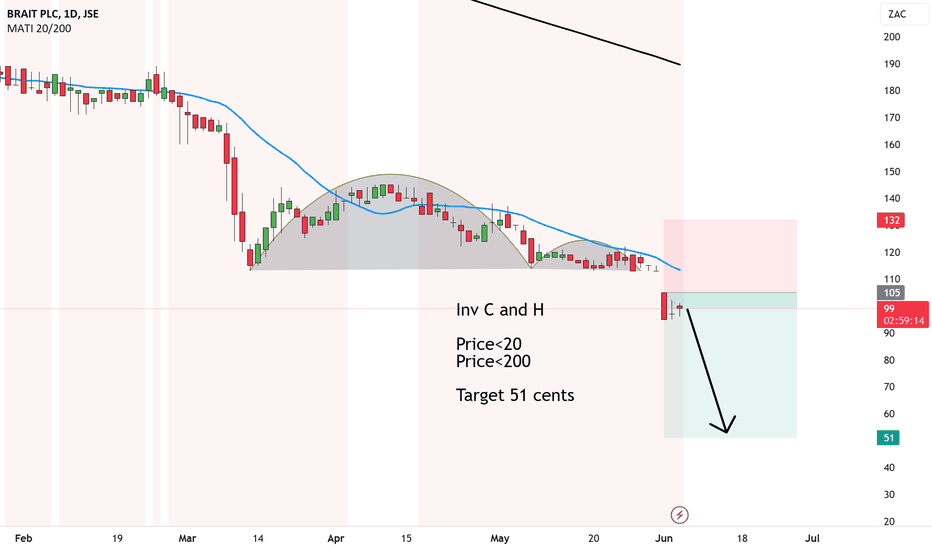
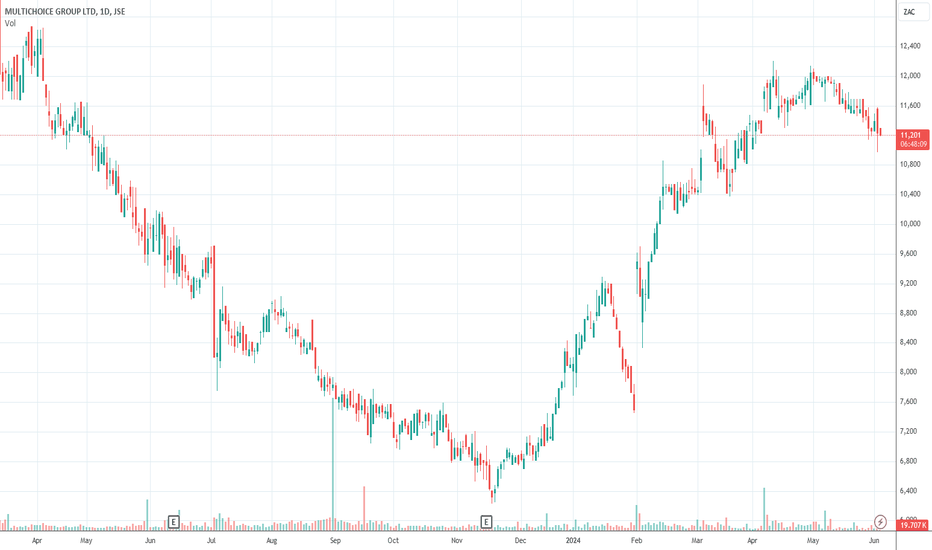
Our opinion on the current state of MC-GROUP(MCG)MultiChoice (MCG) is a leading entertainment company in Africa and one of the fastest-growing pay-TV broadcast providers in the world with 21.1 million subscribers in 50 countries. The company's 90-day subscriber base is split 42% (8.9 million) in South Africa and 58% (12.2 million) in the rest of Africa. The share was spun out of Naspers and separately listed on the JSE on 27th February 2019.
This company is likely close to an ideal investment for private investors because its income is mostly annuity income, in the form of debit orders, with a very diverse client group. It has virtually no working capital requirements because it is essentially a service company and does not need to carry large stocks. It also does not have a large unskilled or semi-skilled workforce, although it has had union problems in the past. The potential for pay-TV in Africa appears substantial but may be eroded by 5G internet access in the future and the existence of free online access through platforms.
Icasa (Independent Communications Authority of SA), in its efforts to boost competition, is looking at changing the rules for dominance in the pay-TV market, which may impact MultiChoice. This may include changing the rules for dominance in sports coverage, which has been MultiChoice’s strongest appeal. This would impact MultiChoice’s ability to negotiate exclusive sports contracts.
The company is in the home entertainment business, which received a boost from the COVID-19 lockdowns. On 2nd March 2023, the company announced that it had entered into an agreement with Sky News and NBC Universal to enhance the Showmax service and make it dominant in Africa. In its results for the six months to 30th September 2023, the company reported revenue down 1% and headline earnings per share (HEPS) down 5%. The company said, "...the group's overall 90-day active subscriber base contracted by 2% (0.4m) to 21.7m. The Rest of Africa base, accounting for 60% of linear customers, grew by 1% to 13.0m. The South African business had to contend with the effects of ongoing high levels of loadshedding as 43% of the days in the reporting period were impacted by stage 4 - 6 loadshedding."
In our view, this is a solid blue-chip share which faces some challenges due to alternative products available to its subscribers. On 5th February 2024, MCG reported that Canal+ had increased its stake in MCG to 35.01%, triggering a mandatory offer at R105 per share to the remaining shareholders. The company rejected the offer as too low. On 28th February 2024, the company announced that the Takeover Regulation Panel (TRP) had ruled that since Canal+'s ownership of MCG had exceeded 35%, it was required to make a mandatory offer to buy out the remaining shareholders in terms of section 123 of the Companies Act (71 of 2008). On 6th March 2024, the company announced that Canal+ had increased its offer to R125 per share.
On 7th April 2024, the company announced that it had reached a cooperation agreement with Canal+ to implement the takeover. On 24th April 2024, the company announced that Canal+ had acquired 41.6% of its issued shares and it had filed the required notices with the Takeover Regulation Panel (TRP) and the Companies and Intellectual Property Commission (CIPC). On 16th May 2024, Business Day reported that Canal+ had increased its stake to 45.2%. On 4th June 2024, Canal+ made an offer of R125 per share for all the remaining shares in MC Group which it did not own.
Technically, the share had been falling since 6th March 2023 and we recommended waiting for a break up through the 65-day exponential moving average before buying. That happened on 19th December 2023 at a price of 7440c. Since then, the share has risen to 11235c. M